
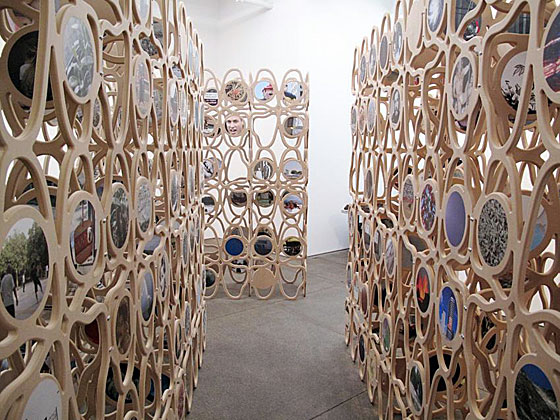
Many people in New York know Jorge Pardo’s work because he designed the last ground floor exhibition for the Dia Foundation’s 22nd Street location, before that space went to rot to make way for Dia Beacon. Pardo’s colorful, Jim Isermann-like floor tiles were visible through the windows for years. His installation at Friedrich Petzel, which closed June 19, will not leave such an indelible impression. The exhibition began promisingly with some kitschy-but-catchy photos of guinea pigs in overdetermined, mazelike frames but then the main room had to go and make a statement about modular display apparatus. Aisles made of freestanding wood-colored plastic stackable units, a couple feet higher than your head, with a kind of open weave shamrock pattern reminiscent of Alvar Aalto furniture, were positioned like hedge rows, shopping aisles, or lacy Richard Serras to dominate the room and force you to wander around among them–much like the Heather Rowe installation a few doors down from Petzel, or to a less manipulative extent, the Anne Truitts across the street at Matthew Marks (June was a banner month for meandering inside art).
This Container-Store-on-Steroids might have worked but for Pardo’s choice of adornment for the stackables: round peel-and-stick photos affixed to medallions inside the “shamrocks.” (Some of these were starting to unpeel, I noticed.) The idea of defacing Aaltos with stickers–impurifying modernist purity with popular iconography, blah blah–isn’t of itself bad. It was Pardo’s choice of photos that rankled, all of which, we were told in the press release, came, inevitably, “from the internet.” At least when Mike Kelley wanted to give some Net frisson to his traditional installations, he chose well (e.g., the video clips of kids having accidents incorporated into some recent Gagosian sculpture). Pardo’s was the worst kind of laundry calendar imagery–flowers, scenes of nature, pets, clothing accessories, Lady Di. Neither bad enough to be bad nor bad enough to be good, just relentlessly bland. What is the point of this? That the internet is bland? Is that really a problem? At least when “surf club” artists use stock photo imagery they leave the watermark on them. The only reason I can think for the “Internet Lite” metaphor is that Pardo is anticipating an institutional sale and wants to keep the work “family friendly.” Yet Christian kids with parental filters firmly in place will see a racier internet than this.
Pardo’s popularity with institutions has long been a mystery to me. Jim Isermann, who I mentioned earlier, makes smarter, better-crafted, and overall more succulent work: he emerged from the SoCal scene around the same time as Pardo with a vocabulary of discarded Modernist motifs and “questioning the boundaries among painting, furniture, and architecture,” as museum wall labels like to say. Because Pardo apparently had a better command of institutional critique-speak, Isermann fans were forced to watch in dismay as the less-talented Pardo blitzed the mid-’90s art magazines. Now, judging by this show, Pardo is an established figure on autopilot, cranking out the festival circuit art, regardless of whether it’s particularly interesting to look at or has anything to say.
Tomorrow I may do a final post wrapping up my discussion of the Truitt, Pardo, and Rowe shows, using them as examples of the creeping vacuity in large Chelsea exhibitions, a style Jesse P. Martin has called “mannered bereft.” It may turn out I may have nothing more to say about this work about nothing, in which case I’ll try to write about something (maybe work on the Internet, where more compelling things are happening). Comments should be functioning now but we are back to the old system where there may be a delay before they appear. Everything will be read (except butt plug ads).
Update: Commenter Matthew says Isermann emerged a “decade (plus)” before Pardo. I was giving Pardo every benefit of a doubt on the fuzzy concept of “emergence” but certainly won’t dispute vigorously that he copped an earlier style. See discussion in comments.


{ 91 comments }
<3 U Tom!
<3 U Tom!
Funny how time changes things…I haven’t see this show but I get your point. I actually do like his work. Pardo couldn’t be any more institutionally-friendly in the high-level “serious” curatorial class. He is the other Relational guy who does the design/art thing really well, but doesn’t blabber as badly as Liam Gillick. He seems to be happily making functioning furniture that is collected with high-end design objects. This just reminds me that artists and curators “grow up” together so because so many of the people who supported him institutionally are very powerful, he will always be shown. I guess after artists reach a “certain level” no matter how bad the work gets, it will always be shown. (see Doug Aitken). Plus, he shows with the very top galleries, Petzel, neugerriemschneider, Regen Projects, etc…it will be hard to see the work disappear from view.
Funny how time changes things…I haven’t see this show but I get your point. I actually do like his work. Pardo couldn’t be any more institutionally-friendly in the high-level “serious” curatorial class. He is the other Relational guy who does the design/art thing really well, but doesn’t blabber as badly as Liam Gillick. He seems to be happily making functioning furniture that is collected with high-end design objects. This just reminds me that artists and curators “grow up” together so because so many of the people who supported him institutionally are very powerful, he will always be shown. I guess after artists reach a “certain level” no matter how bad the work gets, it will always be shown. (see Doug Aitken). Plus, he shows with the very top galleries, Petzel, neugerriemschneider, Regen Projects, etc…it will be hard to see the work disappear from view.
“We all came up together” explains some of the endurance–good point. Walter Robinson once analogized artists who reach a certain level to “made guys” in the Mob. No matter how obnoxious they become they can’t be brought down. Of course this is the enemy of an Open Society, transparency, reason, and flux. Gallery shows become a kind of Kabuki ritual–the made guy has some new work so space is committed, press releases are sent out, curators are contacted, pieces are placed: hollow rituals. I’ve seen some Pardo work I like but most of it leaves me cold. He had some shaped canvas-style paintings crowding the walls of this already overcrowded show that I didn’t particularly feel like describing: they were very cluttered, with patterns piled on patterns for no discernible reason.
“We all came up together” explains some of the endurance–good point. Walter Robinson once analogized artists who reach a certain level to “made guys” in the Mob. No matter how obnoxious they become they can’t be brought down. Of course this is the enemy of an Open Society, transparency, reason, and flux. Gallery shows become a kind of Kabuki ritual–the made guy has some new work so space is committed, press releases are sent out, curators are contacted, pieces are placed: hollow rituals. I’ve seen some Pardo work I like but most of it leaves me cold. He had some shaped canvas-style paintings crowding the walls of this already overcrowded show that I didn’t particularly feel like describing: they were very cluttered, with patterns piled on patterns for no discernible reason.
the dia tiles are so overrated. i prefer his brother, don.
the dia tiles are so overrated. i prefer his brother, don.
the dia tiles are so overrated. i prefer his brother, don.
the dia tiles are so overrated. i prefer his brother, don.
m, it wasn’t just tiles (I should add) but a “complex, multifaceted project that includes redesigning the lobby, creating a new bookshop, and staging an exhibition in the reconfigured gallery,” according to Dia’s website. The exhibition included a scale model Volkswagen that looked like it was made of brown clay and some other objects scattered around the room (I forget what they were). As Gianni notes, this was considered “relational” because it was meant to be used by people and create a kind of ever-changing social sculpture where no single object was privileged. So there you have it.
m, it wasn’t just tiles (I should add) but a “complex, multifaceted project that includes redesigning the lobby, creating a new bookshop, and staging an exhibition in the reconfigured gallery,” according to Dia’s website. The exhibition included a scale model Volkswagen that looked like it was made of brown clay and some other objects scattered around the room (I forget what they were). As Gianni notes, this was considered “relational” because it was meant to be used by people and create a kind of ever-changing social sculpture where no single object was privileged. So there you have it.
As highbrow interior decoration I thought the dia lobby was quite fun and beautiful, though pardo’s work has never worked for me as meaningful or fruitful art. Is Jim Isermann really that much more of an important artist though? After looking at his site, I do respect him more as an artist; However his work seems drained by the mildly antagonistic stances it takes towards its debt to minimalism and op-art. Pardo’s pieces always have a lively and carefree feel which makes them so passably enjoyable (both in good and bad ways) and why they are usually popular. This show at petzel was quite staid and unsuccessful, but was Isermann’s last show at dietch that much more vibrant? (i refer to the 2005 show)
As highbrow interior decoration I thought the dia lobby was quite fun and beautiful, though pardo’s work has never worked for me as meaningful or fruitful art. Is Jim Isermann really that much more of an important artist though? After looking at his site, I do respect him more as an artist; However his work seems drained by the mildly antagonistic stances it takes towards its debt to minimalism and op-art. Pardo’s pieces always have a lively and carefree feel which makes them so passably enjoyable (both in good and bad ways) and why they are usually popular. This show at petzel was quite staid and unsuccessful, but was Isermann’s last show at dietch that much more vibrant? (i refer to the 2005 show)
ugh, now i remember the vw…anyway, it is the tiles that remain and i suppose they have a chance of getting better with age. whatevs. nice review though.
ugh, now i remember the vw…anyway, it is the tiles that remain and i suppose they have a chance of getting better with age. whatevs. nice review though.
ugh, now i remember the vw…anyway, it is the tiles that remain and i suppose they have a chance of getting better with age. whatevs. nice review though.
Sven, I missed that Deitch show but based on the installation shot I can’t particularly defend it. These pieces below made of fabric I like a lot, though:
…as well as all the continuing references in Isermann’s work to Op Art and ’70s supergraphics. There’s a blunt specificity to it, a kind of take it or leave it stance. It’s more than well crafted, the graphic ideas pop, and you don’t feel that there’s some other object or text outside your field of vision that you need to refer to. The lively and carefree feel you ascribe to Pardo is how I feel about Isermann, but tastes can differ. As for Isermann’s position being antagonistic, I know from past reading and writing about him that he says “I love my sources.” This may be what doomed him vis a vis Pardo–he didn’t establish the necessary faux-academic distance with his material (or talk the talk). I think he is important precisely because he doesn’t do that–the viewer supplies the necessary irony, theory, and incredulity to “handle” the work.
Sven, I missed that Deitch show but based on the installation shot I can’t particularly defend it. These pieces below made of fabric I like a lot, though:
…as well as all the continuing references in Isermann’s work to Op Art and ’70s supergraphics. There’s a blunt specificity to it, a kind of take it or leave it stance. It’s more than well crafted, the graphic ideas pop, and you don’t feel that there’s some other object or text outside your field of vision that you need to refer to. The lively and carefree feel you ascribe to Pardo is how I feel about Isermann, but tastes can differ. As for Isermann’s position being antagonistic, I know from past reading and writing about him that he says “I love my sources.” This may be what doomed him vis a vis Pardo–he didn’t establish the necessary faux-academic distance with his material (or talk the talk). I think he is important precisely because he doesn’t do that–the viewer supplies the necessary irony, theory, and incredulity to “handle” the work.
point taken, but how much more is built upon Lewitt’s precedent in these choices? I like these pieces and the materiality of the medium would probably win me over more in person, but is he inaugurating much besides humor and benign insouciance here? I think he’d be more successful if he was willing to be a bit more incendiary.
point taken, but how much more is built upon Lewitt’s precedent in these choices? I like these pieces and the materiality of the medium would probably win me over more in person, but is he inaugurating much besides humor and benign insouciance here? I think he’d be more successful if he was willing to be a bit more incendiary.
point taken, but how much more is built upon Lewitt’s precedent in these choices? I like these pieces and the materiality of the medium would probably win me over more in person, but is he inaugurating much besides humor and benign insouciance here? I think he’d be more successful if he was willing to be a bit more incendiary.
point taken, but how much more is built upon Lewitt’s precedent in these choices? I like these pieces and the materiality of the medium would probably win me over more in person, but is he inaugurating much besides humor and benign insouciance here? I think he’d be more successful if he was willing to be a bit more incendiary.
point taken, but how much more is built upon Lewitt’s precedent in these choices? I like these pieces and the materiality of the medium would probably win me over more in person, but is he inaugurating much besides humor and benign insouciance here? I think he’d be more successful if he was willing to be a bit more incendiary.
Lewitt didn’t get all “op” in his style till after Isermann was well known. (Isermann came out of CalArts around the same time as Jim Shaw, so late ’80s/early 90s.) Lewitt was still doing these horrible ink wash things around that time. Am not a Lewitt fan, except for the early conceptual sentences and some of the cinderblock works. No, I don’t think Isermann needed to hate his sources–Warhol walked a similar line when he said “Pop Art is about liking things.”
Lewitt didn’t get all “op” in his style till after Isermann was well known. (Isermann came out of CalArts around the same time as Jim Shaw, so late ’80s/early 90s.) Lewitt was still doing these horrible ink wash things around that time. Am not a Lewitt fan, except for the early conceptual sentences and some of the cinderblock works. No, I don’t think Isermann needed to hate his sources–Warhol walked a similar line when he said “Pop Art is about liking things.”
Tom, enjoying the posts.
I think its important to acknowledge that Jim Iserman graduated from CalArts in 1980, and was already making modernist/mid-century-design-inspired sculptural work then (and which was widely shown), a full decade (plus) before Pardo emerged. Iserman would have been at CalArts roughly around the time Mike Kelley and Jim Shaw were there too – in the very late 70s/very early 1980s, not late 80s/early 90s. Iserman’s work from this period looks unlike pretty much anything else being made at the time.
Tom, enjoying the posts.
I think its important to acknowledge that Jim Iserman graduated from CalArts in 1980, and was already making modernist/mid-century-design-inspired sculptural work then (and which was widely shown), a full decade (plus) before Pardo emerged. Iserman would have been at CalArts roughly around the time Mike Kelley and Jim Shaw were there too – in the very late 70s/very early 1980s, not late 80s/early 90s. Iserman’s work from this period looks unlike pretty much anything else being made at the time.
Thanks, Matthew. Please see my reply down-thread.
Thanks, Matthew. Please see my reply down-thread.
Thanks, Matthew. Please see my reply down-thread.
Lewitt didn’t get all “op” in his style till after Isermann was well known. (Isermann came out of CalArts around the same time as Jim Shaw, so late ’80s/early 90s.) Lewitt was still doing these horrible ink wash things around that time. Am not a Lewitt fan, except for the early conceptual sentences and some of the cinderblock works. No, I don’t think Isermann needed to hate his sources–Warhol walked a similar line when he said “Pop Art is about liking things.”
Lewitt didn’t get all “op” in his style till after Isermann was well known. (Isermann came out of CalArts around the same time as Jim Shaw, so late ’80s/early 90s.) Lewitt was still doing these horrible ink wash things around that time. Am not a Lewitt fan, except for the early conceptual sentences and some of the cinderblock works. No, I don’t think Isermann needed to hate his sources–Warhol walked a similar line when he said “Pop Art is about liking things.”
Tom, enjoying the posts.
I think its important to acknowledge that Jim Iserman graduated from CalArts in 1980, and was already making modernist/mid-century-design-inspired sculptural work then (and which was widely shown), a full decade (plus) before Pardo emerged. Iserman would have been at CalArts roughly around the time Mike Kelley and Jim Shaw were there too – in the very late 70s/very early 1980s, not late 80s/early 90s. Iserman’s work from this period looks unlike pretty much anything else being made at the time.
Thanks, Matthew. Please see my reply down-thread.
They were ripping out the tiles just last week. This was going on across the street from petzel as they were installing the pardo show.
They were ripping out the tiles just last week. This was going on across the street from petzel as they were installing the pardo show.
They were ripping out the tiles just last week. This was going on across the street from petzel as they were installing the pardo show.
They were ripping out the tiles just last week. This was going on across the street from petzel as they were installing the pardo show.
They were ripping out the tiles just last week. This was going on across the street from petzel as they were installing the pardo show.
oof. that Pardo image looks bad bad bad. But then, nothing really bores me more than furniture.
oof. that Pardo image looks bad bad bad. But then, nothing really bores me more than furniture.
oof. that Pardo image looks bad bad bad. But then, nothing really bores me more than furniture.
oof. that Pardo image looks bad bad bad. But then, nothing really bores me more than furniture.
oof. that Pardo image looks bad bad bad. But then, nothing really bores me more than furniture.
I considered the possibility that you could buy a piece of the installation, like a little portable shelf unit you could have in your home or apartment, since the longer walls are easily disassembled (screws are visible), but did not ask at the desk.
I considered the possibility that you could buy a piece of the installation, like a little portable shelf unit you could have in your home or apartment, since the longer walls are easily disassembled (screws are visible), but did not ask at the desk.
I considered the possibility that you could buy a piece of the installation, like a little portable shelf unit you could have in your home or apartment, since the longer walls are easily disassembled (screws are visible), but did not ask at the desk.
I considered the possibility that you could buy a piece of the installation, like a little portable shelf unit you could have in your home or apartment, since the longer walls are easily disassembled (screws are visible), but did not ask at the desk.
I considered the possibility that you could buy a piece of the installation, like a little portable shelf unit you could have in your home or apartment, since the longer walls are easily disassembled (screws are visible), but did not ask at the desk.
As a really young art student I travelled to Ravenna, Italy to see the church mosaics and was satisfyingly blown away. As a slightly less young artist I was similarly thrilled by the Dia tiling. I thought it was an impressive long term commitment between the institution and the artist … so much work … and it made for a truly fun and beautiful interior. I bought lots more books at the store than I needed to just because I was inspired to participate somehow. The car-sculpture-thingy always confused me, though and I never understood why it was there.
As a really young art student I travelled to Ravenna, Italy to see the church mosaics and was satisfyingly blown away. As a slightly less young artist I was similarly thrilled by the Dia tiling. I thought it was an impressive long term commitment between the institution and the artist … so much work … and it made for a truly fun and beautiful interior. I bought lots more books at the store than I needed to just because I was inspired to participate somehow. The car-sculpture-thingy always confused me, though and I never understood why it was there.
As a really young art student I travelled to Ravenna, Italy to see the church mosaics and was satisfyingly blown away. As a slightly less young artist I was similarly thrilled by the Dia tiling. I thought it was an impressive long term commitment between the institution and the artist … so much work … and it made for a truly fun and beautiful interior. I bought lots more books at the store than I needed to just because I was inspired to participate somehow. The car-sculpture-thingy always confused me, though and I never understood why it was there.
As a really young art student I travelled to Ravenna, Italy to see the church mosaics and was satisfyingly blown away. As a slightly less young artist I was similarly thrilled by the Dia tiling. I thought it was an impressive long term commitment between the institution and the artist … so much work … and it made for a truly fun and beautiful interior. I bought lots more books at the store than I needed to just because I was inspired to participate somehow. The car-sculpture-thingy always confused me, though and I never understood why it was there.
This show was awful. What the installation shot doesn’t show you is how badly the dividers were arranged in the space. It was a labyrinth of sorts — maybe it was supposed to mimic the web (boring) — but if you weren’t going through the space because you had to Pardo’s piece offered no reason to do so. It wasn’t even good as furniture.
At least formally, I think this work would have fared far better if it were broken up a little. But giant environmental installation seems to be very popular in Chelsea these days so perhaps that’s why Pardo chose the form he did.
This show was awful. What the installation shot doesn’t show you is how badly the dividers were arranged in the space. It was a labyrinth of sorts — maybe it was supposed to mimic the web (boring) — but if you weren’t going through the space because you had to Pardo’s piece offered no reason to do so. It wasn’t even good as furniture.
At least formally, I think this work would have fared far better if it were broken up a little. But giant environmental installation seems to be very popular in Chelsea these days so perhaps that’s why Pardo chose the form he did.
This show was awful. What the installation shot doesn’t show you is how badly the dividers were arranged in the space. It was a labyrinth of sorts — maybe it was supposed to mimic the web (boring) — but if you weren’t going through the space because you had to Pardo’s piece offered no reason to do so. It wasn’t even good as furniture.
At least formally, I think this work would have fared far better if it were broken up a little. But giant environmental installation seems to be very popular in Chelsea these days so perhaps that’s why Pardo chose the form he did.
This show was awful. What the installation shot doesn’t show you is how badly the dividers were arranged in the space. It was a labyrinth of sorts — maybe it was supposed to mimic the web (boring) — but if you weren’t going through the space because you had to Pardo’s piece offered no reason to do so. It wasn’t even good as furniture.
At least formally, I think this work would have fared far better if it were broken up a little. But giant environmental installation seems to be very popular in Chelsea these days so perhaps that’s why Pardo chose the form he did.
As a really young art student I travelled to Ravenna, Italy to see the church mosaics and was satisfyingly blown away. As a slightly less young artist I was similarly thrilled by the Dia tiling. I thought it was an impressive long term commitment between the institution and the artist … so much work … and it made for a truly fun and beautiful interior. I bought lots more books at the store than I needed to just because I was inspired to participate somehow. The car-sculpture-thingy always confused me, though and I never understood why it was there.
This show was awful. What the installation shot doesn’t show you is how badly the dividers were arranged in the space. It was a labyrinth of sorts — maybe it was supposed to mimic the web (boring) — but if you weren’t going through the space because you had to Pardo’s piece offered no reason to do so. It wasn’t even good as furniture.
At least formally, I think this work would have fared far better if it were broken up a little. But giant environmental installation seems to be very popular in Chelsea these days so perhaps that’s why Pardo chose the form he did.
Kiki Smith’s “Lodestar” show at The Pace Gallery (http://bit.ly/br6SVV) had the “giant environmental installation” thing going, but instead of overwrought picture-frames, her Ikea-model appeared to be dressing screens.
Kiki Smith’s “Lodestar” show at The Pace Gallery (http://bit.ly/br6SVV) had the “giant environmental installation” thing going, but instead of overwrought picture-frames, her Ikea-model appeared to be dressing screens.
“an impressive long term commitment between the institution and the artist”
That’s what everyone in New York thought, too.
“an impressive long term commitment between the institution and the artist”
That’s what everyone in New York thought, too.
“That’s what everyone in New York thought, too.”
Funny, I was in New York when I saw it. Anyhow, everyone with an art education of any kind knew that’s what Dia was up to and at the time it was pretty great. I will shed tears if/when the Earth Room comes down.
“That’s what everyone in New York thought, too.”
Funny, I was in New York when I saw it. Anyhow, everyone with an art education of any kind knew that’s what Dia was up to and at the time it was pretty great. I will shed tears if/when the Earth Room comes down.
“That’s what everyone in New York thought, too.”
Funny, I was in New York when I saw it. Anyhow, everyone with an art education of any kind knew that’s what Dia was up to and at the time it was pretty great. I will shed tears if/when the Earth Room comes down.
Not sure if we’re on the same page here, Sally. Everyone in NY (and elsewhere, but we’re the ones who walk by it every week) thought Dia was making a long term commitment to the 22nd Street space but then the doors closed one day. And stayed closed. And then it was “that was then, this is now…. Beacon!” It’s so corporate to change plans for money reasons and then spin it as a grand success.
Not sure if we’re on the same page here, Sally. Everyone in NY (and elsewhere, but we’re the ones who walk by it every week) thought Dia was making a long term commitment to the 22nd Street space but then the doors closed one day. And stayed closed. And then it was “that was then, this is now…. Beacon!” It’s so corporate to change plans for money reasons and then spin it as a grand success.
Oh I see what you mean. I’m thinking nostalgically. Their programming in that space was generally long-term-ish, which was actually great for out-of-towners, and you could count on seeing some fantastic shows. I don’t think Beacon is a good substitute (I still haven’t been there). I get how Dia’s shifted mandate could be kind of demoralizing and reflect negatively on the whole Chelsea vibe in general.
Oh I see what you mean. I’m thinking nostalgically. Their programming in that space was generally long-term-ish, which was actually great for out-of-towners, and you could count on seeing some fantastic shows. I don’t think Beacon is a good substitute (I still haven’t been there). I get how Dia’s shifted mandate could be kind of demoralizing and reflect negatively on the whole Chelsea vibe in general.
ps – head cheese.
ps – head cheese.
ps – head cheese.
Demoralizing is a good word for it. But ours is not to question the whims of the gods who walk among us, it is merely to follow where they lead (about an hour upstate).
Ryder, you need to email me the head cheese story so I don’t tell it wrong.
Demoralizing is a good word for it. But ours is not to question the whims of the gods who walk among us, it is merely to follow where they lead (about an hour upstate).
Ryder, you need to email me the head cheese story so I don’t tell it wrong.
Demoralizing is a good word for it. But ours is not to question the whims of the gods who walk among us, it is merely to follow where they lead (about an hour upstate).
Ryder, you need to email me the head cheese story so I don’t tell it wrong.
Demoralizing is a good word for it. But ours is not to question the whims of the gods who walk among us, it is merely to follow where they lead (about an hour upstate).
Ryder, you need to email me the head cheese story so I don’t tell it wrong.
Demoralizing is a good word for it. But ours is not to question the whims of the gods who walk among us, it is merely to follow where they lead (about an hour upstate).
Ryder, you need to email me the head cheese story so I don’t tell it wrong.
A nice curtain to lay somewhere about the home – institution-wise….. blando calrissian
A nice curtain to lay somewhere about the home – institution-wise….. blando calrissian
A nice curtain to lay somewhere about the home – institution-wise….. blando calrissian
A nice curtain to lay somewhere about the home – institution-wise….. blando calrissian
A nice curtain to lay somewhere about the home – institution-wise….. blando calrissian
Was a bit too casual in my sentence above:
“Lewitt didn’t get all ‘op’ in his style till after Isermann was well known. (Isermann came out of CalArts around the same time as Jim Shaw, so late ’80s/early 90s.)”
The word “so” referred to when Isermann became well known, with national magazine spreads and so forth, not to when he graduated. Thanks to commenter Matthew above for giving me an opportunity to clarify and for giving us the date of Isermann’s graduation (1980).
As Matthew says (and it bears repeating), Isermann “was already making modernist/mid-century-design-inspired sculptural work… a full decade (plus) before Pardo emerged… Isermann’s work from this period looks unlike pretty much anything else being made at the time.”
I concur with that, remembering an Art in America spread on Isermann and how fresh it looked in the latter ’80s. I guess I was willing to give Pardo being a “rough contemporary” of Isermann’s but am perfectly happy to say he came later, not that it matters since “art history” has already decided who is the more important. Sounds like Matthew possibly shares my dismay that Pardo got most of the goodies on a style someone else developed.
Was a bit too casual in my sentence above:
“Lewitt didn’t get all ‘op’ in his style till after Isermann was well known. (Isermann came out of CalArts around the same time as Jim Shaw, so late ’80s/early 90s.)”
The word “so” referred to when Isermann became well known, with national magazine spreads and so forth, not to when he graduated. Thanks to commenter Matthew above for giving me an opportunity to clarify and for giving us the date of Isermann’s graduation (1980).
As Matthew says (and it bears repeating), Isermann “was already making modernist/mid-century-design-inspired sculptural work… a full decade (plus) before Pardo emerged… Isermann’s work from this period looks unlike pretty much anything else being made at the time.”
I concur with that, remembering an Art in America spread on Isermann and how fresh it looked in the latter ’80s. I guess I was willing to give Pardo being a “rough contemporary” of Isermann’s but am perfectly happy to say he came later, not that it matters since “art history” has already decided who is the more important. Sounds like Matthew possibly shares my dismay that Pardo got most of the goodies on a style someone else developed.
In 2000 the American poet Jorie Graham gave a reading at Dia in Pardo’s installation. Shy wryly commented: “I’ve heard of being a creature of context but this is ridiculous.” Her comment always stayed with me. Graham is a Pulitzer Prize winning, important American writer whose work addresses large, difficult themes. I almost felt a little embarrassed that the discourse of contemporary art had become so insular and academic, maybe even insignificant to an artist of Graham’s depth.
In 2000 the American poet Jorie Graham gave a reading at Dia in Pardo’s installation. Shy wryly commented: “I’ve heard of being a creature of context but this is ridiculous.” Her comment always stayed with me. Graham is a Pulitzer Prize winning, important American writer whose work addresses large, difficult themes. I almost felt a little embarrassed that the discourse of contemporary art had become so insular and academic, maybe even insignificant to an artist of Graham’s depth.
In 2000 the American poet Jorie Graham gave a reading at Dia in Pardo’s installation. Shy wryly commented: “I’ve heard of being a creature of context but this is ridiculous.” Her comment always stayed with me. Graham is a Pulitzer Prize winning, important American writer whose work addresses large, difficult themes. I almost felt a little embarrassed that the discourse of contemporary art had become so insular and academic, maybe even insignificant to an artist of Graham’s depth.
In 2000 the American poet Jorie Graham gave a reading at Dia in Pardo’s installation. Shy wryly commented: “I’ve heard of being a creature of context but this is ridiculous.” Her comment always stayed with me. Graham is a Pulitzer Prize winning, important American writer whose work addresses large, difficult themes. I almost felt a little embarrassed that the discourse of contemporary art had become so insular and academic, maybe even insignificant to an artist of Graham’s depth.
The moment I saw your page was like wow. Thank you for putting your effort in publishing this site.
Comments on this entry are closed.
{ 1 trackback }