
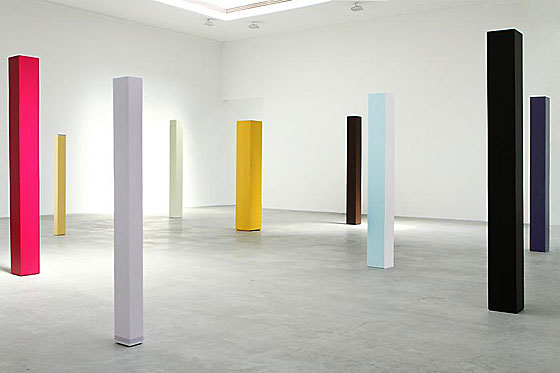
Matthew Marks Gallery’s show of Anne Truitt’s work closed June 26. Viewing it opened a time portal back to the late ’60s, when Clem Greenberg’s grip had loosened in New York but still held provincial Washington DC in a vise-like clutch. Truitt’s work rather weakly weds the uninflected solid hues of the Washington Color School with then-hipper and tougher “specific objects” of Donald Judd & Co. Although she began making these columns before Judd’s boxy vision had fully matured and arguably influenced his circle, she continued working in this style to her death, and her surfaces and exquisite color-choices quickly became anachronistic within a milieu that moved on to metal, plexiglas, and other un-artlike media. One must move around the columns to see stripes and bands of differing colors, in a kind of theatrical, phenomenological, unfolding blah blah. Marks’ Truitt mini-retrospective treated each column with the respect we would give the 2001 monolith should it appear on Earth. To stand in the gallery’s awesome, vast, pristine, Manhattan-real estate-wasting whiteness with only Truitt’s dolmens in our field of view was to experience the best secular temple money can buy. Gentle light wafted down from skylights and one’s eyes rose heavenward from the columns to study a flawless painted ceiling. One imagined that the moment a single spot of mildew appeared an underpaid factotum would be up a ladder for touchup. The slight new paint smell lingered in one’s nostrils like incense. Only two elements marred this slice of Modernist Nirvana: the guy watching the sculptures and pretending to read his iPhone and a single Truitt work in a back gallery that looked like it was made of siding or some other ordinary building material. Greenberg would have spanked Truitt for this demotic reference and wouldn’t know what to make of the guy with the phone.
[Note from the guest blogger: Paddy is on vacation for a few days so I will be taking the wheel. Initially we’ll talk about three 22nd Street shows that all closed within a few days of each other, with a bit of compare-and-contrast: the Anne Truitt above, then Heather Rowe and Jorge Pardo. I’m not familiar with the comment system here so it may take a few days before I start replying to comments (if any) – please bear with me and let’s stick to talking about art and not whether certain bloggers are “player haters.” Till the next post – Tom]
Update: The first comment has come in, from Paddy Johnson on twitter: “Tom Moody on Anne Truitt at Matthew Marks. He doesn’t sound like he likes it, but it’s hard to say.” OK, if we must: thumbs down. The show spared no trouble to dress up mediocre work of minor historical relevance.
Update 2: We had a bug infest the comment thread below so I am moving comments from the end into the main body of the post. The discussion on Anne Truitt begins as follows:
I thought it was pretty clear you didn't like it, but you seem awfully short on criticism of the actual work. Did Truitt actually discuss her work in terms of “a kind of theatrical, phenomenological, unfolding blah blah?” It seems pretty unfair if you're going to dismiss her work based on what was written about her by a critic.
It seems equally unfair to dismiss her for the posthumous setting of the exhibition. Who exactly do you see as being worthy of that square footage, and does that assessment apply to all the big street level galleries in Chelsea? The fact that Truitt's work has not been well represent in New York would make it a good candidate for this sort of exhibition; it's at least nice to be able to see it for ourselves to come our conclusions.
briandupont June 28, 2010Brian, most minimalist-style work was discussed as a kind of theatrical, phenomenological, unfolding blah blah. You walk around the work noting where one color changes to another and study the bands and their widths—the photo above covers that pretty well, I think. I suppose my basic position is that living artists working in the 'hood making art that is relevant to today should always trump minor art from the provinces dealing with old concerns. Having gone to art school in DC I was very familiar with Truitt, and trust me, you don't really need to know about her. It will become clearer, I hope, as I discuss the Rowe and Pardo shows in the coming days, that most big Chelsea shows these days are about nothing, and not in the Seinfeld sense.
tom_moody June 28, 2010By looking at the chronology (“evolution”) of these types of Truitt's sculptures — at least as how they're displayed on her website (http://bit.ly/dsgQ40) — it's interesting to note that the stately chromonoliths (word coin) had their formal origins in a white (picket) fence. Moody's description of the gallery as a meaningless antiseptic temple seems to work well with a show whose forms were extrapolated from the quintessential icon for aestheticized, normative suburban protection(ism).
To be fully liberal and tangential, I like to think of this show as an homage to the best Tetris block ever: the “I” tetrominoe (you know, the skinny rectangle block that wipes out *everythang*).
Jesse_P_Martin June 28, 2010If only minimalism had hewed closer to Truitt than Judd it would be recognized more for what it did for art than how it undermined it.
edravo June 28, 2010Thanks, Jesse, and edravo. Just as a housekeeping issue, I ask that folks please use the comment box at the bottom of the page, as a courtesy to commenters who came before you and so we have a nice linear, un-poMo thread. I don't plan to respond to any upstream replies.
tom_moody June 28, 2010While it seems that the the critique of Truitt's work got conflated with a critique of the gallery space itself, it nonetheless opens up some interesting questions:
1) What can be learned/gained by critiquing the use of space in a gallery (particularly as the usage changes from show to show)?
2) Can we separate our associations with the architecture from the work it contains? For instance, as Tom points out, Matthew Marks is not a neutral space. It's massive size is about asserting prestige, it whisper/screams “anything housed within me must be important!”.
3) Wouldn't it be fun to start critiquing the architecture of gallery spaces independently of the work they show? I'm thinking Top 10 Best, Worst, and Most Interesting. Or maybe small venues deserve their own category. I love the way the exposed wooden beams in Mary Boone get nested into the wall yet I often find it completes (sometimes outdoes) the works on view. So how does one rate such a space?
saul_chernick June 28, 20101) Maybe a lot. It sounds like a good idea to do a long-term study of a few gallery spaces. I guess the question is, what do you measure? Do you just make observations or do you track some sort of objective data?
2) Well probably not. It's like the Calder show at Gagosian a couple of months ago. It was just silly how much space was around those 5 pieces, especially since you would normally see them outdoors.
3) It would be fun, but wouldn't a way to critique be centered around the interaction with the work? I suppose you could rate by categories: Good in the Dark, Good for 3D, Good for _____, etc. The key would be to see them empty, which would be a rarity. Then again, I do go into some spaces where I don't like the work, but I'm struck by how cool the room is.
Good call.
Mead June 28, 2010


{ 54 comments }
I'm familiar with the Michael Fried vs Donald Judd/ Robert Morris phenomenology and specific object debates, but I think lumping Truitt in with that discourse is problematic. While her work superficially looks similar to the guys, she was making this work before they completely fleshed out their own ideas, and at the same time doggedly pursued a handmade method of production at odds with them. That (in addition to obvious gender discrimination) may account for her not being invited "into the club." I think it stands to reason that she was probably approaching her work from a different thematic tack, and that should at least be considered.
I am also pretty familiar with Truitt, and I beg to differ with your opinion that I/ we don't need to know more about her. She arrived at a minimal language before the big boys and has mostly been ignored; if her recent retrospective had been seen in NYC then I think you would have a case about her level of exposure, but if I think its actually a good thing that large galleries are picking up the slack where NY museums have holes in their programing.
And while I would love to see "living artists working in the 'hood making art that is relevant to today" getting more play in large galleries, I don't think you (or anyone) should decide what exactly "is relevant to today." Without accepting pluralistic visions of what should be made/ shown/ written about you wind up reinforcing a pretty limited view of history, and one that is going to see rich, white males defining taste in the artworld more than they already do.
I also don't see the point of geographic prejudice; why is it more important for artists to be from a large city or "art hub" like NY? What value does that bring to the work that can't be found in work produced in "the provinces?"
We obviously disagree on a lot, but I'm looking forward to see where you take this argument in the rest of the series.
I'm familiar with the Michael Fried vs Donald Judd/ Robert Morris phenomenology and specific object debates, but I think lumping Truitt in with that discourse is problematic. While her work superficially looks similar to the guys, she was making this work before they completely fleshed out their own ideas, and at the same time doggedly pursued a handmade method of production at odds with them. That (in addition to obvious gender discrimination) may account for her not being invited "into the club." I think it stands to reason that she was probably approaching her work from a different thematic tack, and that should at least be considered.
I am also pretty familiar with Truitt, and I beg to differ with your opinion that I/ we don't need to know more about her. She arrived at a minimal language before the big boys and has mostly been ignored; if her recent retrospective had been seen in NYC then I think you would have a case about her level of exposure, but if I think its actually a good thing that large galleries are picking up the slack where NY museums have holes in their programing.
And while I would love to see "living artists working in the 'hood making art that is relevant to today" getting more play in large galleries, I don't think you (or anyone) should decide what exactly "is relevant to today." Without accepting pluralistic visions of what should be made/ shown/ written about you wind up reinforcing a pretty limited view of history, and one that is going to see rich, white males defining taste in the artworld more than they already do.
I also don't see the point of geographic prejudice; why is it more important for artists to be from a large city or "art hub" like NY? What value does that bring to the work that can't be found in work produced in "the provinces?"
We obviously disagree on a lot, but I'm looking forward to see where you take this argument in the rest of the series.
Brian, am juggling some other matters today and will give you a more considered reply later, but are we talking about the same artist? What is your proof that Truitt has been mostly ignored? And as for couching it as a gender issue, I seem to recall a woman who stayed in the New York milieu, went up against the "big boys," and won: that was Eva Hesse, who continued growing and evolving up to her untimely death and has had far more influence on how art is made (then and now) than Truitt's pretty painted columns. You're saying geography doesn't matter and at the same time saying if Truitt could only have had this show in NY in the '60s she could have been a contender. She did in fact have a solo at Emmerich in '63 and was included in the "Primary Structures" show along with the lads. You're reinventing her as a female martyr figure. I suppose that's true in the sense that Helen Frankenthaler was one of those.
Brian, am juggling some other matters today and will give you a more considered reply later, but are we talking about the same artist? What is your proof that Truitt has been mostly ignored? And as for couching it as a gender issue, I seem to recall a woman who stayed in the New York milieu, went up against the "big boys," and won: that was Eva Hesse, who continued growing and evolving up to her untimely death and has had far more influence on how art is made (then and now) than Truitt's pretty painted columns. You're saying geography doesn't matter and at the same time saying if Truitt could only have had this show in NY in the '60s she could have been a contender. She did in fact have a solo at Emmerich in '63 and was included in the "Primary Structures" show along with the lads. You're reinventing her as a female martyr figure. I suppose that's true in the sense that Helen Frankenthaler was one of those.
It seems more appropriate to comment in haiku, given that the work is both minimal and poetic:
Truitt from the Grave:
"Rachel Harrison, you jacked
my monoliths, bitch."
Harrison's response:
"Did my PoMo-grab besmirch?
Marks will get your back."
Not Pez dispensers:
Stately feminist phalli
For gay men to hock.
It seems more appropriate to comment in haiku, given that the work is both minimal and poetic:
Truitt from the Grave:
"Rachel Harrison, you jacked
my monoliths, bitch."
Harrison's response:
"Did my PoMo-grab besmirch?
Marks will get your back."
Not Pez dispensers:
Stately feminist phalli
For gay men to hock.
As an aside, Paddy's new comments include a thumbs up/thumbs down for individual comments. You should be aware that a negative score is the best, as it indicates a strong challenge to conventional wisdom (and/or a "crank" who may be vindicated with time).
As an aside, Paddy's new comments include a thumbs up/thumbs down for individual comments. You should be aware that a negative score is the best, as it indicates a strong challenge to conventional wisdom (and/or a "crank" who may be vindicated with time).
Saul, I'd say the critique of Truitt's work got conflated with a critique of the gallery space because the two are a perfect union of form and function. But yes, more consideration should be given to these containers.
Saul, I'd say the critique of Truitt's work got conflated with a critique of the gallery space because the two are a perfect union of form and function. But yes, more consideration should be given to these containers.
Tom, I get the sense that she has been mostly ignored in NY by the fact that it is not easy to find her work on view here. Other than this show and an appearance at the Jewish Museum's contemporary show a couple years ago it's not like you see them that often. However I'm not suggesting that she's a new discovery (she's been more recognized in recent publications like Phaidon's "Themes and Movements" series).You seem to think that this is just, as she is not that interesting an artist. My point on the matter relates to your idea that this exhibition was somehow a waste of space in NYC; I think given that most people will not have a good idea of the actual work, and showing it so people can make up their own minds has intrinsic value.
I'm not sure I intend to portray her as a female martyr figure, but she wouldn't be the first example of a minority artist who was making work very similar to white male artists of the time who was marginalized in the master historical narrative. This was the thread for a decent talk by Kristen Hileman who curated the Smithsonian retrospective (available as a podcast). That Eva Hesse wasn't ignored and was more influential seems neither here nor there; aside from chronological differences (Truitt would have to be seen as influencing Judd/ Morris while Eva Hesse seems to fall pretty clearly into the post-Minimalist camp), I think there must be room for more than a single woman in the group.
My issue with the geography of art centers vs out lying areas is not specific to Truitt; it goes towards how we are applying value judgments to the work. Your comment wasn't part of the article proper, but I still don't see why it matters at all, after all, isn't an ignored or uninteresting artist (depending on your point of view) the same whether they're in Bushwick or DC?
Tom, I get the sense that she has been mostly ignored in NY by the fact that it is not easy to find her work on view here. Other than this show and an appearance at the Jewish Museum's contemporary show a couple years ago it's not like you see them that often. However I'm not suggesting that she's a new discovery (she's been more recognized in recent publications like Phaidon's "Themes and Movements" series).You seem to think that this is just, as she is not that interesting an artist. My point on the matter relates to your idea that this exhibition was somehow a waste of space in NYC; I think given that most people will not have a good idea of the actual work, and showing it so people can make up their own minds has intrinsic value.
I'm not sure I intend to portray her as a female martyr figure, but she wouldn't be the first example of a minority artist who was making work very similar to white male artists of the time who was marginalized in the master historical narrative. This was the thread for a decent talk by Kristen Hileman who curated the Smithsonian retrospective (available as a podcast). That Eva Hesse wasn't ignored and was more influential seems neither here nor there; aside from chronological differences (Truitt would have to be seen as influencing Judd/ Morris while Eva Hesse seems to fall pretty clearly into the post-Minimalist camp), I think there must be room for more than a single woman in the group.
My issue with the geography of art centers vs out lying areas is not specific to Truitt; it goes towards how we are applying value judgments to the work. Your comment wasn't part of the article proper, but I still don't see why it matters at all, after all, isn't an ignored or uninteresting artist (depending on your point of view) the same whether they're in Bushwick or DC?
Brian, you write persuasively and you're almost convincing me of some up-is-down propositions. You are arguing in defense of one of the largest, most influential galleries in NY, a show with overwhelming power signifiers (as Saul noted), pure structures that fit within Greenberg's ideas of a specialized art "entrenched in its area of competence" that refer to nothing social or economic (yet are embraced by the decisionmaking class). Yet somehow my review repeats the original error of a male establishment to exclude a woman and a non-New Yorker from the pantheon. You are minimizing Truitt's actual exposure to the process (shows in major institutions from the early '60s to the present) in favor of a conspiracy argument that somehow Don Judd kept her down, and I am perpetuating this unfairness with my review.
Eva Hesse is relevant to this discussion, and not a case of bringing in someone from another movement or timeline. Here's how I see it: Judd was an assemblage artist and still including ungainly pipes and breadpans in his boxy constructions. Truitt may have influenced him to cut out the non-essential elements and just concentrate on the box. But then he asked, "why paint these things? isn't that superfluous decoration?" He influenced a generation to see industrial materials as adequate substance for art. Then Hesse came along and began deforming the structures, bringing in chaotic elements. This is still relevant to current work (Rachel Harrison, as Jesse noted). Meanwhile Truitt left the dialog, and continued to paint her "primary structures" the same way she did in '63, till she died. Sometimes people get excluded because of who they are but sometimes the system gets it right (at least up until now): this is a backward art that clung to old theories, which can still be passed off as "classically modern." It's a historical curiosity, not an overlooked master.
Brian, you write persuasively and you're almost convincing me of some up-is-down propositions. You are arguing in defense of one of the largest, most influential galleries in NY, a show with overwhelming power signifiers (as Saul noted), pure structures that fit within Greenberg's ideas of a specialized art "entrenched in its area of competence" that refer to nothing social or economic (yet are embraced by the decisionmaking class). Yet somehow my review repeats the original error of a male establishment to exclude a woman and a non-New Yorker from the pantheon. You are minimizing Truitt's actual exposure to the process (shows in major institutions from the early '60s to the present) in favor of a conspiracy argument that somehow Don Judd kept her down, and I am perpetuating this unfairness with my review.
Eva Hesse is relevant to this discussion, and not a case of bringing in someone from another movement or timeline. Here's how I see it: Judd was an assemblage artist and still including ungainly pipes and breadpans in his boxy constructions. Truitt may have influenced him to cut out the non-essential elements and just concentrate on the box. But then he asked, "why paint these things? isn't that superfluous decoration?" He influenced a generation to see industrial materials as adequate substance for art. Then Hesse came along and began deforming the structures, bringing in chaotic elements. This is still relevant to current work (Rachel Harrison, as Jesse noted). Meanwhile Truitt left the dialog, and continued to paint her "primary structures" the same way she did in '63, till she died. Sometimes people get excluded because of who they are but sometimes the system gets it right (at least up until now): this is a backward art that clung to old theories, which can still be passed off as "classically modern." It's a historical curiosity, not an overlooked master.
Thanks for providing a detailed chronology, that makes it a bit easier to see where we agree and where we differ:
Here's how I see it: Judd was an assemblage artist and still including ungainly pipes and breadpans in his boxy constructions. Truitt may have influenced him to cut out the non-essential elements and just concentrate on the box. But then he asked, "why paint these things? isn't that superfluous decoration?" He influenced a generation to see industrial materials as adequate substance for art. Then Hesse came along and began deforming the structures, bringing in chaotic elements. This is still relevant to current work (Rachel Harrison, as Jesse noted). Meanwhile Truitt left the dialog, and continued to paint her "primary structures" the same way she did in '63, till she died.
I agree with you right up to the part about her painting "the same way she did in '63, till she died." It's a fairly neutral reading of history. Where we disagree is on the details of how an artist's work can or should be read and who is making these decisions and what are the responsibilities of the parties involved.
So, to be clear, I am not positing that Truitt is some ignored genius whose ideas were stolen by the patriarchy. I never suggestedthat Donald Judd went exercised some secret power against her (that hyperbole is your own). When I point out that she may have gotten short shrift as opposed to the acknowledged Titans of Minimalism it is not with the sense that this is a huge injustice, only that it might be a valid point to consider, and perhaps we should look at the work again. My argument focuses on the fact that she has not been well represented in NYC recently. That she has been well collected does not change this; if the work is not on view, the fact that it is owned by MoMA, or the Met, or the Whitney or whomever is of little import if people can't see it, and so there is value in Matthew Marks pulling the work out of storage so it can be seen, rather than merely dismissed.
Where I have a problem with your chronology is in the values that are implied; if "Truitt left the dialog" she did so only a bit sooner than Judd (who is one of my favorite artists); it's not exactly like Judd continued restlessly innovating and making grand changes to his art throughout his life. I don't expect artists to press relentlessly building on their art, and I don't think all that many do. Truitt found what was true to what she wanted to do and did it. I think there are some small changes in her work over the years (evolutionary rather than revolutionary), and that's enough.
Similarly, that she wasn't terribly influential should not disqualify her from an exhibition (after all if your criteria is that an artist should be as influential as Hesse then most of the ground floor Chelsea galleries will able to be reclaimed by storage facilities and taxi garages because there won't be that much art that lives up to your standards). Isn't there the chance that the work being more visible might lead to it's influence spreading? I think we should allow for that possibility, especially since new artists may seek out the obscure and debased as a way to separate themselves from what came directly before.
As to the the Gallery being the problem, is Matthew Marks space really that different from Peter Blum, Sean Kelly, Paul Kasmin, Robert Miller, LeLong, Mitchell Innes & Nash, Cheim & Reade, Lehman Maupin, Lurhing Augustine, Boesky, Gagosian, Gladstone, Mary Boone, Andrea Rosen, Pace, Sonnabend, Sikkema Jenkins, Paula Cooper, Yvone Lambert, Tannya Bonakdar, Jack Shaiman, or David Zwirner? I guess I am arguing in defense of one of the largest, most influential galleries in NY, but at the very least Marks is showing work that hasn't been seen in awhile, and I thought it deserved a bit more than an off-hand dismisal that barely addressed the actual objects.
That said, we'll see where you take things.
Thanks for providing a detailed chronology, that makes it a bit easier to see where we agree and where we differ:
Here's how I see it: Judd was an assemblage artist and still including ungainly pipes and breadpans in his boxy constructions. Truitt may have influenced him to cut out the non-essential elements and just concentrate on the box. But then he asked, "why paint these things? isn't that superfluous decoration?" He influenced a generation to see industrial materials as adequate substance for art. Then Hesse came along and began deforming the structures, bringing in chaotic elements. This is still relevant to current work (Rachel Harrison, as Jesse noted). Meanwhile Truitt left the dialog, and continued to paint her "primary structures" the same way she did in '63, till she died.
I agree with you right up to the part about her painting "the same way she did in '63, till she died." It's a fairly neutral reading of history. Where we disagree is on the details of how an artist's work can or should be read and who is making these decisions and what are the responsibilities of the parties involved.
So, to be clear, I am not positing that Truitt is some ignored genius whose ideas were stolen by the patriarchy. I never suggestedthat Donald Judd went exercised some secret power against her (that hyperbole is your own). When I point out that she may have gotten short shrift as opposed to the acknowledged Titans of Minimalism it is not with the sense that this is a huge injustice, only that it might be a valid point to consider, and perhaps we should look at the work again. My argument focuses on the fact that she has not been well represented in NYC recently. That she has been well collected does not change this; if the work is not on view, the fact that it is owned by MoMA, or the Met, or the Whitney or whomever is of little import if people can't see it, and so there is value in Matthew Marks pulling the work out of storage so it can be seen, rather than merely dismissed.
Where I have a problem with your chronology is in the values that are implied; if "Truitt left the dialog" she did so only a bit sooner than Judd (who is one of my favorite artists); it's not exactly like Judd continued restlessly innovating and making grand changes to his art throughout his life. I don't expect artists to press relentlessly building on their art, and I don't think all that many do. Truitt found what was true to what she wanted to do and did it. I think there are some small changes in her work over the years (evolutionary rather than revolutionary), and that's enough.
Similarly, that she wasn't terribly influential should not disqualify her from an exhibition (after all if your criteria is that an artist should be as influential as Hesse then most of the ground floor Chelsea galleries will able to be reclaimed by storage facilities and taxi garages because there won't be that much art that lives up to your standards). Isn't there the chance that the work being more visible might lead to it's influence spreading? I think we should allow for that possibility, especially since new artists may seek out the obscure and debased as a way to separate themselves from what came directly before.
As to the the Gallery being the problem, is Matthew Marks space really that different from Peter Blum, Sean Kelly, Paul Kasmin, Robert Miller, LeLong, Mitchell Innes & Nash, Cheim & Reade, Lehman Maupin, Lurhing Augustine, Boesky, Gagosian, Gladstone, Mary Boone, Andrea Rosen, Pace, Sonnabend, Sikkema Jenkins, Paula Cooper, Yvone Lambert, Tannya Bonakdar, Jack Shaiman, or David Zwirner? I guess I am arguing in defense of one of the largest, most influential galleries in NY, but at the very least Marks is showing work that hasn't been seen in awhile, and I thought it deserved a bit more than an off-hand dismisal that barely addressed the actual objects.
That said, we'll see where you take things.
@BrianDuPont: It's somewhat noble of you to want to elevate Truitt's status within the minimalist canon – and even nobler to believe that Matthew Marks is trying to do the same – but it's really nothing new for big-name galleries to re-present what Tom Moody is rightly calling "mediocre work of minor historical relevance" as overlooked major art-historical treasures.
Chelsea has been awash with shows like this in recent years (@ Zwirner and Gagosian, for instance), and I would argue that their pushing of these usually deceased, second-or-third tier artists' work (and "legacies") is more about them trying to push their crowded inventories. You have the right to champion Truitt's work and defend the significance of her contributions, but it's worth considering why a blue-chip gallery who exclusively represents an artist's estate is echoing nearly all of the same sentiments you've stated above. Galleries aren't museums; they're businesses, and they have products to sell.
And I'm still not clear on why you feel that it's so necessary for people to see Truitt's work at this point in time. Other than the (debatable) esoteric historical footnotes that you've touched upon above, what else should be gleaned by a (probably less informed/interested) contemporary viewer?
@BrianDuPont: It's somewhat noble of you to want to elevate Truitt's status within the minimalist canon – and even nobler to believe that Matthew Marks is trying to do the same – but it's really nothing new for big-name galleries to re-present what Tom Moody is rightly calling "mediocre work of minor historical relevance" as overlooked major art-historical treasures.
Chelsea has been awash with shows like this in recent years (@ Zwirner and Gagosian, for instance), and I would argue that their pushing of these usually deceased, second-or-third tier artists' work (and "legacies") is more about them trying to push their crowded inventories. You have the right to champion Truitt's work and defend the significance of her contributions, but it's worth considering why a blue-chip gallery who exclusively represents an artist's estate is echoing nearly all of the same sentiments you've stated above. Galleries aren't museums; they're businesses, and they have products to sell.
And I'm still not clear on why you feel that it's so necessary for people to see Truitt's work at this point in time. Other than the (debatable) esoteric historical footnotes that you've touched upon above, what else should be gleaned by a (probably less informed/interested) contemporary viewer?
Hmm. One point Brian raised still stands. What role does her provincial origin have in your placement of her work?
Regardless of the specific place of Truitt in any given canon, the use of the word "provinces" carries a ring like the word "commoner" — and is equally problematic when used un-self-consciously, which it seemed to be here. I am aware of the argument that regions become important art historically (Rome, Paris, etc.), but surely you do not mean that non-important regions therefore by definition produce non-important art. And of course, 'important' is a moving target.
Otherwise, looking forward to seeing your post on Pardo!
Hmm. One point Brian raised still stands. What role does her provincial origin have in your placement of her work?
Regardless of the specific place of Truitt in any given canon, the use of the word "provinces" carries a ring like the word "commoner" — and is equally problematic when used un-self-consciously, which it seemed to be here. I am aware of the argument that regions become important art historically (Rome, Paris, etc.), but surely you do not mean that non-important regions therefore by definition produce non-important art. And of course, 'important' is a moving target.
Otherwise, looking forward to seeing your post on Pardo!
Sorry, everyone, comments are disappearing from this queue and at least one earlier thread. It appears to be a timestamp based bug – earliest comments disappear first.
Sorry, everyone, comments are disappearing from this queue and at least one earlier thread. It appears to be a timestamp based bug – earliest comments disappear first.
Sorry, everyone, comments are disappearing from this queue and at least one earlier thread. It appears to be a timestamp based bug – earliest comments disappear first.
Paddy has been apprised and is investigating – hopefully we'll be getting everything restored.
Paddy has been apprised and is investigating – hopefully we'll be getting everything restored.
Paddy has been apprised and is investigating – hopefully we'll be getting everything restored.
Have any of y’all seen those cats playing Schoenberg? Man they’re cute. 😉
Have any of y’all seen those cats playing Schoenberg? Man they’re cute. 😉
OK, we had some problems with this thread but I think everything is in the right order now. My reply to DWBG:
You are correct that regions do become important art historically. I think it should be possible to discuss this without saying “of course good art can be made at any time anywhere in the world.†It is a fact that rapid changes in style and theory can happen in a place and if you stop following those, move to a cabin, and say “All I need is this here paintbrush and my creative soul!†you risk making art that is provincial. I felt Brian was contradicting himself, saying on the one hand “good art can be made anywhere†and on the other, “what if Truitt had gotten more prominent play in New York in the early ’60s?†(Not his exact words.) You are either participating in a certain discourse or you are not. I feel she was not, or if she was, “look how well I paint these columns!†was not enough considering what happened in the transition from minimalism to post-minimalism, earth art, etc. Addendum: having spent time in both DC and NY I believe the former is highly provincial, which is why I hoot when Tyler Green tries to cut the weak deer out of the New York herd from his blind in the nation’s capital.
OK, we had some problems with this thread but I think everything is in the right order now. My reply to DWBG:
You are correct that regions do become important art historically. I think it should be possible to discuss this without saying “of course good art can be made at any time anywhere in the world.†It is a fact that rapid changes in style and theory can happen in a place and if you stop following those, move to a cabin, and say “All I need is this here paintbrush and my creative soul!†you risk making art that is provincial. I felt Brian was contradicting himself, saying on the one hand “good art can be made anywhere†and on the other, “what if Truitt had gotten more prominent play in New York in the early ’60s?†(Not his exact words.) You are either participating in a certain discourse or you are not. I feel she was not, or if she was, “look how well I paint these columns!†was not enough considering what happened in the transition from minimalism to post-minimalism, earth art, etc. Addendum: having spent time in both DC and NY I believe the former is highly provincial, which is why I hoot when Tyler Green tries to cut the weak deer out of the New York herd from his blind in the nation’s capital.
OK, we had some problems with this thread but I think everything is in the right order now. My reply to DWBG:
You are correct that regions do become important art historically. I think it should be possible to discuss this without saying “of course good art can be made at any time anywhere in the world.†It is a fact that rapid changes in style and theory can happen in a place and if you stop following those, move to a cabin, and say “All I need is this here paintbrush and my creative soul!†you risk making art that is provincial. I felt Brian was contradicting himself, saying on the one hand “good art can be made anywhere†and on the other, “what if Truitt had gotten more prominent play in New York in the early ’60s?†(Not his exact words.) You are either participating in a certain discourse or you are not. I feel she was not, or if she was, “look how well I paint these columns!†was not enough considering what happened in the transition from minimalism to post-minimalism, earth art, etc. Addendum: having spent time in both DC and NY I believe the former is highly provincial, which is why I hoot when Tyler Green tries to cut the weak deer out of the New York herd from his blind in the nation’s capital.
Jesse, I am not necessarily interested in seeing Truitt “elevated” within the minimalist cannon. Also, I am well aware that this type of show is, if not exactly common, at least a recurring genre within the Chelsea gallery scene. Dealers are trying to sell things, but I don’t have a problem with that; if every ground floor level Chelsea dealer that I listed above suddenly had what would be tantamount to a religious conversion and decided to instead start showing the interesting, young artists from Bushwick that Tom is advocating for, those artists would still want to sell their work at the gallery. In that regard I don’t see how my critique of Tom’s criticism is invalidated just because it might be similar to what Mathew Marks might be thinking. When I say that galleries are taking up the slack of museum programing, I mean it not so much to champion galleries as to indict museums.
My starting point on this particular tangent is that Tom was pretty dismissive, and there seems to be a pretty good reason for this show to be seen in NYC, namely that she is fairly widely known, but not widely seen, especially in NYC. If her retrospective had made it to NYC I would agree that this exhibition was looking to cash in, but that’s not the case. Even given Matthew Marks prestige and venue, the amount of space this exhibition took, expressed as square feet of exhibition per day, amounted to less than a single drop in the bucket over the same measure applied to all of Chelsea this season; it’s not like there wasn’t plenty of other stuff to look at, and since Tom claims to be familiar enough with the Truitt’s work, he really shouldn’t have been surprised by what he saw (I’m assuming that he’d been into Marks’ 22nd St. space before).
Now this tends to be the sort of work I like, so I was interested to see it, but at the same time I recognize that my tastes are not that of the mainstream. To that end I’m for an absolute mess in the galleries where there is true pluralism and everybody can find something they’re interested in, but also has to encounter work that annoys and pisses them off (for whatever reason). That will not only insure that I can see something I like, but that most people interested in art will be able to find something to look at. I haven’t found Tom’s reasons for saying this show should not have been mounted all that convincing; If you’re going to suggest that then I think that you should be able to suggest what would better take its place, but perhaps that’s to come in the final installment (Isermann vs Pardo being a start).
Jesse, I am not necessarily interested in seeing Truitt “elevated” within the minimalist cannon. Also, I am well aware that this type of show is, if not exactly common, at least a recurring genre within the Chelsea gallery scene. Dealers are trying to sell things, but I don’t have a problem with that; if every ground floor level Chelsea dealer that I listed above suddenly had what would be tantamount to a religious conversion and decided to instead start showing the interesting, young artists from Bushwick that Tom is advocating for, those artists would still want to sell their work at the gallery. In that regard I don’t see how my critique of Tom’s criticism is invalidated just because it might be similar to what Mathew Marks might be thinking. When I say that galleries are taking up the slack of museum programing, I mean it not so much to champion galleries as to indict museums.
My starting point on this particular tangent is that Tom was pretty dismissive, and there seems to be a pretty good reason for this show to be seen in NYC, namely that she is fairly widely known, but not widely seen, especially in NYC. If her retrospective had made it to NYC I would agree that this exhibition was looking to cash in, but that’s not the case. Even given Matthew Marks prestige and venue, the amount of space this exhibition took, expressed as square feet of exhibition per day, amounted to less than a single drop in the bucket over the same measure applied to all of Chelsea this season; it’s not like there wasn’t plenty of other stuff to look at, and since Tom claims to be familiar enough with the Truitt’s work, he really shouldn’t have been surprised by what he saw (I’m assuming that he’d been into Marks’ 22nd St. space before).
Now this tends to be the sort of work I like, so I was interested to see it, but at the same time I recognize that my tastes are not that of the mainstream. To that end I’m for an absolute mess in the galleries where there is true pluralism and everybody can find something they’re interested in, but also has to encounter work that annoys and pisses them off (for whatever reason). That will not only insure that I can see something I like, but that most people interested in art will be able to find something to look at. I haven’t found Tom’s reasons for saying this show should not have been mounted all that convincing; If you’re going to suggest that then I think that you should be able to suggest what would better take its place, but perhaps that’s to come in the final installment (Isermann vs Pardo being a start).
Jesse, I am not necessarily interested in seeing Truitt “elevated” within the minimalist cannon. Also, I am well aware that this type of show is, if not exactly common, at least a recurring genre within the Chelsea gallery scene. Dealers are trying to sell things, but I don’t have a problem with that; if every ground floor level Chelsea dealer that I listed above suddenly had what would be tantamount to a religious conversion and decided to instead start showing the interesting, young artists from Bushwick that Tom is advocating for, those artists would still want to sell their work at the gallery. In that regard I don’t see how my critique of Tom’s criticism is invalidated just because it might be similar to what Mathew Marks might be thinking. When I say that galleries are taking up the slack of museum programing, I mean it not so much to champion galleries as to indict museums.
My starting point on this particular tangent is that Tom was pretty dismissive, and there seems to be a pretty good reason for this show to be seen in NYC, namely that she is fairly widely known, but not widely seen, especially in NYC. If her retrospective had made it to NYC I would agree that this exhibition was looking to cash in, but that’s not the case. Even given Matthew Marks prestige and venue, the amount of space this exhibition took, expressed as square feet of exhibition per day, amounted to less than a single drop in the bucket over the same measure applied to all of Chelsea this season; it’s not like there wasn’t plenty of other stuff to look at, and since Tom claims to be familiar enough with the Truitt’s work, he really shouldn’t have been surprised by what he saw (I’m assuming that he’d been into Marks’ 22nd St. space before).
Now this tends to be the sort of work I like, so I was interested to see it, but at the same time I recognize that my tastes are not that of the mainstream. To that end I’m for an absolute mess in the galleries where there is true pluralism and everybody can find something they’re interested in, but also has to encounter work that annoys and pisses them off (for whatever reason). That will not only insure that I can see something I like, but that most people interested in art will be able to find something to look at. I haven’t found Tom’s reasons for saying this show should not have been mounted all that convincing; If you’re going to suggest that then I think that you should be able to suggest what would better take its place, but perhaps that’s to come in the final installment (Isermann vs Pardo being a start).
Brian, I’m not trying not to convince you to dislike Anne Truitt. No argument of mine could make you question her importance in the history of art or change the fact that shows like this will continue to happen. The point of my three posts is that the art world is a clockwork machine, devoted to showing living artists at a certain level regardless of their output or “reviving” dead artists with a conveniently limited pool of work to sell. I said nothing about Bushwick or “young artists,” though it would be nice to see a show that looked fresh. By “the ‘hood” I meant New York, where galleries run these large lovely mausoleums, as opposed to some other city where a deceased artist comes from. As for what I think should be a higher priority, I invite you to page back through nine years of my blog(s)–I ain’t gonna summarize it in one post for you.
Brian, I’m not trying not to convince you to dislike Anne Truitt. No argument of mine could make you question her importance in the history of art or change the fact that shows like this will continue to happen. The point of my three posts is that the art world is a clockwork machine, devoted to showing living artists at a certain level regardless of their output or “reviving” dead artists with a conveniently limited pool of work to sell. I said nothing about Bushwick or “young artists,” though it would be nice to see a show that looked fresh. By “the ‘hood” I meant New York, where galleries run these large lovely mausoleums, as opposed to some other city where a deceased artist comes from. As for what I think should be a higher priority, I invite you to page back through nine years of my blog(s)–I ain’t gonna summarize it in one post for you.
Sorry, I wanted to jump out of order just to address the detail you bring up regarding Bushwick and Young artists; I did make the leap to that from “living artists working in the ‘hood making art that is relevant to today”; it may not be what you meant, but I don’t think its that large a leap (at least in part because I subscribe a pretty liberal definition of “young”; I think NYC is much to large these day’s to be a single ‘hood, so went with the one where all the artists seemed to be going.)
Sorry, I wanted to jump out of order just to address the detail you bring up regarding Bushwick and Young artists; I did make the leap to that from “living artists working in the ‘hood making art that is relevant to today”; it may not be what you meant, but I don’t think its that large a leap (at least in part because I subscribe a pretty liberal definition of “young”; I think NYC is much to large these day’s to be a single ‘hood, so went with the one where all the artists seemed to be going.)
Brian, I’m not trying not to convince you to dislike Anne Truitt. No argument of mine could make you question her importance in the history of art or change the fact that shows like this will continue to happen. The point of my three posts is that the art world is a clockwork machine, devoted to showing living artists at a certain level regardless of their output or “reviving” dead artists with a conveniently limited pool of work to sell. I said nothing about Bushwick or “young artists,” though it would be nice to see a show that looked fresh. By “the ‘hood” I meant New York, where galleries run these large lovely mausoleums, as opposed to some other city where a deceased artist comes from. As for what I think should be a higher priority, I invite you to page back through nine years of my blog(s)–I ain’t gonna summarize it in one post for you.
Sorry, I wanted to jump out of order just to address the detail you bring up regarding Bushwick and Young artists; I did make the leap to that from “living artists working in the ‘hood making art that is relevant to today”; it may not be what you meant, but I don’t think its that large a leap (at least in part because I subscribe a pretty liberal definition of “young”; I think NYC is much to large these day’s to be a single ‘hood, so went with the one where all the artists seemed to be going.)
Tom, I also wanted to address your above statement about how I contradict myself by suggesting “…on the one hand “good art can be made anywhere†and on the other, “what if Truitt had gotten more prominent play in New York in the early ’60s?â€
You are conflating two separate points. I do think that good art can be made anywhere. It is quite easy for artists in NYC to make banal and provincial work, despite the high rents where they happen to live. Even if theory were somehow important to making art, in this day and age do you really think that someone living upstate, downstate, or way out in the boonies, doesn’t have access to it?
I think you can argue (and I would agree) that Truitt’s living outside of NYC probably went towards the marginalization of her work, but but at the same time I don’t think that that marginalization is a reason that her work shouldn’t been seen now.
Thank you for at least acknowledging that the idea of “what if Truitt had gotten more prominent play in New York in the early ’60s?†were not my exact words, because as a summation it completely misstates my point. Mine is that she was not as prominent, despite being someone who “…began making these columns before Judd’s boxy vision had fully matured and arguably influenced his circle…” Since this would indicate that she was at least influential in the genesis of one of, if not the last high modernist movement, then that is a reason to consider her work in person, and enough of reason to not dismiss the show outright.
Tom, I also wanted to address your above statement about how I contradict myself by suggesting “…on the one hand “good art can be made anywhere†and on the other, “what if Truitt had gotten more prominent play in New York in the early ’60s?â€
You are conflating two separate points. I do think that good art can be made anywhere. It is quite easy for artists in NYC to make banal and provincial work, despite the high rents where they happen to live. Even if theory were somehow important to making art, in this day and age do you really think that someone living upstate, downstate, or way out in the boonies, doesn’t have access to it?
I think you can argue (and I would agree) that Truitt’s living outside of NYC probably went towards the marginalization of her work, but but at the same time I don’t think that that marginalization is a reason that her work shouldn’t been seen now.
Thank you for at least acknowledging that the idea of “what if Truitt had gotten more prominent play in New York in the early ’60s?†were not my exact words, because as a summation it completely misstates my point. Mine is that she was not as prominent, despite being someone who “…began making these columns before Judd’s boxy vision had fully matured and arguably influenced his circle…” Since this would indicate that she was at least influential in the genesis of one of, if not the last high modernist movement, then that is a reason to consider her work in person, and enough of reason to not dismiss the show outright.
Tom, I also wanted to address your above statement about how I contradict myself by suggesting “…on the one hand “good art can be made anywhere†and on the other, “what if Truitt had gotten more prominent play in New York in the early ’60s?â€
You are conflating two separate points. I do think that good art can be made anywhere. It is quite easy for artists in NYC to make banal and provincial work, despite the high rents where they happen to live. Even if theory were somehow important to making art, in this day and age do you really think that someone living upstate, downstate, or way out in the boonies, doesn’t have access to it?
I think you can argue (and I would agree) that Truitt’s living outside of NYC probably went towards the marginalization of her work, but but at the same time I don’t think that that marginalization is a reason that her work shouldn’t been seen now.
Thank you for at least acknowledging that the idea of “what if Truitt had gotten more prominent play in New York in the early ’60s?†were not my exact words, because as a summation it completely misstates my point. Mine is that she was not as prominent, despite being someone who “…began making these columns before Judd’s boxy vision had fully matured and arguably influenced his circle…” Since this would indicate that she was at least influential in the genesis of one of, if not the last high modernist movement, then that is a reason to consider her work in person, and enough of reason to not dismiss the show outright.
People who influenced modern movements are a dime a dozen. How about a Siquieros show because Pollock saw drips in his studio?
When a scene is hopping and there are lots of changes happening in work and ideas, this is probably not the best time to be out of town for an extended period–as in forever. We are talking about work (painting, sculpture) that must be seen physically and discussed in real time in the presence of the work, not listened to on a record or described over the phone. Especially in a time when there is no internet to keep you in touch, and art mags are monthly and travel by ground mail. Why do you think so many career decisions get made in NY? I shouldn’t have to be explaining this or defending the status quo. Brian, can we stop soon? Please?
People who influenced modern movements are a dime a dozen. How about a Siquieros show because Pollock saw drips in his studio?
When a scene is hopping and there are lots of changes happening in work and ideas, this is probably not the best time to be out of town for an extended period–as in forever. We are talking about work (painting, sculpture) that must be seen physically and discussed in real time in the presence of the work, not listened to on a record or described over the phone. Especially in a time when there is no internet to keep you in touch, and art mags are monthly and travel by ground mail. Why do you think so many career decisions get made in NY? I shouldn’t have to be explaining this or defending the status quo. Brian, can we stop soon? Please?
As I mentioned on Twitter, I’ll put up my own thoughts on Truitt’s show on my own blog; it seems only fair to state where I stand and let that stand.
Despite the fact that we clearly have very different views on contemporary art and it’s attendant structures, I enjoyed the discussion.
As I mentioned on Twitter, I’ll put up my own thoughts on Truitt’s show on my own blog; it seems only fair to state where I stand and let that stand.
Despite the fact that we clearly have very different views on contemporary art and it’s attendant structures, I enjoyed the discussion.
People who influenced modern movements are a dime a dozen. How about a Siquieros show because Pollock saw drips in his studio?
When a scene is hopping and there are lots of changes happening in work and ideas, this is probably not the best time to be out of town for an extended period–as in forever. We are talking about work (painting, sculpture) that must be seen physically and discussed in real time in the presence of the work, not listened to on a record or described over the phone. Especially in a time when there is no internet to keep you in touch, and art mags are monthly and travel by ground mail. Why do you think so many career decisions get made in NY? I shouldn’t have to be explaining this or defending the status quo. Brian, can we stop soon? Please?
As I mentioned on Twitter, I’ll put up my own thoughts on Truitt’s show on my own blog; it seems only fair to state where I stand and let that stand.
Despite the fact that we clearly have very different views on contemporary art and it’s attendant structures, I enjoyed the discussion.
I know I said I wanted to wind down this discussion but a friend noted that Google has some relevant pages we can all refer to from James Meyer’s book Minimalism: Art and Polemics in the ’60s.
Pages 63-74 discuss Truitt and offer some anecdotes about Truitt’s retrograde aims vis a vis ’60s developments. In particular a studio visit with Robert Morris (p. 70) where she missed the point of his work. (She had seen it in magazines and was disappointed that it wasn’t more handsomely fabricated.) According to Meyer, Truitt valued intuition and hand-craft in making her sculptures, “something that must have struck Morris as distinctly passe.” That was in 1965. Although Meyer suggests from his anecdotes that Truitt’s motivations for making her sculptures were old-fashioned and sentimental (the objects reminded her of real places and people), he still believes her work “is most comprehensible in relation to [the minimalists’] literalist practices,” so it wouldn’t be out of line to discuss them with the vocabulary of Morris, et al. Meyer believes her work is still “remarkably unexplained” but I don’t agree–she is an artist working in the abstract expressionist tradition of subjectivity and feeling who incidentally makes “nice” minimalist-style objects, perfect for the secondary market.
I know I said I wanted to wind down this discussion but a friend noted that Google has some relevant pages we can all refer to from James Meyer’s book Minimalism: Art and Polemics in the ’60s.
Pages 63-74 discuss Truitt and offer some anecdotes about Truitt’s retrograde aims vis a vis ’60s developments. In particular a studio visit with Robert Morris (p. 70) where she missed the point of his work. (She had seen it in magazines and was disappointed that it wasn’t more handsomely fabricated.) According to Meyer, Truitt valued intuition and hand-craft in making her sculptures, “something that must have struck Morris as distinctly passe.” That was in 1965. Although Meyer suggests from his anecdotes that Truitt’s motivations for making her sculptures were old-fashioned and sentimental (the objects reminded her of real places and people), he still believes her work “is most comprehensible in relation to [the minimalists’] literalist practices,” so it wouldn’t be out of line to discuss them with the vocabulary of Morris, et al. Meyer believes her work is still “remarkably unexplained” but I don’t agree–she is an artist working in the abstract expressionist tradition of subjectivity and feeling who incidentally makes “nice” minimalist-style objects, perfect for the secondary market.
Meyer has a chapter section called “The Case for Truitt: Minimalism and Gender” (pp. 222 – 228–not available in the Google scan), Haven’t read.Meyer’s book, just reviews and some articles by him. My friend who owns the book says the “case” is Greenberg’s case. My prediction: Meyer or someone of equal scholarly weight will “re-evaluate” Truitt in the next Artforum based on this show and the conclusion will be she is an overlooked feminist minimalist, nay, the lynchpin of the movement (even though that is not the consensus now). Brian, you will get the exegesis and apologetics you desire if you just wait a few weeks, and my bad-tempered analysis that this show was by no means an eye-opening new look at an artist–just market business as usual–will be a fading bad memory.
Update (before my guest blogging ends and while I can still do updates): In anticipation of the full-court press from the print media I want to add one detail I now feel is missing from the above review, which is, a description of the columns’ paint surfaces. I called them “uninflected” and they mostly are, but should add that on close inspection you can see evidence of brushing and the application of many careful coats. Perfectly smooth John McCrackens these ain’t. The effect of sanding and layering like an old school craftsman and including some sweet, pastel-y colors is to draw attention to the objects and away from the room, which rather goes against everything Minimalism stands for. There is nothing particularly “feminist” about this; plenty of stodgy conservatives are guys. And to the extent the pastel hues could be called “girly” it is a return to gender norms, not a blow against them.
Meyer has a chapter section called “The Case for Truitt: Minimalism and Gender” (pp. 222 – 228–not available in the Google scan), Haven’t read.Meyer’s book, just reviews and some articles by him. My friend who owns the book says the “case” is Greenberg’s case. My prediction: Meyer or someone of equal scholarly weight will “re-evaluate” Truitt in the next Artforum based on this show and the conclusion will be she is an overlooked feminist minimalist, nay, the lynchpin of the movement (even though that is not the consensus now). Brian, you will get the exegesis and apologetics you desire if you just wait a few weeks, and my bad-tempered analysis that this show was by no means an eye-opening new look at an artist–just market business as usual–will be a fading bad memory.
Update (before my guest blogging ends and while I can still do updates): In anticipation of the full-court press from the print media I want to add one detail I now feel is missing from the above review, which is, a description of the columns’ paint surfaces. I called them “uninflected” and they mostly are, but should add that on close inspection you can see evidence of brushing and the application of many careful coats. Perfectly smooth John McCrackens these ain’t. The effect of sanding and layering like an old school craftsman and including some sweet, pastel-y colors is to draw attention to the objects and away from the room, which rather goes against everything Minimalism stands for. There is nothing particularly “feminist” about this; plenty of stodgy conservatives are guys. And to the extent the pastel hues could be called “girly” it is a return to gender norms, not a blow against them.
Meyer has a chapter section called “The Case for Truitt: Minimalism and Gender” (pp. 222 – 228–not available in the Google scan), Haven’t read.Meyer’s book, just reviews and some articles by him. My friend who owns the book says the “case” is Greenberg’s case. My prediction: Meyer or someone of equal scholarly weight will “re-evaluate” Truitt in the next Artforum based on this show and the conclusion will be she is an overlooked feminist minimalist, nay, the lynchpin of the movement (even though that is not the consensus now). Brian, you will get the exegesis and apologetics you desire if you just wait a few weeks, and my bad-tempered analysis that this show was by no means an eye-opening new look at an artist–just market business as usual–will be a fading bad memory.
Update (before my guest blogging ends and while I can still do updates): In anticipation of the full-court press from the print media I want to add one detail I now feel is missing from the above review, which is, a description of the columns’ paint surfaces. I called them “uninflected” and they mostly are, but should add that on close inspection you can see evidence of brushing and the application of many careful coats. Perfectly smooth John McCrackens these ain’t. The effect of sanding and layering like an old school craftsman and including some sweet, pastel-y colors is to draw attention to the objects and away from the room, which rather goes against everything Minimalism stands for. There is nothing particularly “feminist” about this; plenty of stodgy conservatives are guys. And to the extent the pastel hues could be called “girly” it is a return to gender norms, not a blow against them.
Comments on this entry are closed.
{ 2 trackbacks }