
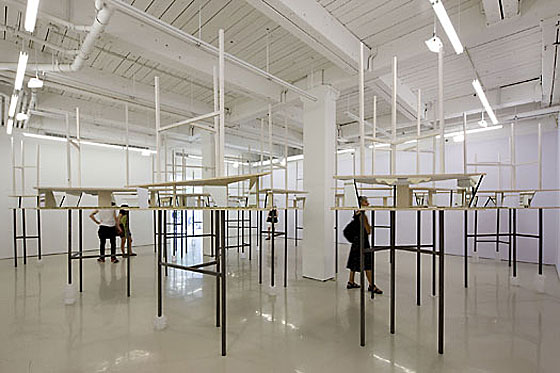
Heather Rowe‘s exhibition at D’Amelio Terras, which closed June 19, offered a poMo counterpoint to Anne Truitt’s highMo across the street at Matthew Marks. Where Truitt gave us skyscrapers we weren’t supposed to compare to skyscrapers, Rowe gave us a funhouse that that wasn’t fun. That smart crack isn’t necessarily a criticism–it would be perfectly acceptable to wander around Rowe’s maze of construction materials with strategically placed mirrors and dollhouse cutaway views and seriously reflect on self-reflection without “enjoying yourself.” Some people were determined to liven up the proceedings, though. The second time I visited the space, a fellow with video camera, lights, and umbrella had parked himself conspicuously in the middle of Rowe’s pristine-but-busy jungle gymnasium. This (official? amateur?) videographer urged us to “walk naturally” around the inside of the maze so he could get some dynamic shots of humans interacting with the installation. Signs in the gallery warned you to be careful lest the sculpture’s sharp corners injure you while you wander, so there were limits to how natural you could be.
Rowe’s piece mimicked a single cross-section view of a high-rise floor, or rather, the space between floors, improbably suspended at eye level between dark metal stilts anchoring it to the gallery’s polished concrete, and white-painted struts extending to the ceiling. Whereas Anne Truitt embellished the “specific objects” of the minimalist era by coating them with pretty paint colors, Rowe “maximalized” minimalism’s implied reference to architecture with scores of details hiding in plain sight. The unfun funhouse experience was discovering all these architectural “reveals” as you meandered inside the suspended floor. In the place of dollhouse dolls or the little Tom Otterness bronze men doing funny things you might expect, Rowe gave us exotically unexotic glimpses of carpet padding, plywood stacks, and fragments of curvy moulding, all carefully tucked into the crevices of the cutaway and “discovered” as you moved about. Mirrors placed at angles within the floor’s plywood sandwich transformed the gallery into a Piranesian space of cross sections of cross sections of….
Ultimately, like the Seinfeld TV show, the installation was about nothing. Or nothing reflecting on nothing until, I assume the artist thought, it became something. The subject matter wasn’t just the floors of non-descript buildings but the spaces between those floors. And not the conduit, asbestos, dirt, and candy wrappers you would expect to find in those interstitial planes but rather curiosity-cabinets of hiply obscure construction materials. The show could be a comment on urbanization or condo-ization or overdevelopment but one perceived no commitment to those messages in all the archness and scruffy elegance surrounding you. The show hints at the political but finally comes down to taste and not disturbing people’s sensibilities too much. It could almost serve as a rule book of what can and can’t be shown in a certain mid-to-upper-level Chelsea Gallery these days: something so dry and self-consciously correct it needed the warning signs and an intrusive cameraman to bring it to life.


{ 22 comments }
My first thought upon looking at the slideshow on the exhibition website was that the work seems to emulate jaunty 50's diner/gas station mockups. It's clear that Rowe is prodding for some sort of reveal, but the work/space looks so distracting that you couldn't quietly contemplate foam insulation even if you wanted to. Are the "legs" part of the art?
I guess it's exhibitions like this that make me wonder; if Groys is right about the whole strong/weak images thing, how weak is too weak? Are mirrors strong?
My first thought upon looking at the slideshow on the exhibition website was that the work seems to emulate jaunty 50's diner/gas station mockups. It's clear that Rowe is prodding for some sort of reveal, but the work/space looks so distracting that you couldn't quietly contemplate foam insulation even if you wanted to. Are the "legs" part of the art?
I guess it's exhibitions like this that make me wonder; if Groys is right about the whole strong/weak images thing, how weak is too weak? Are mirrors strong?
My first thought upon looking at the slideshow on the exhibition website was that the work seems to emulate jaunty 50's diner/gas station mockups. It's clear that Rowe is prodding for some sort of reveal, but the work/space looks so distracting that you couldn't quietly contemplate foam insulation even if you wanted to. Are the "legs" part of the art?
I guess it's exhibitions like this that make me wonder; if Groys is right about the whole strong/weak images thing, how weak is too weak? Are mirrors strong?
Rowe's work – like much of the work in the New Museum's inaugural "Unmonumental" show – is what I like to refer to as "mannered bereft." Work like Rowe's owes a lot to artists like Richard Tuttle, Dan Graham, etc., and is (also) so gallery/institution/trend/self-aware that it can't possibly enjoy being classified under Groys' definition of "weak images." (If you fancy a more stylized, "dark," and phantasmagorical take on the whole architectonic-mirrored-unfinished aesthetic, just look to David Altmejd or Banks Violette).
Maybe "mannered bereft" work imitates the "weak" but is really aiming for the "strong" classification. Because, you know, according to the press-release: "(Rowe's) constructions derive their tension from a refusal to fit neatly into any one category."
Rowe's work – like much of the work in the New Museum's inaugural "Unmonumental" show – is what I like to refer to as "mannered bereft." Work like Rowe's owes a lot to artists like Richard Tuttle, Dan Graham, etc., and is (also) so gallery/institution/trend/self-aware that it can't possibly enjoy being classified under Groys' definition of "weak images." (If you fancy a more stylized, "dark," and phantasmagorical take on the whole architectonic-mirrored-unfinished aesthetic, just look to David Altmejd or Banks Violette).
Maybe "mannered bereft" work imitates the "weak" but is really aiming for the "strong" classification. Because, you know, according to the press-release: "(Rowe's) constructions derive their tension from a refusal to fit neatly into any one category."
Rowe's work – like much of the work in the New Museum's inaugural "Unmonumental" show – is what I like to refer to as "mannered bereft." Work like Rowe's owes a lot to artists like Richard Tuttle, Dan Graham, etc., and is (also) so gallery/institution/trend/self-aware that it can't possibly enjoy being classified under Groys' definition of "weak images." (If you fancy a more stylized, "dark," and phantasmagorical take on the whole architectonic-mirrored-unfinished aesthetic, just look to David Altmejd or Banks Violette).
Maybe "mannered bereft" work imitates the "weak" but is really aiming for the "strong" classification. Because, you know, according to the press-release: "(Rowe's) constructions derive their tension from a refusal to fit neatly into any one category."
Hypothete: The legs are part of the art, some of them are too short to reach the floor and rest on stacks of shims, just like sidewalk bridges out on the street. Except the shims are made of glass, adding to the whole functional/non-functional dynamic.
Jesse, "mannered bereft" is spot on for this work.
The more I read Groys' Art Power, the more I worry that he is the Heather Rowe of art criticism. I honestly can't imagine what he'd say about this work, or which ironic slot he would put it in.
Based on the lighter comments today, I'll predict that 47 years from now, if someone criticizes Rowe's work, a staunch supporter will step forward, to say she didn't get a fair shake from the art world and deserves a second look in one of Manhattan's top galleries.
Hypothete: The legs are part of the art, some of them are too short to reach the floor and rest on stacks of shims, just like sidewalk bridges out on the street. Except the shims are made of glass, adding to the whole functional/non-functional dynamic.
Jesse, "mannered bereft" is spot on for this work.
The more I read Groys' Art Power, the more I worry that he is the Heather Rowe of art criticism. I honestly can't imagine what he'd say about this work, or which ironic slot he would put it in.
Based on the lighter comments today, I'll predict that 47 years from now, if someone criticizes Rowe's work, a staunch supporter will step forward, to say she didn't get a fair shake from the art world and deserves a second look in one of Manhattan's top galleries.
Hypothete: The legs are part of the art, some of them are too short to reach the floor and rest on stacks of shims, just like sidewalk bridges out on the street. Except the shims are made of glass, adding to the whole functional/non-functional dynamic.
Jesse, "mannered bereft" is spot on for this work.
The more I read Groys' Art Power, the more I worry that he is the Heather Rowe of art criticism. I honestly can't imagine what he'd say about this work, or which ironic slot he would put it in.
Based on the lighter comments today, I'll predict that 47 years from now, if someone criticizes Rowe's work, a staunch supporter will step forward, to say she didn't get a fair shake from the art world and deserves a second look in one of Manhattan's top galleries.
But in the future, what top gallery will nobly sacrifice their space to restore prestige to Rowe's long-ignored work? Will it be "Peter Blum, Sean Kelly, Paul Kasmin, Robert Miller, LeLong (sic), Mitchell Innes & Nash, Cheim & Reade (sic), Lehman Maupin, Lurhing (sic) Augustine, Boesky, Gagosian, Gladstone, Mary Boone, Andrea Rosen, Pace, Sonnabend, Sikkema Jenkins, Paula Cooper, Yvone (sic) Lambert, Tannya (sic) Bonakdar, Jack Shaiman (sic), or David Zwirner?"
And will that "videographer's" documentation from this past show serve as proof of how seminal Rowe's work was?
But in the future, what top gallery will nobly sacrifice their space to restore prestige to Rowe's long-ignored work? Will it be "Peter Blum, Sean Kelly, Paul Kasmin, Robert Miller, LeLong (sic), Mitchell Innes & Nash, Cheim & Reade (sic), Lehman Maupin, Lurhing (sic) Augustine, Boesky, Gagosian, Gladstone, Mary Boone, Andrea Rosen, Pace, Sonnabend, Sikkema Jenkins, Paula Cooper, Yvone (sic) Lambert, Tannya (sic) Bonakdar, Jack Shaiman (sic), or David Zwirner?"
And will that "videographer's" documentation from this past show serve as proof of how seminal Rowe's work was?
But in the future, what top gallery will nobly sacrifice their space to restore prestige to Rowe's long-ignored work? Will it be "Peter Blum, Sean Kelly, Paul Kasmin, Robert Miller, LeLong (sic), Mitchell Innes & Nash, Cheim & Reade (sic), Lehman Maupin, Lurhing (sic) Augustine, Boesky, Gagosian, Gladstone, Mary Boone, Andrea Rosen, Pace, Sonnabend, Sikkema Jenkins, Paula Cooper, Yvone (sic) Lambert, Tannya (sic) Bonakdar, Jack Shaiman (sic), or David Zwirner?"
And will that "videographer's" documentation from this past show serve as proof of how seminal Rowe's work was?
I'm teasing Brian about yesterday–I don't mind at all that he made me work to explain my position on Anne Truitt. Judging by all the votes he got, he smoked me, anyway. Of the galleries you listed, I predict Gagosian will do the Rowe retrospective–the decision will be made by Larry's cryogenically frozen head.
I'm teasing Brian about yesterday–I don't mind at all that he made me work to explain my position on Anne Truitt. Judging by all the votes he got, he smoked me, anyway. Of the galleries you listed, I predict Gagosian will do the Rowe retrospective–the decision will be made by Larry's cryogenically frozen head.
I'm teasing Brian about yesterday–I don't mind at all that he made me work to explain my position on Anne Truitt. Judging by all the votes he got, he smoked me, anyway. Of the galleries you listed, I predict Gagosian will do the Rowe retrospective–the decision will be made by Larry's cryogenically frozen head.
This "voting-system" is bupkis.
If you place Boone's frozen head across from Gagosian's frozen head (or any dealer's frozen head) across from one another, will they "communicate" in a manner similar to Furbies?
If this dealer-head-cryogenics comes to pass, that would make Marc Quinn's refrigerated blood-head a prescient work and valuable investment…
This "voting-system" is bupkis.
If you place Boone's frozen head across from Gagosian's frozen head (or any dealer's frozen head) across from one another, will they "communicate" in a manner similar to Furbies?
If this dealer-head-cryogenics comes to pass, that would make Marc Quinn's refrigerated blood-head a prescient work and valuable investment…
From the minute I first saw this work, I have been bored to tears by it. It’s just barely there, like a small hamster near death. “Unoffensive” has been used to describe a lot of current work (the bulk of GNY, for instance), but I find this tepid art to be deeply offensive and ultimately insulting.
From the minute I first saw this work, I have been bored to tears by it. It’s just barely there, like a small hamster near death. “Unoffensive” has been used to describe a lot of current work (the bulk of GNY, for instance), but I find this tepid art to be deeply offensive and ultimately insulting.
Some good comments…..loved the site …looking forward to get more information here…..
Great points.
Some people were determined to liven up the proceedings, though.
Comments on this entry are closed.
{ 1 trackback }