
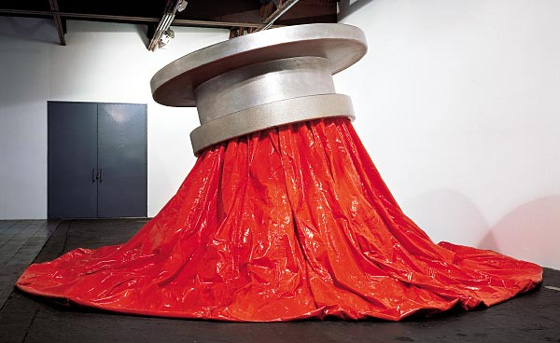
This Claes Oldenburg water bottle is roughly as useful as Greene Naftali's website.
Practicality isn’t a strength of the art world. We’re better at the nonsensical, the impossible, the intentionally obfuscated. It’s no surprise, then, that we’re often so terrible at constructing functional web sites. Today, we’re offering up the worst of the worst for public humiliation. Later this week, we’ll be honoring the best. Hopefully, we can do some good: our post on the topic five years ago actually prompted changes by Exit Art and Luhring Augustine, and now Luhring Augustine’s like a big gallery with famous artists and stuff. That’s all our doing. Today’s worst offenders:
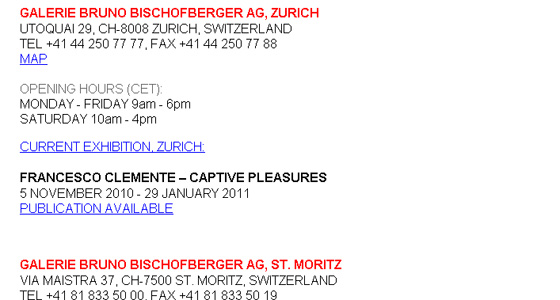
Are you shitting me?
Bruno Bischofberger– Bruno Bischofberger’s website is, frankly, stunning. It’s difficult to know where to begin – the fact that the home page is all text? That it’s all caps? That every exhibition page, along with the “Works for Sale” page, includes the line “IF YOU ARE INTERESTED IN THE ACQUISITION OF A WORK, PLEASE CONTACT MR. BRUNO BISCHOFBERGER”, as though there were some confusion about who runs the gallery, or how one buys art? Another big plus, of course, is the near-complete lack of content on artists, shows, or anything I could conceivably be interested in other than pictures of works for sale.
Techy types should note the Frontpage-induced mania of the index page’s HTML; perhaps two-thirds of it are unnecessary, and the other third is actively incorrect. It’s not even a matter of skillz, particularly, but of sloppiness – anyone who can include a CSS stylesheet can go so far as to name it something other than Ohne_Titel.css.
Bruno – you bought the back cover of Artforum. You can afford a web designer.
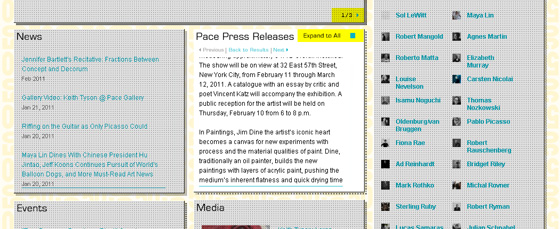
My preferred way to read press releases.
Pace – As I write this, a rotating news ticker on Pace’s website promoting a Jennifer Bartlett show is telling me that “Bigger Is Better”. Untrue. Pace’s website – recently redesigned – attempts to throw everything at the user all at once, and it’s a disaster. Unlike Bruno’s web site, the problem here isn’t a lack of information but its absolute uselessness. Press releases and reviews are stuck in teensy-tiny boxes, regardless of length, that prevent you from being able to copy them, link to them, or even read them effectively, particularly on mobile devices. Images can’t be used by most users because Pace has disabled the right-click menu. The design – which attempts to center itself around the idea of “Expanding” one topic into nearby panels – would be fine as an experimental site, or for something consciously organized around tags, but for a gallery it has the notable downside of being completely unusable for anyone who wants to find information quickly. Having a creative site structure doesn’t do you any good in most businesses: if I’ve been looking at gallery after gallery arranged around the same Artists/Exhibitions/News/Publications/About menu, I start to categorize my desires according to that menu; any other structure becomes disorienting and takes longer to navigate. There’s a reason why grocery stores all have the sugar next to the tea, and the butter next to the milk – these systems help people get things done faster. Having a drop-down nav menu is particularly jarring, because every other site on the web gave up on those ten years ago; of course, the space saved by not having a proper menu appears to have been spent on 16 x 16 pixel portraits of artists. Which we couldn’t do without.
Finally: what the hell is going on with their URLs? There’s absolutely no reason for them to be so long, and parts of them are clearly redundant. At the very least, I should not be annoyed by your web site before arriving on it.

Greene Naftali - iPhone view. Note that none of those links work.
Greene Naftali – Greene Naftali’s web site, being entirely in Flash, is unusable to the point of invisibility on an iPhone. To understand the importance of this, understand that a typical gallery trip for the AFC staff involves us standing sort of near art while tapping at our phones. On a desktop, the site at least loads – slowly; then, you get the pleasure of discovering that the home page doesn’t actually contain any information about artists or exhibitions. That’s all in a separate series of Flash pop-ups, with their own waits to load and questionable benefits when they do: the artist bios are minimal, and the photos are both difficult to navigate and, because of Flash, unusable for anything other than quiet contemplation. Awesome.
Flash, though rapidly aging, can be a great piece of kit. It’s browser-independent and multimedia-friendly. The entirety of Greene Naftali’s site, though, is a perfect example of when Flash shouldn’t be used; everything on the site could have been accomplished more quickly, easily, and accessibly in plain old HTML, CSS, and Javascript. I don’t love Sean Kelly‘s navigation from a usability standpoint, but it’s a good example of how you can make something really beautiful without a bit of Flash – or even particularly tricky Javascript. The simplest comparison is sometimes the best: Sean Kelly’s splash page is 50kb, Greene Naftali’s is 350kb; individual artist pages on Sean Kelly’s site are about 70kb, Greene Naftali’s artist applets are in the neighborhood of 500kb. Greene Naftali takes an order of magnitude longer to load, while giving me less information and looking uglier.
Special Achievement in Caution: Gasser/Grunert‘s website doesn’t look so bad visually, and works well enough, but they’ve made one oversight: the entire site is in the folder /test/. It looks good, guys. I think it works. Lose the water wings.
Special Achievement in Web Design for a Web Design Firm:
BASIK Group are the designers behind the Pace disaster, along with work for David Zwirner and Michael Werner. It took me half a minute of clicking everything on their page before I discovered that rather than using links, they’d simply placed every work in their portfolio on one page. What’s worse, they start about 800 pixels down the page – which is to say, below the fold on most laptops.
This usability stuff isn’t hard – grab a book by one of these guys off Amazon and you’re more-or-less set. Or, better yet, look to your peers – some galleries do get it right, so join us later in the week for a few sites that put these guys to shame.


{ 16 comments }
I might have a new winner: gallery 13 in Minneapolis:
http://www.gallery13.com/
Not a horrible gallery–lots of good artists–you would never know it by their site
French. Museums.
Oh. Yes.
to be completely fair to GALERIE BRUNO BISCHOFBERGER, their back cover artforum ads are also in all caps and when you roll as high as they do, having a website at all is almost ludicrous. for one to have practical use value beyond presenting the idea of a gallery existing is even more ludicrous. do you think them better catering to a specific, web-literate audience is going to even slightly shore up their profits?
um are you kidding?!?
the Bischofberger website is awesome 90’s html revival. the web only type colors, all caps underlined hyperlinks — im a fan
Yes ! Finally someone has brought up this topic and hopefully some galleries will “get it”.
My biggest complaint is encountering the list of artists in a gallery’s stable and quickly finding out that I must click each (link) to see an example of their work and then must click BACK to return to the list again. We really don’t have time for all that . . . . . . . .
Surely this bothers you too.!?!
That’s what really got me about Pace’s artist-portraits – they’re the one kind of image I don’t care about at all. If those portraits were tiny pictures of artworks, I’d be a lot happier.
I don’t get this. Galleries like Bischofberger don’t even need websites so it’s strange that you’re criticizing them for having a bad one. When you’re on their level, it’s almost better not to have a website—they don’t need it and maintaining one would be a waste of time. There are plenty of artists that don’t have websites and do just fine. And for some artists it seems strange—why does Jeff Koons really have a website? It’s also bad, but… does it matter? Not really.
I do agree that the Pace website is pretty shitty but only because it’s obvious they tried so hard to make it fancy.
Why wouldn’t they need a website? I mean, C-Town (a grocery store, for those who don’t live in art critic neighborhoods) has a website, and I used it the other day to find out the hours. That experience went well, and after it I purchased things at C-Town. If I were a wealthy time traveler from the 1980s, the same thing might happen with Bruno Bischofberger (after a certain amount of familiarization with the basic concepts involved).
More practically: I write about art. If I want to write about some artist and there’s no information available online, I don’t write about that artist and that artist dies cold and alone. If there is information available online, I write about that artist. If there is information available online from his or her gallery, I write about that artist in a way which, even given journalistic caution, can be shaped by that gallery. Present (?) financial success aside, the job of an art dealer is to promote their artists – and, more pointedly, their work – as best they can. Spending a few thousand dollars on a web designer is a very, very easy part of this, and dealers who don’t think their artists are worth a few thousand dollars – a single sale! – are bad dealers. As an artist, I wouldn’t want to be represented by a dealer who didn’t think he needed to pay any attention to my web presence; I guess maybe this isn’t a problem when all your artists are dead or irrelevant.
All of this is entirely avoiding the most pragmatic point, which is that the two greatest sources of new art-world money are tech billionaires and collectors outside of Europe and the US, both of which would care more than most about a nice website.
For clarification to any interested dealers: I’m only signing if I get my name on a blimp.
“Fortunes in art are made in the spotlight of publicity, not outside of it.” writes Sergey Skaterschikov in his book, Skate’s Art Investment Handbook. Part of making money is promoting and marketing your artists and your gallery. I don’t think it would be that hard to demonstrate that Bischofberger is actually throwing hundreds of thousands of dollars away by not maintaining a better website.
Absolutely spot on. Amen!!. Well done for spelling it out, especially re the Flash. So frustrating when I hear about an artist or gallery on Twitter, click on their link on my phone and am met with a blank screen.
drop downs — every other website but myspace. and they are doing GREAT right?
I don’t have anything against them generally (we use them here), but putting ALL your navigation in a single tiny drop-down? That’s ancient. I understand the designers want us to use the page in an everything-at-once desktop-metaphor space-newspaper “ENHANCE!” sort of way, but that menu is the entirety of their concessions to people who want information more than a paradigm shift. And it’s not enough.
you forgot Feldman Fine Arts. Useable, but hideous.
http://www.feldmangallery.com/pages/home_frame.html
so true!
Comments on this entry are closed.
{ 2 trackbacks }