
POST BY PADDY JOHNSON
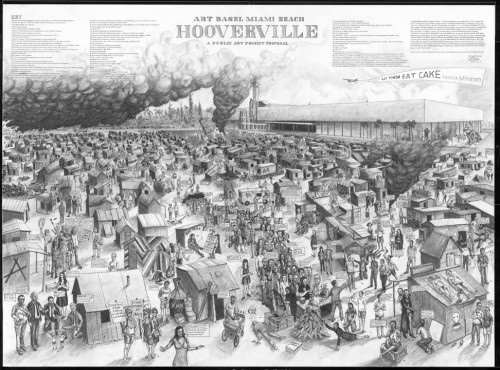
William Powhida, Hooverville, 2010
Following today’s earlier post on comments around the web, part two of our post tracks artist William Powhida’s latest shit storm of attention. Let’s go back a week and work our way forward:
Lindsay Pollock notes Powhida’s 20×200 edition of 200 sold out in less than a day.
A few days later, Time Out’s senior art critic Howard Halle says over Facebook, “Personally, I don’t what the big deal is with William Powhida. Like working the outsider game is such a new or brave thing? It’s an old trick they teach you at the Ivies: Insult your betters to get their attention.” The following conversation occurs:
Andrea Schwan
outsiders who promote themselves aggressively as such = insidersHoward Halle
exactly. and when all it takes is making a drive-reference in one of drawings to Jerry Saltz to get Jerry to say “Give that guy a show at the New Museum,” you know it’s an insider game being played very shrewdly.Paddy Johnson
Being an outsider implies a lack of knowledge about the inside. Powhida does a pretty good job at “insulting your betters” because he’s been very thorough and thus knowledgeable about the inside. Still, this kind of art making has limitations. I suspect it’s more in vogue than it has been because social networking makes sharing dirt publicly a little more sexy than it’s been in the past. Everyone wants more transparency in their networks, and Powhida creates this for people, even if he does so through a persona. I personally don’t see the need for the character.Lisa Beck
court jesterHoward Halle
right. I get it. he’s tapping into some kind of art-world equivalent of tea-party rage. there’s a lot young artists out there who were promised superstar careers in art school, and now, thanks to the shitty economy, they’ve got bubkis. they are networked however, and I guess his work gives them the illusion of power or connection. still, I’ve seen this sort of thing before—this ain’t my first art-world recession—calls to the barricades, blah, blah, blah, and then it’s back to business as usual. The art world is in need of deep reform and has been for a long time. it would be nice of artists really addressed that, mainly I think, by working for themselves first. I don’t see that happening in Powhida’s work.Paddy Johnson
I follow you up until the last bit. What is it about Powhida’s work that’s not working for himself first?Sean Capone
I never thought of Powhida as an “outsider”; he seems to have a deep working inner knowledge of art world persons and politics which he gets from I-don’t-know-where. His comics are for a really specific inside audience. Problem is will this work even make sense to anyone 10 years from now, or to anyone outside the inner circle… questions which are obviously besides the point.Howard Halle:
First Sean: Yes, you’re right; obviously, Powhida is working from a deep knowledge of the art world’s inner workings, but what I was trying to convey by the term “outsider game” was the pose of speaking truth to power, when it’s really not. I mean, when you preface a shot at someone like Jerry Saltz with “I love you Jerry but”¦” of course, the target is going to be flattered. That’s holding up a mirror in the wrong sort of way. And I agree that this approach has a short shelf life, but I wouldn’t say that the issue is besides the point; it is the point, which takes me to Paddy’s question. “Working for yourself first” means just that: Working through an idea that maybe nobody understands except you, until they do understand it. And yes, this could likely mean not until well after you are dead. What we’ve had over the past 30-35 years isn’t art so much as formula of one sort or the next. Meeting other people’s expectations while giving them some sort of cover of novelty and/or line of theoretical bullshit—which is bullshit. We all know terrific artists who, absent the right connections or right last name, labor for years in obscurity until one day their work surfaces somehow, and everybody goes, Wow, that’s amazing! Conversely, we’ve all seen the work of artists who were huge in their time in a museum somewhere, and immediately wondered, What were people thinking? Neither situation obtains all the time, but enough of the time to make you realize that being an artist is not suppose to be easy. It’s suppose to be hard. It’s almost like the difference between being on a desert island, tossing messages in a bottle into the ocean, and commandeering the giant TV screens at Madison Square Garden. No doubt the latter makes the bigger impression, but does it spark the same sense of wonderment as finding that bottle on the beach? It’s a tough choice, but I don’t think Powhida is making it.Sean Capone
I just wrote on Jazz’ photo wall that under no circumstances, even in satire, do I like the casting of death-spells on another person (Saltz in question, in the ‘Hooverville’ piece), even if it’s under the guise of working “through a character”. Starts to reek of cynicism; the court jester who envies the emperor instead of pointing out that he has no clothes.But I may not have all the facts here.
To describe Powhida’s work another way, the drawings are a visual manifestation of media whoring, which unlike years past, is quite socially acceptable these days. I find Sean Capone’s question about its longevity the most challenging to the artist’s practice. Like most people, I put my faith art I think will matter twenty years down the road. Powhida’s an interesting media phenomenon, but I just don’t see enough evidence indicating that his work will have any lasting importance.
Over in Jerry Saltz land, the New York Magazine senior art critic then professes his love of Powhida’s lastest masterpiece at Pulse, Hooverville. This isn’t much of a surprise. Saltz is known to have an affinity for art either about or pertaining to the art world. Being featured in the work probably doesn’t hurt (disclaimer I’m in it too); the piece depicts the five million art world personalities at Art Basel Miami this year. Saltz notes over facebook that he didn’t even attend.
The most amusing response I’ve read to this story comes from Hrag Vartanian (@Hragv) who teases Mr. Powhida (@powhida) over Twitter by saying: Sorry to be crude, but I wonder if you took a dump on Jerry’s head if he’d applaud at this point? Powhida tells Vartanian he’d have to charge for the service.
Meanwhile, artnet’s Walter Robinson moves from harassing bloggers over email to issuing death threats over facebook. He left the following comment on Jerry Saltz’s facebook page:
I can’t believe all you people like that fucken Powhida. I hate him and am going to kill him when I see him for that caricature of me, if only I knew what the little dweeb looks like. It’s ARTNET MAGAZINE editor, you dweeb, not Artnet.com editor. Stupid twerp. He tried to write for me once or twice but he’s so fucken nondescript I wouldn’t recognize him in one of his own stupid drawings. And he couldn’t write worth shit. Never gave me any of his fucken caricatures, either, the drip.
Hmm. That’s a sensible argument.


{ 124 comments }
I thought Walter Robinson is a blogger.
I thought Walter Robinson is a blogger.
Wow. Obviously the fact that so many people are talking about Powhida and his work means that there is some kind of critique that pinches a nerve. Many people in the art world feel uncomfortable with exposure and mirror turning which the persona of Powhida relishes and does very well. William did not just arrive on the scene, he has been working away for years, writing art criticism and producing work that not only deals with the art world but with politics, the film and music industry, pop culture..etc. As an emerging artist he has been telling Jerry and Roberta to fuck off for years in his work…along with major dealers and collectors. This could have been the end of his career but in reality it was only getting started. He is not a media whore, they came to him because he was brave enough to say things we all feel but do not have the balls to say. I first met him when he was writing art criticism which was brilliant and insightful. He is no longer an outsider, this is true. His work sells and he has critical attention but he can see into both worlds. There is nothing wrong with that. He has never labeled himself an outsider, other people did that for him……namely the New York Times. Powhida has a lot to say and the art world will always need a mirror. Do painters make work wondering if it will be relevant in 10 years? Who the fuck knows what will be? All I know is that his work is brave, hysterical and smart. It is not often an artists work makes me think and double over with laughter at the same time. Im sick of yoga balls or a 2 x 4 with a found polaroid and a can of peas stuck on it being considered art. Bravo Powhida, keep it coming!
Wow. Obviously the fact that so many people are talking about Powhida and his work means that there is some kind of critique that pinches a nerve. Many people in the art world feel uncomfortable with exposure and mirror turning which the persona of Powhida relishes and does very well. William did not just arrive on the scene, he has been working away for years, writing art criticism and producing work that not only deals with the art world but with politics, the film and music industry, pop culture..etc. As an emerging artist he has been telling Jerry and Roberta to fuck off for years in his work…along with major dealers and collectors. This could have been the end of his career but in reality it was only getting started. He is not a media whore, they came to him because he was brave enough to say things we all feel but do not have the balls to say. I first met him when he was writing art criticism which was brilliant and insightful. He is no longer an outsider, this is true. His work sells and he has critical attention but he can see into both worlds. There is nothing wrong with that. He has never labeled himself an outsider, other people did that for him……namely the New York Times. Powhida has a lot to say and the art world will always need a mirror. Do painters make work wondering if it will be relevant in 10 years? Who the fuck knows what will be? All I know is that his work is brave, hysterical and smart. It is not often an artists work makes me think and double over with laughter at the same time. Im sick of yoga balls or a 2 x 4 with a found polaroid and a can of peas stuck on it being considered art. Bravo Powhida, keep it coming!
This is soooooooooooooooooooooooooooooooooooooooooooooooooooo
dumb.
This is soooooooooooooooooooooooooooooooooooooooooooooooooooo
dumb.
The only thing I can say is: it all keeps getting weirder, and more puzzling, and will soon disappear right up its own butthole.
“That fucken Powhida”!
The only thing I can say is: it all keeps getting weirder, and more puzzling, and will soon disappear right up its own butthole.
“That fucken Powhida”!
Yeah, this is dumb, noname.
and….
I tip my hat to Powhida.
Yeah, this is dumb, noname.
and….
I tip my hat to Powhida.
Sean
Why does it get weirder or more puzzling? Sorry but this will not disappear or go away…..as much as you would like it to.
Sean
Why does it get weirder or more puzzling? Sorry but this will not disappear or go away…..as much as you would like it to.
Powhida’s work is not so much “dumb” as it literally correct. There’s no bone to the meat. I think of him as the Blink 182 of the art world.
Powhida’s work is not so much “dumb” as it literally correct. There’s no bone to the meat. I think of him as the Blink 182 of the art world.
Paddy
I think you miss one thing in your commentary. And it speaks to the idea of a kinetic vs a static worldview. In a static worldview, which I will assign to you, yes powhida’s work as it is now, can’t really go anywhere. No one is going to look at Hooverville in 20 years and go, oh that was a seminal piece, a transformative moment. It lives in this moment. But doesn’t attach itself to a long lasting art historical tradition.
But that fails to account for how Bill’s work might evolve. If anything, Powhida’s work has shown an ability to speak to the moment. So who is to say, that as the conversation progresses, so too will Bill’s insight into those moments, and that the technique and virtuosity of his work may progress.
That to me seems like something that you’ve overlooked.
Paddy
I think you miss one thing in your commentary. And it speaks to the idea of a kinetic vs a static worldview. In a static worldview, which I will assign to you, yes powhida’s work as it is now, can’t really go anywhere. No one is going to look at Hooverville in 20 years and go, oh that was a seminal piece, a transformative moment. It lives in this moment. But doesn’t attach itself to a long lasting art historical tradition.
But that fails to account for how Bill’s work might evolve. If anything, Powhida’s work has shown an ability to speak to the moment. So who is to say, that as the conversation progresses, so too will Bill’s insight into those moments, and that the technique and virtuosity of his work may progress.
That to me seems like something that you’ve overlooked.
I may as well comment on the outsider vs insider aspect of the above comments . Powhida has said publicly that he is an insider. He is an artist working in NYC, engaged in the conversation. He may feel like an Outsider, particularly in recent years as colleagues and peers rocketed up the art world hierarchy while his own career failed to ignite with the same velocity, but he’s never been shy about being on the inside. The #class exhibition that he is staging with Jen Dalton is taking place WITHIN a gallery, something that is crucial to the project. This is criticism and rejuvenation from within.
I may as well comment on the outsider vs insider aspect of the above comments . Powhida has said publicly that he is an insider. He is an artist working in NYC, engaged in the conversation. He may feel like an Outsider, particularly in recent years as colleagues and peers rocketed up the art world hierarchy while his own career failed to ignite with the same velocity, but he’s never been shy about being on the inside. The #class exhibition that he is staging with Jen Dalton is taking place WITHIN a gallery, something that is crucial to the project. This is criticism and rejuvenation from within.
@Zachary “Overlooking” something suggests a fact that was willfully omitted, but what you’re talking about is a given in the work. Powhida’s art will evolve and of course his commentary will respond with the time. So what?
Speaking specifically to Hooverville: I think it’s a reasonable piece, but I personally like the more discrete works better. At his best, Powhida offers concise cutting commentary about the art world, and contrary to what I’ve said above, I do wonder if some of that has the potential to be remembered. That stronger stuff though, gets lost in the web of these larger works.
@Zachary “Overlooking” something suggests a fact that was willfully omitted, but what you’re talking about is a given in the work. Powhida’s art will evolve and of course his commentary will respond with the time. So what?
Speaking specifically to Hooverville: I think it’s a reasonable piece, but I personally like the more discrete works better. At his best, Powhida offers concise cutting commentary about the art world, and contrary to what I’ve said above, I do wonder if some of that has the potential to be remembered. That stronger stuff though, gets lost in the web of these larger works.
Powhida has only had two solo shows in New York at Schroeder Romero. So I disagree Zach, his career ignited pretty quickly. His career went from 0 to 100 instantly. His career did not start with the #class show.
Powhida has only had two solo shows in New York at Schroeder Romero. So I disagree Zach, his career ignited pretty quickly. His career went from 0 to 100 instantly. His career did not start with the #class show.
Also: @lisas I disagree re media whoring. I use the term loosely, in the same way I used to see internet personalities use the term to describe their daily activities. Personally, I don’t think it’s possible to spend as much time on twitter as Powhida does without there being an element of media whoring to the work. It’s not a bad thing. In fact, I think it’s necessary part of building the art.
Also: @lisas I disagree re media whoring. I use the term loosely, in the same way I used to see internet personalities use the term to describe their daily activities. Personally, I don’t think it’s possible to spend as much time on twitter as Powhida does without there being an element of media whoring to the work. It’s not a bad thing. In fact, I think it’s necessary part of building the art.
“Speaking specifically to Hooverville: I think it’s a reasonable piece, but I personally like the more discrete works better.” Which pieces are more discrete Paddy?
“Speaking specifically to Hooverville: I think it’s a reasonable piece, but I personally like the more discrete works better.” Which pieces are more discrete Paddy?
I’ve met Powhida, and seriously, these people need to not take this shit so seriously. It’s art, not fucking astrophysics. He’s being poigniant and funny, and just because it pisses people off it gets written about and the credibility of the work comes into question because no one wants to step on toes. He isn’t promoting himself as an outsider; he knows what he’s doing, and if by giving into the gallery system he’s somehow an insider, then so what? No one else is making work that mocks the world that supports it right now. If he were more self deprecating and self-obsessed rather than projecting his interpretations of the art world, would he then be more appreciated by these critics and writers? At that, his work is super timely, and I’ve asked him before how he thinks it will transcend its own time. It’s a question no one can answer, but the fact that he has the gaul to carry through with it, that THIS is what he has to do seems to mean a lot more to me than making something else and just tailoring it to the market. If we look back at this time in 50 years, we’ll all probably remark the boom of the art world at the time, as well as the bubble bursting, so I don’t see how this caricaturing of the world, despite its personal specificities wouldn’t be relevant, at least as a social study of the climate.
I’ve met Powhida, and seriously, these people need to not take this shit so seriously. It’s art, not fucking astrophysics. He’s being poigniant and funny, and just because it pisses people off it gets written about and the credibility of the work comes into question because no one wants to step on toes. He isn’t promoting himself as an outsider; he knows what he’s doing, and if by giving into the gallery system he’s somehow an insider, then so what? No one else is making work that mocks the world that supports it right now. If he were more self deprecating and self-obsessed rather than projecting his interpretations of the art world, would he then be more appreciated by these critics and writers? At that, his work is super timely, and I’ve asked him before how he thinks it will transcend its own time. It’s a question no one can answer, but the fact that he has the gaul to carry through with it, that THIS is what he has to do seems to mean a lot more to me than making something else and just tailoring it to the market. If we look back at this time in 50 years, we’ll all probably remark the boom of the art world at the time, as well as the bubble bursting, so I don’t see how this caricaturing of the world, despite its personal specificities wouldn’t be relevant, at least as a social study of the climate.
I think William is brave to put himself out there.
To talk about shit that no one else will. To criticize – gasp – collectors, critics, institutions. The very people he parodies and mirrors are the ones who collect and write about his work.
He gets beaten up for this all the time. He does have a heart deep down in there, you know. Like we all do.
People get angry when they’re not included in one of his drawing tirades and when they are…guess what. They love it. Even if they don’t admit it.
I think William is brave to put himself out there.
To talk about shit that no one else will. To criticize – gasp – collectors, critics, institutions. The very people he parodies and mirrors are the ones who collect and write about his work.
He gets beaten up for this all the time. He does have a heart deep down in there, you know. Like we all do.
People get angry when they’re not included in one of his drawing tirades and when they are…guess what. They love it. Even if they don’t admit it.
NY has homework to do, look outside your island and somehow contextualize all of this:
In 2003, at Locust Projects in Miami, collective Law Office and Pedro Velez went after Rosa de la Cruz, Pierre Huyghe and Phillipe Pareno. It was all over the news…similar case to the Powhida thing, but we never avoided responsibility or used false names. We actually talked to Rosa for an hour, long story short… she promised we would never work again in the art world. Locust did a series of panels on the issue, etc…it was a hit.
In ’05 at NADA fair we did a similar project, this time Bonami and Maurizio Cattelan were the subject. Back then Jerry saw the work and thought it was a bore. In ’08, same thing, we did a piece on Koons, Yablonsky and Joannou– before your big NuMu hoopla– and it went unnoticed in NY. Now you see a poster here and there in Chelsea an go all berzerk, like the Tea Party at a Democratic convention.
You can even go before these dates I just gave you and find a whole bunch of other projects that were way “hardcorer.” We never played the pseudo activist/ socially conscious card. Not to say we don’t believe in anything, we do, but the idea in the end is to make art, not illustrations.
My point is not to say that we did it first or any of that. Haacke, Wojnarowics, Gonzalez -Torres, Ferrer, all of 60’s Brazil did it first, that’s not the issue here. My point is that unless it’s not made in NY or all the victims are NYCers, you just don’t want to see it and that’s a bit unfair towards a bunch of people that have been there before. If you guys investigate a little bit more you’ll figure out very easily if that gossipy thing you got going there with Powhida, and all those Facebook comments used out of context, is relevant or not. From the outside–thank god for social media and blogs– it has the feel of a henhouse…too regional. Where is the substance? We want substance?
My take is that Jerry and his review won the argument against Powhida, he killed it, he neutralized the issue. And that Robinson rant was pure satire thrown back at Powhida…he shouldn’t be surprised, after all that’s what he wants, right?
PV
NY has homework to do, look outside your island and somehow contextualize all of this:
In 2003, at Locust Projects in Miami, collective Law Office and Pedro Velez went after Rosa de la Cruz, Pierre Huyghe and Phillipe Pareno. It was all over the news…similar case to the Powhida thing, but we never avoided responsibility or used false names. We actually talked to Rosa for an hour, long story short… she promised we would never work again in the art world. Locust did a series of panels on the issue, etc…it was a hit.
In ’05 at NADA fair we did a similar project, this time Bonami and Maurizio Cattelan were the subject. Back then Jerry saw the work and thought it was a bore. In ’08, same thing, we did a piece on Koons, Yablonsky and Joannou– before your big NuMu hoopla– and it went unnoticed in NY. Now you see a poster here and there in Chelsea an go all berzerk, like the Tea Party at a Democratic convention.
You can even go before these dates I just gave you and find a whole bunch of other projects that were way “hardcorer.” We never played the pseudo activist/ socially conscious card. Not to say we don’t believe in anything, we do, but the idea in the end is to make art, not illustrations.
My point is not to say that we did it first or any of that. Haacke, Wojnarowics, Gonzalez -Torres, Ferrer, all of 60’s Brazil did it first, that’s not the issue here. My point is that unless it’s not made in NY or all the victims are NYCers, you just don’t want to see it and that’s a bit unfair towards a bunch of people that have been there before. If you guys investigate a little bit more you’ll figure out very easily if that gossipy thing you got going there with Powhida, and all those Facebook comments used out of context, is relevant or not. From the outside–thank god for social media and blogs– it has the feel of a henhouse…too regional. Where is the substance? We want substance?
My take is that Jerry and his review won the argument against Powhida, he killed it, he neutralized the issue. And that Robinson rant was pure satire thrown back at Powhida…he shouldn’t be surprised, after all that’s what he wants, right?
PV
I don’t think it’s Powhida’s artwork itself that’s important. What I think is important is that it seems to be igniting a flame within the art community in the spirit of revolution and change in the art world. We don’t like the system but we don’t know how to change it. Artists have lost creative freedom and control and handed it over to gallerists, critics, art marketing and the pursuit of the ‘art persona’. We’ve got no balls left!
Powhida is kind of the whistle-blower, and our reaction to him is only going to increase the importance of his work over time. He’s posing questions and although the solutions are not there yet, he’s got the ball rolling. I for one commend him on speaking out. Sure there’s a bit of whoring going on, but so what? I’m all for whoring if it’s giving back control to the artist.
As an outsider I’m loving hearing gossip about art people I’m ignorant about. It’s fascinating how a small group of people on the ‘inside’ can influence contemporary art. What a power trip.
I don’t think it’s Powhida’s artwork itself that’s important. What I think is important is that it seems to be igniting a flame within the art community in the spirit of revolution and change in the art world. We don’t like the system but we don’t know how to change it. Artists have lost creative freedom and control and handed it over to gallerists, critics, art marketing and the pursuit of the ‘art persona’. We’ve got no balls left!
Powhida is kind of the whistle-blower, and our reaction to him is only going to increase the importance of his work over time. He’s posing questions and although the solutions are not there yet, he’s got the ball rolling. I for one commend him on speaking out. Sure there’s a bit of whoring going on, but so what? I’m all for whoring if it’s giving back control to the artist.
As an outsider I’m loving hearing gossip about art people I’m ignorant about. It’s fascinating how a small group of people on the ‘inside’ can influence contemporary art. What a power trip.
Jesus? I kind of think some of you are incapable of seeing the forest for the trees? “Is he a feckless, ruthless self promoter, insulting his betters to get their attentions, or vengeful talentless hack?†It’s satire. Most of this criticism seems like envy? William, for better or worse, is an equal opportunity offender, an art satirist whose drawings and repertoire draw their entertainment from art politics, which I hate to say, too often run to the parochial. I enjoy art, and I regale in it’s subversive intent, especially when it has been politically incorrect or forbidden for a spell? If Triumph, the Insult Comic Dog, couldn’t draw (like William Powhida) he too would probably be able to sell out a limited edition tableau vivant called, “I poop on your Art History and Contemporary Art Institutions.†And if Triumph’s work was as reasonably well rendered as William’s, his drawings would probably be very popular too, because people are at a very skeptical moment in time, or history, where their general creeping complete disillusionment with all manner of human institutions; governmental, academic, military, economic have been badly rattled, and, in doing so, many have been revealed to be so systemically corrupt, cracked, or plain broken, that’s lowered the general mood, (especially after a couple drinks) often leading to a cynically, passive nihilistic point of view, that they all might as well be destroyed, as reformed, because they’re all extremely suspect?! An impractical and destructive proposition, about as useful as breaking your fist punching a hole in the wall? But Art! Art is supposed to represent our dedication to the virtues? The apex of our social values? What? You can’t make fun of that? I think that, apart from some sore heads, who hate the unappealing way they been depicted, (or actually look) most of the sophisticated target connoisseurs of William’s work enjoy the succès de scandale, and can’t get enough of it? Jerry Saltz is almost too comfortable being satirically caricaturized, because he realizes that inexplicably he’s landed smack dab square in the center of the Nexus of a ridiculously complex, contradictory and often compromised system that nonetheless represents all of our best intentions. So, lighten up everybody. It’s double entendre, with a hint of protest and a pinch dissent, but it doesn’t presume to dare to hope to influence the agenda, it’s just commentary, (and protected as free speech.) His Art is a literary device, raisonneur drawings, mise en scène, that speak truth to power, and, all of this brouhaha, balderdash, cacaphony, endorsements and denunciations only add to the deliciousness of the spectacle. I was starting think art didn’t had a nerve left that could be touched? But he’s certainly touched something? So, I challenge thee, he or she, who is without sin, and/or never ever suspected that there ever was the least bit of collusion between museums, curators and major collectors, be the first to cast the rotten egg? (Play it safe and hit yourself in the forehead with it.)
Jesus? I kind of think some of you are incapable of seeing the forest for the trees? “Is he a feckless, ruthless self promoter, insulting his betters to get their attentions, or vengeful talentless hack?†It’s satire. Most of this criticism seems like envy? William, for better or worse, is an equal opportunity offender, an art satirist whose drawings and repertoire draw their entertainment from art politics, which I hate to say, too often run to the parochial. I enjoy art, and I regale in it’s subversive intent, especially when it has been politically incorrect or forbidden for a spell? If Triumph, the Insult Comic Dog, couldn’t draw (like William Powhida) he too would probably be able to sell out a limited edition tableau vivant called, “I poop on your Art History and Contemporary Art Institutions.†And if Triumph’s work was as reasonably well rendered as William’s, his drawings would probably be very popular too, because people are at a very skeptical moment in time, or history, where their general creeping complete disillusionment with all manner of human institutions; governmental, academic, military, economic have been badly rattled, and, in doing so, many have been revealed to be so systemically corrupt, cracked, or plain broken, that’s lowered the general mood, (especially after a couple drinks) often leading to a cynically, passive nihilistic point of view, that they all might as well be destroyed, as reformed, because they’re all extremely suspect?! An impractical and destructive proposition, about as useful as breaking your fist punching a hole in the wall? But Art! Art is supposed to represent our dedication to the virtues? The apex of our social values? What? You can’t make fun of that? I think that, apart from some sore heads, who hate the unappealing way they been depicted, (or actually look) most of the sophisticated target connoisseurs of William’s work enjoy the succès de scandale, and can’t get enough of it? Jerry Saltz is almost too comfortable being satirically caricaturized, because he realizes that inexplicably he’s landed smack dab square in the center of the Nexus of a ridiculously complex, contradictory and often compromised system that nonetheless represents all of our best intentions. So, lighten up everybody. It’s double entendre, with a hint of protest and a pinch dissent, but it doesn’t presume to dare to hope to influence the agenda, it’s just commentary, (and protected as free speech.) His Art is a literary device, raisonneur drawings, mise en scène, that speak truth to power, and, all of this brouhaha, balderdash, cacaphony, endorsements and denunciations only add to the deliciousness of the spectacle. I was starting think art didn’t had a nerve left that could be touched? But he’s certainly touched something? So, I challenge thee, he or she, who is without sin, and/or never ever suspected that there ever was the least bit of collusion between museums, curators and major collectors, be the first to cast the rotten egg? (Play it safe and hit yourself in the forehead with it.)
zach, unfortunately powhida’s work has not really evolved. the works are glorified lists, which is all they’ve ever been. maybe his train needs to switch to a new track. if william powhida was as “couragous” and “honest” as everyone romanticises, he would come out of the woodwork with a complete new treatment ala Guston. that’s being brave. instead, his art has worked itsself into a redundant lather. cheers.
zach, unfortunately powhida’s work has not really evolved. the works are glorified lists, which is all they’ve ever been. maybe his train needs to switch to a new track. if william powhida was as “couragous” and “honest” as everyone romanticises, he would come out of the woodwork with a complete new treatment ala Guston. that’s being brave. instead, his art has worked itsself into a redundant lather. cheers.
@Lisa Why does this feel like a test? I’m talking about the lists and the smaller drawings…the stuff where’s got a single issue he’s tackling. There’s a Where’s Waldo element to Hooverville that means people just end up looking for their friends or personalities, rather than really discussing the issues he’s tackling.
Also, the word “brave” is being thrown around as though it’s a quality of the art that makes it better. That’s a quality of the artist, and frankly a dubious claim. He’s not saying anything that will get him expelled from the art world. In fact, if recent events are any indication, just the opposite has occurred. He’s probably creating situations for himself with art world personalities that will be awkward, but that’s the worst of it.
To put a better spin on it, perhaps this is work Powhida feels so compelled to make it never occurred to him not to do so. This kind of compulsion tends to be the spark of unique vision.
@Lisa Why does this feel like a test? I’m talking about the lists and the smaller drawings…the stuff where’s got a single issue he’s tackling. There’s a Where’s Waldo element to Hooverville that means people just end up looking for their friends or personalities, rather than really discussing the issues he’s tackling.
Also, the word “brave” is being thrown around as though it’s a quality of the art that makes it better. That’s a quality of the artist, and frankly a dubious claim. He’s not saying anything that will get him expelled from the art world. In fact, if recent events are any indication, just the opposite has occurred. He’s probably creating situations for himself with art world personalities that will be awkward, but that’s the worst of it.
To put a better spin on it, perhaps this is work Powhida feels so compelled to make it never occurred to him not to do so. This kind of compulsion tends to be the spark of unique vision.
@Douglas Kelley. Please, let’s not compare Powhida to a real genius like Rob Smigel (creator of Triumph the Insult Comic Dog); that’s just insulting everyone’s intelligence.
@Douglas Kelley. Please, let’s not compare Powhida to a real genius like Rob Smigel (creator of Triumph the Insult Comic Dog); that’s just insulting everyone’s intelligence.
It was Ashley Bickerton who said something along the lines of,
“Imagine if musicians just wrote about the politics at RCA records.”
Sounds horrible doesn’t it?
It was Ashley Bickerton who said something along the lines of,
“Imagine if musicians just wrote about the politics at RCA records.”
Sounds horrible doesn’t it?
Of course we don’t know how to change the art world’s system. Nobody is at the head of it, nobody has control of it, and nobody is at the tail end of it. The only point of resistance to all this is on a person-to-person level, and perhaps this is why Powhida’s work is creating this energy–because it’s personal (or at least it’s about people). We all know that timely art dies quickly, but if he lives a long time, maybe he’ll come around to the side of making more timeless work. Sometimes satirists do create a timeless piece because of the importance of who’s being made fun of; unfortunately, we’ll never know, in our time, who that is. Maybe Powhida will get lucky.
Of course we don’t know how to change the art world’s system. Nobody is at the head of it, nobody has control of it, and nobody is at the tail end of it. The only point of resistance to all this is on a person-to-person level, and perhaps this is why Powhida’s work is creating this energy–because it’s personal (or at least it’s about people). We all know that timely art dies quickly, but if he lives a long time, maybe he’ll come around to the side of making more timeless work. Sometimes satirists do create a timeless piece because of the importance of who’s being made fun of; unfortunately, we’ll never know, in our time, who that is. Maybe Powhida will get lucky.
God forbid we insult people’s intelligence. That’s totally part of the point of the work.
God forbid we insult people’s intelligence. That’s totally part of the point of the work.
“Like most people, I put my faith art I think will matter twenty years down the road.”
Is twenty the new two hundred?
“Like most people, I put my faith art I think will matter twenty years down the road.”
Is twenty the new two hundred?
I’ve probably said this elsewhere, but in general, the problem I have with art about the art world, is that aside from its participants nobody gives a shit about the ins and outs of the profession. Speaking to a related field, one of the unique achievements of Gawker was that it managed to create celebrities out of media figures only the media cared about. If Powhida’s work had that kind of influence, we’d be talking about something entirely different. But even Gawker’s crafting of media-celebs was maintained for only a short period of time. Now they focus on actual celebrities, and people describe the shift as a maturation of the web. And so, even if Powhida’s work were reaching vastly different numbers of people, the point at which it stopped talking about itself would still be considered a marker of maturation.
I’ve probably said this elsewhere, but in general, the problem I have with art about the art world, is that aside from its participants nobody gives a shit about the ins and outs of the profession. Speaking to a related field, one of the unique achievements of Gawker was that it managed to create celebrities out of media figures only the media cared about. If Powhida’s work had that kind of influence, we’d be talking about something entirely different. But even Gawker’s crafting of media-celebs was maintained for only a short period of time. Now they focus on actual celebrities, and people describe the shift as a maturation of the web. And so, even if Powhida’s work were reaching vastly different numbers of people, the point at which it stopped talking about itself would still be considered a marker of maturation.
As someone who’s been chronicling William’s work from near the beginning with “Bill of Wrongs: Will the Real William Powhida Please Stand”, in November 2004, I’d say I speak with a bit of authority. William has done a fantastic job of finding the vulnerabilities and sensitive spots in the art world’s facade. He’s a master at using the establishments own vanity and snarkiness as a bludgeon to first get its attention and then exploit its masochistic predilections. And, as stated above, it’s like creatively crapping on some one’s head, but in William’s case, it seems, people are eager to pay for the privilege.
I enjoy and respect the work and think we (the art community) need obnoxious gadflies, and transgressive jesters to blurt out the truths that sane “careerists” fear to utter.
Regarding the future relevance of the work, I think, for the specialist, it has staying power, and continues the legacy of some of the better, more topical “institutional critique”. I am disturbed by the implications of its influence and the probability of it being miss read. A future generation of young artists trying to out Powhida Powhida is a truly frightening and cynical specter.
As someone who’s been chronicling William’s work from near the beginning with “Bill of Wrongs: Will the Real William Powhida Please Stand”, in November 2004, I’d say I speak with a bit of authority. William has done a fantastic job of finding the vulnerabilities and sensitive spots in the art world’s facade. He’s a master at using the establishments own vanity and snarkiness as a bludgeon to first get its attention and then exploit its masochistic predilections. And, as stated above, it’s like creatively crapping on some one’s head, but in William’s case, it seems, people are eager to pay for the privilege.
I enjoy and respect the work and think we (the art community) need obnoxious gadflies, and transgressive jesters to blurt out the truths that sane “careerists” fear to utter.
Regarding the future relevance of the work, I think, for the specialist, it has staying power, and continues the legacy of some of the better, more topical “institutional critique”. I am disturbed by the implications of its influence and the probability of it being miss read. A future generation of young artists trying to out Powhida Powhida is a truly frightening and cynical specter.
I agree with Kelley….
Powhida’s work will mature once we dig deep into his ideas and stop talking about him. That’s the problem, we are not making any connections out of his “lists”… probably because there’s nothing to talk about in the end.
Look at the work of Deb Sokolow and you’ll notice the big difference.
I agree with Kelley….
Powhida’s work will mature once we dig deep into his ideas and stop talking about him. That’s the problem, we are not making any connections out of his “lists”… probably because there’s nothing to talk about in the end.
Look at the work of Deb Sokolow and you’ll notice the big difference.
AFC, regards to your response to @Lisa just above here, your analysis that people just end up looking for themselves or their friends speaks to one of the points I made last night about context and narrative. Now of course we were discussing art criticism from the writer’s point of view. For me, an outsider for sure, Hooverville, now that I think about it in terms of your comment, allows me a keyhole into the world. I don’t know who many of the people are beyond Jerry, Larry, and a sprinkling of others.
So yeah, if you are knee deep in the art world, are familiar with everyone “worth” knowing, then I suppose Hooverville is just a gimmick like Where’s Waldo.
But if you don’t know who or what you are looking at, then one is forced to consider the source material, employ the image and meaning of Hooverville’s, shanty towns, and the great depression and see the art world through that lens. Also, one is forced to simply forced to consider the formal elements, the story and to actually read the work.
Hooverville, which btw I agree is not his best work, simply his (and Jade’s) largest, delicately balances the line between insider and outsider perspectives.
Perhaps it is that aspect that compelled Jerry to write what he wrote last week. As one of the few remaining writers to have a broader audience (and soon to be MUCH broader audience what with the Bravo thing) he’s celebrating work that can speak to both worlds.
Let us not forget that Jerry basically ignored the NuMu controversy, Bill’s artistic reaction at first,and then, of a sudden, annointed Bill in his 2009 Best of.
Off point, but quite the evolution in a short amount of time. We can be cynical and just say it was a wise way for Jerry to appropriate the growing fervor around Bill’s work. Or perhaps Jerry realized that Bill’s work has a way of speaking to an extended audience.
That is what I would like to believe.
AFC, regards to your response to @Lisa just above here, your analysis that people just end up looking for themselves or their friends speaks to one of the points I made last night about context and narrative. Now of course we were discussing art criticism from the writer’s point of view. For me, an outsider for sure, Hooverville, now that I think about it in terms of your comment, allows me a keyhole into the world. I don’t know who many of the people are beyond Jerry, Larry, and a sprinkling of others.
So yeah, if you are knee deep in the art world, are familiar with everyone “worth” knowing, then I suppose Hooverville is just a gimmick like Where’s Waldo.
But if you don’t know who or what you are looking at, then one is forced to consider the source material, employ the image and meaning of Hooverville’s, shanty towns, and the great depression and see the art world through that lens. Also, one is forced to simply forced to consider the formal elements, the story and to actually read the work.
Hooverville, which btw I agree is not his best work, simply his (and Jade’s) largest, delicately balances the line between insider and outsider perspectives.
Perhaps it is that aspect that compelled Jerry to write what he wrote last week. As one of the few remaining writers to have a broader audience (and soon to be MUCH broader audience what with the Bravo thing) he’s celebrating work that can speak to both worlds.
Let us not forget that Jerry basically ignored the NuMu controversy, Bill’s artistic reaction at first,and then, of a sudden, annointed Bill in his 2009 Best of.
Off point, but quite the evolution in a short amount of time. We can be cynical and just say it was a wise way for Jerry to appropriate the growing fervor around Bill’s work. Or perhaps Jerry realized that Bill’s work has a way of speaking to an extended audience.
That is what I would like to believe.
@zachary Powhida’s work doesn’t speak to an extended audience. You have to already be interested in the art world to inspect the drawing that carefully. The people I know who don’t know anything about fine art, don’t care about this drawing and never will. My sister doesn’t expect me to give a shit about who’s done the latest research on anterior cruciate ligaments, so why should I expect her to invest time in Hooverville?
@zachary Powhida’s work doesn’t speak to an extended audience. You have to already be interested in the art world to inspect the drawing that carefully. The people I know who don’t know anything about fine art, don’t care about this drawing and never will. My sister doesn’t expect me to give a shit about who’s done the latest research on anterior cruciate ligaments, so why should I expect her to invest time in Hooverville?
inbreeding…its all about inbreeding
inbreeding…its all about inbreeding
I love surgical talk! 😉
ok yeah, you are right that Powhida’s work doesn’t speak to the American public at large. But there are a great deal of people who would like to know what’s going in the art world, who would like to connect with contemporary art, but who have felt, especially over the past 5 or 10 years, ill equipped to do so, or simply downright not wanted. There must exist a middle ground for a larger audience to engage contemporary art without asking them to translate all the pomo and altermodernism gobblyedeegook, speak five languages, travel to Miami and Europe and visit 300 galleries.
Again, I think there was some discussion around the edges of this issue at the critic’s panel last night, where, without acknowledging it outright, most of the critics seemed to be of the belief that they were writing for smaller and smaller audiences, and that, in differing degrees, this was lamentable.
Why do you think Jerry said what he said last week that Powhida should be commissioned to do an enormous piece for a museum?
I love surgical talk! 😉
ok yeah, you are right that Powhida’s work doesn’t speak to the American public at large. But there are a great deal of people who would like to know what’s going in the art world, who would like to connect with contemporary art, but who have felt, especially over the past 5 or 10 years, ill equipped to do so, or simply downright not wanted. There must exist a middle ground for a larger audience to engage contemporary art without asking them to translate all the pomo and altermodernism gobblyedeegook, speak five languages, travel to Miami and Europe and visit 300 galleries.
Again, I think there was some discussion around the edges of this issue at the critic’s panel last night, where, without acknowledging it outright, most of the critics seemed to be of the belief that they were writing for smaller and smaller audiences, and that, in differing degrees, this was lamentable.
Why do you think Jerry said what he said last week that Powhida should be commissioned to do an enormous piece for a museum?
You guys wanna know what Powhida’s work will look like when it “matures”? Take a look at the career of Sue Williams.
You guys wanna know what Powhida’s work will look like when it “matures”? Take a look at the career of Sue Williams.
a broader audience? didn’t Lady Gaga (Koh), James Franco, David Blaine accomplished that already? I know they’re tacky but…
a broader audience? didn’t Lady Gaga (Koh), James Franco, David Blaine accomplished that already? I know they’re tacky but…
Your average outsider is just as confused by post-minimal installation as well and that contributes to the psychology of why some people like it so much. On some level everyone likes to think they understand something that others don’t. It’s not exclusive to the art world, it’s just a facet of human nature.
Also, if Powhida’s work is now applauded by dealers, collectors, and critics I think the critical aspect of the work is broken. It doesn’t mean the work is bad, or disingenuous, it’s just that it’s part of the system that it criticizes and feeds into it. The only thing I can think of that has truly affected the dynamics of the art world in a meaningful way is HowsMyDealing. It helps to disrupt the power structure of this business by giving a modicum of power back to artists. The only reason why it works is because it’s anonymous and people can say the things that would get them black-listed in the art world if said out in the open.
Your average outsider is just as confused by post-minimal installation as well and that contributes to the psychology of why some people like it so much. On some level everyone likes to think they understand something that others don’t. It’s not exclusive to the art world, it’s just a facet of human nature.
Also, if Powhida’s work is now applauded by dealers, collectors, and critics I think the critical aspect of the work is broken. It doesn’t mean the work is bad, or disingenuous, it’s just that it’s part of the system that it criticizes and feeds into it. The only thing I can think of that has truly affected the dynamics of the art world in a meaningful way is HowsMyDealing. It helps to disrupt the power structure of this business by giving a modicum of power back to artists. The only reason why it works is because it’s anonymous and people can say the things that would get them black-listed in the art world if said out in the open.
To the detractors of William Powhida’s work
Preoccupation with his posterity?
Are you joking? Does he care?
Powhida is Billy Bragg with a busted button,
the Hogarth of Hooverville,
the crapper taking down Koons and his goons
who made the NuMu Moo and Swoon
throwing Urs Fischer onto the bonfire of the vanities.
He is Savonorola with a swagger
raising up a #class of unbeknownst blog buzz,
with a raft of fanatical starving artists about to disembark
from the raft of Medusa,
willing and ready to rip your artwork off the wall
and throw it in with the rest of the soylent green
Hello!?
Never has their been an online Cedar Tavern so engaged,
even with it shit-licking fly on the wall webcam
perched in the upper back corner
like a reverse Russian icon,
the eye of God,
Malevich come back from the dead.
This little ass-kicking Willy Blake has rather smoothly run a hashtag class,
has been holding court at Winkelman Gallery for what?
I venture he wants to you feel pain.. think about it for a moment
…what worth is it all when tectonic plates are shaking the real earth
beneath our feet, when Haiti’s headlines are tomorrow’s forgotten Chile dogs.
What do you really want?
…hypocrisy, banality, endless hours in denial and therapy bills
or something a tad other…
Sober up. Go walk the dog, call your mother, think again.
In short, I thank Powhida and Jen Dalton and Ed Winkelman for making art, however illusory, personified, characterized with some “integrity and morality†interesting again…
My hats of to the Hogarth of Hooverville.
To the detractors of William Powhida’s work
Preoccupation with his posterity?
Are you joking? Does he care?
Powhida is Billy Bragg with a busted button,
the Hogarth of Hooverville,
the crapper taking down Koons and his goons
who made the NuMu Moo and Swoon
throwing Urs Fischer onto the bonfire of the vanities.
He is Savonorola with a swagger
raising up a #class of unbeknownst blog buzz,
with a raft of fanatical starving artists about to disembark
from the raft of Medusa,
willing and ready to rip your artwork off the wall
and throw it in with the rest of the soylent green
Hello!?
Never has their been an online Cedar Tavern so engaged,
even with it shit-licking fly on the wall webcam
perched in the upper back corner
like a reverse Russian icon,
the eye of God,
Malevich come back from the dead.
This little ass-kicking Willy Blake has rather smoothly run a hashtag class,
has been holding court at Winkelman Gallery for what?
I venture he wants to you feel pain.. think about it for a moment
…what worth is it all when tectonic plates are shaking the real earth
beneath our feet, when Haiti’s headlines are tomorrow’s forgotten Chile dogs.
What do you really want?
…hypocrisy, banality, endless hours in denial and therapy bills
or something a tad other…
Sober up. Go walk the dog, call your mother, think again.
In short, I thank Powhida and Jen Dalton and Ed Winkelman for making art, however illusory, personified, characterized with some “integrity and morality†interesting again…
My hats of to the Hogarth of Hooverville.
I would like to second Mark Philip Venema // 13 Mar 2010, 1:36 pm: HATS OFF TO THE HOGARTH OF HOOVERVILLE!
I would like to second Mark Philip Venema // 13 Mar 2010, 1:36 pm: HATS OFF TO THE HOGARTH OF HOOVERVILLE!
Good afternoon. This is for Paddy’s sister: Our society seems to be quite broken at the moment. Artworld, however small and irrelevant for the outside, is an intense mirror that reflects larger forces in global economy, politics, class hierarchies etc. We have our own growing polarization of wealth and power, we have the establishment and and the seemingly powerless, we have the geniuses and the hacks, we have idealists and opportunists, we have corruption, celebrities, white knights, and utterly misguided douchebags. Like in the real world there are people that expose these mechanism. Powhida does this with humor and panache and while in years to come the names of most “players” will be forgotten, these mechanisms reflect basic strenghts and weaknesses of human nature so there is relevance beyond momentary snapshot. It is not uninteresting to see it from outside. A “2×4 with a found polaroid and can of peas stuck to it” (Lisa S’s irresistible vision of bullshit art) may ultimately be less of a discovery.nand by the way I am not a unequivocal fan of Hooverville (IMHO Jerry got on a bus with the wrong work, I think #class as a whole is a way more seminal project that Bill and Jen conceived of)
Good afternoon. This is for Paddy’s sister: Our society seems to be quite broken at the moment. Artworld, however small and irrelevant for the outside, is an intense mirror that reflects larger forces in global economy, politics, class hierarchies etc. We have our own growing polarization of wealth and power, we have the establishment and and the seemingly powerless, we have the geniuses and the hacks, we have idealists and opportunists, we have corruption, celebrities, white knights, and utterly misguided douchebags. Like in the real world there are people that expose these mechanism. Powhida does this with humor and panache and while in years to come the names of most “players” will be forgotten, these mechanisms reflect basic strenghts and weaknesses of human nature so there is relevance beyond momentary snapshot. It is not uninteresting to see it from outside. A “2×4 with a found polaroid and can of peas stuck to it” (Lisa S’s irresistible vision of bullshit art) may ultimately be less of a discovery.\nand by the way I am not a unequivocal fan of Hooverville (IMHO Jerry got on a bus with the wrong work, I think #class as a whole is a way more seminal project that Bill and Jen conceived of)
I’ll preface this by saying that I enjoy Powhida’s twitter feed, bought his 20×200 print, and generally like his work — including Hooverville, which I thought was one of the highlights of the otherwise very mediocre Pulse fair.
However: I think #class has been getting a lot of credit for being revolutionary, and I just don’t see it. From my perspective, #class has been getting a bunch of people together who fundamentally agree — it’s self-congratulatory, and isn’t advancing the dialogue. Yes, I know not everyone who has participated literally agrees on every point, but on the broader issues, you’re getting people who are more or less on the same page in terms of a desire for democratization of the art world, etc. Which is not to say that the conversations haven’t been interesting, or profoundly satisfying for participants and observers, but this is not a major turning point in art history and it’s not going to profoundly change the art world. This doesn’t make it a bad project, or an unworthy one, but it’s not “Important” with a capital “I”.
I also don’t necessarily think the fact that it’s in a commercial gallery means much — would Powhida and Dalton have chosen Winkleman if another space had been offered to them for free? A museum? A raw space? My guess would be that they chose to do it in a gallery because a gallery was the space that was offered to them for free. Nothing wrong with this, and it opens up avenues for discussion, but simply putting art that is unsaleable/mostly critical of the market system in a gallery isn’t inherently interesting or revolutionary.
I follow most of the main #class participants on twitter, and listening to (reading, I guess) everyone constantly talk about how #class is something transformative has gotten really old, because it simply isn’t true. This reminds me somewhat of Claire Bishop’s article about Relational Aesthetics a few years back (Antagonism and Relational Aesthetics) which addressed Rirkrit Tiravanija and his projects serving curry to gallery guests. People who participated came away feeling like they’d been a part of something revolutionary, something game-changing, something rejuvenating — Saltz’s review speaks to this. However, as Bishop pointed out, this was a bunch of fundamentally similar people (artists, critics, gallerists, curators, art world insiders) getting together and allowing themselves to think that they were a part of something big, democratic, etc. Essentially, something feel-good for the people involved. I think the same can be said of #class.
I’ll preface this by saying that I enjoy Powhida’s twitter feed, bought his 20×200 print, and generally like his work — including Hooverville, which I thought was one of the highlights of the otherwise very mediocre Pulse fair.
However: I think #class has been getting a lot of credit for being revolutionary, and I just don’t see it. From my perspective, #class has been getting a bunch of people together who fundamentally agree — it’s self-congratulatory, and isn’t advancing the dialogue. Yes, I know not everyone who has participated literally agrees on every point, but on the broader issues, you’re getting people who are more or less on the same page in terms of a desire for democratization of the art world, etc. Which is not to say that the conversations haven’t been interesting, or profoundly satisfying for participants and observers, but this is not a major turning point in art history and it’s not going to profoundly change the art world. This doesn’t make it a bad project, or an unworthy one, but it’s not “Important” with a capital “I”.
I also don’t necessarily think the fact that it’s in a commercial gallery means much — would Powhida and Dalton have chosen Winkleman if another space had been offered to them for free? A museum? A raw space? My guess would be that they chose to do it in a gallery because a gallery was the space that was offered to them for free. Nothing wrong with this, and it opens up avenues for discussion, but simply putting art that is unsaleable/mostly critical of the market system in a gallery isn’t inherently interesting or revolutionary.
I follow most of the main #class participants on twitter, and listening to (reading, I guess) everyone constantly talk about how #class is something transformative has gotten really old, because it simply isn’t true. This reminds me somewhat of Claire Bishop’s article about Relational Aesthetics a few years back (Antagonism and Relational Aesthetics) which addressed Rirkrit Tiravanija and his projects serving curry to gallery guests. People who participated came away feeling like they’d been a part of something revolutionary, something game-changing, something rejuvenating — Saltz’s review speaks to this. However, as Bishop pointed out, this was a bunch of fundamentally similar people (artists, critics, gallerists, curators, art world insiders) getting together and allowing themselves to think that they were a part of something big, democratic, etc. Essentially, something feel-good for the people involved. I think the same can be said of #class.
I gotta hand it to you Paddy…you are one of the hardest working art writers in the city today. Bravo. I have been a part of the #class goings on and did not know Bill P. outside of a handshake before #class. At first I was skeptical…I had heard the rumors such ad “art curmudgeon,” “angry artist” etc. Some of the rumors might actually warrant some credibility, but who cares? The bottom line is that Bill has specific beliefs about what he does, has been able to find/locate the avenues for his art/narrowcasted audience, and now he is getting his due. Bill has been able to execute an art career strategy that has been utilized for years. Nothing different. He has made use of all the tools i.e. contention/contradictions, including, art fairs, museums, galleries, and whatever else. The major point that has become clear to me through this whole #class experience/Powhida effect is that the same tools that are being utilized by individuals/bloggers/corporations on the internet today, have been in use by artists/artworld folks for over 150 yrs. The idea of getting your work in front of a “NARROWCASTED NICHE” audience, which, in fact is what the art world is, and perhaps will always be. I remember how Letterman used to bring artists/art onto his shows in the early days and how it seemed so obtuse and weird for late night television. I laughed, and then I cried a bit. Perhaps Bill’s next conquest will be to appear on Letterman. That will give all us folks/pundits something else to discuss.
I gotta hand it to you Paddy…you are one of the hardest working art writers in the city today. Bravo. I have been a part of the #class goings on and did not know Bill P. outside of a handshake before #class. At first I was skeptical…I had heard the rumors such ad “art curmudgeon,” “angry artist” etc. Some of the rumors might actually warrant some credibility, but who cares? The bottom line is that Bill has specific beliefs about what he does, has been able to find/locate the avenues for his art/narrowcasted audience, and now he is getting his due. Bill has been able to execute an art career strategy that has been utilized for years. Nothing different. He has made use of all the tools i.e. contention/contradictions, including, art fairs, museums, galleries, and whatever else. The major point that has become clear to me through this whole #class experience/Powhida effect is that the same tools that are being utilized by individuals/bloggers/corporations on the internet today, have been in use by artists/artworld folks for over 150 yrs. The idea of getting your work in front of a “NARROWCASTED NICHE” audience, which, in fact is what the art world is, and perhaps will always be. I remember how Letterman used to bring artists/art onto his shows in the early days and how it seemed so obtuse and weird for late night television. I laughed, and then I cried a bit. Perhaps Bill’s next conquest will be to appear on Letterman. That will give all us folks/pundits something else to discuss.
I really want to like WP’s work but when I think about people like Honore Daumier and Goya (esp. los caprichos) I don’t recall the illustrations that are about time specific events/people… But “Asta su Abuelo” and “The Sleep of Reason” are burned into my brain! Still, the # of conflicting comments in this thread is probably a testament that he’s onto something.
I really want to like WP’s work but when I think about people like Honore Daumier and Goya (esp. los caprichos) I don’t recall the illustrations that are about time specific events/people… But “Asta su Abuelo” and “The Sleep of Reason” are burned into my brain! Still, the # of conflicting comments in this thread is probably a testament that he’s onto something.
@Chris Walker’s statement: “No one else is making work that mocks the world that supports it right now.”
Believe it or not, there actually are other artists creating work of that nature, right now in fact! But, I suppose to the WP-Controversy-Mongers, they simply don’t exist at all.
@Chris Walker’s statement: “No one else is making work that mocks the world that supports it right now.”
Believe it or not, there actually are other artists creating work of that nature, right now in fact! But, I suppose to the WP-Controversy-Mongers, they simply don’t exist at all.
Caricature and cartoon imagery still have major import with the potential to attract attention. Powhida follows in a long line of artists like Gary Panter, R Sikoryak and R Crumb who have made cartoon drawings that are independent of the censorious Comics Code that was established in the 1950s. It’s terrifying to see how that medium was monitored by the FBI and deemed “dangerous” to society (by Congress) only to be chalked up as bad teenage behavior that was the result of growing up with either a WWII vet or single parent. Check out “The Ten Cent Plague.” Powhida’s drawing shouldn’t be judged so harshly. Instead it’s a huge success.
Caricature and cartoon imagery still have major import with the potential to attract attention. Powhida follows in a long line of artists like Gary Panter, R Sikoryak and R Crumb who have made cartoon drawings that are independent of the censorious Comics Code that was established in the 1950s. It’s terrifying to see how that medium was monitored by the FBI and deemed “dangerous” to society (by Congress) only to be chalked up as bad teenage behavior that was the result of growing up with either a WWII vet or single parent. Check out “The Ten Cent Plague.” Powhida’s drawing shouldn’t be judged so harshly. Instead it’s a huge success.
Wow R. I totally disagree. I didn’t have some superficial feeling of self-congratulation or being a part of something revolutionary. I could give a shit about that!
It was a space to come and geek out with a bunch of people who are into (sort of) the same things you are. I mean outside of school, or working in academia, how often does an artist off the street get to come in and hold forth and seriously discuss and debate things with other art world people. Openings are just not like that. And yes, all the people at the discussions are art-interested people, but anyone can attend, no matter what your knowledge or educational background and it’s free. Honestly, all this bemoaning ‘art world insiders,’ who’s going to change the art world? A bunch of insurance adjusters? No! People who like and care about art, i.e. PEOPLE IN THE ART WORLD.
I think the end result is much different than what Saltz was talking about with the Rikrit thing, because there was an inherent self-conscious aspect about that project, if you weren’t in the ‘in crowd.’ In #class, the discussion serves as an organizing focal point for interaction and engagement. It’s much harder to feel alienated.
To assert that the excitement people are feeling when they participate in #class isn’t real, is just BULLSHIT!
Wow R. I totally disagree. I didn’t have some superficial feeling of self-congratulation or being a part of something revolutionary. I could give a shit about that!
It was a space to come and geek out with a bunch of people who are into (sort of) the same things you are. I mean outside of school, or working in academia, how often does an artist off the street get to come in and hold forth and seriously discuss and debate things with other art world people. Openings are just not like that. And yes, all the people at the discussions are art-interested people, but anyone can attend, no matter what your knowledge or educational background and it’s free. Honestly, all this bemoaning ‘art world insiders,’ who’s going to change the art world? A bunch of insurance adjusters? No! People who like and care about art, i.e. PEOPLE IN THE ART WORLD.
I think the end result is much different than what Saltz was talking about with the Rikrit thing, because there was an inherent self-conscious aspect about that project, if you weren’t in the ‘in crowd.’ In #class, the discussion serves as an organizing focal point for interaction and engagement. It’s much harder to feel alienated.
To assert that the excitement people are feeling when they participate in #class isn’t real, is just BULLSHIT!
i keep reading the name jerry saltz. take that man off the pedestal.
i keep reading the name jerry saltz. take that man off the pedestal.
Re: Gina
I wasn’t saying that #class was totally meritless — there were a lot of really interesting talks, etc. that I very happily followed and mostly enjoyed listening to. But I’ve also heard a lot of people talking about the project as something democratic, transformative, revolutionary, game-changing, etc. which I personally don’t think it is. That’s not to dismiss the project entirely, but I think everyone should be realistic about what it is and what the limitations are. It’s not even necessarily Powhida/Dalton who are making these sort of claims, but the general dialogue surrounding the project has been somewhat frustrating. Personally, I’m uninterested in the whole insider/outsider dialogue and think it’s a waste of time. I for one know I’m an insider (as is anyone who reads, let alone takes the time to comment on, this blog.) Most art-world outsiders don’t CARE if they’re outsiders, and many don’t think the art world is particularly important. I’m also not saying that people shouldn’t be excited about #class — but there needs to be more of a recognition that it’s the sort of excitement you feel when you’ve had a really good conversation, not “this-is-changing-the-world” excitement. Also, given all the discussion of insider vs. outsider, there seems to be little acknowledgment of the fact that the “art world” represented by #class participants is actually only a small fragment. Correct me if I’m wrong, but there were no museum/institutional people involved — a significant part of the art world, surely.
Lastly, I wasn’t trying to make an exact comparison by bringing up the Rirkrit project and don’t want to break off into too much of a tangential conversation, but I’m not sure my above comment was totally clear. Bishop cited Saltz’s review of Tiravanija’s show as an example of the sort of insidery feel-good back-patting: his review of the show was all about how fun it was to sit around schmoozing, essentially. In her article, Bishop doesn’t dismiss Tiravanija or say that the project was useless, but that much of the discourse surrounding his work (Bourriaud’s particularly) was essentially giving it too much credit in terms of its political agency and democratic possibility, which is what I thought was similar. And that work was just as much “open to everyone” as #class — galleries are free, openings are public. Frankly, I’d imagine it’s more intimidating to an “outsider” to come into a gallery where people are sitting around debating art, the art world, etc. than to come in and eat curry.
Re: Gina
I wasn’t saying that #class was totally meritless — there were a lot of really interesting talks, etc. that I very happily followed and mostly enjoyed listening to. But I’ve also heard a lot of people talking about the project as something democratic, transformative, revolutionary, game-changing, etc. which I personally don’t think it is. That’s not to dismiss the project entirely, but I think everyone should be realistic about what it is and what the limitations are. It’s not even necessarily Powhida/Dalton who are making these sort of claims, but the general dialogue surrounding the project has been somewhat frustrating. Personally, I’m uninterested in the whole insider/outsider dialogue and think it’s a waste of time. I for one know I’m an insider (as is anyone who reads, let alone takes the time to comment on, this blog.) Most art-world outsiders don’t CARE if they’re outsiders, and many don’t think the art world is particularly important. I’m also not saying that people shouldn’t be excited about #class — but there needs to be more of a recognition that it’s the sort of excitement you feel when you’ve had a really good conversation, not “this-is-changing-the-world” excitement. Also, given all the discussion of insider vs. outsider, there seems to be little acknowledgment of the fact that the “art world” represented by #class participants is actually only a small fragment. Correct me if I’m wrong, but there were no museum/institutional people involved — a significant part of the art world, surely.
Lastly, I wasn’t trying to make an exact comparison by bringing up the Rirkrit project and don’t want to break off into too much of a tangential conversation, but I’m not sure my above comment was totally clear. Bishop cited Saltz’s review of Tiravanija’s show as an example of the sort of insidery feel-good back-patting: his review of the show was all about how fun it was to sit around schmoozing, essentially. In her article, Bishop doesn’t dismiss Tiravanija or say that the project was useless, but that much of the discourse surrounding his work (Bourriaud’s particularly) was essentially giving it too much credit in terms of its political agency and democratic possibility, which is what I thought was similar. And that work was just as much “open to everyone” as #class — galleries are free, openings are public. Frankly, I’d imagine it’s more intimidating to an “outsider” to come into a gallery where people are sitting around debating art, the art world, etc. than to come in and eat curry.
These are relevant historical examples:
1. Hogarthnhttp://www.news.wisc.edu/news/images/hogarth1-lg.jpg
2. Mort Druckernhttp://www.aboutfacesentertainers.com/images/caricature/about_caricature_samples/drucker.jpg
3. Bruegelnhttp://www.wga.hu/art/b/bruegel/pieter_e/13/14sin.jpg
THE FOLLOWING SEEMS RELEVANT AS WELL:
The artist is the creator of beautiful things.
To reveal art and conceal the artist is art’s aim.
The critic is he who can translate into another manner or a new material his impression of beautiful things.
The highest as the lowest form of criticism is a mode of autobiography.
Those who find ugly meanings in beautiful things are corrupt without being charming. This is a fault.
Those who find beautiful meanings in beautiful things are the cultivated. For these there is hope.
They are the elect to whom beautiful things mean only beauty.
There is no such thing as a moral or an immoral book.Books are well written, or badly written. That is all.
The nineteenth century dislike of realism is the rage of Caliban seeing his own face in a glass.
The nineteenth century dislike of romanticism is the rage of Caliban not seeing his own face in a glass.
The moral life of man forms part of the subject-matter of the artist, but the morality of art consists in the perfect use of an imperfect medium. No artist desires to prove anything.
Even things that are true can be proved.No artist has ethical sympathies. An ethical sympathy in an artist is an unpardonable mannerism of style.
No artist is ever morbid. The artist can express everything.
Thought and language are to the artist instruments of an art. Vice and virtue are to the artist materials for an art.
From the point of view of form, the type of all the arts is the art of the musician. From the point of view of feeling, the actor’s craft is the type.
All art is at once surface and symbol.Those who go beneath the surface do so at their peril.
Those who read the symbol do so at their peril.
It is the spectator, and not life, that art really mirrors. Diversity of opinion about a work of art shows that the work is new, complex, and vital.
When critics disagree, the artist is in accord with himself.
We can forgive a man for making a useful thing as long as he does not admire it. The only excuse for making a useless thing is that one admires it intensely. All art is quite useless.
-Oscar Wilde, Picture of Dorian Gray (the Preface)
These are relevant historical examples:
1. Hogarth\nhttp://www.news.wisc.edu/news/images/hogarth1-lg.jpg
2. Mort Drucker\nhttp://www.aboutfacesentertainers.com/images/caricature/about_caricature_samples/drucker.jpg
3. Bruegel\nhttp://www.wga.hu/art/b/bruegel/pieter_e/13/14sin.jpg
THE FOLLOWING SEEMS RELEVANT AS WELL:
The artist is the creator of beautiful things.
To reveal art and conceal the artist is art’s aim.
The critic is he who can translate into another manner or a new material his impression of beautiful things.
The highest as the lowest form of criticism is a mode of autobiography.
Those who find ugly meanings in beautiful things are corrupt without being charming. This is a fault.
Those who find beautiful meanings in beautiful things are the cultivated. For these there is hope.
They are the elect to whom beautiful things mean only beauty.
There is no such thing as a moral or an immoral book.Books are well written, or badly written. That is all.
The nineteenth century dislike of realism is the rage of Caliban seeing his own face in a glass.
The nineteenth century dislike of romanticism is the rage of Caliban not seeing his own face in a glass.
The moral life of man forms part of the subject-matter of the artist, but the morality of art consists in the perfect use of an imperfect medium. No artist desires to prove anything.
Even things that are true can be proved.No artist has ethical sympathies. An ethical sympathy in an artist is an unpardonable mannerism of style.
No artist is ever morbid. The artist can express everything.
Thought and language are to the artist instruments of an art. Vice and virtue are to the artist materials for an art.
From the point of view of form, the type of all the arts is the art of the musician. From the point of view of feeling, the actor’s craft is the type.
All art is at once surface and symbol.Those who go beneath the surface do so at their peril.
Those who read the symbol do so at their peril.
It is the spectator, and not life, that art really mirrors. Diversity of opinion about a work of art shows that the work is new, complex, and vital.
When critics disagree, the artist is in accord with himself.
We can forgive a man for making a useful thing as long as he does not admire it. The only excuse for making a useless thing is that one admires it intensely. All art is quite useless.
-Oscar Wilde, Picture of Dorian Gray (the Preface)
Micah,
great comment above. Last night Ed Winkleman said something to the effect that Artists have THE MOST power in the market, that their work CAN shift paradigms.
He cited Jaspers Johns “painting with two balls” absolutel evisceration of the market for abstract expressionism. http://www.artchive.com/artchive/J/johns/twoballs.jpg
Z
Micah,
great comment above. Last night Ed Winkleman said something to the effect that Artists have THE MOST power in the market, that their work CAN shift paradigms.
He cited Jaspers Johns “painting with two balls” absolutel evisceration of the market for abstract expressionism. http://www.artchive.com/artchive/J/johns/twoballs.jpg
Z
Nice citations of Oscar Wilde Noah.
Last night I found the Jerry link to Hooverville and downloaded the PDF, and examined it carefully, which is difficult because his balloons are hard to read. As much as I love his work, as a former art director from long ago, if I had commissioned it, I would say it’s a great first effort, now do it over and make it legible. Which is another reason he has to be an artist, because he couldn’t take it as an illustrator? Does he do any crazy, brilliant, precise painting like Hieronymus Bosch or Robert Williams? In the drawing, I liked the rabble, or angry with “bonus artists,” in the distance trying to tip up a wooden medieval Siege Tower in the distance, and would kind of like to see things like that painted?
Nice citations of Oscar Wilde Noah.
Last night I found the Jerry link to Hooverville and downloaded the PDF, and examined it carefully, which is difficult because his balloons are hard to read. As much as I love his work, as a former art director from long ago, if I had commissioned it, I would say it’s a great first effort, now do it over and make it legible. Which is another reason he has to be an artist, because he couldn’t take it as an illustrator? Does he do any crazy, brilliant, precise painting like Hieronymus Bosch or Robert Williams? In the drawing, I liked the rabble, or angry with “bonus artists,” in the distance trying to tip up a wooden medieval Siege Tower in the distance, and would kind of like to see things like that painted?
You folks who are slamming Powhida need to deal with this fact: The man is mostly correct in his diagnosis of the art world. All this talk about whether the work has “evolved” or whether he’s inside or outside, or whether it’s formally interesting or has “staying power:” All are side issues. Powhida is a humane voice saying something we need to hear.
You folks who are slamming Powhida need to deal with this fact: The man is mostly correct in his diagnosis of the art world. All this talk about whether the work has “evolved” or whether he’s inside or outside, or whether it’s formally interesting or has “staying power:” All are side issues. Powhida is a humane voice saying something we need to hear.
Was anyone arguing that Powhida’s diagnosis of the art world wasn’t correct?
I just don’t see “staying power” as a side issue. So few constants remain to evaluate art that I’m simply not willing to give up “long term importance” to the willy-nilly shifting of criteria that occurs when art gets assessed. Making art with staying power does matter. It doesn’t communicate if it’s forgotten.
Was anyone arguing that Powhida’s diagnosis of the art world wasn’t correct?
I just don’t see “staying power” as a side issue. So few constants remain to evaluate art that I’m simply not willing to give up “long term importance” to the willy-nilly shifting of criteria that occurs when art gets assessed. Making art with staying power does matter. It doesn’t communicate if it’s forgotten.
Powhida’s drawings remind me a great deal of ad reinhardt’s drawing/ranting and ravings about the art market/world during his time
http://www.mauricegolubov.net/ADR_Tree_small2.gif
…But, to Reinhardt’s credit he took it a step further and made an effort to create something he believed in that wasn’t just about the bitching and moaning about the insular art world we all love to hate!
Powhida’s drawings remind me a great deal of ad reinhardt’s drawing/ranting and ravings about the art market/world during his time
http://www.mauricegolubov.net/ADR_Tree_small2.gif
…But, to Reinhardt’s credit he took it a step further and made an effort to create something he believed in that wasn’t just about the bitching and moaning about the insular art world we all love to hate!
@R. First, you say you’ve been following along on Twitter (and watching the streams) yet you identify only as “R?” Why remain anonymous?
I have a modest twitter following that includes a pretty broad spectrum of the art world and I follow most of these people back. The limited zealotry that I’ve seen about #class has come from a select few whose opinions should not be weighed more or less than anyone else’s; regardless of how often they’re tweeting. Along those lines, it would be helpful if you could identify these people and specifically quote them. I personally don’t think it speaks to the larger view of the show (public/critical), which has been varied. However on a totally selfish note I hope Magda’s opinion that #class is seminal is right!
@R. First, you say you’ve been following along on Twitter (and watching the streams) yet you identify only as “R?” Why remain anonymous?
I have a modest twitter following that includes a pretty broad spectrum of the art world and I follow most of these people back. The limited zealotry that I’ve seen about #class has come from a select few whose opinions should not be weighed more or less than anyone else’s; regardless of how often they’re tweeting. Along those lines, it would be helpful if you could identify these people and specifically quote them. I personally don’t think it speaks to the larger view of the show (public/critical), which has been varied. However on a totally selfish note I hope Magda’s opinion that #class is seminal is right!
Any work whose criticism results in me having to scroll down this far to comment on must be rather important, no?
Any work whose criticism results in me having to scroll down this far to comment on must be rather important, no?
@ Man – the reason I responded more or less anonymously is because I didn’t want a rambling comment I dashed off on a blog to haunt me in perpetuity on google, not because I don’t stand behind what I said. I’d be more than happy to identify myself to you and any others privately, if anyone’s really that interested. Though I note that no one seems to be too bothered by the fact that Museum Nerd remains anonymous on twitter or anywhere else (I include myself in those who don’t particularly care.) There are a variety of reasons why one might not want to be publicly associated with a comment; it doesn’t mean that I wouldn’t say the same thing to Powhida’s/Dalton’s/your face.
With that said, you do make a good point about twitter/blog zealotry; in a relatively democratic medium such as twitter, it can be difficult to differentiate between one person “screaming,” so to speak, versus a widely held opinion. It’s quite possible that the sort of comments I am reacting negatively to are coming from a very limited group of people and aren’t reflective of broader responses. I could certainly cite examples, but didn’t for the same reason I didn’t post my full name here — I don’t want to get into a public pissing match with anyone. This doesn’t mean I wouldn’t disagree with them directly, but calling individuals out on a blog is the sort of thing that turns into ugliness pretty quickly, no?
Once again, I want to reiterate that I’m not criticizing #class as a project — I personally relish opportunities to come together and chat with like-minded people. It’s fun, it’s interesting, etc. Providing a venue for discussion is a worthy cause. What I took issue with was what I perceived as a sense of inflated importance and broader critical significance which glossed over any and all potential problems and complexities. As I said, I am a fan of Powhida’s work (I don’t know enough about Jennifer Dalton’s work individually to comment about her) but that doesn’t mean that I (or anyone else) I appreciate every single project.
We’re talking about an artist whose work is all about taking a critical position — those defending it should remember that the ability to voice dissenting opinions is a necessary part of any legitimate dialogue about art, and central to Powhida’s own practice.
@ Man – the reason I responded more or less anonymously is because I didn’t want a rambling comment I dashed off on a blog to haunt me in perpetuity on google, not because I don’t stand behind what I said. I’d be more than happy to identify myself to you and any others privately, if anyone’s really that interested. Though I note that no one seems to be too bothered by the fact that Museum Nerd remains anonymous on twitter or anywhere else (I include myself in those who don’t particularly care.) There are a variety of reasons why one might not want to be publicly associated with a comment; it doesn’t mean that I wouldn’t say the same thing to Powhida’s/Dalton’s/your face.
With that said, you do make a good point about twitter/blog zealotry; in a relatively democratic medium such as twitter, it can be difficult to differentiate between one person “screaming,” so to speak, versus a widely held opinion. It’s quite possible that the sort of comments I am reacting negatively to are coming from a very limited group of people and aren’t reflective of broader responses. I could certainly cite examples, but didn’t for the same reason I didn’t post my full name here — I don’t want to get into a public pissing match with anyone. This doesn’t mean I wouldn’t disagree with them directly, but calling individuals out on a blog is the sort of thing that turns into ugliness pretty quickly, no?
Once again, I want to reiterate that I’m not criticizing #class as a project — I personally relish opportunities to come together and chat with like-minded people. It’s fun, it’s interesting, etc. Providing a venue for discussion is a worthy cause. What I took issue with was what I perceived as a sense of inflated importance and broader critical significance which glossed over any and all potential problems and complexities. As I said, I am a fan of Powhida’s work (I don’t know enough about Jennifer Dalton’s work individually to comment about her) but that doesn’t mean that I (or anyone else) I appreciate every single project.
We’re talking about an artist whose work is all about taking a critical position — those defending it should remember that the ability to voice dissenting opinions is a necessary part of any legitimate dialogue about art, and central to Powhida’s own practice.
seems like his work is a one liner all blended together. a bunch of prodding-shit stirring-funny to some-i hate the art world (but kind of really secretly love it)-type stuff. “let’s see what i can say about anyone and anything just to get a rise.” i personally don’t care either way. but good for his new found interest. in a while we’ll all forget about it.
seems like his work is a one liner all blended together. a bunch of prodding-shit stirring-funny to some-i hate the art world (but kind of really secretly love it)-type stuff. “let’s see what i can say about anyone and anything just to get a rise.” i personally don’t care either way. but good for his new found interest. in a while we’ll all forget about it.
erm, well. after reading more about him elsewhere, i kind of like it. that shit stirring is pretty great.
erm, well. after reading more about him elsewhere, i kind of like it. that shit stirring is pretty great.
Thx for the comments R. Totally understand re: anonymity and definitely respect the Google factor. I had just left another art blog where 3 anonymous posters were going off about various things and generally wishing more transparency was possible…
Thx for the comments R. Totally understand re: anonymity and definitely respect the Google factor. I had just left another art blog where 3 anonymous posters were going off about various things and generally wishing more transparency was possible…
Tempests in teapots are the funniest tempests of all. While Powhida says the drawing isn’t comprehensive it certainly feels like it is — art scene in a nutshell. It’s like a diorama, a little microcosm that’s like a pseudo-objective model of the real world – fixed in a specific time & place. I’m not understanding the longevity issue. This isn’t a big-aura artwork, it’s a political cartoon, and will be relevant to the archive if anyone in the future has an historic curiosity about art in NYC in 2010. And for that very reason people who aren’t in the picture will be pissed that they haven’t been included. Tempest! in a teapot! It’s pretty funny.
The positive outcome of a social critique like this is that, for some people, it will render the teapot kind of inconsequential. Like, hey – there are so many other great art questions we could spend our time evaluating besides who’s who.
Tempests in teapots are the funniest tempests of all. While Powhida says the drawing isn’t comprehensive it certainly feels like it is — art scene in a nutshell. It’s like a diorama, a little microcosm that’s like a pseudo-objective model of the real world – fixed in a specific time & place. I’m not understanding the longevity issue. This isn’t a big-aura artwork, it’s a political cartoon, and will be relevant to the archive if anyone in the future has an historic curiosity about art in NYC in 2010. And for that very reason people who aren’t in the picture will be pissed that they haven’t been included. Tempest! in a teapot! It’s pretty funny.
The positive outcome of a social critique like this is that, for some people, it will render the teapot kind of inconsequential. Like, hey – there are so many other great art questions we could spend our time evaluating besides who’s who.
4 billion years from now when the sun burns bigger and envelopes the Earth a passenger will be on one of the the last rockets to leave the solar system and he or she (or maybe sexless by then) will be guarding boxes of the last art collection to leave Earth. I foretell that Mr. Powhida’s Hoovervill drawing will be in one of those boxes. (alongside one of my sculptures).
4 billion years from now when the sun burns bigger and envelopes the Earth a passenger will be on one of the the last rockets to leave the solar system and he or she (or maybe sexless by then) will be guarding boxes of the last art collection to leave Earth. I foretell that Mr. Powhida’s Hoovervill drawing will be in one of those boxes. (alongside one of my sculptures).
Artists employ the very institutions and politics they are restrained by. The majorities bow down, hoping to make an impression. Sometimes a door opens and a lucky one sneaks inside the polished, well licked world of art. And even more rare, an instance occurs when the employer(s) meet this establishment eye to eye with serious honesty. Not to play games, but to morally reckon with, question and challenge. Such as history has had these cases, there shall never be too many. What ripens effectively dies from exhaustion. Therefore another must take its place, or their society will surely become ineffective.
Artists employ the very institutions and politics they are restrained by. The majorities bow down, hoping to make an impression. Sometimes a door opens and a lucky one sneaks inside the polished, well licked world of art. And even more rare, an instance occurs when the employer(s) meet this establishment eye to eye with serious honesty. Not to play games, but to morally reckon with, question and challenge. Such as history has had these cases, there shall never be too many. What ripens effectively dies from exhaustion. Therefore another must take its place, or their society will surely become ineffective.
I found Bill’s interview refreshing…..the inner city schools are lucky to have such a great teacher…..I can only imagine his influence on these kids….Bill is making his work and putting something back into the community…<<kudos to him….
This is a very interesting article. I don’t think Mr. Powhida’s art deserves such a treatment. Artists have their ways of expressing things. They don’t know how to appreciate the art that he’s done. I personally believe that it was a magnificent art piece. I hope he just shut his mouth if he got nothing good to say. Anyway, thank you for sharing this post. I am glad that I came across this site. I would love to come back again to see your other posts. I bookmarked this site already. Thanks again. I hope you keep this site up and running!
Comments on this entry are closed.
{ 1 trackback }