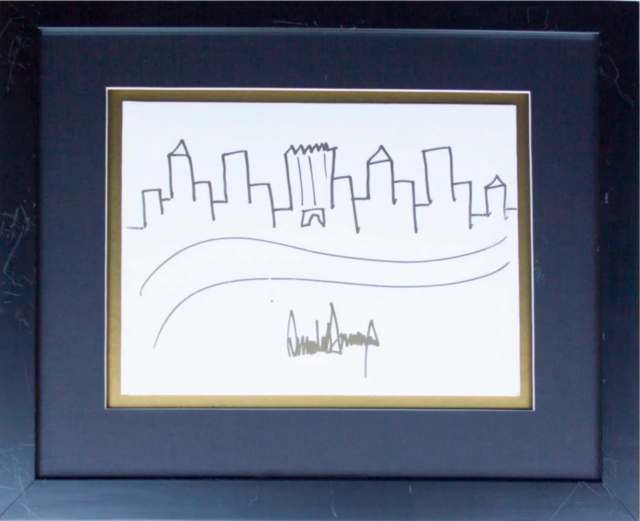
Donald Trump, who has the drawing ability of a seven year old, produced a drawing of the New York City Skyline that sold for close to $30,000. It was originally made for a charity event in 2005. The drawing is without a doubt the worst presidential drawing we’ve ever seen, and possibly the worst drawing by an adult. And that’s an evaluation that comes completely independent of his incompetence as a president. The line drawing doesn’t reach the edges of the page, doesn’t indicate that Trump has any awareness of what Manhattan even looks like, and includes two swooshy lines at the bottom that maybe indicate water or are perhaps just needless flourishes. It appears Trump signed the piece in gold marker and of course the only recognizable building on the skyline is Trump Tower. [artnet News]
Rhizome is offering 4-6 “microgrants” for web-based artworks, ranging from $500-$1,500. Applications are due August 14th. [Rhizome]
Berkshire Museum in Pittsfield has come up with a reinvention plan that includes raising 60 million dollars to help it refocus its mission to include science and history as well as art. The details of this plan, however, are making The American Alliance of Museums and the Association of Art Museum Directors—of which it is a member— very uncomfortable.The Berkshire wants to deaccession works to fund this new mission. This breaks with the association’s code of ethics, which dictates that Museums not deaccession works unless the funds are used for acquisition and direct care of the collection. Seems unlikely the museum will be able to remain a member of the association if it continues along this path. [NPR]
Non-art neon is making a big comeback in New York, from signs to restaurant interiors. [Eater]
Brace yourselves, New York, Miley Cyrus wants to return to the Big Apple to have another art exhibition. [Just Jared]
Why are auction prices so high for Mark Grotjahn works? An abstract painting by the 49 year old fetched $16.9 million at Christie’s and his primary market works can sell for $20 million. In a profile in the NYT, it’s revealed that Grotjahn has a rare amount of control over his career, working in with multiple galleries in multiple cities, often bypassing dealers completely, and having the final say over who his works sell to. This power shows up in the piece, as pretty much every quote comes off as an entry in a competition to offer the most ass-kissy complement to the artist. Notably Grotjahn didn’t respond to requests for comment. We weren’t asked, but we’re a bit confused about how even the best business management could push the value of these patterned paintings up so high. It’s not that they’re bad—but only a few feel truly distinctive. [The New York Times]
Danielle Directo-Meston considers the gentrification issue in her family’s house hunt. Not a lot of new information here, but it has plenty of Los Angeles-specific details and conversations about strategies for preventing displacement. Possible suggested legislation includes a ban on house flipping within a year and another that incentivizes owners to live in their properties for ten years. [Curbed]
Into the Unknown is a science fiction show at the Barbican Centre in London that should get the sci-fi nerd in us pretty excited. There are 800 works, going all the way back to the 19th century, and Hyperallergic has a review and photos to show off the exhibition. The review, though, doesn’t seem very excited about any of it. It’s a flat description, that complains that Octavia Butler and other African American artists didn’t get their due, but it’s still a significant show regardless because who else is doing this? I say, give us a few more photos and let us decide. [Hyperallergic]
Probably the most salacious news broke late yesterday and has nothing to do with art. Trump’s new Director of Communications, Anthony Scaramucci, called up the New Yorker’s Ryan Lizza, talked about killing leakers, firing his entire department to get the leakers, and described Steve Bannon, the White House’s Chief Strategist, as a cock sucker. The New Yorker reached out to Bannon for comment but received none. [The New Yorker]
Healthcare lives to see another day thanks to three Republicans who voted no and 49 Democrats, making the vote 51-49. The Republican representatives are: Sens. John McCain of Arizona, Susan Collins of Maine and Lisa Murkowski of Alaska. Thank you. Again, nothing to do with art, except for how thousands of artists depend on it. [The Internet]
Oof. Over in Toronto, 401 Richmond Street, a long time location for artist-run centers, festivals, theatre companies, supportive arts institutions, artist studios, etc learned they’d be getting an enormous tax increase. The Municipal Property Assessment Corporation (MPAC), which calculates commercial property taxes, decided that 401, which enjoys subsidized rent because they do not bring in a lot of money, should pay the same tax rate as everyone else on that block. Bad news for the art community. [Canadian Art]
Jerry Saltz gives MoMA’s redesign a resigned thumbs up after getting a tour with the architect Liz Diller, a partner in Diller Scofido + Renfro. Diller talked about trying to solve problems of flow with Saltz, which he appreciated. Ultimately, he thinks Lowry is the problem, not the architects. [New York Magazine]
The Artist Pension Trust is having troubles. The business pools work by thousands of artists to provide them future financial security, and recently announced it would begin charging for storage. Many artists involved are not happy about this. [artnet News]
Governor Andrew Cuomo floats the idea of selling naming rights to subway stations as a way of earning additional cash. It doesn’t seem like such a bad idea to me, though it may increase the disparity between “rich” stations and “poor” stations if they aren’t smart about how they sell the product. [Curbed]
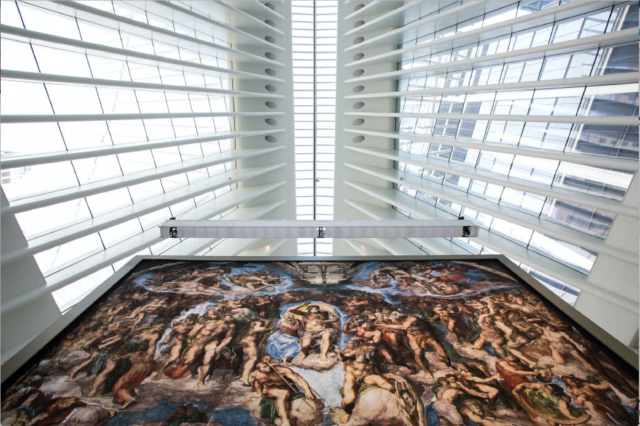
For those who missed Up Close: Michelangelo’s Sistine Chapel at the WTC Oculus, I’ve got good news—Gothamist has great pics. [Gothamist]
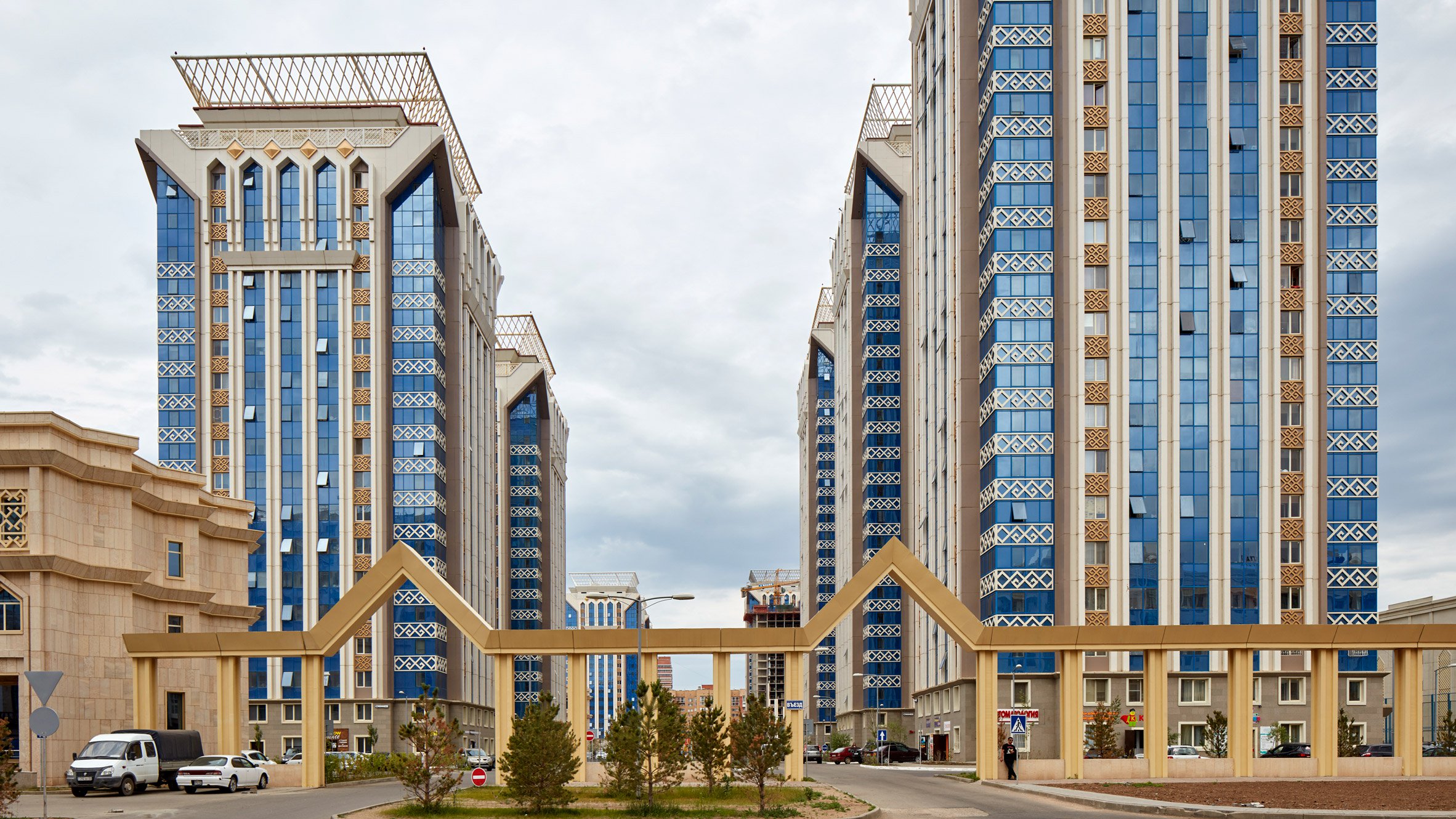
Photographer Paul Raftery has documented the bizarre architecture of Kazakhstan’s post-Soviet capital Astana. The city looks like a weird low budget sci-fi show’s CGI landscapes brought to life. [Dezeen]
BienalSur, a new biennial organized by the Universidad Nacional de Tres de Febrero of Argentina, launches this Fall with 379 projects scattered across different continents. This biennial format is sort of uncharted waters—Buenos Aires is the hub, but the focus is on South America in general, and projects will take place as far away as Paris and Tokyo. [The Art Newspaper]
The American Alliance of Museums and the Association of Art Museum Directors have both come out against the Berkshire Museum’s plan to sell 40 artworks to line its endowment and renovate its building. “One of the most fundamental and longstanding principles of the museum field is that a collection is held in the public trust and must not be treated as a disposable financial asset.” [The New York Times]
Ralph Steadman and Ceri Levy got a profile of their collaborations over at VICE. They make cheesy activist drawings of endangered animals, which are relevant because Steadman used to collaborate with Hunter S. Thompson, a well-known journalist and founder of the Gonzo journalism movement. (Thompson’s significance is never explained.) Anyway the drawings look exactly as you’d imagine—contrived splatter, extreme poses, compositions that all sit in the middle of the page. They’re no Walton Ford, that’s for sure. But the author seems to believe that if Steadman played into artist stereotypes more, and was “weirder, hermetic, less astonishingly prolific, and more pretentiously grandiose”, he’d be recognized as one of the truly great artists of our time. Sure. [VICE]
Why is today such a slow art news day? (Yes, we saw the Dana Schutz controversy. Lay off her, already.) I literally just found myself reading this blurb about butter sculptures at the Ohio State Fair, fascinated: “The American Dairy Association Mideast says the sculpture unveiled Tuesday salutes chocolate milk as the official drink of the Ohio High School Athletic Association. It’s the first time the butter sculpture has included color. Cocoa was added for the bottle.” [Seattle Times]
Thank fucking God. The MTA board has pushed back against the authority’s ambitious new rescue plan that would include more fare hikes. The authority’s chief financial officer, Robert E. Foran, pushed for those hikes, but the board thinks the money needs to come from other sources. Andrew Cuomo, the state governor has promised half the funds for the rescue plan, but New York City Mayor Bill de Blasio has resisted giving the authority the rest. The mayor needs to man up. [The New York Times]
TRIXI studios has used new ARKit software to develop an augmented reality version of A-Ha’s “Take on Me” video. Is this the future of music videos? [The Verge]
Image of the day: France is burning. By Valery Hache/Agence France-Presse — Getty Images [h/t The New York Times]
The latest news from the surreal hellscape that is our nation’s government is that Trump is banning transgender people from the military. Doesn’t it seem like the right wing always comes up with a culture wars bone to pick when their political/economic agenda (Russia investigation, healthcare repeal, etc…) is under siege? At any rate, this is terrible, but if laughing is therapeutic for you, watch this Samantha Bee bit in which she provides commentary to rambling speeches made by potentially drunk Republican congressmen about trans people in the military. How is our country this insane? [Facebook]
Pussy Riot and Les Enfants Terribles are fundraising for “an immersive theater project” in which the audience would get to experience the Pussy Riot ordeal. That includes everything from their infamous performance in a Russian church to their crazy trial and time in a labor camp. Sounds fun? [Kickstarter]
Here’s a new, pretty comprehensive list of grants and loans for artists and entrepreneurs. Lots of funding sources on here we’ve never heard of. [Insight Personal Finance]
Remember “Chewbacca Mom”? The Texas woman who rose to brief, unlikely fame because she laughed so hard wearing a Chewbacca mask in a parking lot on Facebook Live? Writer Alyssa Bereznak does, as she’s been following Candace Payne via Google alerts for the past year. Here she has a timeline of the viral sensation’s rise and fall in public favor. It’s fascinating. The internet is a weird (and judgemental) place. [The Ringer]
Phew. After much outrage (including plenty of cute tributes from artists included in this link) Microsoft announced that MS Paint would NOT be disappearing, but will be available for download from their app store. [artnet News]
Rumors have been flying that beloved Baltimore dive bar The Club Charles will be closing, starting August 1st, indefinitely. Some say it will reopen following renovations, but there are few details here. The 66 year old institution is basically like the evening office of the city’s art/theater/literati scene. It’s John Waters’ favorite bar, among countless other filmmakers, musicians, artists, and drunks. I (Michael) will be devastated if this is a permanent closure. [City Paper]
The Tonya Harding/Nancy Kerrigan 1994 Museum will partner with @popculturediedin2009—an archive dedicated to the drama of the aughts—to mine the decade’s pop-culture. I’m not sure what to think of this. On the one hand, these scandals may already be a source of nostalgia, and therefore hold some enjoyment. On the other, is it not too soon for this? I keep thinking there’s got to be a better use of intellectual engagement than this—particularly given our current political climate. [artnet News]
Karen Loew makes the case for the Small Business Jobs Survival Act, and looks at what other cities are doing to stop the spread of chain stores, closure of neighborhood retail, and “high rent blight” that’s been hitting Manhattan so hard. Basically, New York is way behind on protecting legacy businesses. This is something every gallerist or artist with a studio (or really, anyone who enjoys bodega food) should be getting behind. [City Lab]
Related: The Zapatista-inspired Eastside Café (which functions as an art/activism/community space in East Los Angeles) managed to stand its ground against gentrification and buy their building from the landlord when developers came knocking. Amazing. [Remezcla]
2070 photographs by Annie Leibovitz were purchased by a wealthy patron in 2012 and donated to The Art Gallery of Nova Scotia in Halifax. That was a boon for Leibovitz who was struggling financially at the time. The problem is, while the donor purchased the work for 4.75 million, it’s valued at 20 million and the Canadian government doesn’t want to sign off on the deduction. The panel tasked with approving the donation has accepted that only some of the photographs are art. Also, it seems the valuation of the portfolio is less than that of the individual works, thus creating the disparity of value. [The New York Times]
A score for Acquavella Gallery: Phillip de Montebello, former head of the Metropolitan Museum of Art, will join their staff as curator of special exhibitions. [The New York Times]
Applications close in four days for the free 360 Xochi Quetzal artist/writer residency on Lake Chapala, Mexico. This place looks beautiful. [360 Xochi Quetzal]
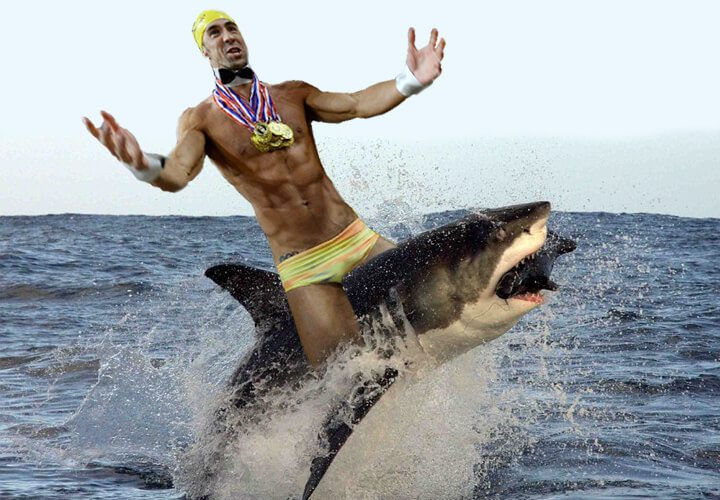
Following up on our Shark Week coverage, the Discovery Channel aired their “race” of 500 time Olympic Gold Medalist Michael Phelps swimming against a Great White Shark, and people are pissed. Obviously, they weren’t going to put Phelps in the water with a shark, but I at least thought there would be a shark. Nope. Basically, they had Phelps wear a fin to give the swimmer the same advantage the fish had, filmed him swimming alone, and then paired him with a computer animation. Lame. There were at least some good memes to come out of this whole thing though. Whomever the intern is that made this image—hire them. [The New York Times]
Hate read: a guide to New York City’s largest mega mansions. There are typically created by rich people buying two to three buildings, kicking everyone else out, and combining them into one home so oversized it’s hard to imagine most of the space being used. The list of owners living/creating mega mansions includes Michael Bloomberg, Madonna, Larry Gagosian, and Jeff Koons. [Curbed]
“I’m getting braver at saying the name of a sorely under-known Brazilian artist whose retrospective at the Whitney Museum, “Hélio Oiticica: To Organize Delirium,” comes as an overdue revelation.” This is the first line of Peter Schjeldahl’s review in The New Yorker and we’re seeing grumblings on Twitter of how offensive this is. Get a grip. If you don’t know how to pronounce a name, or if it’s hard to pronounce properly for English people, it’s embarrassing. This is an admission that he’s working to learn, not that he’s revealing his implicit racism. If anyone has a right to poke fun at unpronounceable last names, it’s a guy named Schjeldahl. [Twitter, The New Yorker]
Artist Sarah Craske found a 300 year old edition of Ovid’s “Metamorphosis” at a junk shop. She’s since cultured centuries’ worth of readers’ bacteria from over the centuries for an artwork. [The Guardian]
Why is Condo being described as an art fair alternative? The event is an gallery-share model where galleries share their space with foreign dealers for the length of a show. Is launching exhibitions now secondary to participating in art fairs? [artnet News]
It turns out Alice Cooper has had a Warhol “Electric Chair” painting rolled up in a tube in storage for decades. The rocker totally forgot he had it. [The Guardian]
Microsoft is killing off its 32 year program beloved of artists, MS Paint. Well, there goes that genre of art making. [The Guardian]
Season 2 of Stranger Things starts in October and the trailer is out. Holy. Crap. I don’t know if my post-internet self is designed to wait this long for anything. Related: Strange Genitals. [The Internet]
Bubbles the chimpanzee, famous for having belonged to Michael Jackson and immortalized in a Jeff Koons sculpture, is now an artist in his own right. The 34 year old primate has taken up painting, and his pieces can fetch up to $1,500. [New York Post]
The stories the internet brought—The truck nut wars. For those who don’t know, Truck Nuts are the testicals truck drivers will hang from the hitch on their back bumpers. There is now a turf war between the two dudes who both claim to have invented the nutz. [VICE]
Here’s an opinion column advocating for painter Yulia Kuznetsova, a recent SAIC graduate trying to get a visa to remain in the United States after school. Kuznetsova is from Russia, which is bleak as fuck and a terrible place to be an artist, apparently, thanks to Putin’s draconian censorship laws. [Chicago Sun Times]
Following up on the Salvador Dali paternity dispute story that lead to his exhumation, the embalmer charged with the task reports that the dead artist’s mustache is still in tact. The results of the DNA test, which would prove once and for all whether the 61-year-old fortune teller, Maria Pilar Abel, is the lone daughter of Dali will take 1-2 months to come back. In the meantime, we’ll be waiting. [The Guardian]
More than 100 of Crocket Johnson’s mathematically based paintings made between 1965-1975, now online at The National Museum of American History. [American History]
Here’s the latest, most ridiculous skirmish from the culture wars: makeup artist Gypsy Freeman has lost her spot as the winner of an Instagram contest because reality television star Kat Von D found out she was a Trump supporter. Is that unfair to Freeman? Probably. But so is being deported/dying from climate disasters. It’s hard to feel that sorry for Freeman here, particularly given that this is a prize sponsored by an individual. Something tells me we’ll be dealing with bitterness like this for years to come. [New York Daily News]
A guide to New York’s affordable housing units. Nice. But remember, landing one of these units is like winning the lottery. It’s a fake program designed to make the city look like it’s doing something about the rising costs associated with living in the city when in fact it is doing nothing. [Curbed]
Josh Baer questions the valuation of Artsy in his newsletter. An excerpt: “Artsyannounced a new round of $50 million in funding – bringing investment to over $100 million – with a valuation that financial experts we talked to speculate may be as high as $2 billion. Artsy declined to answer our question about valuation but reported doubling revenue. They are staffed at 180 now. Since Sotheby’s is at a record stock price and still only a market cap of just under $3 billion – well you get our questions.” This looks like the beginning of a much more interesting article than all the other fluff pieces this week. Most of what we learned from them was in the artsy press release. [Baer Faxt]
A good overview on the city’s cultural plan by David Freedlander. The plan advocates for all the lefty stuff you’d think it would —”translations services for arts organizations, new funding to support cultural workers with disabilities, and a professional development program aiming to help people of color ascend the ranks of leadership at the city’s museums and art spaces.” Also, it would “help arts organizations lower their carbon footprint and increase direct support to artists, particularly those working with and in historically disenfranchised communities.”
Great, though the article lands on a rather ugly statement by Cultural Commissioner Tom Finkelpearl. “We believe there are cracks,” Finkelpearl said referring to the issue of gentrification. “And if enough people are talking about how the city is too expensive to be an artist in, then there will be a breaking point.”
“But it is not happening,” he added. “Artists are still moving here.”
This is according to a study by The Center for an Urban Future, which defines artists broadly. Architects, graphic designers and advertisers—all creatives that typically make much more than visual artists can still afford to live here. But visual artists, a group that makes up on 24 percent of their calculations, make much less on average and aren’t doing well. Where are those numbers? [ARTnews]
Israeli student Rotem Bides has generated a major controversy after allegedly stealing items from the Auschwitz-Birkenau memorial site in Poland for an artwork. The university has since cancelled the exhibition, and Bides may face prosecution from Poland as well as disciplinary action from the school. [The New York Times]
The Roddenberry Foundation is giving out 20 fellowships worth $50,000 each to activists fighting to make the world a little more like Star Trek. You can apply for projects related to civil rights, climate change and environmental justice, immigration and refugee rights, or LGBTQIA and women’s rights. Hurry, applications close on July 25th! [The Roddenberry Fellowship]
Whoa. Keanu Reeves is partnering with artists to launch X Artists’ Books, a new publishing platform that will focus on “unconventional, interdisciplinary and collaborative” print projects. [Los Angeles Times]
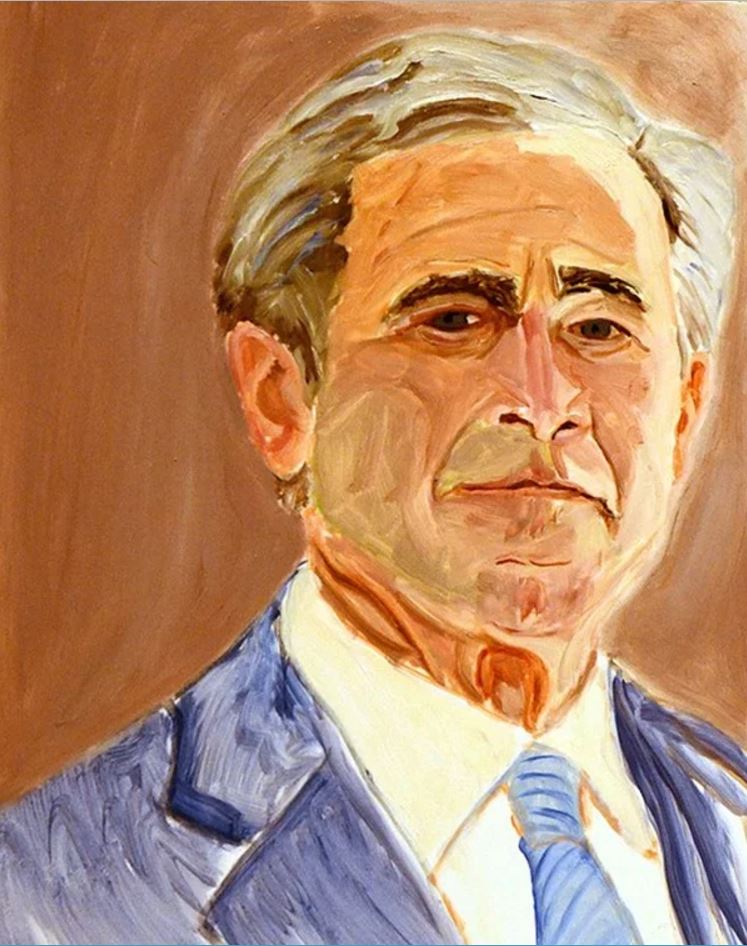
The conservative Steamboat Conference is going to feature a one day pop-up exhibition of George W. Bush’s paintings in Colorado. There’s nothing particularly noteworthy about this beyond the fact that I never miss an opportunity to bring up GEORGE EFFING BUSH’S WEIRD PAINTINGS. [artnet News]
The final U.S. iteration of Now Be Here, the photography project that documents thousands of women in the arts at the same time, will take place at the National Museum of Women in the Arts in Washington, D.C. The project is a collaboration between the NMWA, LA-based artist Kim Schoenstadt, and D.C.-based artist Linn Meyers. Female-identifying artists, curators, and gallerists in the DC/Baltimore metropolitan region are invited to participate, and can register here. [Google Forms]
Police in Spain have recovered three out of five Francis Bacon paintings (valued at nearly $30 million) stolen in Madrid in 2015. They managed to track down the photographer who took photos of the stolen paintings when the images appeared on the market. The case is considered Spain’s largest ever contemporary art heist. [BBC]
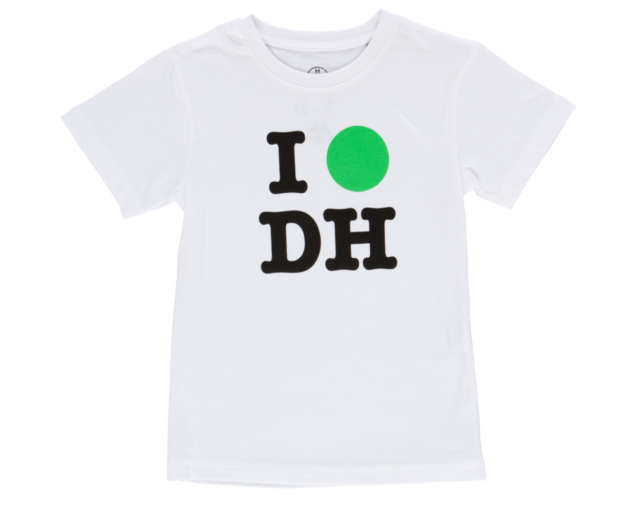
Okay, who is buying “I “spot” Damien Hirst” t-shirts for their kids and why???
This seems pretty big for creatives in Sacramento: $500,000 has been allocated to a pilot program that will fund art, tech and food projects with a public benefit. [The Sacramento Bee]
A kinda sorta rags to riches story about art dealer Peter Loughrey, who began his career as a stunt man living out of his van, got life-threatening cancer, and is now a rich art dealer. [CNBC]
Governor’s Island will remain open for the fall for the first time ever. [Curbed]
Dorothea and Leo Rabkin Foundation has awarded grants to $50,000 each to eight arts journalists. The prize totals $400,000. Winners are Phong Bui (publisher of the Brooklyn Rail); Charles Desmarais (art critic for the San Francisco Chronicle); Bob Keyes (features writer for the PortlandPress Herald, Maine); Jason Farago (writer for the New York Times and the Guardian and founding editor of the magazine, Even); Jeff Huebner (contributor to the Chicago Reader); Carolina Miranda (culture writer for the Los Angeles Times); Christina Rees (editor-in-chief of Glasstire, Dallas); and Chris Vitiello (freelance writer and independent curator and organizer, Durham, North Carolina). Congrats – this prize is a huge deal in the media world, where writers are chronically underpaid. [Dorothea and Leo Rabkin Foundation]
Random thought: Do we really need op eds about Donald Trump’s secret meeting with Vladimir Putin? There’s zero new information to be gained from this and what is there to say about this past the obvious fact that this President is not operating in the best interests of the country. [The Internet]
Is art schwag in trouble? Damien Hirst’s store Other Criteria has announced it will close and relaunch as a book store. (Good luck making money on that venture.) In addition to selling his limited edition prints, the store sold all manner of art on skateboards, plates, mugs, t-shirts and whatever else you could print on or mass produce. [Devonline]
Baltimore Clayworks, a much-beloved ceramic studio and education nonprofit, is filing for chapter 7 bankruptcy after 37 years. Frustratingly, it seems like the board didn’t cooperate with the community in attempting to resolve their cash flow problems, and instead were relying on a real estate deal that fell through. [The Baltimore Sun]
Speaking of closures/real estate deals, The Hard Times continues to roll out the best headlines on the internet: “Record Store You Didn’t Shop at Becomes Condo You Can’t Afford”. [The Hard Times]
I guess this is what it looks like when a reporter who begins with no knowledge of the art world writes about the art world’s transition to online sales. That transition is tracked wholly through Artsy – when other companies are described they’re lumped into categories so broad they misdescribe them. Quotes sometimes come from sources who aren’t exactly authorities on the subjects they discuss. That’s just a result of not knowing much though. The story has an extra grating edge because it’s a tale of privilege (Carter Cleveland is the son of an art historian and financier) soliciting funding for a company that tailors to privilege (art collectors). AND the company’s entire spiel-using the site is so easy it’s “almost pedestrian”—contains a whiff of class appropriation. That said, the article does contain some useful tidbits — the company now reports $20 million a month in facilitated sales (whatever that means). Glad it’s doing well. [The Verge]
The list of amenities at this artist residency is pretty funny. Highlights include “List of extreme activities all around the country” and “Bulgarian phone number – SIM card”. Sign us up! [Art Connect
Frank Lloyd Wright’s Fallingwater house famously straddles a waterfall. Unfortunately, the rapids were a little too rough recently and caused exterior damage, including to the Jacques Lipchitz sculpture “Mother and Child,” which Wright himself selected for the site in 1941. [Architectural Digest]
The NYT has an adorable blurb about the unlikely friendship between Jamie Wyeth, Andy Warhol, and Archie Warhol, the painter’s dachshund. [The New York Times]
Here’s a slideshow of Columbia University’s new Lenfest Center for the Arts, designed by Renzo Piano. It’s an “eh” building. Functional, but I believe Paddy once accurately described the exterior as looking “like a pharmaceutical company’s corporate campus”. [Dezeen]
Politicians about to re-enter an election campaign need to stop getting on the train anytime a problem is announced and start solving the problems. Bill de Blasio doesn’t need to ride the 7 train to see a Mets game, he needs to fix it. [Curbed]
Speaking of Curbed, we’ve noticed Famous New Media artist Jeremy Bailey has taken out an ad that appeared on the site for his “The You Museum”. The project “curates personalized exhibitions that are delivered to you via banners on the websites you visit most.” We want this. [The You Museum]
Brooklynites rejoice: Deborah Kass’ “OY/YO” sculpture is back! It’s been moved to the Williamsburg waterfront. [untapped cities]
Fiercely Independent. New York art news, reviews and culture commentary. Paddy Johnson, Editorial Director Michael Anthony Farley, Senior Editor Whitney Kimball, IMG MGMT Editor
Contact us at: paddyATartfcity.com

![Image of the day: France is burning. By Valery Hache/Agence France-Presse — Getty Images [h/t The New York Times]](http://artfcity.com/wp-content/uploads/2017/07/27France2-superJumbo.jpg)