
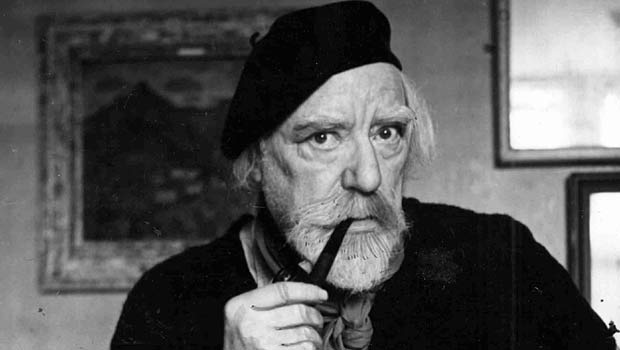
Augustus John, an actual bohemian artist.
Bushwick artists be warned: bohemia ended without you. In Christian Viveros-Faune’s latest piece “How Uptown Money Kills Downtown Art,” a chronicle of the art world’s middle-class dealers and artists, he asks Yale School of Art Dean Robert Storr about whether “the art world’s laboring classes” have any future outside the market. He responds dismissively:
“Allan Kaprow announced the end of bohemia in his 1964 essay, ‘The Artist as a Man of the World.’ Essentially, what Kaprow said is that what contemporary artists really want is to become is proper middle-class citizens. Of course, there are moments in every generation when a facsimile of bohemia arrives. There was the Lower East Side in the 1980s, Williamsburg in the ’90s, Bushwick now—but those aren’t examples of bohemia proper so much as periods of adolescence lived through by successive artistic cohorts.”
So much for the Bushwick avant-garde!
Bohemia, with its notions of aloof artists dallying in salons isn’t quite the Bushwick scene; but did Kaprow really announce the death of Bohemia and the desire for contemporary artists to be “middle-class”? From reading “The Artist as a Man of the World”
There is a chance that modern “visionaries” are even more of a cliche than their counterpart, “conformists”, and that neither truly exists. We look around, and what do we see?
They do not live very differently from anyone else. Like anyone else, they are concerned with keeping the rooms warm in winter, with the children’s education, with the rising cost of life insurance. But they are apt to keep quietly to themselves no matter where they live—in the suburbs or the city—rather than enter into the neighborhood coffee break or meetings of the P.T.A. This is not unfriendliness so much as it is a lack of commitment to the standard forms of camaraderie, a detachment born partly of lingering vestiges of romantic alienation and partly of the habit of reflectiveness. Their actual social life is usually elsewhere, with clients, fellow artists, and agents, an increasingly expedient social life for the sake of career rather than just for pleasure. And in this they resemble the personnel in other specialized disciplines and industries in America.
They differ from their middle-class neighbors, not in beliefs, but in consciousness of what is implied by their unexpected position. It shows up in their relations to the art world, in their connection as artists to society, in their sense of themselves and the role they are playing.
All this has become accepted as a given; artists end up taking on day jobs, and their roles have become increasingly professionalized, just like their industrious brethren. But we still see signs of bohemia, at the very least in online communities who don’t necessarily need or seek approval from society at large. Those pockets of creativity still exist; now they’re just sitting next to—and within—the “art world’s laboring classes”.


{ 9 comments }
Except for direct aristocratic/wealthy/government patronage, when has any artist ever truly existed outside the “art market” (so narrowly defined to a gallery/auction system) except in absolute penury? And when is extreme poverty a justification for anything? The reasonable anticipation of living until eighty; the desire for plumbing; and having a day job so as to able to pay off a de rigueur MFA hardly compromises avant-garde communities, which are certainly atomized, but larger and more diverse than ever. (How else to explain something like Burning Man?)
As for Storr, I doubt he would give the time of day to an artist without a CV, and really, when was the last time he drank from the bottle and pissed in an alley? He talks about the avant-garde and the bohemian in terms of neighborhood and decades like a tour guide might evoke turn of the century Montmartre.
Romantic poverty, artistic “genius,” and drunken carousing has always belied artists working their asses off and thinking nonstop. The idea of isolated bohemians purposefully living in a louche death spiral is a total myth; the bohemian has always been the flip-side of the bourgeois. Picasso suffered patron studio visits and haggling with Kahnweiler; Duchamp had an allowance from his parents and leached off of Katherine Dreier for a couple of decades (not to forget shaped her collection which is at Yale).
i’m kind of fascinated by how much Romantic ideas are out of favor. are they so much so that their over-correction can blur the sight? plenty of artists are poor [rentless, foodless], though it may not be romantic to them, and certainly there’s a lot of drunken carousing [artistic or not]. neither of which, among the creative people i know, is antithetical to working their asses off.
That’s a good observation. Let’s just admit it: all work and no play makes artists pretty fucking dull.
Long before the questionable Occupy Art movement came along, I figured out for myself that the professional fine art field is a giant tax shelter and money laundering merry-go-round guided by the auspices of phony scholarship and appraisal. Contemporary art functions as a kind of financial insider scrip, a value counterweight to tax liability (given the convenient smoky, nebulous nature of artistic valuation), and critics, curators and appraisers are the value-anointing high priests of this cartel. It’s also seems to function like a hedge fund in it’s own fake alternative stock market. The galleries, art fairs and newer art museums seem little more than a turnstile for this wrongful activity mill. Someone once said that the art market is the greatest miracle for duplicating money since the invention of compounding interest. That goes hand-in-hand with the uncanny co-advent of abstract art (think 1913 Armory Show) and the 16th amendment. And today, isn’t it peculiar that China, India and Dubai didn’t have contemporary art markets until fairly recently? Whatever it all is, why does the FBI allow it to go on here? Why isn’t the visual art market regulated? My guess is that elected officials would never want regulation of the art world because it is a great smoke cover for when they themselves play the art game to reduce what they would owe in taxes. Also, the art world may make a convenient observable “savanna watering hole” for authorities to see with their “binoculars” what kind of wildlife shows up to drink, in case it’s really dangerous (terrorists, spies). The government has been cozy with art before as New York becoming the art capitol of the world was a CIA led Cold War sham implemented to outdo the Soviets in the culture department (Rothko, DeKooning, Pollock). After that the art racket evolved into a higher gear financial racket too good to decommission, and ironically, now the Russian new rich use the art turnstile to protect their dough.
For real artists, the path to career success resembles a carefully designed cattle-herding pen used to systematically concentrate and confound artists into frustration, keeping them there and grounding the electricity of their career drive; “Maybe if they get frustrated with trying and trying, they’ll just go away after a while”. Grant foundations, fellowships, museums and galleries are all shams with dual purposes as tax shelters and tools to discourage. Perhaps this is a stealth plan manifested by government partnered with big industry to frustrate the majority of would-be artists who take up the journey along the byzantine maze of a yellow brick road to the elusive land of art career success. Artists are perhaps dissuaded because the rich and powerful don’t want the masses disengaging from productivity to take up the intrinsically rewarding artistic life. How can you guarantee a profitable taxed workforce if everyone wants to pursue intrinsic value in a creative life instead of working unfulfilling jobs?
The brilliance we are left to admire is that a small group of financial and academic elite have managed to commandeer visual art and convert it into a factory that serves their non-artistic needs. It’s kind of like grafting a bountiful orchard branch onto a poisonous tree that bears no edible cultural fruit. If I were the devil, I would count this attempt to crush the human spirit as one of my crowning achievements. This is the real manifestation of “culture wars”; civilization’s ability to showcase it’s humanity through art has been bottlenecked by crooks, intellectualists and lackeys. Most of America’s visual culture has been artificially kept a desert by this system. Even the once bustling field of editorial illustration has been smothered to death by thrift. Correct me if I’m wrong but there doesn’t seem to be one single genuine opportunity of which artists can avail themselves in this realm.
Art would be a giant tax shelter — if artists, galleries, and buyers didn’t pay taxes, and if the sales of art pieces weren’t taxed, and if they lived in a tax haven, but that’s not the case. It’s unconventional to launder art — when you sell work (whether out of your studio, your gallery or in an auction house), that piece is accompanied by a receipt for tax purposes, and future reference. It’s a pretty bad business for the black market — paintings are hard to forge, hard to sell once they’re stolen, and there aren’t very many paintings that are sold for very much money.
It seems to me like you’re another bitter commenter who is too mystified by the art world to wrap your brain around it — more talk about ‘real’ artists, Marxist generalizations and evil conspiracies. It’s one thing to be contrarian, or to be pragmatic, or to take issue with the convolution and favoritism of the art world, but it’s another to denounce it as a scam just because it flies over your head.
Oh, come on Cameron! How else can you explain the missing “dark matter” and balance the big screwy equation of the art world? It’s all about the appraisal machine attatching value to things using official authority. My words aren’t paranoid rants; they are informed by what veritable sources I’ve been able to find and backed up by acquaintences from old money Philly families who spilled some of the beans to me when I lit this flare. They knew this was going on as far back as the 1960’s. I’ve heard inside horror stories about museum donations stacking up in basements, getting flood damage and the resulting “double screwing” insurance claims. Auction houses, chandelier bidding, MFA programs, Critical Theory, ridiculous appraisals, critics and “challenging” art…..most of it is predicated on shite for decades. I’m not talking about forgeries or even just paintings. Look at phonies like Sterling Ruby, Jerry Saltz&Roberta Smith. Also, the big Eurotrash style art fairs…..ArtPalmBeach, ArtHamptons, ArtBasel, Friese etc. How else can this wingless, engineless airplane still defy gravity and stay in the air all of these years? In nature, outmoded species are swept away by evolution’s progress; contemporary art should have gone extinct long ago.
Links and books to start, a fraction of what I’ve seen:
http://www.independent.co.uk/news/world/modern-art-was-cia-weapon-1578808.html
http://artmarketmonitor.com/2009/04/10/forbes-calls-chinese-contemporary-art-a-scam/
“The 12 Million Dollar Stuffed Shark” (Don Thompson)
“What’s Wrong with Contemporary Art” (Peter Timms)
Bitter commenter? Yes. Mystified? Less and less. But as an artist who has achieved uncommon things without the blessings of the establishment, I have earned a prime seat from which to judge. Not too many living artists sell their work multiple times for five figures (certified) and are in multiple collections along with Garber, Wyeth and Lathrop, and wind up in multiple publications as I have. I’ve earned the respect of other decent artists who’ve achieved simlar things and who are also pissed of that they’ve hit a glass ceiling with this global clearinghouse for Emperor’s New Clothes while surviving what is really a global depression. As it is now I fund my guerilla campaign to keep making art by gigging on the Highland bagpipes, keeping me out of some minion wage-slave job. I would like to be wrong about this and be pleasantly surprised that there are some grant foundations or dealers I’ve overlooked. I dare anyone on ArtFagCity to show me a rock I can turn over for new success. Show me a NY dealer who can shut me up by doing right for my art.
“Dark matter”? “Big screwy equations”? “Eurotrash” art fairs? Really? If you don’t think EVERYTHING in the world works behind closed doors and in dubious ways (politics, academia, art, sports, EVERYTHING) then you’ve pretty naive. And just because you don’t appreciate critical theory, don’t like Roberta Smith, or believe in gravity, doesn’t mean that those are convincing critiques. Are there absurd amounts of money being spent on art that are disproportionate to their worth? Yeah. Are there back-room deals, mismanagement, corruption, and intrigue in art? Yes, and in every other conceivable profession. But if you think it’s all one giant conspiracy against you, then I suggest you find a doomsday cult or Tea Party branch near you who has the patience to listen to incoherent, paranoid rants.
May be off topic. In the neo-bohemian movements there is a great deal of ugliness and political work. We know so much already in the society that does not work. Why keep rehashing the wrongs? Let’s see an alternative that is aesthetic and healthy – life giving. Also, part of being an artist can be doing your own work, engaged with an idea, an object, nature, etc. and not setting out to change the world but to live within it. It gives the adults somewhere to aim as they age.
Top Ten popular Female Singers in the World, Indian Singers, Pakistani Singers and American Singers hot News and Images
hotentertainnews.blogspot.com
Comments on this entry are closed.