
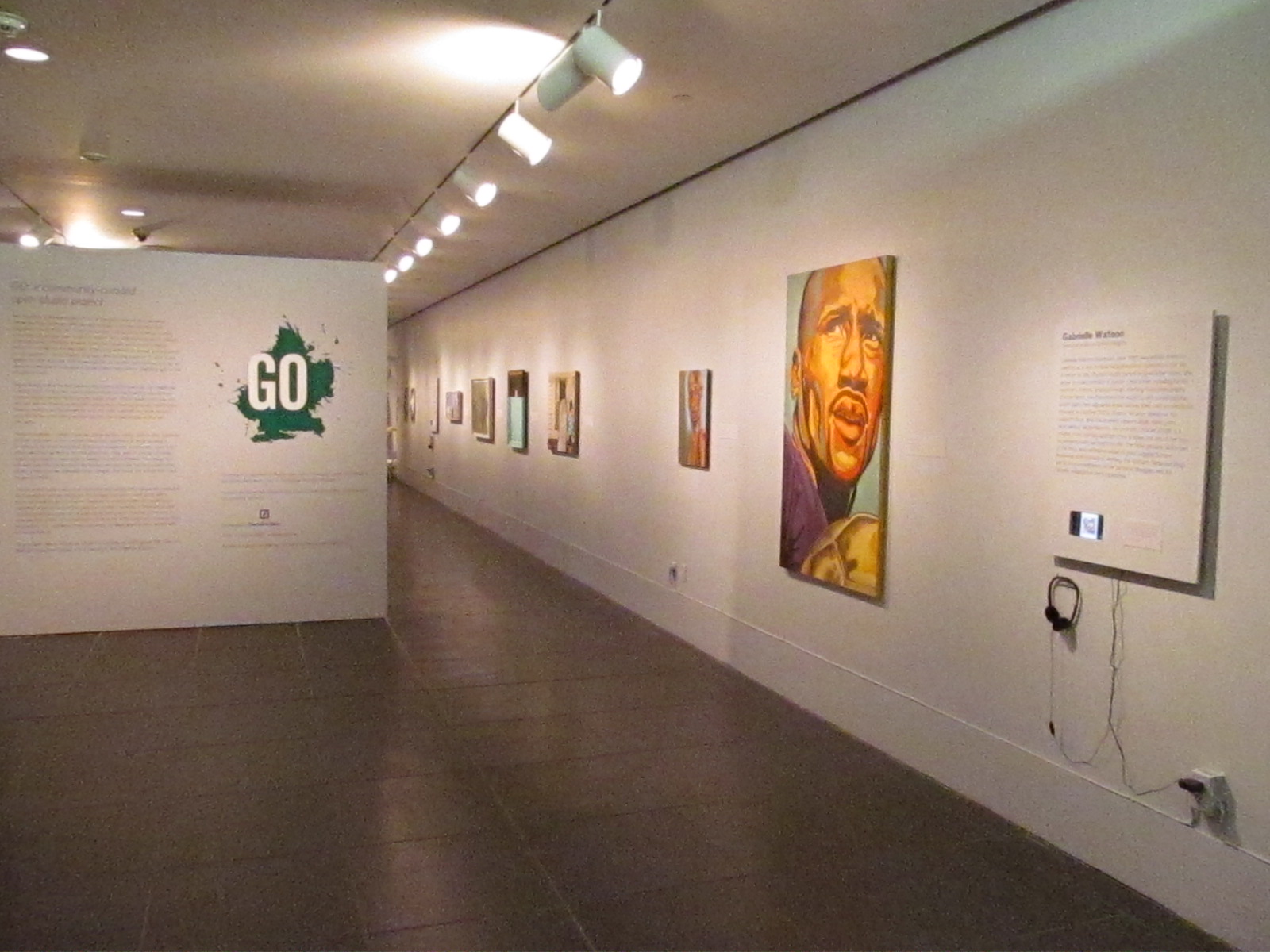
After months of speculation over whether the Brooklyn Museum’s crowdsourcing experiment would work, the museum’s efforts have resulted in a 5-person (Adrian Coleman, Oliver Jeffers, Naomi Safran-Hon, Gabrielle Watson, and Yeon Ji Yoo) group show. Now that the works are on view, it’s a good time to reflect on the “community-curated” exhibition.
In the spring of last year, the Brooklyn Museum began its first steps toward the exhibition by hosting open studios. But the process was full of kinks. Only artists with an appropriate studio could participate. Then, by the time open studio weekend came around, the voting process was too short, and full of technical difficulties. From those results, the museum’s curators whittled down the field to the five artists seen in the current exhibition.
All in all, it was a lot of work to narrow down the field for Brooklyn’s best homegrown artist.
Of the artists chosen for GO, all but one was born outside the United States. While that appears to represent the globalism that is Brooklyn, it also demonstrates the borough’s rampant art careerism; one of the artists, Oliver Jeffers, appears primed for celebrity, or at the very least a successful Kickstarter campaign. Watching the Australian-born Irishman’s video interview (all the GO artists have them as part of their wall labels), he exudes good looks, goofiness, and charisma. From reading the label, it appears he had a fanbase prior to GO, for a series of children’s books. That vein of small-scale celebrity troubled me more than anything else in the exhibition. But I’m not sure how we get rid of it with an exhibition resulting from a popular vote.
As for the exhibition itself, it doesn’t look great. That flaw’s not the artists’ fault: most of the work appears poorly considered for the gallery—actually a long, squat hallway at the Brooklyn Museum. The artists should be upset.
There’s really no better example of ill-fitting exhibition design than Yeon Ji Yoo’s The Fight, an installation of sparkling white paper trees that are too short to reach up to the gallery ceiling. These tree trunks don’t fit in the gallery, making them look like props stored away in a corner. They did, however, make great backdrops for many gallery-goers’ Instagrams.

Yoo is one of the more experienced artists in the GO bunch—she has her MFA and currently teaches at Queens College—and she’s exhibited The Fight before. When it was installed in Wave Hill’s “sun porch” gallery last year, the translucent paper surely benefited from light seeping through the windows. That quality was nowhere to be seen in the Brooklyn Museum’s low-ceilinged interior.
As one might expect with the results of crowd-curated shows, a lot of the work feels generic. Naomi Safran-Hon’s collages start out as photographs, but then she painted and glued on materials like lace and cement to give them a greater, hyper-realistic effect; they look like ruin porn. Gabrielle Watson’s portraits appear to have been filled in with a paint-by-number style popularized by Andy Warhol, and more recently, Shepard Fairey. As it stands, the democratic-ish selection process has yet to discover any great artists.
Of course, maybe that’s a lot to ask of democracy, which exists to make sure all voices are heard and there’s an alternative to the powers that be. In the art world, we need some democracy; otherwise, we’d only get blue chip galleries. Still, democracy’s not perfect. While we don’t expect the people to choose the very best American Idol or President, we hope that the experts—the judges, delegates, curators, whomever—can assist with the process.
In the case of the Brooklyn Museum, we at least expect the curators to help put on a quality exhibition. What we got was a shoddy popularity contest.


{ 12 comments }
Can you expand on this: “That vein of small-scale celebrity troubled me more than anything else in the exhibition.” Why would the fact that people like Jeffers work be troubling?
I’ve got no problem with people having charisma. We should all aim for that. But in a contest where the winners are chosen by a public vote, those with a “following” already have a group of built-in voters. They have a better chance at winning, not based on art, but fans. That’s a problem.
I agree that the space was not great for the exibition and I cannot say anything about the process of selection. Yet, I found the conversation among the varied works interesting and the show as a whole full of energy. It is worth a trip. I would hope the museum gives this another try.
What did you think was the conversation among the works? I didn’t think they had much in common with each other.
Formally, they do seem at first to have much in common but I liked the “writing over” of the photographs and the found pictures and the materiality of the stuff on the photos and the trees. The portraits and the watercolors brought figuration which was trying to be altered but not effaced in the other works.. For me, the enery was not just that of the young “found” artists, but of the interrelations of the glimpses in the room.
This is great. I think a thorough review of the Brooklyn Museum previous “quality” exhibitions could be interesting. You might be giving them too much credit. Maybe this is mentioned somewhere, but how many museum curators actually ended up going to any studios?
On another note, isn’t it possible that this show was born out of the idea that they couldn’t afford to hire curators in the first place? A while back, I remember seeing it listed on NYFA as a paid curatorial position, where the job opening was then reposted a few times. Each time it was posted it was downgraded from a full time position to part time and eventually to an internship (if I remember correctly).
Well, I’m not sure if they’re known for “quality” exhibitions. The curators did end up having studio visits with the ten finalists. They selected five. I know that the curators are full-time, but maybe there was something on NYFA that was specific to GO? I never saw that listing, so I can’t be sure.
That’s ridiculous. GO happened because a few people were passionate enough about community involvement that they spent over a year coordinating volunteers and nearly 2,000 participants. Having spoken with Sharon Matt Atkins and Shelley Bernstein throughout the process, and visited GO myself, I can tell you it would have been a lot easier to hire someone. The resulting work was typically pretty bad, but the museum can’t do much about that. Also I think it should be mentioned that they were aware of the popularity contest issue, which is why voters had to check-in to several studios before making their decision, and the curators themselves made the final selections.
http://www.thelmagazine.com/TheMeasure/archives/2012/09/07/why-go-wont-be-a-popularity-contest
“Ridiculous” is a little ridiculous. It was just a question but thanks for the info anyhow. There were definitely listings on NYFA for curatorial positions, not mentioning GO directly, but mentioning having your own laptop and so you could travel to visit studios. Sounds pretty similar.
Sorry, that was harsh. I just get upset when people look for a corruption angle, because this sounded like a long-term passion project. Shelley and Sharon just wanted to get the community to talk to local artists. I have no proof that this isn’t some stingy scheme, but Sharon had mentioned that they’d thought about not even including the exhibition, and ended up deciding it was a good way of bringing the community back there. Regardless, very few people in high-level institutional jobs would care enough to orchestrate something like this, and the effort shouldn’t go unacknowledged.
That’s a good point about the question of whether an exhibition is actually necessary. Here’s what I think needs to happen: more than a one-time exhibition, it would behoove Brooklyn artists more, and help them get experience, to have a regular series of exhibitions devoted to emerging Brooklyn-based artists. They can do studio visits, there can be a regular series of exhibitions, and maybe there’s some form of voting/community feedback involved. Heck, I’d love to see workshops, maybe with NYFA, about how to make it as an artist. Whatever. I just don’t think a one-time exhibition helps as much with community engagement. This is just an idea.
Yeah, it doesn’t sound like the exhibition hit any of goals laid out, especially with just five artists. It would also have been nice if more established Brooklyn artists participated so people could learn from each other.
Comments on this entry are closed.