
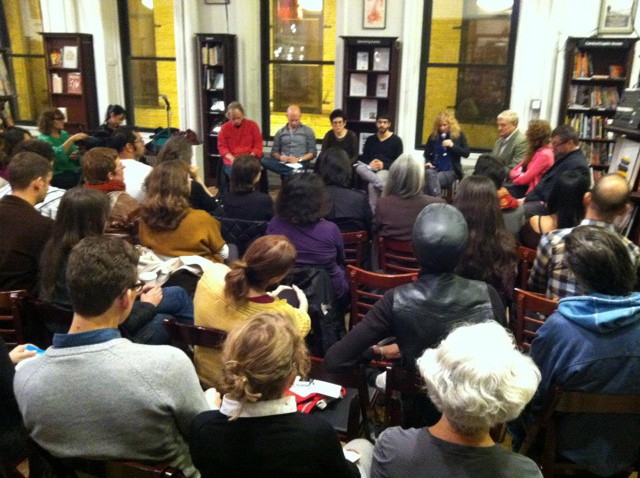
OWS Arts & Labor’s panel discussion of eight arts writers at Housing Works Bookstore Cafe (all images via OWS Arts & Labor’s Facebook page, via Hyperallergic)
Last month, critic Irving Sandler published a call-to-arms on the state of criticism, “Art Criticism Today” in the December-January issue of The Brooklyn Rail. (This follows a 2006 call-to-arms “A Call to Art Critics,” and response essays, which, already, does not bode well). Sandler believes that private interests are squelching the medium, using John Coplans’s firing from Artforum in 1978 as an example. He also believes criticism is unfocused, due to a lack of some clear art categories with which to build a case (“the growth of pluralism”). Sandler asks: “Who’s in charge here? Can anyone stop the player piano before it rolls us in the trough of a tidal wave? How did we get to be so many?”
I actually happen to think critics are doing alright. You’ve got weekly anti-market rants (Felix Salmon, Jerry Saltz), critics acting as activists (Ben Davis, Martha Schwendener), some pretty great quitting articles this year, constant rallying on Facebook, Twitter, and comment threads, rumor mills like How’s My Dealing?, and people like Hennessy Youngman making criticism relevant to over a million YouTube viewers. It’s not that criticism isn’t happening, it’s just that it has no bearing on the market. That’s been a problem since the seventies.
But for me, the single most limiting problem in contemporary criticism is the meaningless academic language which leaves everything ambiguous and prevents all but a few from making it past the first paragraph. So when many of the responses to Sandler’s piece start off with “the notion of dualism,” or 20th century French philosophy, or The History of Criticism, it’s not exactly a mystery that this conversation isn’t getting anywhere.
Since we’re talking about criticism, though, that conversation is going to be thorough. Sandler came up with fourteen questions about critical criteria, and so far, he’s got over twenty response essays up on the Rail. It took me a whole day, but I read them all. It was horrible. Here are the talking points:
“The Diagnostic Essay,” Alex Bacon
We need more diagnostic essays.
“Responses for Irving Sandler (A Later Seizure),” Bill Berkson
Berkson’s list of answers is at least straightforward.
“Q: Is there a crisis in criticism? A: The idea of a crisis exists only to sell print.”
“Re: Art Criticism Today,” Robert Berlind
Brass tacks: writers should sound like humans. “If the writing has no character, why would anyone bother to read it?”
“If Picasso Is So Sexy, Why Is No One On TV Talking About Art?” Christopher French
A twitter-friendly title and a light read. French advocates for critics re-infiltrating mass media. No strategies offered for how to do that, though.
“Irving:” Dave Hickey
All-caps response from Dave Hickey. Solid Gold.
“I AM A WRITER. I HAVE WRITTEN A LOT ABOUT ART. I NO LONGER DO BECAUSE THE ART WORLD IS TOO STUPID.”
“The Four Corners of Painting,” Richard Kalina
Sandler said we need some categories, so Kalina provides some for painting. Unfortunately, they’re basically abstract and representational, which doesn’t say much about the work.
“Three Crises,” Pepe Karmel
They are: Marginalization, Mourning the Avant-Garde, and Conventional Taste.
“Thanks for the Memory,” Barbara Rose
At least Rose’s damning market rant has some life in it. Artforum is a repugnant object, and MoMA, once a “temple of purity,” is now a suburban mall. DAMN. She leaves us with this: “…Rome was plundered and occupied by uncouth (may I say tasteless, uneducated?) barbarians.”
“Re: Art Criticism Today,” Karen Wilkin
Twitter is ruining criticism!
“Is there a crisis in criticism? Only if you believe that criticism should matter. Art gets along just fine without criticism, although artists, in my experience, almost always benefit from discussions of their work with people whose eyes they trust. The Internet and Twitter culture have made everyone’s opinion seem equally important, however ill-phrased or downright ungrammatical, essentially making the pronouncements of those of us who get paid (admittedly not very much) for having opinions in public beside the point. If this sounds elitist, so be it.”
It just sounds like a critic who doesn’t use tweetdeck. Wilkin continues that she hopes her writing will prompt people to go see the work. I like that.
“Quarterdeck Reflections,” Alexi Worth
Alexi Worth becomes the first person to reference criticism after 1980. I’m frankly shocked that no one’s mentioned Ben Davis yet. But more importantly: finally, someone acknowledges the sterling work of the world’s finest art blog. Us!
Worth writes that we need to consolidate, because there are a ton of great writers whose work isn’t getting its due on individual sites. “Who has time to track all the meaningful voices online and in print, to find out if Jack Bankowsky or David Cohen or Carroll Dunham or Jeffrey Kastner or Jonathan Neil or Barry Schwabsky or Sanford Schwartz or Katy Siegel or Trevor Winkfield or John Yau has a fascinating or infuriating piece, and where it is?”
DO NOT EVER READ THIS:
“Post-Critical,” Hal Foster
“How did we arrive at the point where critique is so broadly dismissed?” Hal Foster breaks it down, explaining how critical theorists like Bruno Latour and Jacques Rancière revealed the essential contradictions of criticism and, thus, convinced everyone they didn’t want to read about art. Foster, in turn, points out the essential contradictions in Rancière’s position, so I guess we’re good now?


{ 35 comments }
is that a person in straight-up full body leather bondage gear sitting 2nd row from the back?
Looks nice and warm.
I’d like to see a discussion begin with an answer to whether or not art criticism SHOULD have any impact on the market. I can understand both “yes” and “no” answers to that, but as this seems to be the essence of why there’s a perceived “crisis,” it would seem to me an important question.
I always thought it depends who’s writing history. Felix Salmon touched on this a few months ago:
“There’s long been a disconnect between critical acclaim and high prices, but so long as the art market pumped money into the broader art ecosystem, no one really minded that. Rather, what seems to have changed is that art — art itself, divorced from commerce — has been drowned in the flood of money. Even the most highbrow museums, these days, only devote major shows to artists who have proved themselves winners in the great game of selling to plutocrats.
This critique, of course, is not a new one, and the Occupy Museums website puts it well:
Museums must be held accountable to the public. They help create our historical narratives and common symbols. They wield enormous power within our culture and over the entire art market. We occupy museums because museums have failed us. Like our government, which no longer represents the people, museums have sold out to the highest bidder.”
http://blogs.reuters.com/felix-salmon/2012/11/19/occupy-art/
People are fed up with crap, those outside the artscene shake their heads in bemused irritation and go elsewhere. The artworld is now so inbred it doesnt know where the BS ends and reality begins. (From one of my favorite movies, All that Jazz)
Games, toys and therapy are NOT art.
I think it should to some noticeable extent. Ideally, disinterested (financially) people who have worked hard at thinking and diagnosing cultural production can have an impact on it, which may help in rewarding merit.
David — What merit? Merit is rarely rewarded within the high profile art world. That goes for art AND directions that impact the larger art world. For example, just a few years ago the BIG art magazines started to take notice of the online art market — they wrote as if it was something ‘new’… something ‘revolutionary’. They praised online efforts like VIP Art Fair as ‘ground-breaking’… yet ignored what sites like Myartspace, and many others — including individual artists, were doing years before VIP existed.
I was Myartspace’s Senior Editor… we had ZERO support from the big art world, aside from SCOPE and a few other international art fairs (we were one of the first online artist communities to infiltrate the big art fairs). Hell, we had zero visibility even after we implemented a program that helped hundreds of art students with tuition expenses throughout the world. When another group with ties to the NY gallery scene did the same thing… they were acknowledged — instant accolades. That is the name of the game.
I was told ‘we don’t write about that’ by several key art bloggers… but they had no problem writing about those other ventures — because those ventures had a stamp of approval from the get-go. They scoffed at what we were doing… until the direction was validated within their own community. Oddly enough, some of the people who once scoffed at the importance of the Internet — and chuckled about the concept of marketing art online — now act as if they were early adopters — offering quotes about the history of it for books. Writing the history as if it is their own.
One writer – my guess is that most of you know him — suggested that he has ‘always’ championed the need for artists today to have an online presence.He has been quoted in articles and books about the subject — and I believe he has did a college lecture or two about it. Ironically, he stated to me years ago that having a website and using social networks is a ‘sign of an amateur’ — a ‘waste of time’. I still have that email. I keep it to remind me of the lengths people will go to re-write history in their favor — their failure to jump while others test the waters before them.
Merit — as dictated by the powers that be within the high profile art world — is not always deserved… not always legitimate IF you dig beyond the hype. I’m ranting
I think the market should be less of a factor in art criticism AND institutional critique. Art has value beyond the dollar sign. Yet critics and museums tend to only focus on high market work… everything else is ignored — at least until it becomes marketable. Ha. BUT looking beyond the high profile circles of the art world does not produce ad sales… so I can see why art critics working for the glossy magazines are stuck.
That’s kind of a tough question to isolate because the art market has an impact on criticism. High art ads finance mainstream print criticism (and its online corollaries), criticism impacts the market and the market impacts the ads, to complete the circle.
I have yet to read through the linked essays, but is art blogging REALLY only mentioned once?! If the question of the art market is so pressing, blogging is a major break in the cycle. Younger demographics, more linked in to other topics– typically fashion, music and movies– and thus access to those audiences, and (most importantly) non-art-market advertisers. If you’re sponsored by American Apparel, that really changes the question of how you are indebted to the art market.
I’m certainly not blind to the importance of the art market, but people who buy and sell high-priced art are a teensy-tiny fraction of society. I read about art in NY because I’m isolated in a fly-over state and, like the rest of the US (at least) I simply want to see interesting things and have a window of understanding into new art. To focus more on the effects on the art market at the expense of the majority of interested readers is a huge disservice to both the art and readers. And, one would assume, it negatively affects the art market in the long run to navel-gaze rather than enlarge the market, even if exclusivity seems to bolster it in the short-term.
Great response, thanks for clearing the hot-headed arguments with a reasonable and well informed piece.
Why not read Hall Foster? doesn’t everyone who studies contemporary art in post-graduate program have to read things like this? why the anti-intellectual slant?
Perhaps if more people actually bothered to read instead of watching reality TV, there wouldn’t be a crisis of criticism. the crisis seems to be generated from two points of view — people who are not versed in serious high-level writing about art and aesthetics (hence, the trashing of Foster) and those who wish to sell magazine ads.
Turn off your TVs, read a book. Read Hal Foster. or Ranciere. or Derrida. heck, read the idiot’s guide to Derrida.
This isn’t an anti-intellectual stance. The position here is that it’s absurd to conclude that Ranciere and Latour convinced people that they didn’t want to read about art when, as you, yourself note, not enough people read these thinkers for there to be any such effect. We don’t think the argument is grounded in reality, and therefore recommend people skip it.
Wait, so the crisis is that people are responding to art without referencing Latour?
My complaint with Foster isn’t that it’s educated, it’s that it’s not a useful response to a “crisis” situation. Dense philosophical posturing, in this context, isn’t bringing any practical solutions to the table, it’s avoiding the issues, and it’s filtering your audience. That’s bad criticism.
However, I should add the disclaimer here that, as far as I know, the essay wasn’t written as a response to Sandler. It was posted among the responses on the Rail, but it appeared in “October” earlier last year. For their readership, it makes sense.
Art is the visual language wordsmiths should go to philosophy, which my buddy Sande Cohen quit from Cal Arts because they wanted him to dumb down his, far too difficult for artistes, critical thinking course.
Intellectuals are those of the mind alone, cut off from the body and soul, they therefore never do, so never learn, so never know anything outside of their own limited “ideas”.
Art is sensual, of the body, and soulful, passionate and spiritual. As well as ideas which are merely starting points, never destinations. the trip leads one to new discoveries and learning. this cannot be done in academia, which is but librarians and pharisees, not prophets.
A man has got to know his limitations. In order to overcome them. That takes work in the real world on multiple levels, not dry categorizing, which is again but for retrieval of information not knowledge.
huh? so all those books about art history and analysis thereof are moot? good luck with that stance.
Of course they are nonsense, they a re for other librarians, artists only read other artists, ones who have been proven by time. Why waste time and money on pseudo intellectuals? In other words, why go to art academies that teach nothing but “concepts”, like the French, always fighting the last war. By armchair generals who dont know what fighting is. .
Few if any great artists have ever graduated from such a beast, for nothing good comes from within its belly. Luck has nothing to do with it. knowledge of EVERYTHING and the ability to communicate it is.
Personally, I consider sex a much greater source of art, and life.
But i might pick up an egghead book when trying to sleep. Or use as a door stop. Its a business like self help books, Arguing over which end of the egg to eat from, truly land of the Lilliputians. In the mean time, Men cook and eat them and get to work.
If I want words on art i read those of artists or their creative writer friends, whose else matters? I’ll pick up Marquez to learn, not wannaabes.
Wordfluff has replaced meaningful content in the visual language, music its true ally is similarly dysfunctional.
How about defining what art is, all true movements start with that, instead of this anything is art nonsense, which therefor means art is nothing.
how about building on the past instead of pretending we are exceptional and “different” When truly embodying mediocrity for careers sake. Dumbing us down into wordfluff.
From my knowledge of Artforum history, which comes from having worked there and knowing John Coplans well, Sandler is making an assumption not based on facts. As I always understood the story, Coplans was fired because he presumed to put his name on the masthead as publisher as well as editor. Not surprisingly, this pissed off Charlie Cowles, who felt entitled to the title of publisher, as he was bankrolling the venture, and when Coplans’s contract ended it was not renewed. Cowles could verify with his end of the story.
I have several market driven solutions:
1) Ban relational esthetics.
2) Appoint James Elkins to re-create the Academy and implement it Nationwide.
3) No more puns in art, visual or otherwise.
4) No more arch commentary on “the armature” or “surface treatment” or whatever.
5) Make sure everyone knows irony is sarcasm if everyone is in on the “joke”.
6) Make sure to include more people to be the butt of the joke.
7) Abolish student loans for art school (encourage entrepreneurship).
8) Send all “tenured” art professors to the gulag every ten years (too make room for new MFA’s)
9) Require all galleries to pass rigorous accreditation process (see James Elkins).
10) FIne anyone who uses a PR firm to get a fluff piece in the style section.
ah yes a dictator emerges 😉
Outside of #2 and 9, sounds good to me. How about opening art galleries with absolutely no connection to art schools,. like they were back in the “good ole days”. Decadence is not art, and the museo/academic/gallery complex is the biggest ponzi scheme on Earth. Soulless, knowledgeless, spineless(without muscle) . its just business, of moving money around, so big in financial(casino) capitals. Ego feeding games toys and therapy.
Pyramids are the only things they create.
100% agree, but the ways of art business have really come into their own. You cannot delete one thing and replace another. There is too much capital for art not to be dealt with like any investment. Schools are the perfect validations of value because they are hugely expensive establishments that claim to be the optimal incubators for creative development. You cannot remove any piece because they make up a network that has soo much vested interest.
Then by pass it, like it shunted aside Modern art and replaced it with standardized mediocrity of Contempt. Stop being so blindered by the PC PR of elitist galleries, and seek the highest common denominator of man.
This aint it.
Artist dont need to make bank, or deal with robber barons. Get regular intelligent folks back in as they want substance again, and will part with a few thousands buck for a good piece. You can make a living off of that, and grow later. Its not about career, lifestyle or being cool, as these are truly dorks, when did they get to says whats “cool”?
Cool is being yourself and not frontin. Where do you see that in this artscene? Be a par tof life, not apart from it.
Isn’t fluff and anti-fluff the same thing? You know, a painting of pretty pink flowers in a forest equals a video of a pile severed and disgorged cow scrotii with a burning crucifix coming out of it?? lol
No more puns! Are you crazy?
I’ll die!!!!
I had Sandler for a course some years back at Hunter, and I have to say he drove me a bit crazy. His bona-fides came from hanging around with artists, as far as I could tell, and being one who appreciates criticism, I was disappointed with his perspective. It’s a bit surprising to hear him take this position when I never thought he was particularly “critical” himself. Though it sounds like he’s pining for a kind of modernist clarity that seems unlikely and undesirable… I guess I should the Rail piece.
Still, I’m not convinced critics are doing alright. I understand the resistance to the kind of criticism that was prevalent in the ’70’s and ’80’s, but often it comes from something that can only be called lazy. I’m not hoping for a return to that kind of dogmatic writing, but I appreciate Hal Foster. I think complex language is helpful in articulation, and that is helpful for deeper understanding. Sometimes, the difficulty is the thing that makes the effort worth it. I also don’t accept the argument that because complaining about the market is traditional, the market isn’t a really big problem in the art world, or that complaining about the market can’t be bracing reading.
Most of the ‘big names’ in art criticism are attached to glossy art magazines or other high dollar forms of press. Like it or not, their opinions tend to be influenced by the need for ad sales — and their voice is made louder with the almighty dollar. The few that expose this, Ken Johnson comes to mind, tend to get hammered for it professionally. You can see that happening with art critics who utilize blogs as well — they go the ad route and suddenly praise things they would have never written about prior to landing a client. Even Jerry Saltz has implied that he has to be careful about what he writes about. The money factor (ad sales) needs to become less of a factor in art criticism — and less of a factor in institutional critique as well.
Shoot, I’m an outsider as a critic. If a big source mentions me, take Artnet for example, they describe me as ‘just a blogger’, ‘conservative nut’ or worse. I write about issues they would never write about — I’ve ‘called things out’ that they would never touch. That is OK. I know I’m not an art critic in their eyes. That is OK. Hell, if I post a discussion with a notable artist, take James Rosenquist or Michael Craig-Martin for example, I know that few in specific circles will link to it. They ignore it. Maybe it is because I don’t play their game 24/7… I don’t know. I never received my art critic club card. BUT I’ve done this for over eight years — it is OK if they don’t take notice. Others do. It has never stopped me from gaining followers or earning an income from expressing my opinion. Apparently my opinion is dangerous. So be it. I don’t need those circles… and they don’t need me. That is fine.The fact that I’m not relevant gives me relevance within the wider world of art. It is a new game.
Seems like the problem is systemic and is the predictable outcome of the recession or depression that has been dragging on. When new thoughts are thought this is exciting gives people something to talk about, throw some money behind them you got a party. At present not much money circulating, not many new ideas, bad times all around. Terrible for the artists, writers, collectors everyone! This has happened twice since I’ve lived in the city. Hopefully we are on the eve of another bubble. Things seem bleak when it gets cold. But, pointing fingers to blame critics is really not very productive. Philosophers really need some support too they usually give the critics a framework to express in words what the artists are doing. The money seems a necessary evil.
There are groups and networks nestled in the BS of it all, There are amazing artists, with intimate relationships with the places and people that exhibit their work and there are buyers who have amazing outlooks on life/art. Its not the status quo but it exists for sure.
Not in the museo/academic/gallery complex its not. Anyone naive and spoiled enough to waste a fortune on a MFA will never get it. its not for them, a small clique, its for Us.
art is now a insulated,self reverential, bland, myopic joke and has been for decades, you are just starting to catch on, thanks artscene.
I would love to find some of whom you speak, haven’t so far. Outsid eof Anselm Kiefer and lately that drunken blowhard Mark Grotjahn i havent seen much. A few here adn there that if they developed, but have seen them fail too in second shows.
The artworld is simply focused on the wrong things, their belly buttons. Its Not about you, its about Us. Until you get that it will continue to be adolescents frontin as adults. Responsibility, commitment, sacrifice.
Those are marks of maturity, where is that in Chelsea or Bergamot Station? Well, Bergamot does have Latin Masters gallery with Tamayo and such, and most god painters til recently have been of Latin America. Norte Americanos take themselves afar too seriously with the gravitas, witness the art jargon.
“It is time to put aside childish things” St Paul and Obama
Real artists dont go to parties. We are busy with work,families and friends to sometimes have a drink with, we aren t needy, we are busy.
Donald you make me laugh. All that bilious bile. All that redundant repetitiveness. The art world is a reflection of society, so many of the things you rail against (shallowness, mediocrity, disposability, planned obsolescence ( you don’t even know do you?) and general vacuity (re: nature/abhorrence) were around in the days of cavemen (the cave paintings were made by children no older than 15 – hellooooooo daycare).
I’d say put it in your pipe and smoke it but your tireless philistineism is de rigeur around here. I hope you aren’t one of those insufferable
Aesthetic Realists because man, the inherent contradictions….
Redundant repetitiveness, uh, OK.
I am glad you are amused, not that the artscene is concerned with anything but. Nothing comes from NYC or any financial center, its just where the money has been skimmed off to, not life or certainly artists. It is the Temple with artistes and its various hangerson, Pharisees, declaring what is what all the while isolated form the world in a gilded ghetto. You reflect your tiny clique, far from humanity. And no true artist ever labels themselves with Isms, we adapt and evolve, only academics neurotically need categories, Thats not life, its being a librarian.
No artist has ever lived in an intentional “art colony” or parties in art artscenes. Being broke while young and near museums, but after a few visits books are good enough now. Great quality craftsmanship does exist, just not in the museo/academic/gallery complex, which is solely concerned with elevating egos with sterilized mirrors of vanity and hubris, all veneer and surface, no substance.
For yes, the games toys and therapy are for the pseudo elite which calls for pseudo intellectuals to back it up which calls for pseudo artists to supply monuments to their majesty. There are more therapists in arts centers for a reason, both for the clientele, and the children who entertain them through various foolishness, jesters are always required at court.
So I am very glad to have amused you, I am not sure if you are capable of any other emotion, so be it.
Have a nice day!
PS, there have been many great artists who lived in NYC or outside but for a reason. Thats where they played, the jazz clubs of Bird(land), Miles, Monk and Coltrane required a home nearby, but were usually travelling. And got the heck out of Dodge as soon as possible.
Enjoy! Its 77 and beautiful here in the LBC! No wimpy westside for me. Unfortunately have to work there.
More recently, in the early 2000s, Paglia was teaching a course that she founded in the 1980s, Art of Song Lyrics, which was directed at musicians and included a spiritual called “Go Down, Moses.” But she said few recognized who Moses was or knew his story well. “If you are an artist and you don’t recognize the name of Moses,” she says, “then the West is dead. It’s over. It has committed suicide.”
Comments on this entry are closed.