
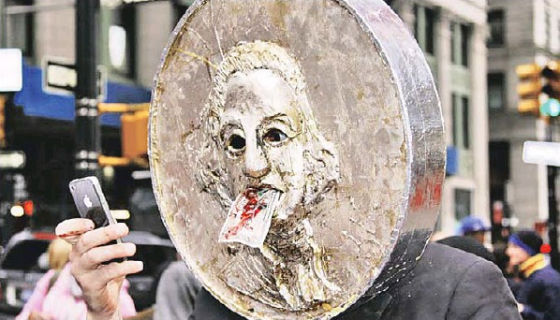
Occupy Museums' Noah Fischer
In the 1960s and early 1970s, art and politics were peas in a pod. For die-hard critics like Barbara Rose, who lived through these decades in New York, that was the time to be alive. Art was good then, and now it sucks.
That all may sound rather black and white, but its literally the argument Rose makes in the pages of this month’s Brooklyn Rail. While elegantly worded—like anything you’d expect from a life-long art critic— “The Politics of Art” succumbs to an almost fairytale devotion to an era of true political art. It’s a crank of an essay, and unless you believe that yesterday’s art heros are better than today’s “kitsch purveyors”, you should be miffed.
The problem with contemporary art, for Rose, is how it pretends to have political content, when in reality it looks like the cultural industry it’s supposed to push against. (If it looks like a duck, and talks like a duck…)
Very little of this work, whose apology is that it is “consciousness raising,” amounts to more than superficial agitprop, often executed in the same slick style as the publicity and propaganda it presumably criticizes. This process thus duplicates in art the same nightmare we see everyday on TV or the Internet.
One has to wonder who she’s thinking about, since she’s talking about work over the span of forty years, and doesn’t offer up a single example. But oh, well. Whomever these artists are, art schools haven’t made them any better either.
Today’s artists, she believes, are no different from the vapid art they produce, taught to keep in line by the professionalization of art practice. “This painless integration into the cultural status quo is, moreover, the implicit objective of leading M.F.A. programs,” she claims, “which rather than developing “old fashioned” manual skills, teach budding artists how to thrive within this system. Thus the Whitney Biennial is but a step up from the Whitney Studio Program.”
Fair dues to Rose on that. Too many recent M.F.A. graduates take no risk in their work thus producing collector-friendly work upon graduation. Further, when the main benefit reaped from taking part in M.A., M.F.A., and post-professional programs looks like nothing more than a bigger Rolodex—and an “in” with leading museum professionals, art dealers, and the like—some serious re-evaluation of higher education needs to occur. It’s here, however, that Rose choses to engage with an irrelevant and stodgy Greenbergian debate of high versus low culture:
Today there is no shame on the part of artists pandering to and celebrating the base and uneducated taste of their public. At the Metropolitan Museum an exhibition of Warhol’s followers ends in a gallery exalting art as business.
There are arguments against the Met’s Warhol exhibition—having influenced nearly everyone, Warhol is hardly a unifying theme for a show—but Rose isn’t making them. Instead, she indulges in a kind of elitism that doesn’t have much place in criticism today. To say that this type of show is for the “base and uneducated” misses the mark that, in fact, there’s nothing wrong with uneducated taste. Often, it communicates more clearly and honestly than what’s fretted about within the white cube anyway.
From here, Rose launches into a back in the day argument, and that’s when things really start to go downhill. “[T]here was a time,” Rose waxed, “when artists risked physical abuse and exile in an attempt to change the course of history.” Mark di Suvero, an artist who exiled himself to France from 1971-74, is her poster child:
The newsreel footage of police beating a crippled Mark di Suvero at an antiwar protest in Chicago remains a sickening reminder of that dark era. In protest di Suvero erected a 100-foot high Peace Tower in Los Angeles on which other artists hung their works in solidarity. Ultimately di Suvero went into exile vowing not to return to the United States until the Vietnam war was over. To keep his word, he did not attend the funeral of his beloved father, instead creating the monumental steel sculpture “Mon Pere, Mon Pere” in his honor which could not be seen in the U.S. until the war ended.
Di Suvero seems to be an extreme example of, assumedly, political devotion—not every artist hopped over the border during this time—and it doesn’t offer much in the way of advice for artists today. And what would that get them, anyway? It’s not like art solved all the world’s political problems in the 1960s and 1970s. Would today’s young artists be better off by moving to France? Making towers of peace? Or protesting more? It’s telling that Rose never mentions the Occupy movements in her essay, which caused a board shake-up at Momenta Art.
It’s unclear, what, if anything, Rose knows about these contemporary movements, and that’s a problem. It means she’s dividing entire generations of artists into do-gooders and do-nothings, without any apparent purpose or end. It means the act ultimately looks like nothing more than ethical one-upmanship. For young people, that’s a pretty rotten deal.


{ 11 comments }
I attended the Brooklyn Rail editorial meeting with Barbara,
and spoke with her personally . She is
very much aware of the “Occupy” movement as it was brought up by some
writers, but obviously questions its relevance and importance in regard to
contemporary art practice.
Actually, it’s not obvious that she questions its relevance. She never mentioned it once.
Personally, I don’t see how she can applaud Mark di Suvero, an artist who has had basically no impact on young people’s understanding of the Vietnam war, and not mention Occupy. The gamble that events like the Rolling Jubilee won’t be relevant, has already been lost.
I would interpret the fact that, although well aware of OWS “she never mentioned it once” because In this case, it didn’t deserve mentioning.
The Occupy movements, including Occupy Museums, are politically active groups including artists, the type that Rose applauded in the 1970s and finds sorely lacking now. They deserve mentioning because they’re the type of politically active groups Rose claims we don’t have!
I’m sure the Brooklyn Rail would consider publishing a well written response if you’d like to chide Rose for her oversight.
I’m sorry but did I read the same article as this author? Quibbling over the historical / critical importance of OWS notwithstanding; I feel that although I don’t agree with Barbara Rose to characterize her rather well thought out and elucidated argument as a screed or tirade just isn’t accurate. The assessment that she presents a black & white, dogmatic speech about how much better art was then and how now it all sucks just doesn’t mesh with what she actually said. Her citing of contemporary artists like Shirin Neshat as well as Margolles who she actually praises at length are perfect examples of her trying and succeeding to find something of value in contemporary art. In short, if Rose’s piece passes for a tirade than what does this response piece resemble.
Hi Brian,
I totally agree with Rose on some points, but when she brings up contemporary art, she doesn’t think politics works so well here in the States. Unlike artists in non-Western countries, we are unable to make politically effective work because, she claims: “Art can no longer be politically or culturally subversive because we live in a society of such absolute tolerance that the Mormon Church made no objection to the obscene and scatological satire of its practices in a tawdry Broadway musical.” In the same paragraph, she goes on to mention artists like Ai Weiwei and then in the next, artists like Neshat and Margolles, who are able to make politically effective work because of the stakes of making an artistic and political stance, stating: “Mainly this work comes from societies in which there are or were real consequences for opposing the regime.” For Rose, there is a gap in overall efficacy based on the type of governing structure where an artist resides, but this gives artists working in the States a very dim future indeed.
Hello Corinna,
I feel like this is a much more valid but different argument than you make in your original response piece. I entirely agree with you that her dismissal of contemporary American art seems to be contingent upon her assumption that there is nothing at risk in America anymore. That’s actually my biggest problem with Barbara’s original piece, that she equates risk as being purely political. I would say that artists today have the greater risk of the financial, we are in the middle of an economic recession that has hit the arts especially hard. I feel that artists like Latoya Ruby Fraizer have addressed this in an especially political manner. However, pointing out that she makes no mention of OWS and making it seem, to this reader at least, that she is dismissive of contemporary art in general just doesn’t seem on point. Why focus on what she doesn’t speak of when you could focus upon calling into question what she does? I feel like a better path might have been to look at her piece from the angle of how she views the things at stake because that would have allowed you to undermine both that claim while still addressing the attention she pays non-American artists instead of ignoring that component which I believe gives the impression that you merely glossed over it because it didn’t fit your original thesis. Ultimately I think you and I are in agreement, I just feel that your argument might have been more coherent if it had come at it’s points from a different angle.
I’m sure we agree—thanks for that—but even though the global argument for political art could have been hit on more, I’ve heard it before. The most pressing issue—more than her discussion of “uneducated taste”—hits a lot closer to home, and it involves how artists here in the West (her “contemporary art” and including artists like Fraizer) cannot make subversive work, like artists in the past:
“There was a time when artists risked physical abuse and exile in an attempt to change the course of history.”
“During the race riots and overseas massacres of the late ’60s and early ’70s many American artists protested the barbarism of their culture. Some, like Ad Reinhardt, Don Judd, and Jack Youngerman lead marches or were jailed but separated their abstract art from their political activities. Others, whose actions are documented by Lucy Lippard in Six Years: The Dematerialization of the Art Object, the subject of the current Brooklyn Museum exhibition, devised strategies that for a time subverted the ability of the art world and its institutions to commodify art as a commercially traded object.
However, today subversion as a tactic no longer works as museums compete to do exhibitions of earthworks, installations, conceptual art, et. al. that seemed so radical at the time.”
“Warhol paid a price for his provocations. What makes today’s political art different is that there is no price for subversion.”
And then, when Rose goes on to complain about rising rents:
“That was then, this is now. Today, real estate czar Aby Rosen, who specializes in evicting tenants (like me and Robert Wilson for example) in order to inflate rents on rent stabilized buildings or turn them into condos, now collects architecture—the new status symbol for the uber uber rich—like Mies van der Rohe’s Park Avenue Seagram Building as well as Skidmore, Owings, and Merrill’s iconic Lever House across the street.”
I would think that’s the perfect time for some irl subversion.
If they want to republish this post they have our permission.
I just sent the link.
Comments on this entry are closed.