
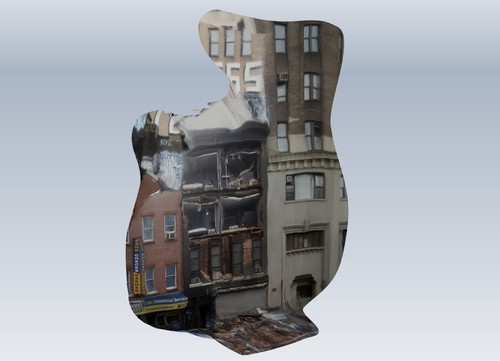
"Collapsed Building, NYC - 3D," by STML. Photo courtesy of new-aesthetic.tumblr.com.
Most AFC readers have probably heard some of the responses by now to this year’s South by Southwest panel “Seeing Like Digital Devices” in which British technologist James Bridle presented his New Aesthetic project. For the past year, Bridle has been compiling a Tumblr of images, mainly of satellite photos and colorful design objects which look like they’ve been run through a computer (have obvious pixels), alongside emerging trends which humanize robots. Together, things like pixelated camouflage and Transformer porn cartoons illustrate an android’s vision of the world.
The New Aesthetic took off soon after, thanks to a response essay to that panel by respected tech writer Bruce Sterling, hailing it as the new avant-garde. His case for the New Aesthetic as a legit movement was helped by the fact that Bridle’s fellow panelists included a bevy of art-tech public intellectuals: Rhizome Senior Editor Joanne McNeil, Cooper-Hewitt National Design Museum Senior Engineer Aaron Straup Cope, Wired UK Contributing Editor Russell Davies, and the UK Government Digital Service’s Head of Design Ben Terrett.
Sterling’s essay provoked months of more response essays, and responses to those responses. On average, the New Aesthetic seems to get more of a rise from technologists, less with artists, and least with art writers. Critics mostly agree that something’s happening, but feel that the New Aesthetic doesn’t ask the hard questions (Gannis, Chayka, Zigelbaum and Marcelo Coelho). It needs to get weirder; it needs to move past shared images; it needs to go native; it needs focus. Art writers in particular knocked its remarkably short memory. The arts community seemed nonplussed by the idea of creating a new worldview based on a collection of images. As tech-minded artists like Jamie Zigelbaum and Marcelo Coelho and Carla Gannis have pointed out, art already does that.
After a few months’ lull in the dialogue, Rhizome’s Joanne McNeil arranged another panel at the New Museum called “Stories from the New Aesthetic”. Its makeup showed how much the ongoing public discussion has impacted the project: all three speakers were on the previous talk, at SXSW. Tickets were sold out for a largely student-aged audience. “Artists are starting to make things that look like the Internet,” I heard one someone explain behind me, thus providing my only primer (the handful of people I met afterwards hadn’t heard much more than that). Like Bridle’s essay earlier this year, panelists wandered through the garden of the Internet, cherry-picking what fit the theory; the discussion felt similar to the tailoring of a Tumblr or Pinterest experience. As such, they all looked and sounded the same. Artists were rarely mentioned, but there were a lot of Streetview screenshots.
Aaron Straup Cope (whose full talk you can read here) loosely structured his presentation around the idea that programming reveals something about our own motives. Self-driving cars would have to be preventatively-programmed, for instance, while Siri leaves room for the illusion of new interactions. Looking through technology opens up our view of the world, he argued, pointing to how Instagram filters compel people to post more photos.
But then he extended the idea that we’re just barely keeping on top of technological advancement with the implication that robots can actually see:
There is a larger question of whether our willingness to allow the robots to act of their own accord on [looking for patterns] constitutes de facto seeing but, by and large, we continue to actively side-step that question.
But Cope didn’t have any proof of artificial intelligence, beyond the existence of drones— apparently, self-evident because they appear to drive themselves. As new media documentarian Jonathan Minard, among others, has pointed out, the New Aesthetic’s intrigue hinges on imagining that you’re seeing these images through the sentient eyes and mind of a robot, as though the webcam is looking back. When recalibrated as the human images which these are, we just end up with far more shitty photos and less privacy.
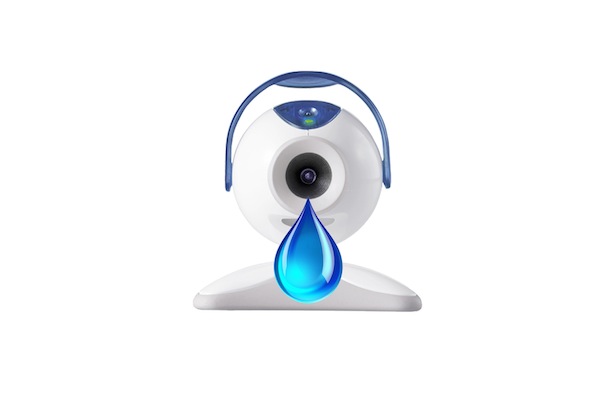
Image for Dora Moutot's "Webcam Tears" project. Photo courtesy of webcamtears.tumblr.com
Joanne McNeil (full talk here) described the psychic space created by machines, as revealed in things she did on the Internet, like posting a photo of a jellyfish as a location on Instagram, or fantasy images that are a result of computer programs, like a realistic rendering of a seemingly infinite bookshelf. McNeil mentioned projects like Dora Moutot’s “Webcam Tears” and Clement Valla’s collection of Google Earth glitches (also part of the current show “Collect the WWWorld” at 319 Scholes), but they were treated as vessels to look at Internet trends, rather than intentional creative acts. Like Cope, she flipped between slides of what the camera sees (Google Street View interiors) and dead-on images of the lens: again, literally assigning the camera a personality.
McNeil held no reservations about her motive to promote the project, concluding: “It’s not radical to point out that the digital and the physical co-exist and that they’re layered upon each other, but it is still unusual, and it’s something that we’re experiencing right now….and it’s why I think the New Aesthetic project is quite valuable.” But if we’re going to declare Bridle’s project as significant as the change it documents, then the same could be said of any number of documentary projects—people who are collecting Occupy Wall Street photos, for one. That’s wishful thinking—people rarely get what they deserve in the art world—but you can expect people to deliver. McNeil’s in the business of promoting artists.
New Aesthetic founder James Bridle then seized the stage: wildly gesticulating, he poured forth a double-time of storytelling and slides, interjecting things like “and yet, and yet, and yet!” I get now why Bruce Sterling described the New Aesthetic as being in its “evangelical, podium-pounding phase.”
It’s important to note that, since the SXSW panel, Bridle has been making less of a logical observation than a visceral appeal. He thinks of a Kafka quote in terms of Tumblr:
You do not need to leave your room. Remain sitting at your table and listen. Do not even listen, simply wait, be quiet still and solitary. The world will freely offer itself to you to be unmasked, it has no choice, it will roll in ecstasy at your feet.
You can experience an elite revolution, in other words, without doing anything. The New Aesthetic promises a Whitman-esque romp into the endless scroll, over the pop fetishization of the pre-computer age.
That zeal came through in the sermon. He started out by lecturing us on what he sees as a widespread reluctance to embrace the inevitable. “Nobody talked about the smell of the book until people started worrying about e-books,” he said.
…even though those things were completely irrelevant, but we had nowhere else to put our fears about what actually might happen…that we identified the cultural importance of literature so closely with a physical object that we could only tie it to its physicality.
He told us that, when it comes to books, what people really care about is: the ability to discuss them, to keep your place, a sense of ownership, and the souvenir of your experience with them. E-books, according to Bridle, “haven’t quite figured that out yet.”
But herein lies the problem with the entire panel: no matter how robotic we’re striving to be, market research doesn’t substitute for human experience. Maybe it doesn’t make as much sense to own a physical copy of Fifty Shades of Grey, but the act of reading an e-book is more than gleaning necessary information from row after row of code. Like any object, the book can also be a gift, an heirloom, an antique, a physical record of someone’s life. All that physicality is inconveniently sentimental.
E-books were just one example of how we’d better get with the program before technology eclipses us. Here, Bridle told us about code/spaces: a name professors and co-authors Rob Kitchin and Martin Dodge gave to physical locations like airport waiting rooms or the Amazon warehouse that are organized by software, without which, they become totally useless. But should the power shut off as it did a few weeks ago, I still managed to find the temporary subway shuttle without my phone; I asked someone.
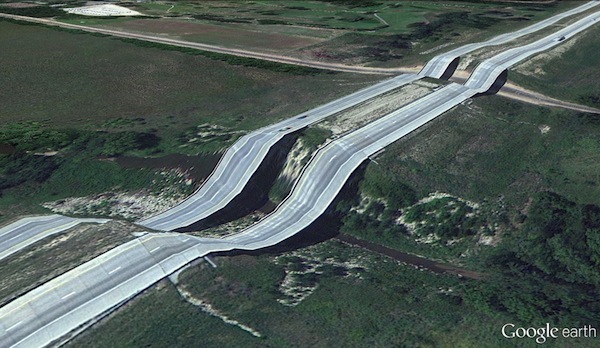
One of Clement Valla's "Postcards from Google Earth" (Photo courtesy of clementvalla.com)
Then another slideshow of New Aesthetic-y stuff. Bridle mentioned Clement Valla, who he’s a “huge fan of,” possibly because Valla’s collecting map glitches, which Bridle half-jokingly described as “one of the largest New Aesthetic artworks ever.” Ha, ha. He’s recently filed Sandy images under that moniker, as well. “It doesn’t matter that most of these things are banal. That’s kind of the point,” he told us. Computer systems are so ingrained in our way of seeing the work that the point is to examine how we’re looking, not the actual products of looking. It was the only statement he made that night that showed signs of even searching for revelation, let alone finding one.
But even that is more of an observation than a takeaway. As artist and digital media professor Carla Gannis wrote of the New Aesthetic back in May, “A movement cannot merely catalogue what currently exists, it is defined by the future(s) it envisions.”
That future materialized in one of Bridle’s more memorable quotes: “Opinions are non-contemporary.” That’s a funny idea to table amongst a panel of speakers who all happened to share one, very strong opinion. Nobody’s changing their mind about what they like; Bridle’s vision seems to diminish empathy more than anything else. Luckily, we were all spared the Q&A, as rows of the audience stood up and walked out as soon as the lights went up.


{ 13 comments }
Isn’t this seapunk? Already jumped the shark. Also this is wrong: “Nobody talked about the smell of the book until people started worrying about e-books.” Giles totally talked about book-smell in the first season of Buffy.
YES, thank. you. I was looking for that example. To be fair, though, I thought the book smell thing was bullshit, too, but I couldn’t actually find a good counter. Turns out Giles is comparing books to computers. It’s annoying, because I don’t think smell is completely irrelevant.
http://www.youtube.com/watch?v=E_M108B3mdY
Isn’t this what Penelope Umbrico has been doing for years, with great intention and critical distance?
I continue to be amused by art writers’ persistent hostility towards The New Aesthetic. What is it that makes this meme so threatening that it must be dismissed at length and with great gusto?
It’s not hard to see that Bridle’s techno-optimism is incompatible with critical art discourse, but that doesn’t mean he doesn’t have a point. Sure, the endless fawning over Google Streetview and Instagram is a little tedious, as is the insistence on “how machines see”. But can you honestly dismiss the idea that technologies like machine vision, 3D printing, search engines and unmanned drones are impacting our cultural landscape in ways that are significant and worthy of critical consideration?
The reluctance of the art world in engaging with technology as cultural artifact is a giant blind spot, amounting to an absconding of responsibility in the face of something that is at odds with the rarified narrative of art. No amount of snarky commentary will save you from the continuing onslaught of new and bizarre aesthetic artifacts produced by the intermixing of technology and culture. And by the way, did you even consider that the very existence of blogs like this one is one of those artifacts?
The New Aesthetic has plenty of weak spots that leaves it open to attack, but outright dismissal is unwise.
Marius, although I respect your defense of technology as cultural ARTifact and that indeed, it is a FACT that resonant, meaningful, “Canon worthy” art can be created with the aid of machines, I’m not reading in(to) Kimball’s report a reluctance of the art world to engage with technology, (or to be more specific, the art world AFC represents). Instead I think many in the fine arts, digital arts, and the #FineDigitalNewMediaTransdisciplinaryMashedUpTwentyFirstCenturyHybridArts are asking for a more complex and meaningful interpretation of tech-inspired and driven art practices. The dismissal here is not of art but of the trite ideology engendered by unfiltered “techno-optimism”.
I guess I was wrong, then. See, to me the above reads like a facile dismissal of the cluster of ideas put forward under the New Aesthetic umbrella, achieved by rhetorical sleight-of-hand and a handy supply of admittedly naive statements on the parts of Bridle and company.
Nowhere in Kimball’s text do I see any discussion or acknowledgment of
the core tenets of The New Aesthetic, namely that: A. Technology is
producing cultural artifacts of a paradoxical and often accidental
nature. B. These artifacts are rapidly coming to frame our perception of reality
and thus deserve investigation, both critical and aesthetic.
Kimball’s summary seems to be simply that there is nothing to see here, we can
all rest easy knowing that these people are just a bunch of kooks. That is not a complex and meaningful interpretation in my book.
I have no trouble seeing that The New Aesthetic stands the risk of being perceived as “unfiltered techno-optimism”. Its tendency towards fascination and fetishization of the artifacts it discusses is obviously problematic from a critical viewpoint. But without that fascination there would be no investigation, and thus no debate.
Technology’s impact on aesthetics/perception is well worth investigating; that’s why artists have been doing it for decades. Just saying that this particular version doesn’t deserve lauding in an art context.
Anybody can shower their optimism on things they found on the internet, that’s what tumblr and pinterest are for. With no attempted analysis, what are you contributing?
It seems I am in the business of flogging dead horses, but why not.
Whitney: Let me re-state my rhetorical question, except this time I’m actually looking for an answer. Do you agree or disagree that technologies like machine vision, 3D printing, search engines and unmanned drones are impacting our cultural landscape in ways that are significant and worthy of critical consideration?
If yes, isn’t it a good thing that Bridle is at least offering up observations on those topics, even if they are presented in the form of a naive wunderkammer rather than a critical discourse? It seems to me that the astounding (popular) success of the New Aesthetic meme has done a pretty good job of setting an agenda for further discussion, even if it did so in a way that is not to everyone’s liking.
Perhaps this would be a good point for arts writers to pick up the glove and change the narrative, perhaps to introduce the critical analysis that you ask for? I’d love to see that happen. Really, I would. Unfortunately I don’t think the above article does the job.
PS: I’m curious about your insinuation that we should be suspicious of Joanne McNeil’s motives because “McNeil’s in the business of promoting artists.” Isn’t that the very same business you’re in?
Carla: This is just a side-note, but I see no need to defend technology as cultural artifact or the notion that “canon-worthy art can be created with the aid of machines” (of which my comment said nothing at all). Those are just facts. The unwillingness of art writers to engage with those facts is what I find problematic, if hardly surprising.
Why not address those concerns rather than simply stating they exist? It seems to me it is easy for people to post about how “obvious” these problems are, but never really seem to get around to actually posing any specific concerns.
Thank you for sharing this, but off topic , I guess many students would surely need textbooks , you may recommend them to go browse at bookboon dot them, this site would surely be useful to them.
Once again: Yes, I agree that new technologies are impacting our cultural landscape and is worthy of *critical* consideration. The New Aesthetic does not offer any.
That criticism has already been opened up, in projects which view the world from the point of view of Google images, by the likes of Guido Segni and Clement Valla, or flickr, by Penelope Umbrico, or the TV, by Andris Feldmanis. Or yearning to see an ideal version of yourself through Second Life, by Eva and Franco Mattes or Cao Fei. Or manipulating one’s own body through the technological lens, by Petra Cortright, or Steina Vasulka. Or adding an awareness of how corporations control a lot of that sphere, by Constant Dullart or the FAT Lab. We even see this accomplished by artists who simply work with ideas of military surveillance, like Trevor Paglen. I admit, though, I’m cherry picking.
What undermines the value of the whole New Aesthetic project for me is the astounding arrogance of putting into religious terms something that everybody’s already experiencing. It’s like taking full credit for being the first to notice that space is vast. That, combined with the astounding arrogance of disregarding the community from which you’ve chosen to propel yourself.
I mean, seriously, who holds a panel of people who all agree with each other to reiterate what they said at their last panel?
Whitney, Thank you for your timely article. I agree with your argument and feel your understanding of the New Aesthetic (as a good piece of marketing rather than an art movement) is accurate. To me the New Aesthetic is clearly a symptom of neophilia promoted in much the same way a brand would promote a product (it was launched at SxSW after all). Plus, every good product needs a celebrity endorsement and what better than from Bruce Sterling – that ought to keep those 140 character hungry attendees happy. It seems, almost accidentally Bridle and co. managed to successfully harness the infectious virality of social media to their own means (thats to suggest they knew what they were doing).
Have you seen Dan O’Hara’s latest article in Imperica Magazine?
http://www.imperica.com/in-conversation-with/dan-ohara-on-ballard-cyberpositive-and-the-skeuomorph
I feel he may further elaborate on some of the points you have touched on. O’Hara notes that the name ‘New Aesthetic’ is,
“Quite provocative and ambitious, as a name for what James Bridle subsequently insists isn’t a movement. There’s the traditional art manifesto gambit of trumpeting the ‘New’, as if we’re all drowning in old, stuffy, cobwebbed art which needs sweeping away by something bright and shiny and challenging and urgent. And then there’s this complex and dignified word ‘Aesthetic’, which flatters what’s being described with a coherent philosophy and entices commentators to discuss it as though it had such.”
O’Hara on the ‘New Aesthetic’ as Marketing,
“New Aesthetic is a tremendous piece of marketing. It picks up on the cutting-edge digital imagery of the last twenty years – though only via current examples found on the internet – and repackages them for a mass web audience. In this sense, it’s simply at the stage of commodification all art movements reach in the West: someone picks up on them when their time is ripe, names them and hence claims them, and ‘monetizes’ them.
So perhaps it’s this matter of commodification that attracts the commentators. If you were interested in such themes and such art, you were already discussing them in the 90s, unless you were too young to do so, in which case it’s bound to be terribly exciting and, for you, of course, new. Bruce Sterling definitely doesn’t fall into the latter category.”
Like you, he agrees that the, “mainstream art world has been doing the ‘new aesthetic’ for some years now…” and points to the fact that, “What we must have with the ‘New Aesthetic’ is a philistine movement that is ignorant of art, and aesthetics, and has no relevance to history. It’s a Boorstinian ‘pseudo-event’: it’s about imagery, and psychology as a marketing tool, and commodification. But it’s not an aesthetic, and it displays nothing in common with what aesthetics are and what they are for.”
I think it might make for an enjoyable companion to your own work.
Comments on this entry are closed.