
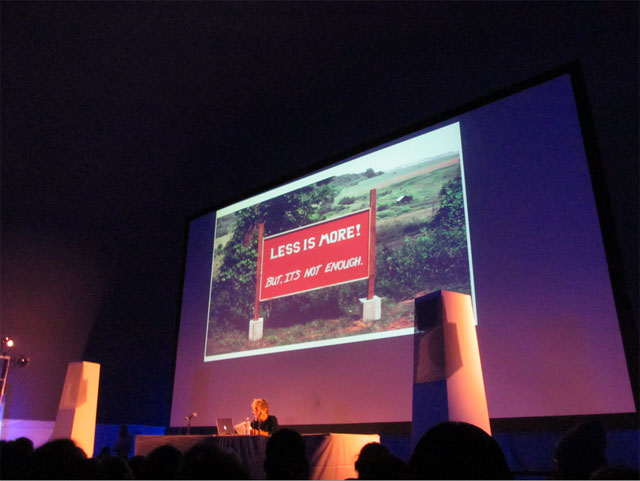
Lucy Lippard at the NY Art Book Fair
What did we learn from attending the NY Art Book Fair talks? For one, 26-year-old digital media artist Petra Cortright hates paper and 75-year-old art historian Lucy Lippard loves it.
At the fair, Cortright read from her new e-book, published through Paul Chan’s Badlands Press, and Lippard gave a keynote on the history of artists’ books from the 1960s through today. The old and new generations were rarely on the same page. But Cortright and Lippard’s talks did form an unlikely duo, both highlighting that pressing issue concerning the future of artists’ books: How do publications stave off a coffee table destiny?
Lippard made clear in her keynote that she is not happy with how many artists’ books have become so pricey, glossy, and pretty. Zooming in on the history of artists’ books as she lived it—from Xeroxed leaflets to her days at Printed Matter—Lippard described an ethos of the 60s and 70s that saw artists’ books as “cheap and mass-produced.” It was a time when bookmaking carved out a niche for artistic activity, outside the typical art market.
Look no further than the NY Art Book Fair for evidence of how jumbled the terrain of artists’ books has become. The first generations’ goals have turned into a sea of booths filled with artists and dealers selling wares for as much as a used car or as little as a stick of gum.
Still, digital books can be produced and sold at very low price points and are arguably more democratic than, you know, a pricey coffee table book. Lippard briefly touched on the advent of e-books, and it was awkward. A low point in the presentation occurred when she talked about “CD-ROMs” as if they were new technology and then asked the audience if artists made video games. Someone in the audience piped in with “Yes.”
Cut to Petra Cortright reading from HELL_TREE. Published as an unlimited e-book edition, for just $1.99 download, Cortright’s book seems to match Lippard’s interests in the bookmaking community. Lippard, of course, is clearly unaware of this, which is too bad, though perhaps unsurprising given her age and her current, self-imposed level of participation in the arts (she told the crowd that for the past few decades, she has lived in a small city in New Mexico where her main editorial interest lies with her community newsletter).
As Cortright read aloud from her iPad, she showed audiences the layout of her book. Each page showed a desktop with multiple open windows, a common motif in the artist’s work. She read from each of these windows, including the file extensions like “dot text” and sometimes, she manipulated her voice to sound robotic. This gave the book a little more life, an added layer to the book’s on-screen layout which is downright chaotic, juxtaposing text with the same space as Lara Croft-in-paradise desktop imagery (Cortright’s description).
It’s worth noting that Cortright’s work is still an outlier at a fair where, for the most part, people still purchase real, honest-to-goodness sheets of paper with a thick piece of leather on top. And what she’s doing is closer to what Lippard wanted for the future of artists’ books: something that can’t be mistaken for a coffee table book.


{ 4 comments }
petra was great & the sound effects by alejandro from arca definitely gave the reading a creepy and fun vibe in such an overcrowded room. also, she did clarify she hates receipts not paper 😉 looking forward to see how publishing reacts and acts on new forms of artist e-books as well as changing the space in how one reads an e-book…
“a desktop with multiple open windows” was a stylistic trope BACK IN 2000. Maybe earlier. In that regard we might say many digital artists are like the dudes who listen to classic rock and sport mullets. SO UNCOOL. But we can forgive 26 year olds for lacking the kind of telescopic insight older digital artists have. Digital art, while still uncool, at least has grown – from nerds who program to nerds who program visually, the “texts” are behind the scenes, or laid bare (echoing the “reveal of process” trope of so much traditional work).
I don’t have a point, but CInema4d is pretty cool and so is Processing, but I don’t have time to turn all the nobs to 11 like I used to. Or I do, but honestly, I;m getting a little worried about how I’m going to retire to the hinterlands like Lucy did. Is she still relevant?
Also: artists should learn about the Bauhaus grid for a few months and realize design is it’s own discipline with rules that you need to learn to break. Do artists even know what “smart quotes” are? I think not. Discipline!
Nobody’s saying a desktop with multiple open windows is new, but it’s not like Lucy Lippard would know that.
Good point. Reminds me of the time I heard someone talk about how artists used to write manifestos “but not anymore” – circa 1997. Funny because I thought artists statements were kind of manifestos that mostly read like an earnest teenagers description of a love affair guided by the diametrically opposed poles of scientific praxis or DIY punk/hippy expressionism. Or Dionysian and Apollonian, as I have heard (my education was inferior and hardly classical).
Where was I…oh yeah, Suzi Gablik wrote some drivel about “re-enchanting” art that I took FAR too seriously. In the same way, these avatars of samizdat (google it if you want) kind of piss me off. Like no one ever reinvented the wheel. TO WHOM do we owe anything? I guess what I’m saying is, what has Lucy Lipard done on the internet lately. Which I guess is the point. But why invoke her? THE ALLURE OF THE LOCAL?
Comments on this entry are closed.