
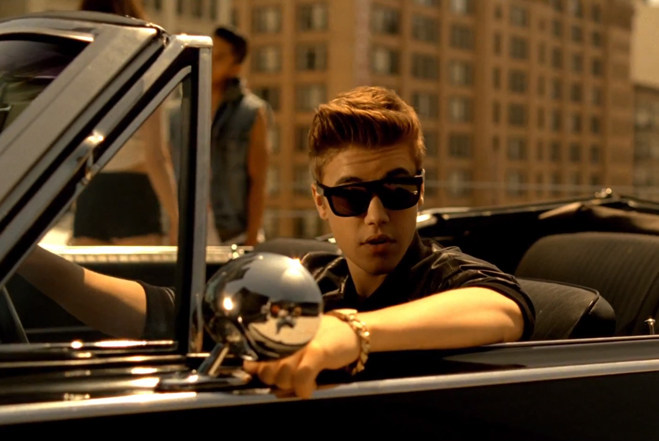
Popdust has rated this Justin Bieber's 6th-swaggiest moment. Still from the music video for "Boyfriend".
I’m no authority on hip-hop, but there’s been a tremendous overuse of “#swag” on Twitter in the past year. For those who are unfamiliar, “swag” is short for “swagger”—meaning that one possesses an admirable demeanor or cool. Justin Bieber says it seven times in his latest single, even going so far as to say “swaggy”, which some music journalists take as a sign that swag is now dead. Bieber’s use of “swag”, though, is no accident; the superstar is signed to a loaded recording venture between hip-hop star Usher, manager Scott “Scooter” Braun, and Island/Def Jam Records, each of which have a direct hand in polishing his image. It’s one of many ways the language of hip hop is moving into Western youth culture.
Cultural studies has established that suburban white kids love hip hop in a complex manner; heaps has been written on aspiration, colorblindedness, misogynism, emulation, and subordination. But just what makes hip hop so appealing to net artists? Instead of passing off any attempt to indulge in hip hop as a 1:1 relationship between appropriation and mockery, I’m interested in looking at how different artists incorporate hip hop in their artwork to talk about themselves.
Before You Use The R Word

Jaakko Pallasvuo, REALNESS, Animated GIF, 2011
Anything, by and large, can be art. After Duchamp and Fluxus, the most marketable contemporary artists get away with animal cruelty (Damien Hirst), buying unusable property (Gordon Matta-Clark), and sexual “exploitation” (Laurel Nakadate). Art about race and racism, though, is a territory that’s not immune from moralization of the artist. In a recent Jezebel post discussing ongoing blogosphere uproar over “hipster racism”, Lindy West argued that:
- lightheartedly joking about something that draws attention to someone’s race is still a racist gesture, e.g. “I know that you know that this joke about using chopsticks to noodles is SO Asian would be racist in the past but we’re past that because I know that you know that I’m just kidding!”
- when white people (or any non-black person) mimic aspects of hip hop culture they are being racist, because they are intentionally mocking a Black gangster stereotype to subordinate them.
I can agree with the first claim. Sorry that I’m not sorry; it’s not productively funny. But according to the logic of mimicry that West described in the second, diasporic acts like Die Antwoord and Das Racist would be considered racist although they use the vocabulary of hip hop to critique the genre. Prior to this, the defamation Jack Early and Rob Pruitt received for satire of White co-optation of Black music in Red, Black, Green, Red, White and Blue’s first installation reflected kneejerk social discomfort with non-Black commentary on Blackness in the media. So non-Black desire to be Black in mannerism is something that is awash in the media and everyday slang, but unspeakable in public.
Black artists are also not free from criticism from accusations of ghettoizing their own culture. A recent performance of Blackface cakecutting that was orchestrated by Afro-Swedish artist Makode Aj Linde invoked criticisms of racism and sexism against Black women from mainstream news reporters and scholars. Enacted at a World Art Day celebration, the Swedish prime minister partook in cutting the nether regions of a cake in the shape of an African woman’s body. Positioned at the head, a cosmetically exaggerated “Blackface” performer screamed while the Swedish Prime Minister cut the cake. Makode Aj Linde intended for the performance to draw awareness to female genital mutilation, but the social response to the event revealed the hypocritical power relations between Black artists and institutions. Black artists can talk about White stereotypes and treatment of Black people in a historicized manner—as a historicized discourse—but a satirical re-enactment, however empowering, is morally questionable because of its potential for literal interpretation.
The first artist to come to mind now when you mention hip hop and contemporary art, Hennessy Youngman, is black. Ridiculing the lofty whims of museum art in the form of the talking-head YouTube video, Jayson Musson’s persona credibly lives up to the white fantasy of the “gangster” stereotype. However these assumptions are unseated by how acutely he can talk about academic art with street language. This tactical performance is known as strategic essentialism: performing a stereotype to disrupt existing ideas of them.

Hennessy Youngman, though, was not the first to use this tactic online. Chuleta (Wanda Raimundi-Ortiz) started doing gallery walkthroughs and art rants over a year before Youngman’s debut on YouTube, but failed to receive the same acclaim. Chuleta’s experience demonstrates how distribution on oh-so-democratic online platforms alone won’t necessarily make the common person famous. In fact, certain performed stereotypes are more fancifully validated by the art world for their potential to be ironic and funny for white gallery-going audiences. (Recall Kalup Linzy, Vaginal Davis, or Rashaad Newsome—all young, tokenist, intersectional queer Black artists who are often included in your typical survey show of American contemporary art!) Conversely, dissent from a bitching “ghetto Latina” stereotype might appear less palatable to audiences unfamiliar with hip hop.
The R Word
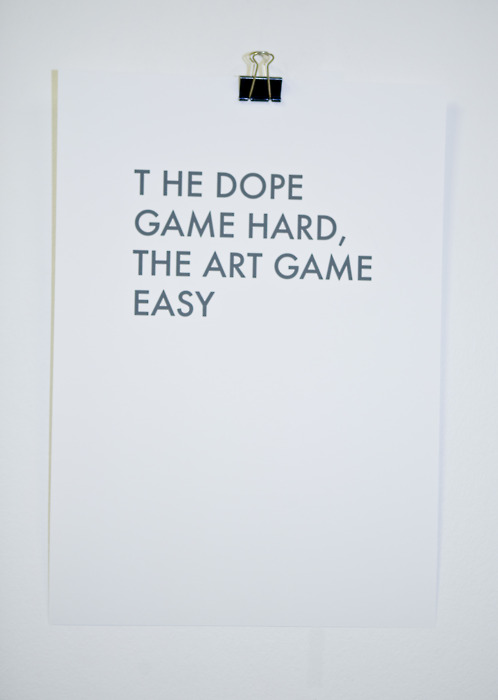
Ida Lehtonen, Artist Statement, 2011
Geek culture and mainstream hip hop have two things in common: both are fairly male-dominated, and both are rife with misogynism. Some obtuse comparisons between net art and rap music could be best summed up by Absis Minas:
If any correlation at all can be drawn between the aesthetic sensibilities of early hip-hop and that of the burgeoning web 2.0 art community, it’s a surface one… both are small-scale, inclusive, and therefore both subject to a certain amount in-group bickering used as (and not in lieu of) artistic content…it would be a lie to say that the world did not find entertainment in the perpetual squabbling of individual rappers…it would be a larger lie to say that the world knows enough about it to bother caring.
The biggest critique of emerging net art so far is its insularity and abundant callow content. The immediacy of sharing art on social networks creates an environment of creative competition where artists keep trying to outdo each other by making the most reblogged one-liner artworks with the newest technologies.
This shouldn’t be surprising. From the advent of photography to the rise of online video, each challenge to art’s craft and authorship has caused it to become more self-referential. Net artists realize they are making work that’s seen by audiences with highly specific knowledge, so self-reflexivity, or a conscious extra layer of reference to one’s position, is a common tool.
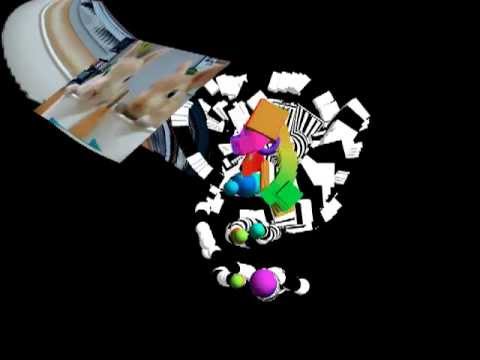
For White artists working with hip-hop, this self-reflexivity is often used to address taboo. Jeremy Bailey’s practice, for instance, toys with stereotypes of the “famous new media artist.” In a livestream performance for a Nam June Paik retrospective at the Tate Liverpool, Bailey mocks masculine authorship by claiming to be the first to perform for a computer in the lineage of Nam June Paik, the father of video art. Hacking a Kinect to erase his own skin colour, and motion tracking his limbs with coloristic, augmented shapes, Bailey becomes a bodiless and raceless subject–a virtual body-sculpture performance. His performance addresses disjunctions between white nerd computer culture and the carnal aggression of Lil Wayne’s “Drop the World”. As Lil Wayne declares “Imma pick the world up and imma drop it on your fucking head,” Bailey’s bodily assemblage explodes, collapses, and disperses across the black space of the screen. A rotating image of bikini babes replaces hip hop’s formulaic video girls.
In a similarly self-deprecating performance, Jaakko Pallasvuo casts his queerness as out of step with the prototypical images of the “art-fag celeb” or the nerdy new media artist. In Vanilla (2011) an audience claps to the beat as Pallasvuo dances hideously to “Drop It Like It’s Hot”, rubbing vanilla ice cream over his face and body. It’s important that he’s doing this six years late; the song was hot in 2005, and here bad taste in performance meets bad taste in music. In both Pallasvuo and Bailey’s work, the absurdity of self-deprecation invokes humor, which lets viewers laugh at the artist’s self-imposed embarrassment. The same mechanism also inoculates the artist from accusations of offensiveness or irrelevance.
Swag Overload
Not all artists opt for the protection of self-reference; some direct their irony outward. Glasspopcorn (Will Neibergall), whom ArtINFO has questionably called “the Art World’s next Justin Bieber”, describes himself as an “international superstar tween rapper” on his Tight Artists page. He’s fifteen and net famous because he is friends with Ryder Ripps and hangs out on dump.fm a lot. In line with Bailey and Pallasvuo’s methodology of satire, Glasspopcorn’s songs “swag face” and “Ed Hardy” recite “swag” to the point of overkill. In “swag face”, he consciously mocks White mimicry of mediated Black coolness, while “Ed Hardy” works as a fanatic yet repetitive homage to the lowbrow fashion and footwear line. Jeremy Bailey and Jaakko Pallasvuo are performing self-mockery by instantiating failure to belong with rap culture, but Glasspopcorn appears as pure mockery of Black and white gangsters.
While Neibergall might struggle with viewers taking him seriously as a young artist performing in the shadow of Bieber, CBS and ArtINFO didn’t see a problem with him rapping while a plus-sized Black woman crawled around on stage at his first public appearance at Ryan Trecartin’s PS1 opening. She might feel empowered, and undoubtedly consented to perform, but without the inoculation of reflexivity the performance looks pretty racist and sexist—not to mention sizeist. Besides Glasspopcorn’s youth, there’s little in his performance to actually challenge the “lurid masculinity” he claims to see in mass cultural products like Monster energy drinks.
Going Shallow
Often, references to hip-hop in net art are self-reflexive without being ironic, and that self-reflexivity acts as a cloak for channeling profoundly personal attractions to Black swag. For example, Robert Lorayn’s stacking videos demonstrate a skilled transformation of gang signs into dance motions with his hands. Eventually none of the gestures look like gang signs, and none of the music he “dances” to is hip hop.
In the work of Ann Hirsch (scandalishious), confused reflexivity plays out in exaggerated ways. Performing extremes of her personality that volley between sweet and moody, awkward and sexy, Hirsch’s dancing camwhore videos discuss the paradoxes tied to women’s sexuality on the internet: Camgirls are both lauded for their sexiness and denigrated for stupidly exposing themselves. Appearing as an alter-ego named Caroline Benton, who makes confessional vlogs and dance videos, Hirsch infuses the camgirl with humanity and quirk by dancing for the webcam in domestic settings. Whether “exploring the dark side” to witch house in her bathroom or rocking her hips to Snoop Dogg’s “Sensual Seduction” in her kitchen, Hirsch mimics the camgirls, but also delights in the dancing. Her self-consciously sexual dancing is awkward, but also self-satisfied. Similarly, in the work of Mary Rachel Kostreva, dance expresses performative pleasure in urban music away from the club setting. When Kostreva makes videos of herself dancing to the intensely misogynist lyrics of Drake and Lil B with webcam filters, her engagement is sincere.
Kostreva, along with Adam Harms, started Tight Artists, a network which describes itself as “a community of trill artists going creatively ham on the net at all times”, offering customizable HTML galleries and profiles for net artists. The network’s only rule is “Don’t hate”.
In an email interview, Bailey mentioned that users enact a confused reflexivity when one sees their self-image feedback on a camera’s video preview window. Perhaps the sense of interpersonal distance offered by online profiles allows users to feel more open to trying on identities they would otherwise not act out in real life.
The Pleasures of Hip Hop
Other times, artists approach hip-hop as themselves. Devin KKenny’s Studio Workout Vol. II (2011), a collection of remixed songs, draws a direct line between artistic competition and hip hop culture, sprinkling its lyrics with truisms about contemporary art. KKenny highlights gaps between Black gangster culture and the professional practices of contemporary art, giving shout-outs to art critics while satirizing white male dominance in abstract painting and minimalist sculpture. Unlike Yung Jake’s consistently ironic auto-tuned commentary on the trendiness of glitch in “Datamosh”, tracks like KKenny’s “Hard in Da Paint” sound like authentic confessions of the mediocrity of being an art student.
Mike Ruiz’s Versions Freestyle, meanwhile, features the artist freestyling over Oliver Laric’s Versions (2010) video essay. In the original video, a computerized voice garbles about the infinite reproducibility of images as versions of reality, while carefully selected diptychs of images and footage from popular media present similar actions and scenes to show how the image is vulnerable to appropriation and doctoring in the digital age.
Ruiz’s cover, recorded from a computer microphone, is spontaneous and amateur, to the point of appearing to ridicule Laric’s video. For Ruiz, however, freestyling is an homage that functions like sampling and remixing. His witty and incessant commentary throughout the nine-minute video demonstrates an enduring appreciation of the theoretical cruxes of the original. In an informal skype chat, Ruiz revealed he had been freestyling for fun in Austin since his teens, and found that Laric was also a prolific freestyle battler at parties in Munich. Instead of mocking swagger, the two artists share a genuine and apolitical affinity for hip hop.
Swag on Infinity
Black men’s bodies and sexuality are all over the media. We have to admit we both love and fear ideas of the Black gangster. Black swag is fetishized, feared, appropriated, assimilated into western pop culture. It is hybridized, transformed and assimilated by users as subgenres, commodified as lifestyles and given meanings that have little to do with its history and politics. We feel alienated from rap and find the glamorization of drugs, bitches, and guns laughable; we find entertainment in what’s Other to also be cool. The culture industry and the art world alike tend to reduce their talents to easily-digested archetypes.
My hope is that viewers become sophisticated enough to recognize these representations and to talk back to them. We should recognize that the line between co-optation and appropriation is very fine; sometimes, an artwork may be both. It’s impossible to mark off a politically correct turf for commentary on hip hop without implicating our race and our intentions, and we should remember the importance of questioning the author’s assumptions about race and class when we encounter a work with hip hop. In the case of Lindy West: a hipster does not a young white poor creative make, and hip hop doesn’t equate to American Black culture.
Trying to preserve cultural sovereignty over hip-hop is a losing battle. Hip hop has become a diverse hobby for people around the world, and should be as open to cultural criticism as anything else in the public domain. When Ang Lee made Brokeback Mountain, he stretched and queered the archetype of the American Western; was he ripping anyone off? Users are seeing opportunities to play with language in the informal space of the web, and not all of it can be read behind a lens of “appropriation”. Appropriation is what keeps the swastika from becoming a religious symbol again, but the next guy who does a Drake cover probably just likes the music.


{ 51 comments }
first
The dawn of swag
http://voices.washingtonpost.com/dcsportsbog/2007/01/gilbert_arenas_has_swag.html
F swag appropriates punk symbolism
http://cdn.hypebeast.com/image/2011/11/aap-worldwide-nike-sportswear-destroyer-jacket-2.jpg
blondie
http://www.youtube.com/watch?v=pHCdS7O248g
lil B positive
http://www.youtube.com/watch?v=dsjvFrZv1Fk
lil B super negative (NSFL)
http://www.youtube.com/watch?v=ODai2ceJQ6E
Who has better flow?
http://www.youtube.com/watch?v=yhXhVMKxnkY
This is mainstream.
WTF
http://www.youtube.com/watch?v=m3gRH-hPS9I&feature=related
FTW
http://www.youtube.com/watch?v=mwZ1b_-54ps
Feels like you are assuming the music is an “authentic” piece
of culture that the artists you highlight are creating friction with. It seems to me that the artists you highlight play more in the register/space of the marketing mythologies of urban music than anywhere else. When we
look at Drake or Rick Ross, there is already so many layers of parody and repetition
at play.
Without getting into the void of authenticity talk, isn’t most
commercial rap already performing the gestures we see so many of these net artists
amplifying or exploring? Unexpected juxtaposition, claims to authentic lived
experience, taking ownership of previously unavailable culture etc. The single punchline joke of “I’m white and like rap” or “I’m rich and mocking/confronting poverty” have already cycled through rap itself endlessly.
There seems
to be something much more disturbing at play in the production of mass media
narratives of blackness then what’s happening in any of these artists work. If anything the question that interests me is how net art exploring race through rap engages the imagined or real audiences of commercial urban music, the actual people whose lived lives these mythologies take their claim to authenticity from.
#notcogent
I agree and think some users and artists have on internalized what the media glamorizes (re: confused reflexivity). Since they’re working with urban music the artists in this article are a fraction of real rap audiences, and most of them fit that archetype of growing up in suburban/cosmopolitan environments where rap is most popular amongst white communities. (An assertion made by media theorists/sociologists in 2000s at least. I.e. http://books.google.com/books/about/Why_White_Kids_Love_Hip_Hop.html?id=F49qOcO6SzMC) This statistic alone makes assumptions about their whiteness, middleclassness, and (in)ability to be critical about hip hop based on the fact that it IS popular in those communities. With these observations, we can blame the media or look at how are negotiating with those representations for better or worse. Because we so heavily associate hip hop with Blackness in America, (the culture is where the genre originated) I felt it was important to look at how people personally indulged in it to talk about themselves.
Coming more from an art-crit standpoint, I don’t feel like I am an authority on the genre enough to define rap’s imagined audiences, but this would be an valuable counter-perspective for someone in-the-know to write about (you?).
In conversation with artists like Mike Ruiz or Mary Rachel, they didn’t make their work with intentions to explore race relations primarily, but instead their own relationship to the genre. I can’t impose “critical intention” about race relations on their work if it wasn’t/doesn’t look like it’s there. Or maybe they weren’t aware of how this would inflect on them; people nowadays think of mainstream hip hop as some form of public entertainment.
Re: isn’t most commercial rap already performing the gestures we see so many of these net artists amplifying or exploring?
(This is the rhetoric I wanted to discuss beyond.) Yes in terms of plain artistic mimicry and no in terms of self-directed mockery. Humor (the self-deprecating and discomforting kind) can be a way to address that taboo desire to speak/act swag in real life.
There’s two levels of mimicry I’m highlighting:
1) mimicking Black “gangster” stereotypes to mock them,
2) mimicking White mimicry of Black mannerism to mock that peergroup desire to be cool like the mediated representations of Black rappers and RnB singers.
Of course some performances appear to be both.
The risk, I guess, is that in either case, certain viewers will take their mimicry to be serious mockery.
Ah, I see what you meant by how net art about rap engages with rap audiences. Right now I would find it difficult to measure its social affect as people can easily backpat each other with non-verbal Likes and Reblogs on a network. Once again I think someone who is part of that online music community might do a thorough and inclusive community interview from such a perspective.
^ backpat
Kitty Pryde.
what about her? i think she’s great.
me too
I agree and I am a huge fan. I wrote about her and her fanatic Justin Bieber cover+OkCupid in the first drafts of this article but that got cut (plus a lot of stuff) because of length. Editorially I think there was an impulse to maintain relevance to moar contemporary art and net art, and less music.
I could see other young/web-based emergent music acts like Le1f, DENA, Jenny Suk, Salem…etc. being relevant to this conversation too.
My favorite rappers right now are white artists who are rejected by many hiphop fans for their own “non-Black commentary on Blackness in the media”. These artists include V-Nasty, Kreayshawn, Riff Raff, Kitty Pryde, Three Loco, and (of course) ME!!!!! : ) I have to mention Lil B also even though he is black, because he has provided an entirely new #based style and vocabulary for hiphop that has been encouraging for non-black artists.
I think the artists I mentioned are fearless in the way they unapologetically reject cultural sovereignty in hiphop. Hiphop is too young and too dynamic to be a sacred cow, but that’s exactly what its “diehards” want it to be. For instance, people accuse Riff Raff of not taking hiphop seriously, even though he is basically the James Joyce of 2012.
Hiphop scholars 20 years from now are going to call this decade the new golden age! And everything will be pre-BasedGod and post-BasedGod! Let’s ruin hiphop together and create something new! Download my fukking mixtape at http://CRADLEGANG.com!!!!
isn’t a way out of much of this aesthetics? it’s not an easy way out, it’s as fraught with complications as what you present, but it’s one way to sort this out. and i wonder that your presentation doesn’t seem to allow it. [i may be wrong. if so, please refute, but that was my impression.] is youngman good? is chuleta? ruiz seems really skilled at creating an object/performance while some of these others don’t. what about the measure of aesthetics? [in other words, whether yr white or black or whatever, the multifacets of yr skill enfolds these questions and renders them (+/-) moot.]
Sure I’m urging people to split hairs about self-referential aesthetics, but it’s also to do with how ideas of hip hop have transformed within the artists’ work (again referring to plain emulation like GlassPopcorn in “Swag Face” versus layered critique like Jaakko’s self-deprecating dance performance in Vanilla). By “good” are you questioning whether Chuleta/Youngman’s tactics are sufficient for unseating racial stereotypes, or whether they are entertaining for audiences?
i think i’m wondering whether, if you are good at creating your object/performance, it allows you to escape these categories. being good is subversive. a well made thing creates and breaks its own boundaries. what is a beautiful thing about? itself.
With the examples I provided, I can see how it would appear that way. All the artist examples (except for Mary Rachel) had work that was on some level, subversive in intention, with some being successful in conveying them in their outcome.
I think most people agree that you produce a “good” piece when it can be read from multiple points of view beyond the author’s ethnicity. However, I also wonder if this interpretation of “good” work resides with an audience that’s been educated with western art history.
A successful use of humor is also possibly a persuasive one with a didactic message. (i.e. Henessy Youngman deliberately makes fun of institutional critique but convinces us that he knows a lot about art even though he’s speaking in slang)
Fanis Spv (above) mentioned that having the skill to entertain and charm audiences was important; maybe this is something that factored into pieces that have succeeded more in contemporary art.
About Chuleta, she seems real but she just isn’t as funny and charismatic as Hennesy with his video breakdowns. You do video art, you do performance art, that is one set of skills. ENTERTAINMENT is completely different skills sets, one that also involves a certain degree of acting ability. And those are skill sets to get viral, be it in art of music or internet famewhoring what have you. Artists generally don’t have those skills because it’s not the point of going to art school. People that have strong natural affinity for entertaining others ( NOT perfuming, but entertaining) are usually end in some form acting, modeling, the music industry, hell even comedy stand-up.
I partially agree with you and you hit something important; people who make work on the internet have to compete with content on the rest of it. I think some of the “artschooled” examples I mentioned (Ann Hirsch, Youngman and Ruiz) caught onto this fact and tried to produce something that infused art with entertainment to say something serious.
thanks for the article (even the part about me). while i think there’s a lot of work that’s not being done to demonstrate exactly how and why using the hip-hop aesthetic for the addressed purposes is distinctly “subordinating” to the subculture in a way that manifests as racist and assertive of white power, i will concede that it was correct (though perhaps a little condescending) to note that my performance at PS1 last year was constituted of a number of problematic components. the set was weak (as noted in the last sentence of this section) and, though my relationship with spicee cajun never departed from respect and mutual admiration, she was instrumentalized in the performance and i can feel little but guilt for sharing in the decision to use her as we did. the “lurid masculinity” blurb i used to justify some of my work is treated in this article like a bunch of juvenile bullshit, which it luckily is. it’s worth nothing that the criticisms this article seems to suggest pertain to qualities of my work i have turned away from. one of the unique things about being an artist at my age is the emotional change that occurs and the respective obligations that come about…while i maintain that “swag face” isn’t racist, it’s probably racist that i used the n-word at PS1 and it’s also inappropriate that i’ve written songs in the past using patriarchal, socially insensitive language. “swag” is most definitely over, but thanks for the article regardless; this is a topic that demands exploration
I’m happy that you added your perspective on this topic in light of your body of work. However condescending this may sound, I intended on mentioning “lurid masculinity” to demonstrate you had a thorough understanding of representations and signifiers of masculinity in hip hop–because inevitably some readers would be prone to thinking you’re only a teen, not professional or practicing artist yet, blah blah. (Art just like any other industry, seems to take skeptical and novel treatment towards new/younger artists.)
I believe there is a big difference between calling someone out as an ignorant racist and saying that their artwork & what they said sounded racist–as I have dissected–the problem caused by disparity between your intentions, and the outcome of the work.
well, the work WAS racist, i think my intentions in the PS1 show are negligible after the fact and even the criticisms your article suggests or hints at (rather than explicitly makes) are totally legitimate. furthermore, i’ve been talking about representations of gender in hip hop for a long time BEFORE i knew the first thing about them, so for me the phx new times interview is a reminder of my growth. again, thanks for writing this because its something ive been trying to find a way to talk about for a while. i can only hope that in the future my work won’t provide itself to your thesis.
“If you don’t want pity, then don’t volunteer to be a victim, if you want constructive criticism, then STOP rhymin’.” Beans ‘Databreaker’ Now Soon Someday
“The Pictures Generation’s critique through appropriation is lost on those born with logons and .com stock options” Devin KKenny as Rashid Monsoon ‘Haters feat. 50 Cent’ Studio Workout vol. 2
This article touches on quite a few interesting currents between several people with divergent practices. And I don’t just say that because I’ve reposted several of these pieces on the tumblr over the years without knowing the original creator. I feel like I just did some visual digging in the crates just now. Lovely
Also, if any of y’all reading this think you can hang, step up to get served like lemon meringue or Wojnarovic harangues and Shostakovich go bang.
is this what passes for intelectual dialouge these days? this is vapid
no.. your dum! i like the article and like all the coments. the dialog beween glass popcorn and jenny chan is also very good.
really sick of hearing that swag is appropriated black terminology, swag originally dropped in A Midsummer Night’s Dream, do some research
“really” sick of people ironically citing esoteric origins of things for cheap laughs, let’s stick with the topic at hand, shall we?
wasn’t joking
So you meant for that remark to read as snidely as it does? If you’re not joking please provide a link. A lot of work was clearly put into this essay.
Yes, I meant it.
http://www.etymonline.com/index.php?term=swagger
http://en.wiktionary.org/wiki/swagger#Noun
http://google.com
i
i believe its important to put both hip hop and emerging net artists and their work in context of a broader economic framework. what strikes me as co-relational as far as hip hop and emerging net artists go is the ease of production and the availability of resources that enable such production of culturally relevant information by virtue of “swag” i.e. by virtue of the possession of a state of consciousness that is at once part of the individual and the community/performative space they share and use for the sake of subjective, embodied, experiential expression albeit to varying degrees of privilege. Both early hip hop artists/black and demographically minority artists and emerging net artists occupy a zone of non representation; one, by virtue of historical prejudices, the other, by virtue of the relative “ease” of the work which is an antithesis of formal/institutional ideas of art practice/image making. In an age where money, as a primary form of capital, is scarce/hard to attain, a new symbolic capital has to emerge that mediates social relations and labor. In this case, swag can be viewed as a form of symbolic capital easily transferred between creator and consumer in a cyclical manner as long as the work is a)relevant to the audience in one way or another and b) manages to capture the viewers attention and engage the viewer/audience’s desire to affirm essential/authentic identity through satire or playful ridicule in the historical space and time they find themselves in. It’s inevitable that emerging net artists see within hip hop (which can be viewed as the African-American version of punk geared towards suburban and inner city “white” kids) a kind of escape from their own socially constructed and mediated embodied being that structures their representation to others and localizes their experience within that body conscious framework outside consideration of creative agency. I mean c’mon, we’ve all been duped by our political overlords both at home and in the social marketplace. keep it raw, no trivia, mark p.
No doubt! And as long as folks big and small don’t forget that a thing like swag is no more reliable as a dominant currency as any other, then big deal. It’s cheap and accessible as capital, so it always has and always will be used, referenced, whatever (to varying effect and value, like anything — usually to pimp out something terrible, like anything). Going apeshit over declarations hung up on the contemporary word/notion of ‘swag’ … it’s the new black, it’s dead, it’s over, it’s out of the closet with it’s tail in it’s mouth … is just going apeshit, basically. ‘Swag’ has always been there somewhere, it’s always been irresistible and wack to some degree or other… like you said (I think).
(Some people say the word to overkill, but) I did not mean swag is dead. I quoted music journalists’ opinion on Justin Bieber as a citation of how music aficionados perceived it’s prominent movement into pop as the final blow (as if they thought there was any authenticity to its belonging within urban/rap genres). I agree there will always be swag, but I interpret it conceptually as a way of carrying oneself, and somewhere along the line in the way it has infiltrate pop culture–as a way to seduce women too :p
You would however, have to read the whole article to critique my opinion instead of the way i instrumentalized “swag” as a title or topic.
No worries, Jennifer – I personally agree on the current ‘overkill’ business, too, even if I enjoy some here and there (that seems to happen with so many things, doesn’t it). I’m sure I will read the article yet … I just happened to read the comments first this time. So yeah, that wasn’t a real critique of your opinion.
Damn — there went all my swagger! So brief, so tepid, like a tiny rainbow … I’m not a real natural like some folks. It never lasts.
It’s interesting, after rereading your article Jennifer, that the “ghetto latina” performance is overshadowed with preference for the “masculine black/ghetto” performance. I wonder if this is because of a perceived lack of relational authenticity to the broad social “struggle” that defines hip hop. If so, it is ironic in that: 1) females are largely underrepresented in the emerging net-art world (I believe Travess Smalley has a link to an article about this subject on his facebook wall) and not just females but demographically underrepresented females; one can agree that if any group has any claim to the broad “social struggle” it is by and large, historically, females and african-americans. So what dictates this oversight and underrepresentation of a key group in the emerging net-art community? Is the net-art community inherently favoring masculine authorship out of convenience or out of degree of co-relation? Can women (and especially minority women) not swag as hard as males and still share a space of creativity within the net-art community? I may be overlooking some key players here when making these claims and raising these questions. However, that only speaks to the exposure women have when it comes to net-art consumption.
These are questions I would be interested in discussing without ridiculing “affirmation” or “merit by gender/race” which is much like accusing a critical voice of using the race or gender “card” to talk about some universal floating signifier that hasn’t been sufficiently addressed in art curation. In all these cases equity vocabulary is largely used by the apathetic against its cause. Discussions like this often recourse to canonical (Anglocentric) notions of what is Good/Great art, tangential points about beauty or entertainment value. And then people from both sides might poo-pooing the possibility of all-girl/Black/etc show for fear it is tokenist or ghettoizing. (If you haven’t already seen, you may find this AFC article on net art’s “gender time bomb” from earlier interesting http://www.artfagcity.com/2012/04/17/enough-with-the-dude-centric-net-art-shows/)
When the debate comes down to quotas and names to talk about existing attitudes and treatment towards femininity/marginality online, I feel like the issue becomes focused on “how-marginalized-art-thou” rather than the nature of a group’s representation (even though numbers do factor into diversity of representation). Though race and gender are often intertwined issues race and religion seems to be placed above all as most contentious. I don’t know, maybe it’s hard to move beyond these questions because of education/lack of curriculum about it. I remember being in a postcolonial studies class where the professor asked students to define racism and gave us examples of questionable instances; no one said anything. It’s likely no one wanted to be a racism-definer, a seeming call-outer, or to sound racist. I’m not saying everyone needs racism classes (ha ha) but if they were inclined to consider their place in social history vis-a-vis who attracts more visibility to represent a group or a genre…
I am curious how it happened with jazz. Nobody talks about the racism of white jazz anywhere ever.. I think eventually hip-hop is heading the same way. But would be interesting to know if white people playing / dancing to jazz was considered a racist thing by African Americans back in the day.
There are contemporary cultural readings of that on the questionable co-optation of jazz and also rock and roll from African-American culture. (Dick Hebdige on youth subculture post-World War II) I am unsure whether or not African Americans thought that was racist or an attempt to share the culture. My guess is that if a minority was at some point historically oppressed or invisibilized, there would be a population that disagrees with the reappropriation of their culture.
i believe that anyone can be whoever they want to be and just because you are black doesnt mean u have to wear hiphop clothing and just because you are white doesnt mean u are trying to be black by wearing it… this is the internet outlook, because of its mediation, on the internet it becomes clear that our actions (profile pictures, blogs, tweets, youtube personas/videos) are a proactive choice. lets stop being racist please and recognize that if you are black and into hiphop, its a choice and that its not weird that obama doesnt rap just because hes black and its not weird that i listen to gucci mane everyday of my life.
your last sentence IS weird. by weird I mean you’re trying to explain away the racial dynamic with this super-simple, ‘black≠rap’ argument that allows your participation to stand on equal footing with black people making the same “choice” as you. I may be out of touch with young black life (I’m 31), but during my middle school years, initiating dress codes, in Ohio public school, was in response to hip hop clothing/violence/fake gang activity–dressing too ‘white’ got you beat up, dressing too fresh got you jacked. Ethno-location is a real thing. the connection i could hear/feel when record’s my mom liked were collaged into new jams was not a choice, dude! Your internet activity is not a true surrogate for Moreland Avenue/East ATL/Decatur (I was about a mile away when Gucci shot those dudes from Jeezy’s camp..I went to colege in atl and accidentally fell into what would become the major hub of rap output for the last 10yrs). In the late 80s/lil90s I felt socially estranged while choosing cartoons and comics and art over hiphop shit, prior to puberty. on some level, I chose to find rappers that resonated with my worldview so that I could exist within my world as a black male, & be a non-outsider(fail), on my own terms. Digable Planets, Wu Tang, Organized Konfusion, Native Tongues, Kwest, ComSense & Hieroglyphics were groups that helped me out in that regard (funny that these “true-school” artists(and today’s Lupes) are largely unpopular with many white rap heads today-i presume because older rap (to be fair, excluding much from the south and west from that same period), mining black music’s past and actively engaging with black community themes, can’t give you the pure ‘sex, drugs, rock&roll’ content of the dudes today that’re swaggin hard.
But at the same time, my mom bought stetasonic’s pan-african anthem A.F.R.I.C.A., and Public Enemy records because they spoke to her culture, her political activity. Aceyalone wasn’t mistaken when he said, “hip hop culture is african,” No surprise that we all come from africa though, rite, Ryder?
wow all that and you still found your way to art fag city!
are you assuming black people don’t visit artfagcity?
dude why are all net artists like totally into hip hop? is this a middle-class white irony thing?
what is the thesis statement?
Sorry this is late, but I still feel this essay is relevant. Reading your other essays lead me here.
I agree with a lot of what you said, but I am curious about the work by Glasspopcorn. Is it possible to read this work (specifically referring to the PS1 performance), in a larger context? Yes, it is a white boy rapping over a sexualized black woman, and yes this is an emulation of what stereotypical black rappers do, but I feel there is much more happening in that piece. For me it seems more of a reference to a dystopian future, or an absurd world that is not far from the one we live in. In this world, 15 year old rappers can rap in front of black female go-go dancers dancing in a sexual manner, and no one really cares. I think your critique seems mostly to be based on this real world premise of what is literally happening. For me, I read it more as pure symbolism, rather than pure emulation.
I think a lot of net art conflates signs and symbols, and sort of renders them meaningless. For instance we can see Will rapping with an under armor wet suit, board shorts, shiny jacket, “bling” watch, and “kewl” sunglasses, all the while rapping about Ed Hardy. Is this not so different from what some mainstream rappers do all the time? Insert brand references into their raps, while sporting highly obvious signs of success and toughness? I feel in this piece by Glasspopcorn sort of takes this idea to it’s logical conclusion. For me it is imagining a near future (that is probably already here) where we just have one line songs about a brand – a sort of hyper-branding. In this strange reality, consumers love it despite the stupidity of what is being said; a dumbing down of sorts. I read his performance as a riff on the absurdity of commercialism, where if left to their own devices, commercial brands/companies would not act on a moral standard, but a money standard. If people want a little white boy acting like a pimp/gangster, then that is what the companies will provide. It also reminds me of the power of meme, how doing something “wild and Crazy” on the internet, can launch someone into fame, due to our uncritical praise towards meme stars. Will’s performance hints towards a world in which spectacle trumps morality and ethics, and he did that through using symbols we are used to in the real world, and making them more hyperbolic – presenting us with a nightmarish landscape that could be or that already is. So I don’t think it is a mockery of gangsters, but more a comment on the state of brands and commercialism. Hip hop is an easy platform to critique those ideas on, because it is probably the least unabashed in it’s love of commercialism. Popular hip hop stars idolize materialism and expensive brands. Where as in rock and other pop music, there aren’t so many direct references to and flaunting of desired materials.
For me, self-deprecation is powerful, but it’s also a defense. “Yes I am doing this stupid thing, but it’s so stupid, you don’t think I really believe in it?” I feel Will went straight to it, and did something that would confront the cultural moral enforcers. Bailey’s piece seems more comfortable for us, because he can hide behind his deprecation and say “Hey guys, it’s not really me.” Of course I see there is irony in Glasspopcorn’s piece as well, but he literally broke taboo, and I guess ideologically, you are trying to stabilize and defend the taboo in this essay? Bailey’s piece sort of referenced hip hop, but Will broke the taboo, and so maybe that made you feel uncomfortable? I mean in a way, this is an academic piece sort of laying groundwork for how we can morally and ethically utilize race and hip hop in our artwork is it not?
blashphemy: the act or offense of speaking sacrilegiously about God or sacred things; profane talk.
sacrilege: violation or misuse of what is regarded as sacred.
there is difference in both.spot and understand it first
spiritual apparel online
BUt this is an essay that examines how artists use hip hop to talk about themselves. It looks at the contemporary usage of the word. I’m not sure I even understand the nature of the criticism here much less why it’s made you so angry.
Michael, I admit to overlooking that origin; thanks for sharing. I’ll consider incorporating that into future iterations of this text.
Addressing “swagger”‘s Shakespearean origins doesn’t nullify my argument though. Appealing to the Great secrets of History, one could argue: “Well, spaghetti isn’t really specific to Italian culture because legend has it that Marco Polo brought noodles from China to Italy. Thus, the fact that you take issue to people currently preferring to cook instant noodles or fusion-Italian today is irrelevant.”
I’d be interested in knowing how that fact could be incorporated into my research to inform what we know of swagger now?
@mirrrroring:disqus: also the use of it in shakespeare’s play is quite vague outside of historical context.
Comments on this entry are closed.