
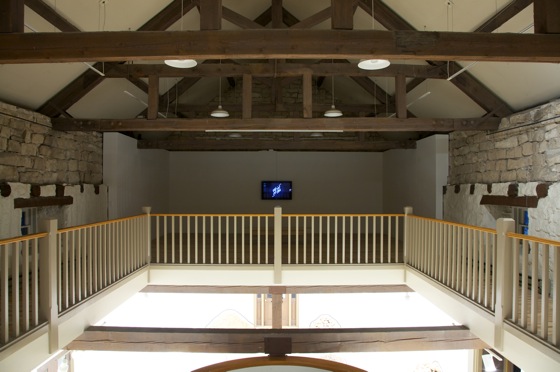
Blake Carrington Insallation Shot, Central Utah Arts Center. (Photo courtesy of cuartcenter.org)
On June 25th, one of the few nonprofit contemporary art institutions in Utah was forced to suspend its mission when, after programming disputes, the town served it a surprise eviction notice. The Central Utah Art Center (CUAC) now claims censorship.
In exchange for providing arts education to the town of Ephraim, the CUAC collected $30,000 annually in town funding and operated rent-free in a historic granary in the town’s Pioneer Square— ample resources for a space which, according to current director Adam Bateman, began with an annual attendance of only 450 people.
Bateman claims that that number has risen to 9,000 since he began to implement a “contemporary” mission in 2003, remodelling the volunteer co-op into a professional contemporary art space and shifting the programming from locally-painted landscape shows to travelling exhibitions of internationally-renowned artists.
In the eviction letter, Ephraim Mayor David Parrish and all five City Council members cited limited town funding and the CUAC’s unfulfilled promise to bring art education to local schools and work with nearby Snow College:
The City’s involvement in an art center must be predicated upon the benefit provided to its residents … Ephraim City is committed to providing a space where local artists can show their work and where art education is the driving force behind the center.
But “limited town funding” doesn’t accurately describe the city’s current financial resources. Bateman said that last year, the town reported a $500,000 dollar surplus, and according to last month’s City Council minutes, Ephraim is “healthy and doing well” financially.
The letter follows an exhibition “superHUMAN,” which, along with extremely well-known artists such as William Pope.L and Kerry James Marshall, featured a few bare breasts in photographs by New York-based artists Xaviera Simmons and Chitra Ganesh. According to Bateman, City Manager Regan Bolli told him in an email that “the art depicted was not appreciated.”
Bateman tells AFC in a phone call that he feels the issue is linked to last year’s “Camera Vivant,” a travelling exhibition which included excerpts from Jack Smith’s Flaming Creatures. That show came at a time when a new mayor and City Council were elected; soon after, the CUAC was subjected to a year-long review—hence the set of conditions that the space was required to meet. The show attracted complaints from local artists and “created an uneasy relationship,” says Bateman, and according to the CUAC, Council members have claimed that recent exhibits are not “Sanpete [County] appropriate.” In protest, the CUAC’s closing party will screen Footloose, a story about a city kid who shakes up an Oklahoma town where rock and roll has been banned.
Footloose, though, isn’t a perfect match. As a town of 6,000 located in a county with a 79% Mormon population, we’re primed to believe censorship, but the question remains why a rural town of 6,000 should support a “professional-level” contemporary art center at all. From the looks of their websites, “SuperHUMAN” includes no local artists, and most of those exhibited already have gallery representation. Bolli maintains that CUAC didn’t adequately involve the local community. “The CUAC has done more art education for artists outside the community than in it, yet out of all of our communities, we’re funding CUAC,” said Bolli in a phone call with AFC. He continued:
We gave them $30,000 a year in funding and a free lease of $20,000. They needed to account for taxpayer dollars they were spending, and that didn’t happen. We wanted more local artists involved, both amateur and professional, and that didn’t happen.
Surplus or not, $50,000 is a lot of free money; nonprofit art centers in New York with presumably higher operational costs spend months scraping for half that. Though thirty-two percent of artists shown at CUAC are from Sanpete County, taxpayers are paying to exhibit the other sixty-eight percent, too. [Edit 7/31: Though the town does provide $30,000 in funding and a rent-free space, most of CUAC’s $130,000 annual budget comes from outside funding. See the comment below.]
Bolli and Bateman fundamentally disagree on definitions of “open community center” and “contemporary art.” “In general, I don’t think they want to have contemporary art,” said Bateman. “They want local elementary and high school kids. There has been more general concern that we don’t include those kinds of people in our exhibitions, and in general, concerns with ideas about contemporary and highly-professional art.” CUAC’s mission echoes this sentiment, specifying Sanpete artists with a “high level of professionalism” and those who are “exemplary of important trends” elsewhere.
Whatever Ephraim’s landscape painters’ role in the contemporary art narrative, Bateman believes that they’re helped by being shown alongside the work of known artists. “Bringing that most contemporary of vision to a regional scene,” Bateman told us in an email, “provides the opportunity to start to contextualize Utah artists with household names from coastal art markets.” This has proven effective in other art communities; AFC editor Paddy Johnson points to the São Paulo Biennial, or Canada’s percentage requirements for Canadian content on TV and radio. CUAC believes that on those terms, it’s done well, touting thirty-two percent as a high mark— another sign that City Council failed to clarify its terms.
And bringing in outside ideas does, in part, fulfill an educational objective, said Bateman. Whether or not they were local, he said, the content was always sensitive to the locale, like experimental video which uses rodeo footage or a contemporary dialogue about landscape. “I tried to challenge people in a way that is educational and helps them to understand what artists are doing, instead of challenging people’s moral or political beliefs,” he tells us.
Bateman continues, “In an April 2011 council meeting we identified seven programs, have completed six out of seven, and have set into motion the last program this fall.” Bolli mentioned expanding the town sculpture garden and the “CUAC Bus,” a mobile arts education classroom, as examples of incomplete projects. “That’s why we call it a censorship issue, because the reasons we were given don’t add up.”
While Bolli mentioned that CUAC had failed to “approach other communities, local school districts, and Snow College for funding,” the center did secure outside funding in 2010: a grant of $97,500 in 2010 from the Warhol Foundation, a sign that the center provides services to the local community while challenging the public. In addition to bringing arts education to 500 students, Bateman reminds us that CUAC is one of the few organizations which is truly expanding contemporary art activity in the area. “Since we started operating,” says Bateman, “art museums in Utah have hired contemporary curators. The Salt Lake Art Center has changed its name to the Utah Museum of Contemporary Art. I don’t want to take credit for that, but our presence in the state has shown that contemporary art is a viable thing that people want to experience.”
Even if it will no longer be supported by the town of Ephraim, CUAC is already entertaining several offers for other spaces. In the meantime, the center has created a petition, is fundraising on its site, plans to host pop-up shows, and will pick up next year— with or without Ephraim.
UPDATE 8/1: An anonymous reader has directed AFC to a blog post titled “The End of the Central Utah Art Center — at last?”
A longtime CUAC visitor notes the lack of proof for censorship claims:
While there is a written comment by City Manager Regan Bolli that ‘no one appreciated’ the work on display, it’s naive to think that government employees don’t routinely hold their noses and vote for things they don’t ‘appreciate,’ but which are supported by others.
It goes on, in reference to current director Adam Bateman:
What supports the CUAC most is the unspoken understanding that there is not enough art in the US and that any effort to produce more must be encouraged. While I am among those in line to sign that pledge, I have not drunk the kool-aid and I will not. Scarce resources need to allocated, not used for self-indulgence or to inflate individual resumes.
For the full piece, click here.


{ 13 comments }
A little clarification toward: “Though thirty-two percent of artists shown at CUAC are from Sanpete County, taxpayers are paying to exhibit the other sixty-eight percent, too.” CUAC’s annual budget has been $130,000. $30k (less than 25%) has come from Ephraim city budget, annually. The remainder has been funded by grants and donations from foundations and donors statewide and nationally.
Hi Andrew,
Thanks for the update. I’ve added that to the text above.
Update: An anonymous reader has directed AFC to a blog post titled “The End of the Central Utah Art Center — at last?”
A longtime CUAC visitor notes the lack of proof for censorship claims:
“While there is a written comment by City Manager Regan Bolli that ‘no one appreciated’ the work on display, it’s naive to think that government employees don’t routinely hold their noses and vote for things they don’t ‘appreciate,’ but which are supported by others.”
It goes on, in reference to current director Adam Bateman:
“What supports the CUAC most is the unspoken understanding that there is not enough art in the US and that any effort to produce more must be encouraged. While I am among those in line to sign that pledge, I have not drunk the kool-aid and I will not. Scarce resources need to allocated, not used for self-indulgence or to inflate individual resumes.”
For the full piece, click here: http://postgeoff.com/?p=229
“but the question remains why a rural town of 6,000 should support a “professional-level” contemporary art center at all.”… I’m from a ‘rural town’. ;p The idea that ‘small town folk’, or whatever you wish to call us, have been under a rock for the last 100 years really needs to be tossed aside. Also, you’ll find that ‘rural artists’ do more than just landscape paintings. The fact that larger museums — specifically those in major cities — have failed to explore what is going on with art throughout the US (including what is going on in smaller communities) is sad. Just my two cents… even if a tad off topic.
Hey Brian,
Yes, I completely agree, “local art” is barely represented aside from outsider art shows. All I meant by that was why would a small town thousands of miles from any major contemporary art center like New York or LA want to support a type of art which mostly comes from there? “Professional-level” strikes me as a very urban term. Why not use Ephraim artists as the starting point for ideas about contemporary art, versus the New York establishment? It seems you could build upon what’s already there and develop a truly fresh perspective.
Whitney, I enjoyed your article, thanks for writing it.
🙂 Thanks for reading!
Also, the “landscape paintings” came from Bateman’s own description to AFC of what was primarily shown at CUAC prior to his directorship. That was unclear because the quote didn’t make it into the final piece, but I wouldn’t have assumed that.
@Brian Sherwin
Having grown up in small town America and subsequently lived in Seattle and now Chicago, I can say that while the attitude big city people have towards small towns is often derogatory and appalling, small town people really do have significant differences from big city people, including their approach to culture and new ideas, differences which are distinctly manifest when it comes to art.
To be sure, every small town is different. (There is even an unusually artistic town near Ephraim called Spring City) But by and large, the issues that concern contemporary artists are irrelevant and sometimes offensive to rural people (even though individual exceptions exist).
No judgement is implied in this evaluation, small towns and big cities are just two separate worlds each having pros and cons.
The small town people that ARE interested in contemporary art, (LIke myself. I grew up in a town of about 1000), often move to big cities with like minded people. (In that sense, contemporary art explores what is going on in small towns via their residents who move to big cities: Andy Warhol is small town guy…which of course is not quite the same). The art world is like any other commercial enterprise, they aren’t going to come find you, people need to barrel down their door and fight hard to be seen/heard and the sort of people who do that tend congregate in big cities. (with the notable exception of ‘Outsider Art’, popular in big city museums/galleries, which, at times fetishizes small town, rural folk.)
If small town people want representation in major galleries/museums then they should, as a community, express this by building galleries/museums and making them great! It is their own responsibility to showcase the work you feel is being over looked.
And if the work is great, then it will get noticed, exactly like has happened in Ephraim at the CUAC!
They built a gallery, showcased local, rural artists while also bringing in well-known contemporary artists to help with clout and diversity. They were building something impressive to showcase small town artists, just like you want, but the community decided it is not something they value and chose to shut it down because, it appears, that small town people (in general) do not have use for a ‘professional-level’ contemporary art center.
Thanks @whitney_kimball:disqus for the article, and thanks @Christopheralmond:disqus for your note, well said. Chris, although the citizens of Ephraim have elected the Mayor and the City Council (and they no doubt speak on behalf of the local citizens), I’m wondering why we are taking everything Mayor Parrish and the council is saying as what the local community wants. I have yet to see any local artists or residents (besides the city council and mayor) speak out about their desire for CUAC to be removed from the city property and to lose it’s funding. If there are any, I have missed them and I’d be interested to hear what they say.
In 2011 I went to the Ephraim City Council meeting where the same Mayor and City Council were questioning the need to continue funding CUAC (although eviction from the building was not on the agenda). They decided to continue to fund CUAC for the following year, but also worked out an agreement with CUAC to strengthen the already existing art eduction programs. There wasn’t a single Ephraim citizen, artist, or anyone for that matter who showed up or spoke out in opposition to the continued funding of CUAC. On the contrary, two previous mayors of Ephraim City showed up to support the art center, and I know that one spoke out in support of CUAC and requested that the City continue funding the art center. In addition to the mayors, there were many local individuals who showed up and spoke up about their support for CUAC, pleading for the city to continue funding. Among these individuals were local artists, local children who had received art education instruction, local Snow College Art Professors, and other local citizens. I remember one citizen distinctly who had just moved to ephraim to work with youth as a counselor, and who was in tears as he pleaded with Ephraim City to continue funding of CUAC. He had recently gone to CUAC openings and saw the ability for an art center such as CUAC to provide a positive impact to the youth that he worked with and to the local community as a whole. I was impressed that this individual had come uninvited to express his support of a contemporary art center in such a passionate way, as I think so often we get in arguments about “art education”, thinking that this is the only value that museums and art centers have in terms of what they can give back to a local community.
I think I will see if I can get ahold of the minutes from that meeting to see if there is anything I’m missing.
I am a practicing artist and want CUAC to remain in Ephraim City for many selfish art-related reasons, but it’s also nice to know that the citizens of Ephraim do in fact value what the art center is doing for reasons that we don’t normally think about.
Hi Jason,
Thank you so much for your response. I just found minutes from a June 2011 City Council meeting you may be thinking of, with several testimonials from the community:
“Amy Jorgensen, a resident and Professor of Art at the College, spoke in support of continuing funding for the CUAC as it has impacted over 5,400 students over the last four years.
Alex Peterson spoke concerning the future of Ephraim and the CUAC. He told of his son attending an art class where he learned about Egypt and mummies and made a costume as part of the project. “These things make a place like the CUAC worthwhile.”
Gary Anderson pointed out that the City is always looking for ways of showing off Ephraim and continuing economic development; thinking of incentives for industry or businesses to come in. He feels showing off Ephraim to people outside Sanpete Countybecomes part of economic development. “People come here because of the college, the quality of life, religious reasons, what they can get, but the CUAC and ball parks, etc.help us put our best foot forward.”
Gary encouraged the Council to continue funding for the CUAC because it is a good economic investment. They bring in money from outside areas and use the money the city contributes to offer projects to the community.
Rob Simons, who is new to the community and has just recently become acquainted with CUAC, spoke in favor of continued funding. He is a mental health therapist and an artist. He came to Ephraim to provide mental health services for youth and sees a program like this as more than just a gem. It is a resource, not only economically, but has the ability to draw people to a community. It also has a healing quality for individuals struggling in this community. Mr. Simons and CUAC personnel have discussed possibilities of partnering to provide services to troubled citizens. Matt Selman, a recent transplant from Utah County, frequents the CUAC and loves the programming and people there. He was impressed to learn Ephraim provided generous funding and would like to congratulate the City Council on such a forward thinking move.
Ava is an artist and loves the gallery and the kid’s classes. Ashley Webb, Ava’s father, said the classes at the gallery as well as everything else impact the kids in a way that’s completely different than just being in a class. When they get to create something at the gallery and see some of the people at the events who work with them directly, they begin to see themselves as artists. The program means a lot to their family and the community.”
http://ephraimcity.org/min/city/060111.pdf
One thing that has not come up during the course of this discussion is that Adam Bateman is a local artist, he grew up in Ephraim, went to school in New York, but returned home in order to bring something back to the community he grew up in. I interviewed him a couple of months ago for our blog Los Angeles Art Resource, as part of a series featuring artist run spaces participating in the upcoming Co/Lab art fair at Art Platform, Los Angeles. He is being painted by select city officials as an outside agitator, who have accused him of “slapping them around” in the recent Huffington Post article. In reality, he has spent a lot of his life as an actively participating citizen in Ephraim, and he has a lot of positive things to say about his community in this interview which you can read here: http://losangelesartresource.wordpress.com/studio-visit/
Thanks, Whitney, for your thoughtful and open-minded consideration of this train wreck. As someone who supported the CUAC before and after the change in focus, I’m not alone in my grief over its demise. There are residents of Ephraim that will be sorry to see it end. It’s a complicated nest of issues that can’t be reduced to black and white slogans. I’m sorry that so many of those who would like to do so are among its supporters. I’m also sorry that things are getting more polarized by the discussion, rather than less. The problem isn’t the art being shown so much as the attitude with which it’s been force fed to the town’s residents. There are examples to be found in the comments you report: Mr. Bateman says the artists he imports will lend recognition to the locals, but most of the locals are famous state-wide, while the imports are household names nowhere. There needs to be a balance, which neither the city nor the CUAC has been able to achieve. Meanwhile, the claim that friction began with a traveling show a year ago is disingenuous: I fielded numerous complaints about the CUACs policies beginning in 2004. Eight years is a long time for a sincere effort to mend fences to take.
Comments on this entry are closed.