
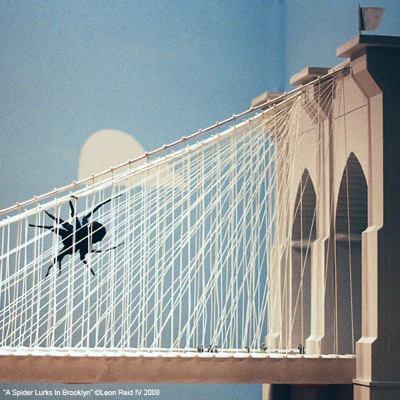
Leon Reid IV's 'A Spider Lurks in Brooklyn'
A Blade of Grass has announced eleven of its twenty candidates for an unrestricted grant of $10,000 for socially-engaged individual artists. The foundation has posted two of its studio visits with candidates on its blog, along with a series of questions about art they want you to discuss. Through those discussions, the evaluation criteria will be developed by the public, in response to work designed to engage them. We consider this an opportunity to potentially improve public funding, which is good, because we think many of their candidates underestimate the public.
Several of the candidates fit the bill. Ed Woodham, founder of Art in Odd Places, presents art at street level in order to start a conversation about public space. Similarly, Risë Wilson brought art programming to laundromats throughout the city in her Laundromat Project. Thomas Allen Harris has spent decades documenting and examining African America. LuLu LoLo writes and performs plays, often commemorating history; it’s not quite the “focused experience” that “one-woman historical act” brings to mind, but technically, they’re engaged.
There’s even some hope that candidate Bayeté Ross Smith won’t continue producing the godawful crap we saw from him on Work of Art. He’s still phoning it in, but a recent collaboration with Question Bridge at least engages the public in a conversation about race, if only through sheer volume of interviewees. (Bayeté was also a Laundromat Project resident, and Woodham produced a documentary for Bravo.)
We draw the line however at candidate Nicky Enright, speller of the word “Inflammatory” with a firehose and designer of stained glass sunsets. New York can do better. Even more inane is fellow contestant Leon Reid IV’s “A Spider Lurks in Brooklyn,” a 30-foot-tall inflatable spider, estimated to run around $800,000. He’s currently fundraising to make the piece, which he says will adorn the Brooklyn Bridge for two weeks in October 2014. On a small scale, that wouldn’t be so bad; we like Reid’s melting ice box in front of Printed Matter. But to put this in perspective, A Blade of Grass could only pay for 1/80th of the bridge spider— approximately 252 minutes of uninterrupted spider. Great.
While the foundation points out the need to deliver resources to a larger community, perhaps factoring in tourism, we hope the last nine spaces leave room for artists who raise the level of dialogue. Enright and Reid in particular have created projects which address the public as though we are children, rather than engaging conversation.
And that’s possible; plenty of artists prove that art can be challenging and intelligible. We see it from social commentary in Fiona Gardner’s documentary photography, or the relentless Guerrilla Girl-style watchdoggery of Jen Dalton. We see it in the simple assholery utilized by William Powhida’s performance alter-ego POWHIDA, a blatant, and essential, protest of economic and power inequity.
Plus, there seems to be little or no representation of artists who talk to people on the internet, as A Blade of Grass itself is doing. The public is accessing art though social media as used by Nate Hill, whose public interaction performances take place as much on the web as they do IRL, or Man Bartlett, whose Twitter feed doubles as performance and OWS protest, or Hennessy Youngman, whose videos cut the art world down to size precisely through their awareness of the general public.
Grantees could even be artists seeking innovative ways of interacting with people, like Ricardo Miranda Zuñiga, who addresses the immigrant experience through technology, workshops, and public demonstrations. They could use technology to further environmental awareness, like ecoarttech.
We hope some of these people will join in the discussion as the grant process develops. If ever there was a case to be made for “the more the merrier,” this would be it.


{ 15 comments }
Fantastic article Whitney–thanks for the opinions! This kind of back and forth is exactly what we are hoping for, both in terms of curatorial decisions and process. Grant makers have a responsibility to understand who they are funding, and how the funding process affects the community.
Unfortunately, the Artist Files website is currently down. We hope to have it up and running ASAP. I’ll comment again when those links work!
–Deborah Fisher
Just a quick note to say that our hacked website is basically back online. The links above work but comments are still broken. I’m enjoying the conversation here! Projects that are intended to engage have to work on a lot of different levels. It’s a great opportunity to be talking about Leon Reid’s projects, as well as these other fantastic artists, in such concrete terms.
Thanks! I hope so too. We’ll update as soon as the site is up and running.
I’ve been a fan of Leon Reid IV for years now and I couldn’t disagree more with your opinions about his work. Not only does his work engage the community (see the hundred story house) but it also makes us rethink public space in completely different and wonderful ways ( http://new-art.blogspot.com/2007/07/public-art.html ) I hope the grant makers do better research on the artists selected than the author of this article!
Just because you don’t agree with the opinions expressed in this post doesn’t mean that the natural conclusion should be that we didn’t do our research.
Meanwhile, you’re aware that you’re defending a 30 foot tall inflatable spider? Exactly what are we supposed to rethink about the Brooklyn Bridge with this thing on it?
I think it’s clear Mr. Reid IV isn’t exactly the next Louise Bourgeois.
Obviously there’s something to the Spider project if the author is using it as the only image to represent this article. I find the artists shortlisted by A Blade Of Grass consistent with what they say they are looking for.
But is that relevant, if he’s currently fundraising for the spider? I didn’t mention his upcoming free outdoor library project “100 Story House” because he and Julia Marchesi have already successfully kickstarted it, though that sounds like a much better idea. All I’m saying is that would be a shame for the funding to go to an inflatable spider, no matter who makes it, and that’s a definite possibility with Reid.
Reid’s public work is interesting because it’s got a lot of handholds–it’s very generous to viewers and doesn’t require a lot of knowledge or explaining. This self-evident quality is a really important aspect of public art! I think that Whitney is suggesting that the self-evident, playful quality that makes Reid’s work sing doesn’t scale in this case, to her eyes.
This is valid, interesting criticism of Reid’s Brooklyn Bridge project, and it certainly doesn’t mean that Reid’s entire body of work is bad. It just means that Whitney isn’t into what Reid is fundraising for right now. She’s totally entitled to that opinion.
This conversation makes me think about how much more acceptable cheerleading is than critique these days, and how art is rarely thought about in terms of failure. My sense is that when someone cares enough to offer a complete opinion about your work, they are giving you a very important gift, and that embracing and openly working with failure makes artists grow and evolve.
Another grantee of ours, Shane Seltzer, is talking about actively working with artistic failure here: http://www.abladeofgrass.org/blog/b/artistfiles/2012/jul/23/we-need-observe-failure/
Dear Art Fag City and Commentators,
This is Caroline Reid, project manager for A Spider Lurks In Brooklyn (ALSB).
The New York Foundation for the Arts (NYFA) is our fiscal sponsor for
this project. Our partnership with NYFA allows us to offer tax
incentives to individuals and corporations in return for their donation.
ASLB does not seek grants or funding designed to support individual
artists, such as the one that A Blade Of Grass is offering.
If you would like to learn more about how to donate to A Spider Lurks In
Brooklyn, please go to our page on NYFA’s crowd-funding site Artspire:
https://www.artspire.org/DirectoryDetail/tabid/95/id/1075/Default.aspx
Thanks!
First, I would like to congratulate all the artists who are
being considered for the grant, best of luck to all of you. Whitney, I am glad that you have formulated an opinion and feel confident to share these opinions with others, but these are only opinions. Why do you want to close conversation and not open conversation? Why do you think that Reid will construct his spider? (If you could post the article, I would appreciate it.) Shouldn’t a journalist lead others with questions, allowing the reader to feel autonomous and reassured in their reactions? Do you trust your audience? I feel as though you are quick to judge when you say things like “Enright and Reid in particular have created projects which address the
public as though we are children, rather than engaging conversation”, perhaps their work has had more of a profound impact on you than you had imagined– maybe you are becoming conscious of your own shortcomings as a journalist– lecturing your audience instead of questioning them? ANYWAY, GOOD LUCK TO YOU ALL,WHITNEY INCLUDED!
Questions are a terrible way to start a discussion! Questions lead to long pauses, foot-shuffling, and requests to restate. Every lecture, panel discussion, group therapy session, etc. I’ve been to has been a snoozefest until someone made a statement with some confidence behind it, and someone else found reason to argue with that.
Besides which, I think you’ve confused the purpose of this piece. A Blade of Grass already asked the question—roughly, “What do you think of this art?” That part’s done with, and it was their job, anyway. Whitney’s not a poor moderator; she’s a respondent, and I think she’s a pretty darn good one.
Dear Paddy,
I am replying to your question,
“Exactly what are we supposed to rethink about the Brooklyn
Bridge with this thing on it?” I don’t think the project is so much about rethinking the Brooklyn Bridge as much as aiding the readjustment of our views and perspectives of man the conscious animal. I think it has more to do with man’s levels of consciousness and the relation of man to his environment. It seems as though the spider could represent man’s natural inclination to complete tasks and make connections — simple projections on the spider project.
This thread has made me think about something that Robert Hult told me (and Whitney, during class at RISD) — someone asked him about the difference between being an artist in Europe and the US. He that while he wasn’t exactly an expert on being an artist in Europe, he did mention that European artists often rely more heavily on government funds (as a generalization, not a rule). He suggested that this could lead to different work being produced (as well as a different approach to selling art).
My point is that public art and ‘non-public’ (for lack of a better word — I’m tired) function somewhat differently than one another. With public art, you have a broader range of viewers, and a different set of challenges — use of public funds, issues regarding cultural sensitivity, a different context for the work in a non-gallery space, and so on. (Again, I’m tired. That’s a long list).
Contemporary art isn’t dependent on the general public to be successful (there are other criteria — validation through galleries, publications, sales) — how does this change when contemporary art becomes public? Can the work be intellectually dense, in conversation with a long and complex history, and be fully self-aware and self-critical when it becomes public? How does an artist make public work that isn’t just decorative, or overly didactic, or banal (like much of public art throughout history)? To what extent does the work serve a social purpose? Is it an issue if the public work serves no other social purpose than being art?
By now I’m ranting. I guess my (final and frustratingly vague) question is: what are the criteria for public art, from the perspective of contemporary artists and art critics?
I think the spider project would be great. It speaks to everyone from all walks of life, young to OLD, English speaking, and non. It’s universal imagery that everyone can enjoy, and would make people re-imagine an iconic NY landmark, and look at the landscape around them in a different way, much like many of Reid’ past pieces.
The article also argues that the spider is to expensive, but isn’t the main purpose of artist grants, to support projects that could financially never happen otherwise for the artists.
I think the spider project would be great. It speaks to everyone from
all walks of life, young to OLD, English speaking, and non. It’s
universal imagery that everyone can enjoy, and would make people
re-imagine an iconic NY landmark, and look at the landscape around them
in a different way, much like many of Reid’s past pieces.
The article also argues that the spider is to expensive, but isn’t the
main purpose of artist grants, to support projects that could
financially never happen otherwise for the artists.
Comments on this entry are closed.