
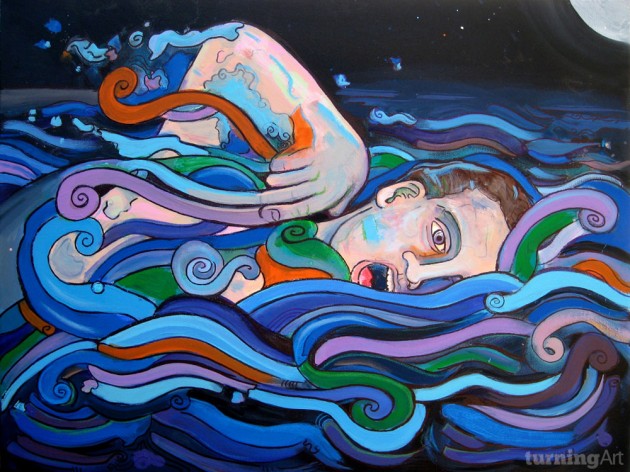
"Changing Tides" by Skip Myers. Courtesy of TurningArt.
Is TurningArt the newest force to be reckoned with in the online edition business? They seem to think so, and so do the tech content blogs that make a buck off of rewriting press releases. From CNN Money to TechCrunch, everyone’s calling their online art rental and sales program the Netflix of art. For a fee as low as $10 per month, TurningArt subscribers can rent limited-edition prints, and then return them anytime. If one of these thrifty consumers falls in love with the print, they’ll have the option to buy the original artwork at a much higher markup. We’re not really sure how they plan on convincing America to open up their wallets, given that there’s not much consumer crossover between the poster and original art markets, but whatever. It’s not our money they’re losing. And they do have investors!
TurningArt announced earlier this year that it received $1.5 million in additional funding, and the company has said that it plans on “using the capital to expand its artwork collection.” They’ve been approaching artists to join their program, but the deal they’re doling out to them isn’t convincing.
TurningArt has been trolling gallery websites for artists, and sending potential recruits digital copies of the artist agreement contract. The contract states that the company will commission an edition of 100 prints from the artist’s pre-existing work for use in the rental program. Every time someone rents a print, the artist will receive royalties— a paltry 10% commission during the rental period. This means that an artist will receive a whopping dollar bill minus PayPal fees at the $10/month subscriber rate.
If there’s real money to be made, it should be when a TurningArt subscriber upgrades from renting prints to purchasing the original artwork. Here’s the details of this process from the company’s artist agreement contract:
When the sale of an original piece is made through turningart.com, you will receive 60% of the sale proceeds and TurningArt will receive 40%. The responsibility for shipping costs will be handled in a case-by-case basis. At no time will the artist be responsible for paying more than 50% of the cost of shipping original artwork.
Since when do artists cover shipping costs for an artwork that’s been purchased by a collector? That’s not standard art gallery practice. The real dealbreaker here, though, is that TurningArt hasn’t left room for a gallery to take a cut in their contract—even though they’re approaching artists who currently have representation. Cutting galleries out of a deal is skeevy when that deal is built, in part, upon their work promoting the artist.
There’s no way represented artists can benefit from the type of deal TurningArt offers. While the company’s model may promise thrifty consumers the dream of cheap art, it doesn’t offer artists much at all. If anyone’s going to get rich off this, it’s not them.


{ 27 comments }
Hack ass internet writing at its finest. You know what might make this reactionary & reductionist opinion credible? Nothing. Maybe try reaching out to artists like myself on the site, or subscribers who use the service. Then….THEN….maybe get a quote or two. This is a great company of great people attempting to build a great service for artists. Whiny, short sighted shit like this is what’s wrong with everything everywhere. Congratulations, you’re a knee jerk stereotype. Keep up the good work.
Another pro tip, if you’re affiliated / support a competitor, for instance Artsicle.com, maybe disclose it in your review. It’s what grown ups do.
http://www.artsicle.com/artfagcity
Corinna has no relationship with Artsicle. Zero. I made that account two days ago and it’s empty.
This tip came from an artist who is represented by a gallery and had been approached. She was unhappy with the approach.
Am I to assume that you’re a represented artist who has done well by the company? If so, please tell us your name, and the gallery that represents you so we can follow up. We’d love to do a follow up post!
So let me get this straight. You just publicly called a company Scum et all. All on a “tip” from an unnamed artist who was “approached”. You did zero research. Gathered zero other opinions or sources. Congratulations, you are Fox News.
It happens that we’ve seen quite a few artist agreements for services similar to TurningArt. We compared. TurningArt, in Corinna’s opinion, looks like a pretty bad deal. This is based on both industry standards (like including a cut for the gallery when you’re specifically approaching represented artists) and contract specifics (I don’t think any of us have seen an edition contract that makes the artist pay shipping). Are there artists that can benefit from this? Absolutely. They are not, however, the gallery-represented artists that TurningArt is approaching.
Band-aid all you want. This is the definition of journalistic hackery, opinion or not.
For the record:
This piece didnt say “I think it’s a pretty bad deal.”
It called the service a scam & the people scum.
I mean, I’m no editor-in-chief, but maybe the bar could be a little higher? Anyhow, you all enjoy your day.
Yes, please tell us what the company has been able to do for artists with gallery representation, and then we’ll compare. And as Will was able to get to before me, we’ve done research. I compared this company’s contract with contracts for other print companies. And we’re aware of industry standards for artists with galleries and artists with galleries working with limited-edition print companies because we’re part of the art world, I’ve worked at galleries and museums, etc., etc.. We’re not amateurs.
To save everyone a click, that’s an empty account registered with the name “artfagcity” on Artsicle’s site. I think we registered an account to see what it was like. Nailed us there.
“We dont approve these comments. Mainly because we’re all that’s wrong with everything. Thanks” – Hack Fag City
While I am not a gallery represented artist, I think I can add a little here. I don’t want to drag this out too long but I will say that I have sold paintings through TurningArt and have generally had a great experience. They have never asked me to pay shipping, they have paid me quickly for the sales and have been overall nice people to deal with. Also, there is one aspect of the system, that I would perceive as being beneficial for the artists involved, that is not covered. A good amount of the money that subscribers are paying TurningArt can be used towards buying actual art. People who would otherwise be happy with a poster store Picasso print, suddenly have hundreds of dollars of credit that can go towards real art – money that is a lot more likely to end up in an actual living, breathing artists pocket.
Beyond that I think the author gets something right, there is not a lot of crossover between the poster and original art market. The people who are shopping for art on this site are not the same people who would find their way into a gallery. The pieces I have sold have been smaller less expensive pieces, studies, experiments, ect. Not exactly the kind of stuff that would be sent to a gallery but, still work that deserves to get out of the studio and find a home. It would seem that an artist could find a way to sell work in both venues if they were so inclined – while keeping everyone happy. TurningArt is definitely not a replacement for gallery representation and, it would seem that – like you said – there is not even much overlap in the two markets. But there is potential for turning new people on to the idea of owning real art.
Anyways, just thought they deserved a little bit more of a fair shake here.
“People who would otherwise be happy with a poster store Picasso print, suddenly have hundreds of dollars of credit that can go towards real art – money that is a lot more likely to end up in an actual living, breathing artists pocket.”
Does this mean that artists get the value of their work knocked down, if someone’s stored up credit?
No, the way I understand it is, they monthly payments go towards the TurningArt 40%, so therefor someone can pay the artists share and own a piece. The artist gets the same cut either way and, like I said, it does seem to help motivate people to make the leap from poster hanger to art buyer.
Amazing. My point exactly. You dont even have a basic understanding of how the company works. But why bother with details or research when you can just haul off & write a scathing review!!!
I’ve read the contract. What Nick mentions is not in the contract, which is odd.
I don’t really want to drag out this out any more because, this is not
exactly secret information, its all spelled out clearly on their website
for anyone who wants to have a look. Corinna, I am not sure which part I have mentioned that is not in the contract? Do you mean the part about subscribers using the membership credit towards art purchases? I would assume that is not in the artist’s contract because it is not part of the artist’s deal – it is an incentive for the buyer. Whether someone “saves up” membership credit for years and gets a discount on the art or makes a purchase at full price the first day, the artist gets paid the same 60% of list price. Are you referring to something else, I am not sure where the confusion is, maybe just ask TurningArt?
Good read. However…. “They seem to think so, and so do the tech content blogs that make a buck off of rewriting press releases.” Don’t you make a buck writing about sponsors. ;p
The ‘rent art’ model rarely takes off… same thing goes with print-on-demand services that focus on original fine art. It is a gamble for the website owners…. I’ve seen dozens of companies go under.
“TurningArt has been trolling gallery websites for artists” — Saatchi Online, one of the AFC sponsors, apparently did the same thing… in addition to harvesting emails from various artist networking sites — according to WetCanvas and a number of other sites. It was a big deal back in the day. Unfortunately, crap like that is standard in this business…. though unethical it is not exactly illegal depending on how it is done.
Another problem is that after these lesser known art sites close… they often end up selling their email lists to former rivals. An email list of 60,000 can go for $2,000 to $10,000 easy depending on a few factors — in the right circles. If the site states that your email is safe… all of that goes out the window once the website closes shop. My gut tells me that some of these sites go into it knowing that if all else fails they can make some cash offering their list.
A lot of art service websites get their footing by buying those lists…. but it is not a good way to start a business — and they almost always end up called out for it.
Interesting. Three questions I’d like to see in a follow up:
1) What part/s of the poster market are they expecting to convert into art buyers, and what does that say anything about the path converting a would-be poster-buyer into an ‘real’ art collector?2) How does this stack up against local, apparently successful efforts such as 20×200?
3) What do you think they are doing with the all-important analytics? In this day and age its all about the numbers, baby…
I was never into art and it was always something that seemed too expensive. But, like wine, I’ve gotten more into it now that I am in my early 30’s and I can appreciate having something tasteful and original on my walls. For the price, I think Turningart.com offers a great service to novice young professionals like myself who would never even enter a gallery, nervermind look to buy an original painting. But now I am building up credit towards buying an original thourgh the site someday, (which would be cool) and in the mean time I am figuring out more about myself and what type of art I like. I get a lot of compliments on the Turningart on my walls and I look forward to getting my new prints every 3 months from my online que. I think that’s the real value here. Does Netflix pay the actors who are in the movies they rent? No, they dont. But if the customer buys the movie, the actor and studio do get some of that money. It’s “Like Netflix” in that you receive new art when you return your current piece. It brings art to the masses. Enjoy it.. it’s on the simple pleasures in life. Don’t hate on a company for being successful. Hard work pays off.
There are thousands of unrepresented and extremely talented artists who deserve to have their work seen by the masses. That makes TurningArt a great deal for artists and those who want to buy it.
Brick and mortar galleries are closing left and right. That isn’t because of companies like TurningArt. In fact, companies like TurningArt is starting because of it.
I love the option of being able to try out different kinds of artwork before commiting to buy an original. Where else can you do that?
I’m a Turning Art artist, and as an emerging artist who has a day job and no representation, Turning Art has been a fabulous way for me to get in front of thousands of art lovers. I’ve been slowly growing my portfolio with them for the last 2 years, and the number of my prints in people’s homes is growing at a slow steady rate (and so is the residual income from it). And I’ve sold a few prints as well. Turning Art is just another way that the creative power of the internet is leveling the playing field for everyday artists like myself. And they’re super nice and responsive over there too! Mari and Liz are awesome. I’m very thankful for their service and my relationship with them as an artist. – Christopher Clark (www.ChristopherClark.com).
See new article here. Turning Art just changed their TOS. http://
http://www.traverselegal.com/internet-law/internet-law/turningart-com-to-customers-you-just-lost-your-artcredits/
Dude, it’s filed under opinion. That category shows up on the front page of the blog and is the first thing readers see before they click through.
Wait, so you’re upset about the tags? Because neither “scam” nor “scum” is in the piece.
The issue brought up by my op-ed is still that represented artists shouldn’t use this service. Back to your comment, the contract doesn’t mention how this saving up affects the price of the artwork. Overall, it devalues a painting at the mercy of the penny-pinching consumer.
I am not sure we just disagree here or if there is a misunderstanding. The artist always gets 60%, TurningArt always gets 40%, the consumer always pays the full list price of the painting. However, if they are a member for a while, they can use some of the money they have ALREADY paid for membership fees towards the TurningArt split of the purchase price. Not really penny pinching or affecting the price or value of a piece in my opinion, since the actual price paid is the full asking price (and potentially better than many galleries that can be quick to mark down a piece to make a sale).
Comments on this entry are closed.