
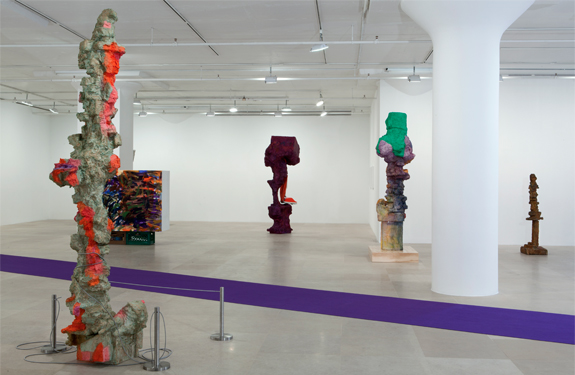
Installation view. All photos by Greene Naftali.
I suspect Rachel Harrison knows how strange it is that her artworks are expensive luxury goods. As you enter her current exhibition, the first work you see is a gangly pile of styrofoam that looks like somebody spraypainted on a tree; around its base lies an ironic tangle of the low, silver barriers museums use to keep you off their valuables. The show, entitled The Help, features a half-dozen sculptures and twenty-odd drawings, each of which taps into a particular kind of ugly-pretty; they scream rebellion, but will still make for a nice contrast in the mid-century modern living rooms of their future owners. Until then, they look great at Greene Naftali.
The rough, unevenly-painted sculptures are the centerpiece, intentionally garish and unapologetically lumpy; it is something of a revelation to discover that this is, indeed, what beautiful looks like today. They’re generally made to look top-heavy—with cement bases and styrofoam spires—and then set in motion by pairs of complementary colors, applied with all the delicacy of a paintball gun. The result led Annette Monnier to describe one of Harrison’s sculptures as looking like “a fat cartoon”, an image which, once stated, is hard to un-see; Harrison’s neatly squared tetrad of colors is a direct loan from Franz West, one of her admitted influences, but it might equally have come from a Dr. Seuss book. As it turns out, sculptures with the off-balance silliness of a cartoon can also have a lumbering weight to them.
All this, though, is the set-up to a joke: walk around to the far side of any of the pieces, and you’ll find hidden readymades that add crushingly mundane, occasionally hilarious purposes to the forms: one paint-splattered boulder exists to hold your vacuum cleaner; another is a plinth for your whey protein. One, inexplicably, is a room to sit in when you want to look at peppers. Read as simple juxtapositions, these would be unoriginal; the exceptionally neat fits of the consumer objects, though, point to a deliciously ironic utility.
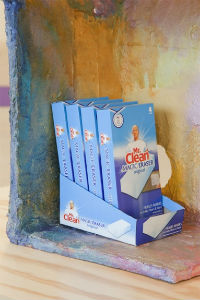
This sculpture provided an excellent Magic Eraser case. All photos by Greene Naftali.
One sculpture, All in the Family, very nearly ruins the effect. It looks a bit like a hulking, purple square bracket, or a niche for a medieval jamb statue of some apostle; it holds, instead, a bright orange Hoover, identical to those in Jeff Koons’s vitrines. The reference is unnecessary, and tempts the viewer in the wrong directions: towards a view of the works as art-jokes or ironic shrines—in which case, they’re all pointed the wrong direction, away from the gallery entrance—rather than as more-or-less earnest forms that happen to also hold vacuum cleaners well. Fortunately, the sculptures are made of tougher stuff than that: whenever they appear to be too arch, their thoroughly hand-worked surfaces draw you right back in.
The walls, meanwhile, bear a series of drawings that take roughly the form of a science experiment. The hypothesis seems to be that you can make a drawing of Amy Winehouse look different depending on whose style you reference. It is a fairly exhaustive study: Picasso is there, and de Kooning, and Gauguin, and Duchamp; for the Bacon drawing, Harrison rotates about twenty degrees around the color wheel to accommodate his favorite shade of orange. They’re well-executed, fun, and often funny, as in the de Kooning-style woman wearing day-glo shorts, or the Winehouse with disjointed, Picassoid eyes that still manages to look like a plausible face the singer might have once made. That said, they’re perhaps pleasing more because they make you feel good than because they are good; there’s the same sort of spot-the-art-history pandering going on here that you find in the recent work of Jon Rafman or Olaf Breuning, where the works mostly exist to make you feel clever. It doesn’t feel as though Harrison has actually discovered anything, visually, for all this investigation.
On the whole, however, this is one of the best shows in Chelsea right now; while the drawings are unfilling, they make a pleasing appetizer, and the sculptures in the main course are vigorous and ha-ha funny. In the school of ugly sculpture, there’s nothing to say that Harrison has chosen the best possible forms; these, though, feel pretty close.


{ 19 comments }
“…it is something of a revelation to discover that this is, indeed, what beautiful looks like today” i could not be rolling my eyes more at this statement
more comments from this guy
Whatever you say Commander Riker.
This is trolling. If you meaningful feedback to offer about the show, let’s hear it. Otherwise, get off the blog.
I’m sorry I didn’t realize making a comment in jest about someone’s avatar was “trolling”.
That’s not trolling. That’s an opinion. And he’s not the only one to feel that way.
unless you’re talking about the second comment. that’s funny… and harmless.
@ Will Brand — How does the directness of the Koons reference nearly ruin the show? Not being sarcastic. Just wondering.
I think it’s unnecessary, as I said. These are expensive sculptures that hold consumer goods, and those facts already put them into a conversation with Koons.
That particular vacuum looks like it was put there to make a reference to Koons, rather than for its particular qualities, and that encourages you to ignore those particular qualities. It’s a little scruffy, on the top of the head. I don’t know if that means anything, but it is. When we went to see the show together, Paddy noticed the scruffiness, and I didn’t; she also, IIRC, saw the vacuum as just a Hoover, and not as a symbol referencing Koons. She thought then that Koons had used a different vacuum. I was right about the vacuum, but it made me miss details that Paddy picked up. I think that’s a common viewing experience.
Similarly, it makes you dismiss the cleaning theme of the show, which is present in the title, in a photograph of the maintenance door to Duchamp’s Etant Donnes, in the carpet bisecting the gallery, and in most of the objects. If that’s all just the setup to an art joke, then like all joke setups I forget it immediately after hearing the punchline. Like, it has the potential to make me go ‘eh, fuck off’ to the whole cleaning thing.
I don’t know, though, that the cleaning thing is super-serious: there’s the idea of a cleaner using a vacuum that’s stored in an ugly sculpture, and that’s funny, but I don’t know how deep it is. There aren’t any actual people anywhere in what’s going on, except in a seemingly unrelated video of a cabbie talking about the economy, so it’s not like there’s some drama or some political thing. Maybe it’s not very valuable after all, and can be quietly discharged after the joke has fired.
I suppose my instinct is that I’d rather not throw it away entirely. I’d rather she use a different vacuum and lose the reference; there are more then enough in the show already to make you feel good about yourself. I think that cleaning is a strange idea to keep in mind when looking at sculptures, and that that’s fun. Perhaps “ruin” is strong, but I frowned when I saw it.
Maybe it’s all an accident and I’m overstating things. Given how particular Rachel Harrison seems to be about the readymade bits in her sculptures, I don’t think so. It’s a pretty big element.
cool. thanks for the response. helps me see where you’re coming from. now I need to check out the show.
I wasn’t talking about your response to Joshua, I was talking about pulling a quote out of the review to say you’re rolling your eyes. Not only is that a sneering response to a review that’s obviously been carefully thought about it, it fails to response to any of the art, or the thoughts brought up in the review.
I think what you’re doing here is really mean spirited and it makes me really sad because it doesn’t reflect the kind of community we’re looking to build here. No one benefits from these kinds of comments.
I think it’s completely fair to state my opinion about the quality of writing in a post. It reads like a fluff piece, and there isn’t really a nice way to say that. I think it’s helpful for anyone, writer or artist, for people to be honest about how they feel about the quality of that person’s work. If you’re going to present something as a critical look at a show, it damn well better employ actual critical methods. “…it is something of a revelation to discover that this is, indeed, what beautiful looks like today” is an almost-pretty sentence that literally means nothing. Revelation? Beautiful? Today? These are all arbitrary terms that need expansion in order to have any bearing on what we’re seeing here. “Screams rebellion” in what way are amorphous forms made from construction materials “rebellious” in the art world? Rebellious against what? It’s pretty much an established tradition at this point (one a professor of mine at labelled “Trash Art” in a totally non-derogatory way). I think your writers owe it to the “community we’re trying to build here” to be thorough and meaningful in critical pieces instead of simply describing what the do and don’t “like” about a piece or a show in overly florid terms.
Do you really have so little to say about the show that you couldn’t muster a single response to any of the opinions articulated here? Is it too much to ask you talk about the substance of the art in either post you’ve commented on? I don’t care if you don’t like word beautiful, I care about what your thoughts were on the actual show. Prove that you have some.
If this is overly florid you gotta read more criticism dude.
I gave you some, if you read the comment, but to articulate further: These forms aren’t rebellious. They’re pretty tired, and I think they should be read that way. They’re lumps of painted concrete, calling back to generations of appropriation of trash and industrial materials for art making. When people first started doing this it was a subversive gesture against the rigidity of media and towards an idea that art should be connected to the world around us. Years on, you have to look at things like this as a comment on those practices and the commodification of those rebellious art objects in the hands of collectors. The point seems not to be that this is what is “beautiful” now, but rather that they are actually quite ugly. Being charitable (and not having had the opportunity to see them in person yet) I would say that they draw an equivalence between the objects they reference and the objects they conceal. Being uncharitable, I would say that the objects chosen for concealment give that relationship a one-line feel. The sculptural objects would serve the idea better by either referencing those generations of artists more literally, or by referencing the forms and materials of contemporary work that actually seeks to be consumed as a commodity. Institutional or market critique from within the gallery is always dubious, and needs to be thoroughly considered in both form and presentation in order to not become exactly what it’s critiquing.
Now that I’ve responded to your criticism of my writing, how about you respond to my criticism of your writer’s?
I agree that they’re ugly. That’s why I called them “ugly sculpture”. I agree that it should be mentioned that these are luxury goods. That’s why the very first sentence of the piece mentions that these are luxury goods. I agree that the works are very nearly one-liners; that’s why I wrote a paragraph about how the directness of the Koons reference nearly ruins the show.
You clearly aren’t replying to this review. You’re just saying things. I hear from your classmates that this is a habit of yours. We’re under no obligation to allow you to continue it.
I think the worst thing for these objects would be to reference other artists more directly. Nobody wants to play a game of art historical Memory.
Sorry, there’s nothing worth responding to in this comment visa vi the writers of this blog. There are posts where an argument could have been made but this isn’t one of them.
Relatedly, we have a commenter on the blog who’s opinions we regularly disagree with. We haven’t come to consensus, but I really like hearing from him regardless. His opinions are really well thought out and they have always been offered with a spirit of generosity.
That’s not what’s going on here. These comments don’t have the ton of those given with generosity but rather with a punitive intent in mind.
As such, I’m requesting that you refrain from commenting on any further posts. I don’t think the staff here is benefiting from this nor the AFC community. It’s clear you don’t want to be a member, and frankly, from everything I’ve seen, that’s a relief.
Tell Whitney I say hi! She was never in class with me, but that’s ok ; ) I expressed my opinion on the work as best as I could based on the pictures given here, as I said I haven’t had a chance to see the show yet. I wasn’t trying to contradict you, simply giving my thoughts as Paddy asked. What I take issue with is, in fact, that you are just saying things, as in the statements I highlighted. I thought/think some of the ideas in here could do with a great deal of expansion. Sorry if I expect more from you than you do!
Also, I gave a very direct response to several of the problems I had with the review, so your response seems pretty much entirely personal, and based on the fact that I partially agree with your assessment of the work. I can think that the writing is bad without disagreeing with everything you say. By the way, from your description (again, haven’t had the chance to see the show) the Koons vacuum is the only relationship here that I think is really interesting, as it gives a nod to the complicity these works have in the system that they’re trying to critique. I can expand on that if you want, but I have a feeling you don’t actually read my comments further than to pick out something you think you can argue with.
“I have a feeling you don’t actually read my comments further than to pick out something you think you can argue with.”
I’ve been thinking the same thing. Let’s just stop.
Comments on this entry are closed.
{ 1 trackback }