
It only took a year, but I’ve finally written about The New Aesthetic. What is it? Does it constitute a new movement? I tell you why I think this thing isn’t going anywhere valuable at The L Magazine.
It’s amazing how much talk an ill-thought-out concept can generate when it comes in the form of a PowerPoint lecture. That’s part of the appeal of “The New Aesthetic,” a term coined by designer James Bridle and discussed by thousands of internet nerds over the last month. Ever since SXSW hosted a panel on the subject and Bruce Sterling produced a 5,000-word response for Wired, a day’s hardly passed when I haven’t seen mention of this so-called burgeoning movement.
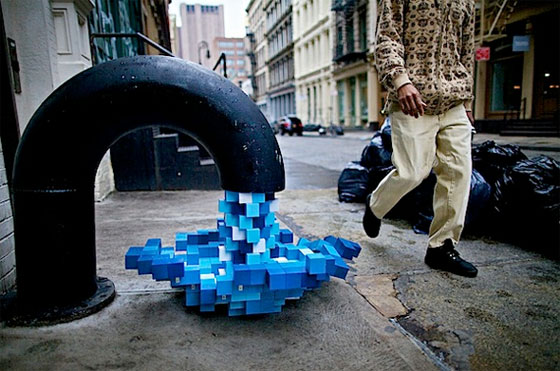
The New Aesthetic, as Bridle tells it, is the new merging of physical and digital, a kind of cybernetic vision with the sudden confidence to throw out all this nostalgia we’ve been trucking around for the past few decades. In truth, it isn’t so much a movement as it is a tumblr paired with a lecture circuit. I mean that literally: Bridle’s blog by the same name hosts image after image of supposed instances of the “New Aesthetic”, from pixelated giftwrap next to an unpixelated child to pixelated water spewing from a pipe on the street. The connecting thread is what Bridle sees as a reaction against nostalgia. “We need to see the technologies we actually have with a new wonder,” he explains in some of the sparse text provided. Bridle doesn’t notice that many of the images posted carry their own nostalgia for the 8-bit era.
Read the whole piece here, but don’t expect much on either the SXSW talk and Bruce Sterling response for Wired that seem to have popularized the term. I didn’t see the talk, and as a friend rightly noted over email, Sterling’s piece isn’t so much as an essay as “someone catching up on lecture notes after a session in the pub.” It’s best to focus on the source material. Those who don’t want to slog their way through Sterling’s piece can read artist William Powhida’s condensed version. I recommend it.


{ 14 comments }
Bruce Sterling frustrates me to no end. Every essays I’ve read or lecture I’ve heard of his seems like just a hastily cobbled together collection of thoughts on someone else’s ideas. That’s basically what his column in Wired is, isn’t it? Just quotations of other people’s writing shot through with his own insipid interjections?
Anyway, “tumblr paired with a lecture circuit” is pretty much spot on. Young artists today are learning as much from tumblr, surfclubs, image blogs and the like as they are from art schools or seeing work in museums and galleries. And the thing about those online platforms is that although they teach you to be visually literate, they don’t teach you how to articulate anything about an image in words, and they de-emphasize the importance of context (historical or otherwise). This whole thing to me seems like the unfortunate collision between that tendency and the ‘every generation thinks they invented cool’ hype of ‘web 2.0’ evangelist culture.
“This whole thing to me seems like the unfortunate collision between that tendency and the ‘every generation thinks they invented cool’ hype of ‘web 2.0’ evangelist culture.”
EXACTLY.
I remember when group image blogs and pixellated images were being promoted as critically important.The criticism that shines through in every attempt to dismiss The New Aesthetic is simply that Bridle isn’t one of us (for whichever value of “us” holds for the author).The one specific criticism made here, that Bridle’s claimed relationship to nostalgia is undermined by a new wave of digital retro, fails to capture the relationship people who never experienced 1,4,8 or16-bit bit “back in the day” have with those aesthetics.
There has been some intelligent engagement with TNA, but the first step is always to look past Chairman Bruce’s reports to what Bridle is actually showing us.
Yeah, but Bridle’s generation does have a nostalgic relationship to that aesthetic and only children who are 10 and younger don’t have a relationship to it. In all likelihood they will come across that imagery at some point, the same way we come across Tron whether or not we were alive when it was made. Maybe Bridle looks at these images and they make him excited about the future, but he’s still just tapping into an excitement at that time for technology that hasn’t really gone away.Â
This essay doesn’t discuss Bruce’s essay at all and there’s a reason for that. Criticism is most useful when applied to the source (also, that essay is garbage). I feel like Tom Moody does a great job of breaking down, on a point by point basis, the problems Bridle has. I address Bridle’s direct quotes, but I think Tom Moody does a great job in a point by point breakdown of his lecture.Â
http://www.tommoody.us/archives/2012/05/02/bridling-at-james-bridle/
While the autocad and rhino and photoshop and indesign prototypes for these kind of things may actually be interesting, once they become manifested into reality, just physics of reality just coldly reject them. It’s like an organ donation that just flatly fails every time. The generation that makes this work was too influenced by Nickelodeon in the 90s where kids got inserted into a digital video game world. The best art talks the most honestly about life, and I’m sorry to report that this New Aesthetic falls increasingly short. The advice I am about to give is the same that is doled out to art critics that make art about criticism and political activists that make art about political activism: If you want to really affect and push something, join that respective mainframe. If you want to critique art, be a critic. If you want to change politics, be a politician. If you want to push the Internet, be a software engineer. If you want to push art, be an artist.
This comment reminded me of Knightmare:Â
http://en.wikipedia.org/wiki/Knightmare / http://www.youtube.com/watch?v=jls0kCeadQs
Which was both an amazing show and a pretty futuristic thing for 1987.
Thanks for the link, Paddy. Your essay has just the right tone of being critically unimpressed by Bridle’s claims. Hopefully what’s “shining through” my notes isn’t that Bridle isn’t “one of us” (whoever us is) but that he’s hodgepodging together critique and puffery into one of those “new and improved” commercial fairytales. (Learn to love the digital world, no matter how incompetent or intrusive it may be.) It’s funny that Rob Myers is still complaining about surf clubs after all these years. Those were heterogeneous, improvisational affairs and made no claims to tie it all together the way Bridle’s tumblr and lectures do.
 yeah, it’s the “tying it all together” that’s exactly the problem. Sterling talks about “moving out of its original discovery phase” but really, it would be a lot more interesting (or at least tolerable) if it didn’t purport to be anything more than pointing a finger and saying “I think these things are related and they also seem relevant to our present cultural moment somehow. let’s discuss.” being as incoherent and self-contradictory as Bridle and Sterling are is totally fine if all you’re doing is collecting nick-knacks; not so much if you’re writing manifestos.
and can we talk about how ridiculous Ian Bogost’s article in The Atlantic was? that guy is really into toaster pastries.
The first link to L magazine is broken :(.
Thanks! Fixed.
cybernetic is the new generation technology . Is hard to accept for old generation
Citing nostalgia doesn’t necessarily invalidate bridle’s “insistent futurism”; the way one’s nostalgia for 8-bit electronic visualizations can (to a greater or lesser extent) naturalize interactions with real-world versions of those visuals is actually a relatively new thing. 8-bit nostalgia has proven to be the easiest whipping boy for criticism of the new aesthetic but, to my mind, the ability to have such nostalgia simply points to an established history that has a clear beginning, but no apparent end. While the nostalgia is obviously backward-looking, it also indicates a specific set of current attitudes and visual vocabularies that exist on a continuum with more forward-looking visuals and their attendant technologies (which are also intriguing to bridle, but less easy to criticize). This isn’t far removed from the logic of the art world’s similarly forward-looking, yet nostalgia-laced “contemporaneity,” less discussed of late, but still ever-present.
(aside: I guess new-aesthetic.tumblr.com=giorgio agamben’s “what is the contemporary?”, each a haphazard grab-bag of whatever the author was looking at right before blogging/writing)
(further aside: I can’t help but hear in all of it hennessey youngman’s “I just be noticing things,” and I don’t really think it yet claims to be any more intellectually rigorous than that. Until it develops a more cohesive whole, spilled ink in criticism of the “movement” just further validates it)
also:
it’s worthwhile to look over joanne mcneil’s own materials which offer some nice art-historical precedents (especially her citation of dziga vertov’s “machine vision”) and are a less reductive summary of some things that were said at the sxsw panel.
http://joannemcneil.com/index.php?/talks-and-such/new-aesthetic-at-sxsw-2012/
I’ve mostly thought of TNA as a naming of a tendency that is inescapable and inevitable– working with what’s around you. Is there any difference between what they’re doing and what any of us are doing, except they’re making an ethical argument that’s supposed to convince us that their brand of seeing more important than others’? Also, the notion that it’s a ‘movement’ is hilariously anachronistic, especially considering what they’re meant to represent, don’t you think?
Paddy, I think you pre-empted the whole thing when you said ‘I am a child of the internet’ should be banned from all artist statements.
Comments on this entry are closed.