
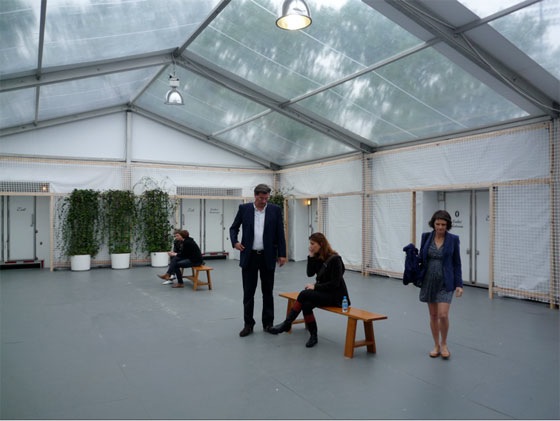
I posted this Frieze rant on my tumblr last night but for those who prefer to read material that’s copy-edited, this should be a better reading experience. The content is entirely the same.
How many different people do you have to shake to get art institutions and businesses to wake up? Our actions as employers affect the quality of life of others. We know this—in general, the art community votes for socially responsible policies—and yet our own labor practices are amongst the very worst across all professions.
This isn't news. We've known these problems have existed for a long time, and no one likes it. But every so often a statement or an event brings these issues to light again and the problem feels fresh. In my case, it's been the Frieze Art Fair's decision to undercut workers wages by cutting out the unions, the unwillingness of museum directors to support the locked-out art handlers' protests at yesterday's Frieze panel discussion, and the seemingly oblivious statements made by co-founder Amanda Sharp about the fair and what kind of compensation artists should expect for the work they make.
Let's start with Sharp's clumsy statements on the Guardian earlier this week connecting artist expectations about wages to reality TV. Sharp says she's not necessarily against the Occupiers, but senses the protest is based on false expectations:
Over the last 10 years, the art world has tracked global economic change. In America there is a more politicised awareness of inequality between class and wealth. At the same time, more people have decided that art can be a career. They've seen art reality TV shows and they think they can make a career purely out of their work. That's an unrealistic expectation so a lot more people feel disenfranchised.
This is just wrong. Work of Art proffered a lot of harmful art myths, but never that artists could or should make a living wage off this shit. Of the artists cast in Work of Art Seasons 1 and 2, only one artist lived off his art: The Sucklord. The $100,000 grand prize cash pot wouldn't last most artists more than 2-3 years.
Also, THERE'S NOTHING WRONG WITH WANTING TO BE COMPENSATED FOR WHAT YOU DO. Artists don't all expect to make a living off their art, but there's an expectation amongst the profession where we're thankful if we make anything at all, because getting a place in the history books will be worth it—if we're so lucky. That's the unrealistic expectation, and we need to call it out for what it is.
This wasn't the only statement Sharp made I took issue with this week. She followed up her Guardian interview with one at the Globe and Mail; her statements made sense this time, but were still far out of sync with her actions as a fair organizer. Observe:
We do want to be more than a fair, in the sense that we always aimed to create a meeting place, a place where discussion could begin.
This sounds great and all, but just who gets to participate in this discussion? Frieze talks aren't free—they come at a 40 dollar ticket price—and on Thursday police shut down the Occupy protests over Frieze's labor decisions. Tomorrow there will be a talk about Occupy at Frieze without a single Occupy representative. It seems Frieze won't be welcoming much discussion after all.
Speaking of discussion, for a fair with a reputation for balancing commerce, art and ideas better than most, they've certainly hosted more than their fair share of bullshit talks. Yesterday Frieze hosted a panel dubbed “Expanding Museums”, which claimed to explore the “current and future roles of contemporary art institutions.” Given the role the internet now has in our lives, there should be a lot to discuss on that topic—how, for instance, can we document and preserve culture online?—but neither that topic nor any number others ever got discussed. Instead, Glenn Lowry, Director of the MoMA, Adam D. Weinberg, Director of the Whitney, and Sheena Wagstaff, Chairman of the Modern and Contemporary Art Department at the Metropolitan Museum offered a full spectrum of PR for their museums, focusing primarily on the various buildings they're each renovating.
That's not a discussion, and if they weren't prepared to have one, they shouldn't have been invited. Frankly, what happened in the Q&A portion of the talk, when each of the Directors feigned ignorance of the Sotheby's Lockout protests, is unconscionable. There are 43 art handlers out there with meaningful jobs. If Sotheby's gets the contract they want, there will be a lot fewer. They will replace full time workers with temporary workers, and those workers will receive less pay and no benefits.
That's just not right. Health care costs companies a lot, but you know what? It saves people's lives. That's meaningful and it's time we started acting that way. We'll all be a lot better off if we stop placing our bets on an imaginary future that might have our name on it, and started investing in the quality of our lives now.


{ 5 comments }
Indeed. It would appear that the organizers of Frieze want to capitalize on any change bubbling up from the art proletariat, so to speak, without having to actually make any of those changes if it will adversely affect their bottom line.
So I attended Frieze today:
“We do want to be more than a fair, in the sense
that we always aimed to create a meeting place, a place where discussion
could begin.”
Definately not that…fail. It was a mall. Painfully traditional and capitalist in nature. That’s all well and good, but to label it as anything else is just denial. :/
Everybody, myself included, went apeshit over the great infrastructure of the fair. Rightly. Barring eastern european quality of the toilet paper, the organization was flawless: the tent, the grounds, the lighting, the food, the navigation etc. Predictably, the art was very specific to a big, glitzy, high-end trade show – good and bad, but certainly not reflective of anything other than commerce – no media, no political content to speak of, nothing urgent or even remotely timely, just a sea of collectible objects. Why expect anything else? IMO the actuall fail was in the hypocrisy that frieze is more than trade floor and it offers an open discussion forum. On top of the panel you refer to, TWO OTHER PANELS: sat “collecting for 99” and sun one about the Occupy Movement relationship to art were CANCELLED last minute. I guess they thought better of having any more potential irritants. Occupy panel was replaced by Rob Storr’s lecture on Richter’s Atlas.
“On top of the panel you refer to, TWO OTHER PANELS: sat “collecting for 99” and sun one about the Occupy Movement relationship to art were CANCELLED last minute. I guess they thought better of having any more potential irritants.”Â
Yes, Allan Sekula’s previously scheduled talk was just pulled off the website with no notice at all. They wouldn’t dare publicize the cancellation b/c they’d have to mention he refused to cross the picket line of the carpenter’s union. I suspect something similar happened with the Occupy panel, but am curious to hear.
Aside from the
nice, big,
well lit tent
with its
curving
aisles, hip
restaurants
and cafes,
aside from the
water views
and the
projects/sculptures
scattered on
the
surrounding
greensward of
Randall’s
Island, I
detected a
good amount of
grumbling re:
the heavy
handed
restrictions,
coercions,
evasions and
overt lies in
Frieze’s
imperialistic
will to power.
So much so
that I coined
a term for the
many who might
take some
pleasure in
watching
Frieze fail,
or at least
experience
some painfully
uncomfortable
shudders. That
term is
Schadenfrieze.Most fairs try to play
nicey nice
with the
locals when
they are
starting up in
a new city.
For example,
Art Basel
Miami admitted
many Florida
galleries in
the early
years to show
that they were
team players
and that they
respected the
turf they were
invading. Many
of these
galleries were
later
blackballed as
ABMB started
feeling its
oats. The same
tendency was
manifest in
their
treatment of
journalists
and their
issuing of VIP
credentials.
Good cop
first, then
bad cop.
In their
arrogance,
Frieze doesn’t
play this
appeasement
game. They are
immediately
nefarious,
excluding,
snobbish and
abusive; they
are bad cops
from the
outset. The
$40 admission,
which had to
be paid in
advance
online. The
noxious
tiering of
accreditation.
The outright
lying. (This
includes their
media partner,
Black Frame.)
Guess they
think they are
already too
big to fail.
Do we detect
the tragic
flaw of
hubris?
Comments on this entry are closed.