
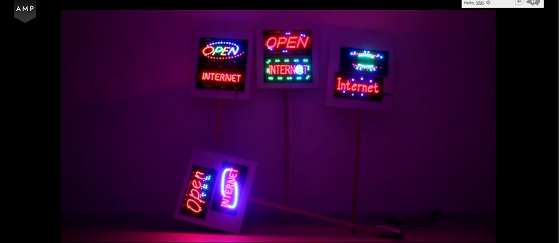
Aram Bartholl's 'Open Internet' (2012)
Aram Bartholl – Open Internet (2012)
Aram Bartholl bought some neon signs that said “open”, and then some neon signs that said “internet”. He then put them on top of each other, so they look like protest signs that say “Open Internet”. They’re double entendres, because “open” has two meanings and two uses (“open for business” and “open for all”), and it’s fun to use commercial tools for anti-commercial purposes. That’s about it.
This is disappointing. Bartholl can be great at one-liners—his light installation Speed (2006), for instance, which recreated visual effects from the game Need for Speed: Underground, was the sick bomb—but these signs just aren’t much of anything on their own.
That didn't need to be the case: on his website, Bartholl offers a video of himself wearing the “Open Internet” sign around New York with a WiFi hotspot attached; it’s a little silly, but also a heck of a lot more interesting than the video of quietly blinking signs that’s included in “C.R.E.A.M.”.
Lindsay Howard, though, chose to leave us with only the signs; that's telling. After all, electric signs have a very strange place in art: they’re magical tools that immediately and easily transmute words into salable objects. They manage to be an ever-present hit at art fairs and, simultaneously, to be the almost exclusive domain of conceptual artists (from Kosuth to Nauman, Martin Creed to Ragnar Kjartansson). It is nearly miraculous that both of those facts should be true. Why not try that silver bullet again? After all, neon was a triumph for the monetization of ideas.
As an aside, it’s weird that it’s not noted anywhere what happened to the signs. Are they an art object? Are they to be carried around with hotspots? Do they even exist anymore? That seems like the sort of detail that might be important, and it’s a point that could use some clarification.
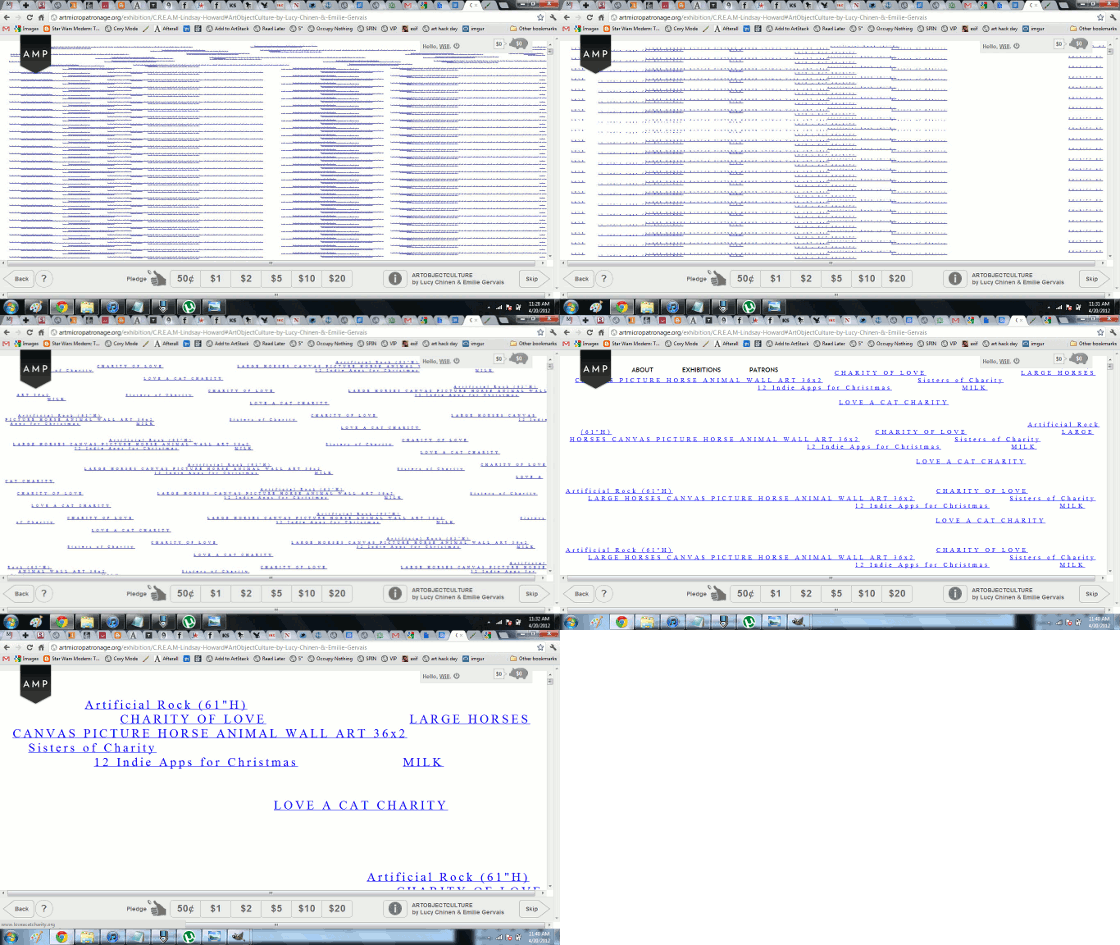
Changing the text size in ARTOBJECTCULTURE (2012), by Lucy Chinen and Emilie Gervais.
ArtObjectCulture by Lucy Chinen & Emilie Gervais (2011)
I first ran into ArtObjectCulture two months ago, when it hosted Michael Manning and Jeff Baij’s Celestial Works (2012), a collection of new constellations with names like “Dorito” (eh) and “Ford Taurus” (S-rank) drawn from readymade stars. It’s a platform for net art, developed by Lucy Chinen and Emilie Gervais, that reduces art-making to something like object juxtaposition consultation; artists are invited to create new, online works from images found on shopping sites, and then offer the works for the combined retail price of their parts (plus, Chinen and Gervais propose, an optional 43% “value added tax”). The purchaser gets all the items depicted, plus their name on a directory on ArtObjectCulture’s site.
As a gesture, turning objects into art and charging a premium isn’t novel; turning it into a platform, though, might be. Even though the actual system isn’t much of anything—prospective works on ArtObjectCulture are generally single JPGs, divided up as image maps—there’s something enticingly now about the idea of building a frontend for declaring things art. I’d love to see the idea taken on by someone with more of the instincts of a professional web developer—manage your declared artworks, track your artistic credentials, etc.
The actual work included in C.R.E.A.M. isn’t all that interesting, though. The curatorial statement sums it up well:
“NOT KLEIN BLUE is a work by Lucy and Emilie, representing the raw material of ArtObjectCulture: hyperlinks. NOT KLEIN BLUE invites users to experience an accumulation of links to purchasable materials, which are used to construct a new art object.”
There are, in my opinion, three things going on this work.
There’s a Lisa Jevbratt-type angle, where you perhaps get a sensation of taking a plunge into the unknown on account of the multitude and illegibility of the links. In that model, the actual content of the links might be inconsequential, but that’s not certain. What are they, then? When I opened a few dozen links at random and tried to find a similarity, I couldn’t identify any beyond the idea of charity. No particular kind of charity seems to be highlighted, and even if one were, I’m not sure when the visitor would have time to notice. In a work with random viewer entry into a complex system, like this one, Jevbratt’s 1:1, Art and Language’s Index 01 (1972), or Nam June Paik’s Random Access (1963), how does one communicate the relative likelihood of various outcomes? Even if 70% of the links on the page were to go to cat charities, how many links would a viewer need to click before he could discern an unusual number of cat links? I’m not sure whether this is a technical issue, to be solved with professional standards, or an idea to be forever idled as a “big thought”.
There’s also the original ArtObjectCulture angle, which here translates awkwardly: you can give some amount of money to a charity, and then I suppose you can also donate to Art Micro-Patronage, and then you’ll get a work worth some amount, maybe? Are we to buy all of the objects available? Some? None? It’s unclear. This is an exhibition of a platform that aims to present simple package deals with a clear agent of artistic transformation, and it’s not clear what I’m to buy, how much it costs, or whether it will be an artwork. That’s a flaw.
Lastly, there’s a nod to Yves Klein and abstraction, which doesn’t seem to do anything other than throw the viewer off-track. Some of the basic principles at work here make sense: blue, on a backlit screen, is now and forever will be “link blue”, which is notable; small text can operate as both visual element and textual information, which is particularly relevant with the rise of search engine optimization as an industry; and it is cool to reference Yves Klein. Beyond that, there’s nothing here. If the links were meant to form an abstract piece, I didn’t notice.
This is a work that could have used a bit of conceptual sharpening; as it is, it wastes energy heading in too many directions at once.


{ 17 comments }
Just as a note, 0-Day art has release stuff that is possibly contentious and thorny, IMHO, including Rhizome “Downloads” Which are meant to be only accessible to paying Rhizome members or donors that supported the fundraiser to download onto personal computers and enjoy privately (or so it seems). I know that this hasn’t exactly sat well with some people over at Rhizome, and other accounts of ambivalence toward what this project does (and the pirating associations that it embodies and employs) doesn’t exactly sit well with those that are wanting to translate primarily digital works into salable/collectable objects.Â
I guess I’ve more to say/respond on this topic, and the exhibition as a whole, but it might have to wait until a later time. That being said, I appreciate the thruoughness of this review in that it actually puts forth an evaluative/judgement claim against/for works existing under the “netart” paradigm – something that is sorely missing from the whole conversation (and instead usually gets substituted for “cultural critique,” “gossip talk,” or “lofty rhetoric/praise,” all of which I’ve contributed to and am not immune).
Hey! Thanks for chiming in. I thought about that, particularly because Ben Fino-Radin & 0-Day were fighting on Twitter the other day after the Verge article.
I still think Rhizome, in the grand scheme of things, isn’t the scariest opponent to take on, and that 0-Day v. Rhizome has been more concerned with rhetoric (like the references to the Armory show fuss last year) than with actual piracy. This isn’t yet, say, releasing The Clock.
Also, more directly to the point, the Rhizome download torrent isn’t on 0-Day’s website (anymore?), which would’ve made it difficult to talk about and unpossible to link to. Was that taken down? I know I downloaded it at some point.
IDK, but that is a good question about what happened to those torrents. Of course, you could always rehost those torrents yourself if you still have them, Will 🙂
 I’m not sure that they could take on “bigger fish” though, since their ideology is so dependent on addressing online works and communities. To take on something that isn’t typically within the realm of net-based practice (like say Paula Cooper in NYC) might divert the attention that this project’s initial intention. That being said, I know a convo on the NewNetArt listserv has discussed taking on projects like art.sy and that 0-Day art have plans to take on galleries that normally are physical spaces, but this process hasn’t really happened much yet…
So, I’m not sure if expanding into non-netart camps is really part of the projects goals, or if they actually intend to be a compliment to something like Karagarga.
I’d have to agree that their targets have been a little soft. And, it seems it will stay that way. Since they have allowed their identities to be public, it would be hard for me to be convinced that they will go after anything too crazy. But, perhaps there aren’t any really big targets in net art. The commercial system for it – as evidenced in this show and article – doesn’t yet fully function (thanks for the google doc btw,) so proving a loss of income could be quite challenging. I also doubt that Rhizome would risk their station in the community to sue an artist hacker duo.
The question of when something or someone becomes a target is pretty interesting though.
Just to head off any confusion, 0-Day Art has never released any of “The Download(s)” from Rhizome.
Whoops, my mistake, sorry about that. I thought I had seen something of that on your twitter a while back, but I’m mistaken. Thanks for clearing that up. Do you have any plans to host those works?
I totally thought I’d seen that too. Mass hallucination?
Sticking to my mass hallucination theory, but I suppose it should be asked: would you?Â
Is The Download okay because it’s not “taken offline”, even if it’s still limited-access?
Does it make a difference that anything included in The Download is probably going to stick around? Rhizome has institutional longevity, an archive-y mentality, and a financial incentive to keep everything that’s ever been in The Download available forever. It seems like a pretty safe bet that in, say, five years I’ll still be able to buy a membership and download Ryder’s Facebook history. Does that change things?
Seems like you have to be a Rhizome member to download The Download on Rhizome. This access measure seems to assume either only media artists would be interested in obtaining The Download, or it just looks like extra hassle for the common person to get an account just to download it…
I’m enjoying the expanded multi-chapter review.Â
In hindsight I also thought JODI’s Goodtimes could have been at the end. To end the exhibition with the heavyweights instead of starting with it or to foreground the emerging artists because JODI is a big pull anyway.Â
Â
I am a sucker for heavy meta and I proposed that commodity critique was the best way to sell work (why bother to make a physical analogue?) without contradicting oneself in The Commodification of Net Art http://pooool.info/from-browser-to-gallery-and-back-the-commodification-of-net-art-1990-2011/ which Tom Moody thought was really tired. According to him, money is a “back room” thing and I like how AMP makes this process (how much we will pay for net art) of valuation transparent.
I appreciate how Lindsay has framed these as individually politicized works without moralistic tone on whether the will of the work is disruptive or enhancing to the browsing experience.Another thing I mentioned as a political issue that is hard to tell with AMP yet is what this platform alone means for artists and curators. It seems to reposition the curator as conceptual gatekeeper. The only way you can get in on the monetization system that AMP offers if is someone curates a show.Â
great review. just one comment on this excerpt from the first page:
“it’s awfully hard to make decent art as a second job”
there’s a hidden assumption here: that all art should be equally easy to make. but i think some art hurts, some art takes time, some takes thought, some takes money. it’s all difficult, but each kind is difficult in its own way. maybe there is no answer here, and net.art is difficult because it’s simply not self-sustaining in a monetary sense.
that said, i think the “donation” model is the closest to being right, and it’s great to see the alternatives being explored.
cool premise good job
Thanks for the comment!
As for the matter of money, it’s a simplification, for sure, but I think it’s one that works. Money solves a lot of problems; it buys materials, buys time, attracts talent. All the uncertainty of art-making exists within certain parameters, and I think we can talk about changing those certain conditions without worrying *too* much about the more complex system within them.Â
Not to say, of course, that we shouldn’t stay awake to assumptions.
I think donations make the most sense, too, in one form or another, but also that the likelihood of me donating money to a project is directly related to how much trouble it is to donate. That’s a Clay Shirky idea, referenced in Lindsay’s curatorial statement, that’s still true.
Art Micro-Patronage did a great job, I think, in offering “wallet” functionality, so that additional donations require diminishing mental effort. Look at the Xbox: you can only put money on in slightly awkward increments, so you’re always left with a couple bucks in your Xbox Live account that you’re willing to spend on extra outfits or whatever. If AMP were to keep going (I really hope it does), I’d love to see them expand the wallet concept.
The problem, I think, is that Microsoft was big enough to force that system on everyone pretty easily. So who’s that big in net art? How about partnering with Rhizome, for instance, to give all their members five bucks in AMP wallet money to spend as they like? I think it’d be possible (though not at all easy) to find a collector or foundation willing to bankroll that for the opportunity to be net art jesus. This is totally a solvable issue.
First off, thanks for the great review and kind words about our project.
I think you’re totally right about the importance of a “frictionless” donation process. Â That was one of our central goals from the start. (Originally we were using paypal’s “one click” solution that promised to be more slick, but in reality it was super buggy and slow, so we had to ditch it for the normal paypal way. I’m sure we lose people there.) Â Now that everyone is comfortable with dollar apps and dollar songs, the thought was that by setting the donation amounts super low, and making the process quick people might actually go one step further than clicking “Like”. Â
It’s funny that you brought up the wallet feature because we were actually considering removing that for the next round. Â Granted, we didn’t have a huge sample, but few people used it as intended. Â Instead most people used it to donate to all the participating artists as all unspent funds get divided evenly at the end of the six shows. Â I really love the idea of finding a sponsor to pre-fill wallets for new users. Â It might be worth keeping around just for that. Â
Rhizome’s notion of “taking a GIF offline so the collector can have it locally” isn’t a viable business model or a particularly good way of educating people about this ill-defined term “net art.”
That’s what Ben Fino-Radin (who works for Rhizome) and 0-Day were “fighting” about on Twitter–none of which is not explained here. Fino-Radin said he couldn’t support 0-Day because their program is rooted in a “diss” — that is, criticism of his employer.
The entire controversy is glossed over here as “the Armory fuss last year.”
Â
I talked about the work in the show, and linked to a lengthy Verge article that does a better job than I would have done in discussing the antagonism between Rhizome and 0-Day. As far as I’m concerned, the fact that 0-Day have continued beyond Rhizome in particular—and the fact that they haven’t specifically targeted Rhizome for some time now—is ample grounds to consider their new work on its own merits.
I didn’t examine the controversy more closely out of a combination of weariness and focus; I was getting sick of this show after 4,000 words, and I didn’t want to reignite a debate about 0-Day and Rhizome that is, in my view, exhausted. Even as it is, half of the comments here concern 0-Day. I didn’t want a piece I wrote with the intention of sparking new conversations to turn into a rehashing of old ones.
Frankly, you’ve won, Tom. So far as I know, Rhizome hasn’t attempted to sell a GIF in such an exclusive manner since you called them out on Lauren’s comments to Hyperallergic; that, I think, is a victory, whether or not anyone flew a white flag. I think your comments surrounding the issue will continue to be a well-known, well-articulated viewpoint, and will be referenced in future if (when!) galleries attempt the same methods of exclusion.
On the other hand, Rhizome also hasn’t attempted to sell net art in so public a venue as the Armory, whatever the terms of sale, since that fight. I think that’s a loss. Your own blog posts on the topic only mention in passing that Rhizome’s Armory booth also included a website by Rafael Rozendaal—an artist who stringently controls his own terms of sale to ensure his works remain available to the public online. It is good and necessary that Rafael Rozendaal’s work be sold at art fairs, and I think the scale and venom of your arguments against Rhizome selling Sara Ludy’s GIFs discouraged that.
I am not eager to further belabor the point. I believe its potential for good has been exhausted, because Rhizome has learned that net artists will not condone unnecessary exclusivity, and because other organizations attempting to sell net art have since then used more fitting models. I believe its potential for bad persists, to wit: the further polarization of the net art community; the discouragement to potential future dealers in net art; and the building of general hostility toward an organization which will very soon have a new face and which, for good or ill, is one of the few American net art-related organizations able to acquire public and private funding.
This beef needs to be quashed. Its usefulness is at an end, and if in future some new tyrant must be reminded that this is the internet, I’m certain your arguments will be the very first salvos. As I hope this review shows, though, we’ve got other things to talk about.
Your ennui is noted, however, Rhizome staffers were sending emails to artists and writers who mentioned the Armory incident, as recently as the C.R.E.A.M. show. The emails didn’t say “We were wrong” but rather, blamed Sara Ludy for the business model and from what I’ve heard, spooked the email recipients rather badly. The Verge article you mentioned also had a correction added at Cornell’s insistence that disavowed her involvement with “taking the work offline so the collector can have it locally.” That isn’t ancient history. Great if you want to assign blame for “building of general hostility” but it helps to know all the facts.
Comments on this entry are closed.