
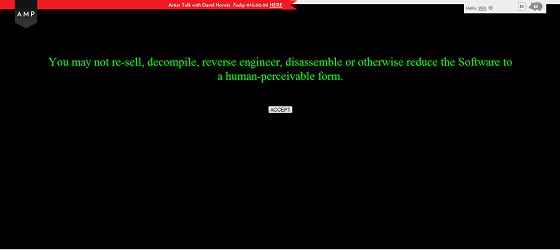
One of the alarmist prompts that face the viewer in JODI's 'Goodtimes' (1996)
JODI – Goodtimes (1996)
Just to start from the top, the title “Goodtimes” is important, here. The “Goodtimes virus” was a hoax that began circulating on AOL in December of 1994 and reached the height of its popularity the next year. There is no virus, per se; what went around was an email warning about the existence of a supposed “Goodtimes” virus, that was supposedly spread by opening emails with “Good times” in the subject. It didn’t take long for canny observers to notice that the email itself, as it was endlessly forwarded and reforwarded between worried users, acted as a virus itself. Goodtimes, the artwork, references on the same fears that circulated the “Goodtimes virus”.
After a series of frightening warning messages in hacker-aesthetic green-on-black, each of which the user must accept to continue, Goodtimes opens up onto a home page of sorts filled with indecipherable pseudocode, out of which three buttons arise, labeled “EXE”, “SEMI”, and “TDOOG”. Of the three, “TDOOG” and “SEMI” are pretty boring; “SEMI” leads back to the warnings, while “TDOOG” leads to a navigable series of pages full of broken images, self-referential alt-text (in one case, “IMG SRC=HTTP:”), more green-on-black, and some visual play with the browser’s image scaling.
None of the pages feel particularly compelling. That might be because their HTML elements aren’t fixed; they expand to fill your browser, and whatever system JODI may have had in mind when designing the page, it certainly wasn’t my 1366 x 768 pixel laptop screen. It’s difficult to say what the intended size was, so the viewer’s left to play around, shrinking and enlarging in the hopes that, out of chaos, they find something that looks nice. I, for one, didn’t.
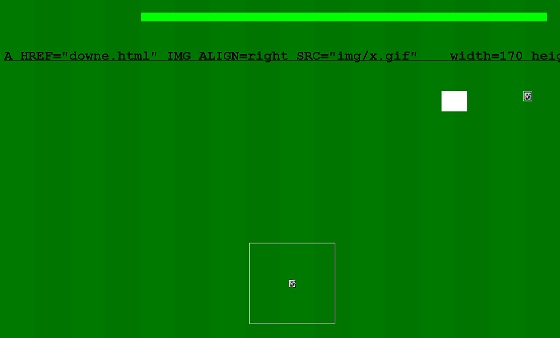
One of the glitch-art pages in 'Goodtimes'.
“EXE” is a meatier section. Clicking it presents you with, among other things, a green briefcase, and clicking that takes you to a series of pages filled with more, and more threatening-looking, pseudocode. The sensation is one of losing control, particularly in pages like capture2.html, where the user is forced to watch helplessly as their browser scrolls through a series of UNIX commands. It feels a little bit like a hijacking, and that’s great; Goodtimes does a good job of looking like the popular image of a virus executing (complete with paths like “/hack/hackdir/rumors”).
If you stop the Javascript that causes the scrolling from executing, you can get a better look at the code itself. JODI have hidden some tasty morsels for the careful viewer. A large part of the text, or instance, comes from the server logs of Tsutomu Shimomura, the computer security expert who was hunting down real-life hacker Kevin Mitnick around the same time as “Goodtimes” began to circulate; the logs were published as part of his evidence against Mitnick. Other parts are taken from Mitnick’s logs a week before his capture, and still more seem to have been created from whole cloth.
Despite its complexity and the amount of work involved, it's hard to see Goodtimesas anything more than a joke—a joke most internet users in 2012 aren’t going to get. It’s not just that the historical references fail to communicate; it’s also the fact that we simply don’t use the web in the same way we did when JODI were working on this project. In 1996, we were not yet in an era of multi-threaded, tabbed browsers with background processes that remember your browsing history; a browser window scrolling uncontrollably might actually have been a worry, and closing it might actually have been a loss. Today, you kill the tab’s process and move on.
Goodtimes is an odd inclusion in a show that’s otherwise fairly tightly organized around money and distribution. It’s not obviously connected, unless one considers the passing similarity between its warning prompts and the single warning prompt in the next work, Greg Leuch’s G.R.E.E.D.. In one warning, I suppose, we are warned not to “re-sell, decompile, reverse engineer, or disassemble the Software”. It’s not quite Rafael Rozendaal’s contract, but it’s a stand for the status of the artwork, even if it is meant as a joke. One possibility is that we are intended to read the warning messages as applying to the show as a whole. If so, that might have been a temptation better left aside.
In a Facebook chat, artist and curator Jennifer Chan pointed out another problem: Goodtimes has a high bounce rate. That is, whatever the merits of JODI’s work, the way it works—by opening a new set of windows and then giving you a good reason to close them—leads exhibition viewers away from the rest of the show. It is therefore, in a very practical sense, a poor choice for the first work in a linear exhibition.
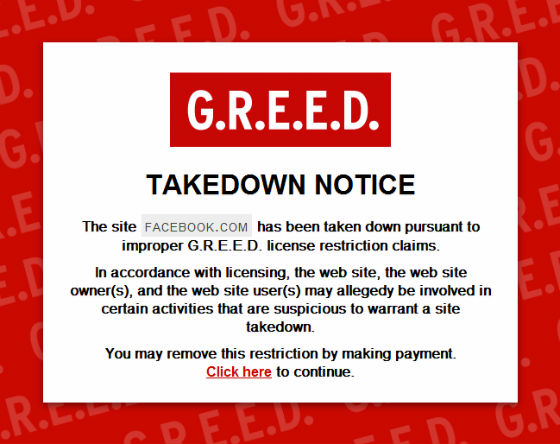
G.R.E.E.D.
Greg Leuch – G.R.E.E.D. (Glom & Restrict Entities on Existing Domains) (2012)
Greg Leuch’s browser plugin G.R.E.E.D. (2012) monitors the user’s activity and occasionally steps in to censor or block specific domains. Placed next to Goodtimes, it reflects changing fears online: today, we’re not afraid of anarchic hackers or celebrity viruses, but the calculated extortion of corporate control. Its self-description is acidly bureaucratic: “a license utility for your web browser that enables you to immediately comply with online license and copyright restrictions.” More than that, however, G.R.E.E.D. tries to turn its control into cash. When you visit a blocked site—in my case, Facebook—G.R.E.E.D. offers you the opportunity to pay $1 for a two-day license for unrestricted browsing; if you do, G.R.E.E.D.agrees to stop monitoring your activity.
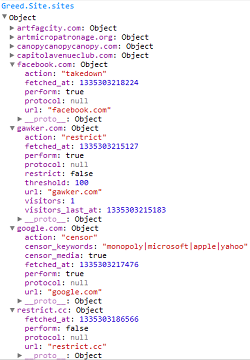
G.R.E.E.D. reaches out to its server for instructions on how to deal with each domain you visit. I dumped its localStorage—a kind of medium-term memory for Javascript—to show some of the variations.
It’s an interesting gesture—funding art through extortion—but one G.R.E.E.D. doesn’t seem particularly interested in capitalizing on. Leuch’s most well-known art plugin, Shaved Bieber (2010), was great because it simultaneously spoke to a popular desire (the elimination of Justin Bieber) and unveiled a relatively unfamiliar power (you can control your browser and what it shows, without limit, so long as you have the tools). Shaved Bieber had the tone of a joke, but it also offered the material tools to enact the great postmodern dream of editing the media to your liking.
G.R.E.E.D., by contrast, is heavy on rhetoric but light on execution. It’s one-sided, too; we’re offered the dystopic possibility of extortion and surveillance, but never forced to face the potential benefits of such a system. There’s no real reason to install the plugin, which offers too easy an out. Ultimately, one suspects the work is less morally nuanced than, say, making a decision about whether to “upgrade” your iTunes songs to DRM-free versions.
Another issue is the practical invisibility of the plugin. Maybe my browsing habits are unusual, but after most of a day of having the plugin installed, I only ever noticed G.R.E.E.D.‘s existence when I tried to use Facebook. True, there’s probably some insidious merit in remaining undetected, and it’s interesting to have an artwork reach out to you only on its own terms; that said, G.R.E.E.D. is sneaky to the point of not existing at all. Looking at the instructions G.R.E.E.D. gets back from its server (see left), it’s clear I’d stumbled near a few features I wouldn’t have triggered on my own; if you were to Google “monopoly”, for instance, you’d find the word blacked out in the results. Trying a few other likely sites (4chan; Rhizome; the website for F.A.T. Lab, at which Leuch is a “Virtual Research Fellow”), I struggled to come up with much else. If you visit Apple.com, I guess, a lot of stuff gets blacked out. Uh, cool?


{ 17 comments }
Just as a note, 0-Day art has release stuff that is possibly contentious and thorny, IMHO, including Rhizome “Downloads” Which are meant to be only accessible to paying Rhizome members or donors that supported the fundraiser to download onto personal computers and enjoy privately (or so it seems). I know that this hasn’t exactly sat well with some people over at Rhizome, and other accounts of ambivalence toward what this project does (and the pirating associations that it embodies and employs) doesn’t exactly sit well with those that are wanting to translate primarily digital works into salable/collectable objects.Â
I guess I’ve more to say/respond on this topic, and the exhibition as a whole, but it might have to wait until a later time. That being said, I appreciate the thruoughness of this review in that it actually puts forth an evaluative/judgement claim against/for works existing under the “netart” paradigm – something that is sorely missing from the whole conversation (and instead usually gets substituted for “cultural critique,” “gossip talk,” or “lofty rhetoric/praise,” all of which I’ve contributed to and am not immune).
Hey! Thanks for chiming in. I thought about that, particularly because Ben Fino-Radin & 0-Day were fighting on Twitter the other day after the Verge article.
I still think Rhizome, in the grand scheme of things, isn’t the scariest opponent to take on, and that 0-Day v. Rhizome has been more concerned with rhetoric (like the references to the Armory show fuss last year) than with actual piracy. This isn’t yet, say, releasing The Clock.
Also, more directly to the point, the Rhizome download torrent isn’t on 0-Day’s website (anymore?), which would’ve made it difficult to talk about and unpossible to link to. Was that taken down? I know I downloaded it at some point.
IDK, but that is a good question about what happened to those torrents. Of course, you could always rehost those torrents yourself if you still have them, Will 🙂
 I’m not sure that they could take on “bigger fish” though, since their ideology is so dependent on addressing online works and communities. To take on something that isn’t typically within the realm of net-based practice (like say Paula Cooper in NYC) might divert the attention that this project’s initial intention. That being said, I know a convo on the NewNetArt listserv has discussed taking on projects like art.sy and that 0-Day art have plans to take on galleries that normally are physical spaces, but this process hasn’t really happened much yet…
So, I’m not sure if expanding into non-netart camps is really part of the projects goals, or if they actually intend to be a compliment to something like Karagarga.
I’d have to agree that their targets have been a little soft. And, it seems it will stay that way. Since they have allowed their identities to be public, it would be hard for me to be convinced that they will go after anything too crazy. But, perhaps there aren’t any really big targets in net art. The commercial system for it – as evidenced in this show and article – doesn’t yet fully function (thanks for the google doc btw,) so proving a loss of income could be quite challenging. I also doubt that Rhizome would risk their station in the community to sue an artist hacker duo.
The question of when something or someone becomes a target is pretty interesting though.
Just to head off any confusion, 0-Day Art has never released any of “The Download(s)” from Rhizome.
Whoops, my mistake, sorry about that. I thought I had seen something of that on your twitter a while back, but I’m mistaken. Thanks for clearing that up. Do you have any plans to host those works?
I totally thought I’d seen that too. Mass hallucination?
Sticking to my mass hallucination theory, but I suppose it should be asked: would you?Â
Is The Download okay because it’s not “taken offline”, even if it’s still limited-access?
Does it make a difference that anything included in The Download is probably going to stick around? Rhizome has institutional longevity, an archive-y mentality, and a financial incentive to keep everything that’s ever been in The Download available forever. It seems like a pretty safe bet that in, say, five years I’ll still be able to buy a membership and download Ryder’s Facebook history. Does that change things?
Seems like you have to be a Rhizome member to download The Download on Rhizome. This access measure seems to assume either only media artists would be interested in obtaining The Download, or it just looks like extra hassle for the common person to get an account just to download it…
I’m enjoying the expanded multi-chapter review.Â
In hindsight I also thought JODI’s Goodtimes could have been at the end. To end the exhibition with the heavyweights instead of starting with it or to foreground the emerging artists because JODI is a big pull anyway.Â
Â
I am a sucker for heavy meta and I proposed that commodity critique was the best way to sell work (why bother to make a physical analogue?) without contradicting oneself in The Commodification of Net Art http://pooool.info/from-browser-to-gallery-and-back-the-commodification-of-net-art-1990-2011/ which Tom Moody thought was really tired. According to him, money is a “back room” thing and I like how AMP makes this process (how much we will pay for net art) of valuation transparent.
I appreciate how Lindsay has framed these as individually politicized works without moralistic tone on whether the will of the work is disruptive or enhancing to the browsing experience.Another thing I mentioned as a political issue that is hard to tell with AMP yet is what this platform alone means for artists and curators. It seems to reposition the curator as conceptual gatekeeper. The only way you can get in on the monetization system that AMP offers if is someone curates a show.Â
great review. just one comment on this excerpt from the first page:
“it’s awfully hard to make decent art as a second job”
there’s a hidden assumption here: that all art should be equally easy to make. but i think some art hurts, some art takes time, some takes thought, some takes money. it’s all difficult, but each kind is difficult in its own way. maybe there is no answer here, and net.art is difficult because it’s simply not self-sustaining in a monetary sense.
that said, i think the “donation” model is the closest to being right, and it’s great to see the alternatives being explored.
cool premise good job
Thanks for the comment!
As for the matter of money, it’s a simplification, for sure, but I think it’s one that works. Money solves a lot of problems; it buys materials, buys time, attracts talent. All the uncertainty of art-making exists within certain parameters, and I think we can talk about changing those certain conditions without worrying *too* much about the more complex system within them.Â
Not to say, of course, that we shouldn’t stay awake to assumptions.
I think donations make the most sense, too, in one form or another, but also that the likelihood of me donating money to a project is directly related to how much trouble it is to donate. That’s a Clay Shirky idea, referenced in Lindsay’s curatorial statement, that’s still true.
Art Micro-Patronage did a great job, I think, in offering “wallet” functionality, so that additional donations require diminishing mental effort. Look at the Xbox: you can only put money on in slightly awkward increments, so you’re always left with a couple bucks in your Xbox Live account that you’re willing to spend on extra outfits or whatever. If AMP were to keep going (I really hope it does), I’d love to see them expand the wallet concept.
The problem, I think, is that Microsoft was big enough to force that system on everyone pretty easily. So who’s that big in net art? How about partnering with Rhizome, for instance, to give all their members five bucks in AMP wallet money to spend as they like? I think it’d be possible (though not at all easy) to find a collector or foundation willing to bankroll that for the opportunity to be net art jesus. This is totally a solvable issue.
First off, thanks for the great review and kind words about our project.
I think you’re totally right about the importance of a “frictionless” donation process. Â That was one of our central goals from the start. (Originally we were using paypal’s “one click” solution that promised to be more slick, but in reality it was super buggy and slow, so we had to ditch it for the normal paypal way. I’m sure we lose people there.) Â Now that everyone is comfortable with dollar apps and dollar songs, the thought was that by setting the donation amounts super low, and making the process quick people might actually go one step further than clicking “Like”. Â
It’s funny that you brought up the wallet feature because we were actually considering removing that for the next round. Â Granted, we didn’t have a huge sample, but few people used it as intended. Â Instead most people used it to donate to all the participating artists as all unspent funds get divided evenly at the end of the six shows. Â I really love the idea of finding a sponsor to pre-fill wallets for new users. Â It might be worth keeping around just for that. Â
Rhizome’s notion of “taking a GIF offline so the collector can have it locally” isn’t a viable business model or a particularly good way of educating people about this ill-defined term “net art.”
That’s what Ben Fino-Radin (who works for Rhizome) and 0-Day were “fighting” about on Twitter–none of which is not explained here. Fino-Radin said he couldn’t support 0-Day because their program is rooted in a “diss” — that is, criticism of his employer.
The entire controversy is glossed over here as “the Armory fuss last year.”
Â
I talked about the work in the show, and linked to a lengthy Verge article that does a better job than I would have done in discussing the antagonism between Rhizome and 0-Day. As far as I’m concerned, the fact that 0-Day have continued beyond Rhizome in particular—and the fact that they haven’t specifically targeted Rhizome for some time now—is ample grounds to consider their new work on its own merits.
I didn’t examine the controversy more closely out of a combination of weariness and focus; I was getting sick of this show after 4,000 words, and I didn’t want to reignite a debate about 0-Day and Rhizome that is, in my view, exhausted. Even as it is, half of the comments here concern 0-Day. I didn’t want a piece I wrote with the intention of sparking new conversations to turn into a rehashing of old ones.
Frankly, you’ve won, Tom. So far as I know, Rhizome hasn’t attempted to sell a GIF in such an exclusive manner since you called them out on Lauren’s comments to Hyperallergic; that, I think, is a victory, whether or not anyone flew a white flag. I think your comments surrounding the issue will continue to be a well-known, well-articulated viewpoint, and will be referenced in future if (when!) galleries attempt the same methods of exclusion.
On the other hand, Rhizome also hasn’t attempted to sell net art in so public a venue as the Armory, whatever the terms of sale, since that fight. I think that’s a loss. Your own blog posts on the topic only mention in passing that Rhizome’s Armory booth also included a website by Rafael Rozendaal—an artist who stringently controls his own terms of sale to ensure his works remain available to the public online. It is good and necessary that Rafael Rozendaal’s work be sold at art fairs, and I think the scale and venom of your arguments against Rhizome selling Sara Ludy’s GIFs discouraged that.
I am not eager to further belabor the point. I believe its potential for good has been exhausted, because Rhizome has learned that net artists will not condone unnecessary exclusivity, and because other organizations attempting to sell net art have since then used more fitting models. I believe its potential for bad persists, to wit: the further polarization of the net art community; the discouragement to potential future dealers in net art; and the building of general hostility toward an organization which will very soon have a new face and which, for good or ill, is one of the few American net art-related organizations able to acquire public and private funding.
This beef needs to be quashed. Its usefulness is at an end, and if in future some new tyrant must be reminded that this is the internet, I’m certain your arguments will be the very first salvos. As I hope this review shows, though, we’ve got other things to talk about.
Your ennui is noted, however, Rhizome staffers were sending emails to artists and writers who mentioned the Armory incident, as recently as the C.R.E.A.M. show. The emails didn’t say “We were wrong” but rather, blamed Sara Ludy for the business model and from what I’ve heard, spooked the email recipients rather badly. The Verge article you mentioned also had a correction added at Cornell’s insistence that disavowed her involvement with “taking the work offline so the collector can have it locally.” That isn’t ancient history. Great if you want to assign blame for “building of general hostility” but it helps to know all the facts.
Comments on this entry are closed.