
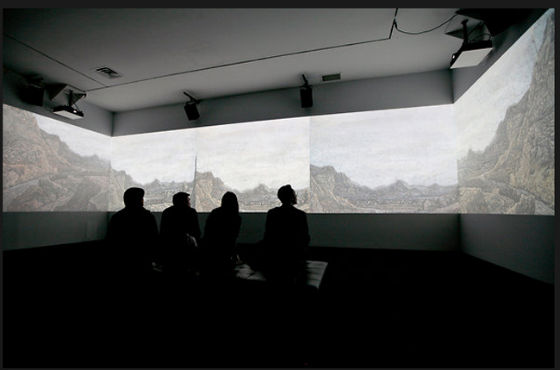
Werner Herzog's 'Hearsay of the Soul', installation view
That Werner Herzog film in the Whitney Biennial sure is a stinker. For those who haven’t seen his Hearsay of the Soul yet, the installation combines five screens of footage that slowly pan over the landscape etchings of Dutch artist Hercules Segers (1589) with the music of Dutch cellist and composer Ernst Reijseger. Reijseger appears on screen playing periodically, as if in a trance, as does a pianist.
The press response has been almost entirely positive. New York Magazine’s Jerry Saltz calls the installation “ravishing“, and New York Times critic Roberta Smith actually went so far as to dare viewers “not to cry” (somehow I managed). Meanwhile, Emily Nathan at ArtNet called it hypnotic and enchanting, Kyle Chayka at ArtInfo wrote that it was “awesome” and “sublime”, and Time Out’s Howard Halle simply described the work as undeniably “beautiful“. Other phrases thrown around the blogosphere include “arresting“, “you are in a cathedral experiencing the divine“, and my personal favorite, a “place for stoners“.
Get a grip, people. Art doesn’t need all these bells and whistles. The whole score reads like a device to support the footage, a crutch that wouldn’t be necessary if the original work were simply hung. Also, anyone who watched Herzog’s tedious two-hour documentary Cave of Forgotten Dreams last summer will recognize the music, as it’s exactly the same. I left with the impression that the director had some footage left over from that film, and figured he’d find something old and art-like, and overlay the two. I’m just glad the piece wasn’t offered in 3D.


{ 18 comments }
I’m grateful I walked into its room without knowing it was Herzog. And that I sat through it long enough to get to the cello playing part. I had managed to avoid seeing images of it online or reading anything about it. The music was what floored me, and that the player seemed to be playing as if it were his last minute on earth. On the other hand it was manipulative, more cinematic than “video art” and more sentimental than most art one is likely to see these days. All of which is maybe why people have responded so much to it. In this context, it sticks out. Also that sentimentality is, I suspect, what amps up your snark-meter.
*more sentimental than most contemporary art in New York…
The sentimentality didn’t help the work but my biggest problem with the piece is laid out in the blurb above. All those visuals buttress the music, not the other way around. The next time I want to see a complicated music video, I’ll head to Herzog, but that’s not what the biennial is about.Â
So your biggest problem is that it’s overrated?
What *is* the Whitney Biennial really about, anyway? And I mean that sincerely.
No. My biggest problem is that every time I look at that piece it looks as though it’s made by someone who doesn’t like looking at art. Slow mo pans, five channel screens, emotive music. You don’t need all that to look at a drawing, and the result is a ham fisted installation.Â
As for what the biennial is about, that’s a question every curator answers differently. Generally speaking though, it’s just a survey of what contemporary art people have cared about the most over the past two years. At least that’s how Francesco Bonami put it in 2010.Â
I didn’t see the video, but from your description of visuals buttressing the music, maybe it’s about questioning the definition of art. Â It seems the whole biennial is about that. Maybe Herzog’s piece is a farewell to old definitions hence the crying.
I’m so sick of “questioning the definition of art”. It’s a dead end conversation that always results in the same answer. If Herzog’s film is a farewell to outdated definitions he’s a hundred years too late. Duchamp beat him to that punch a while ago.Â
‘complicated music video” – I’m dumbfounded. The piece focuses on a few landscapes and two musicians playing music. It’s not Sledgehammer or Ryan Trecartin. Your reporting is more of a reaction to Hearsay’s praise then to its actuality.
THANK YOU. Not only was it kind of schlocky, but the images were grainy and pixelated. You’d do just as well to Google search the guy and listen to some Arvo Part in the comfort of your own home.
U SUCK
Thank God. Â I thought I was the only person in the visuals were overwrought.
such deep analysis sure will be remembered.Â
This post, like this artwork, will be quickly forgotten. That’s fine by us. Writing it was as necessary and as unpleasant as picking up your dog’s shit.
There’s simply nothing to delve into in Herzog’s work. It’s a simple piece, but in its few moving parts it still manages to be the sort of pretentious nonsense that actively fights against all progress, conversation, and real intellectual discourse. Discussing middlebrow schlock in depth is a really funny idea when you’re eighteen and “postmodernism” is still a big scary word, but it’s not what we do here.
Actually, I liked writing this post, but in the way one does when taking advantage of low hanging fruit. Frankly, I’m surprised more people didn’t see it as such. I genuinely find the attention this film got confusing.Â
 You want deep? Don’t look at Internet posts for deep. That’s the problem with the Internet.
Wow, I respectfully and totally disagree with your viewpoint here!
I for one was very moved by this installation. I am amused by how people have to front off about how kitsch it was. You people are too cool for school. It’s an easy rhetorical and intellectual move to dis what a lot of the critics liked. I was disappointed with the Biennial over all. I just cant find pieces of ripped cardboard hung by twine interesting, but when I watch a human being play cello in utter ecstasy I am moved. I sorry people are too cool to let themselves be moved.
In fact I saw this piece as appealing, moving and was very much attracted to by the music… in fact, we throw rotten eggs and tomatoes and potatoes (what a salad) at Herzog’s face… but, really, would the Biennale have had more to offer, I would have also been pleased not to talk about Herzog’s piece… in the end, talking about it shows that overall the Biennale is a disappointment to me… but, who am I to say that ? just a visitor
Comments on this entry are closed.