
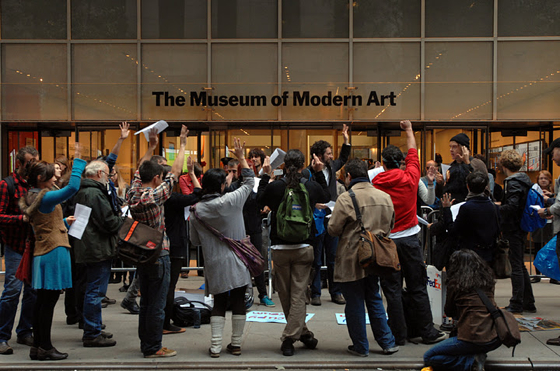
Last fall's Occupy Museums meeting outside MoMA (image via: libertyandbroadway.blogspot.com)
Last month, Christian Viveros-Faune started an online conversation with fellow Village Voice critics Martha Schwendener and R.C. Baker with a simple question: “If an artist had something important to say about the world, would anyone really listen?”
It prompted a fascinating discussion, during which the critics riffed on whether artists' protests are limited in their gains, whether art can make significant political progress, and whether museums are the right place to protest (Viveros-Faune thinks Sotheby's is a better target). Martha Schwendener raised the point that two of last year's Nobel Peace prize-winning women used “symbolic acts lifted straight from the art-world playbook”—sex strikes and a tent occupation—to help end Liberia's civil war, and to protest Yemen's regime, respectively. “Artists have these skills, but I think somehow our system has pushed them in the wrong direction,” she wrote.
Two weeks ago at Spring/Break, William Powhida hosted an open forum to continue the conversation, particularly in light of Occupy Wall Street. Schwendener—who has been an active presence since the movement's inception—mentioned that her life has changed after Occupy Wall Street, that galleries feel different now. Again, she mentioned the Nobel Peace Prize winners: “Those types of social interventions really smack of social practice or early performance art, so I guess it's just a question of context; these people are activists, as opposed to artists.” Here's a bit of that conversation:
Christian Viveros-Faune: “Maybe those are strategies we've forgotten to [employ in an art context.] Everything we do in the arts community seems to be limited by that precinct, the art precinct.” He then raised his objection to the “limited historic premise…that the right place to go protest is the museum. As opposed to, again, Gagosian, or the auction house.”
Powhida: “The museum's the place where it's been legitimized…the museum's a good place. The perception is that it's where you get culture, but it's been constructed around wealth. [T]he museum seems like this physical expression of wealth and power…”
Viveros-Faune: “More than the auction houses? More than Gagosian?”
Powhida: “The auction house doesn't have the public mission.”
Audience Member: “There have been protests at Sotheby's throughout the fall, and Sotheby's has been this model that won't budge an inch. [Sotheby's board member] Danny Meyer sits on the board at MoMA, and he also has restaurants there, so that's where there's a connection being made. To go there, make some noise, make it uncomfortable for the museum, trying to pressure them to get Danny Meyer to step up…it's not just some random [act].”
Viveros-Faune: “… These are [some of the few] institutions in our community that have to be clearly transparent and have some level of accountability… You're right, you did go to Sotheby's, but you didn't necessarily go in to make a larger critique, you went to talk about what they've done to the art handlers, which is grand, but it seems to me that that larger critique is absolutely necessary.”
Powhida: “Yes, but when you get to that larger critique, you're still dealing with the same people who shop at Sotheby's and are on the boards of trustees at the Whitney, at the Guggenheim…David Ganek, who ran Level Global, whose logo was designed by Ed Ruscha, shut down his hedge fund recently because he was being investigated by the [F.B.I.]
[He's one of the] trustees at the Guggenheim, and somebody, I think Andrea Fraser, pointed this out recently….I think there is an immediate overlap between the two things. Part of my own unease with calling for an end to the Whitney [Biennial] is that it also says 'stop showing art' in my mind…it may not mean stop showing art, but it may mean 'stop showing art here, stop participating here.'”
The conversation focused again on art's political impotence. Toward the end of the discussion, a self-identified “art supporter”, Amos Satterlee, said he felt that the comparison between the Nobel Peace prize winners' acts and performance art was trivializing. “I can't imagine being in a refugee camp somewhere, and [all I have is] the most basic, biological weapon,” (referring to Leymah Gbowee, the woman who initiated the sex strike.)
When we broke into discussion groups, I spoke to someone who was not particularly involved in the arts, but seemed to think of the art panels as a funny, niche culture. Something I've noticed about these meetings—and what initially made them so frustrating—was how random the participants seemed to be, and how difficult this made keeping a conversation on track. Frequently, Viveros-Faune asked if the OWS members would identify themselves so that we could have a conversation. Nobody raised their hand—possibly because there's no member certification—but this, we agreed, is the point. Being a “member,” which requires nothing more than being present, immediately gives people some cachet.
Something Schwendener addressed in one of her early Occupy pieces was what the movement means for art—the camp itself was true relational aesthetics. And I completely agree; if we're willing to expand the definition of art to include dinner parties, amusement parks, and curating, then there's plenty of room for protest, too.


{ 5 comments }
Some critics label the entire OWS movement one big art performance. I suggest that performance art, relational aesthetics and/or other, takes on the role of influencer in the larger scope of the OWS protest movement. Therefore, art is still primarily art and protest is still primarily protest. The “crossover-conjecture” discussion between art and protest has merit, but the “world of art” operates as a smaller component of the larger socio-political structure OWS wishes to address and change. Therefore, from this rather specific interpretation, the OWS Art and Culture Group may be better off spending the bulk of it’s time and energy by addressing/collaborating on the more major issues concerning OWS, starting with big business, big banking, and the impotence of governments to represent the 99%. Alternatively, the OWS Art and Culture Group may very well be remembered as being rather short sighted and self serving for focusing on “art-centric” issues of oppression as related to museums, auction houses, and art galleries which in the long run, will probably never substantially effect the hearts, souls, minds, and well-being of the 99% majority in America and around the world.
I agree that OM and arts protests are a smaller part of bigger issues, but I think it’s important to start with small, realizable goals. Even fighting for the Sotheby’s art handlers is proving onerous, despite the fact that all they need is to change the minds of a few individuals– but because of that, it’s still possible to affect change there.Â
Through this dispute, though, people have started to break apart the relationships between Sotheby’s and museums, boards of trustees, and the larger economic system governing all of that. Until recently, James Murdoch was on the board at Sotheby’s, so by rallying for art handlers, we are, in small part, directly addressing News Corp. I think that’s great.Â
I also think it’s important to bring the major issues into galleries, museums, and auction houses. They may represent safe havens from the majority now, but these are useful venues. It’s important to focus on greater access to them, rather than pushing them away.Â
Also, my comments above relate more specifically to the Occupy Museums movement than to the broader OWS Arts and Culture Group. My apologies for any confusion.
The problem with bad protest artists, like bad activists, is the inability to employ truly effective/creative ways to make their point. Suggestion… art handlers…. wanna make a point at Sotheby’s or MoMA? Then DROP SOMETHING at work, on their dime, on their insurance… “accidents” happen all the time. And let’s not forget the bigger context, which is that 100% of Americans are part of the global, privileged, fat 1%.Â
Can art or artists survive without patronage? Ultimately, as artists, are we not the court jesters and playthings of the 1%? Clearly, from the comments above, the people profiting from wall street, sotheby’s, and the whitney are more or less, one and the same.
Maybe, it is time to reconsider what we deem as art and how we relate to it, as artists and a culture. It is an interesting paradox where the art museum and the political protest are both being considered as art and at the same time negated. It’s also interesting that we cannot come up with an agreed upon definition of “Art”. Not that it matters to the maker, but to have any reasonable discourse about something, it must have some definable parameters or point of reference outside of itself. So how can an artists’ protest be seen as something outside of its’ own limitless bubble where anything goes?
As creative types, we may be wrapped up in our own expression of what art is to us, to realize the intricate puppetry involved in the arts community. It seems obvious that we are as a culture out of touch with the art being produced or at least, promoted. It’s all investment, yet also suppression; discrediting and obscuring talented artists for the ambitions of another’s personal and political gain. Not that artists exist outside of the mainstream art market, or care much about social issues, more or less than non-artists. But it’s always the artists being asked to donate to charity, fight for social justice, occupy something, because, you know, we have so much free time.
Comments on this entry are closed.