
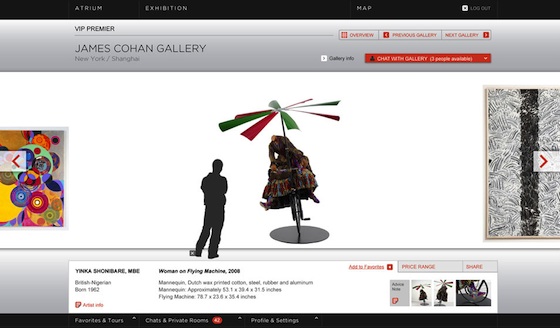
V.I.P. 2.0 began on Friday and ends Tuesday at 11:59 PM. It is the second-ever online-only art fair, truly a product of the 21st century. And yet in many ways it is indistinguishable from a physical event.
The endless flipping through jpegs in a virtual fair is not unlike the experience of walking through the immense labyrinth of neat-looking objects at Pier 92 . An art fair cubicle has a cold, impersonal feeling that is very much like a browser window, and in either context, communication is largely formal, direct, and purposeful. Whereas a physical fair’s participants will tend to do better with well crafted wall mounted, so too does the online fair, particularly as it pertains to flat pieces that do not rely on surface texture for the sell.
The one delightful exception to this is at V.I.P. is new media, whose exhibitors never need to worry about transferring a physical object into digital form. It’s been a particular boon for Magdalena Sawon, whose gallery, Postmasters, has a significant number of video and new media artists in its roster. “I think that this kind of fair is particularly well suited to the idea of presenting media that gets lost at physical fairs,” she said. “You want to represent your true persona at the fair, and online fairs do that.” For this kind of art, the presentation is clear, instantaneous, and under the exact conditions of the artists’ wishes. There is no distraction or unintended background noise. Videos can be viewed full-screen, whenever you want. No painting or sculpture can outdo a computer for attention if there’s no physical space to compete over.
This is a point that breezes past Brian Droitcour in his rather mournful summation of the fair in Artforum. We have here a system that might allow a lot of artists to make themselves heard. We wish it was mentioned, because it is exactly the kind of attribute of the fair that could be very empowering.


{ 1 comment }
I actually found the fair boring. I started with the big boys and of course it’s all the usual suspects. But I really didn’t enjoy the viewing experience – too clinical. There’s a real lack of real life. It’s all product and no romance.
The little perspective guy was good, but when he moved close to me (1 of 3 positions) I felt like I was looking over his shoulder and then I really couldn’t figure out if we were near or far from the work . . .
I didn’t know what to expect, other than seeing a lot of contemporary art work – but I really did get bored.
What’s up with the pricing? Only a couple galleries had straight prices; almost all the galleries presented their prices in a range – -like you’d expect at an auction . . .
Comments on this entry are closed.