
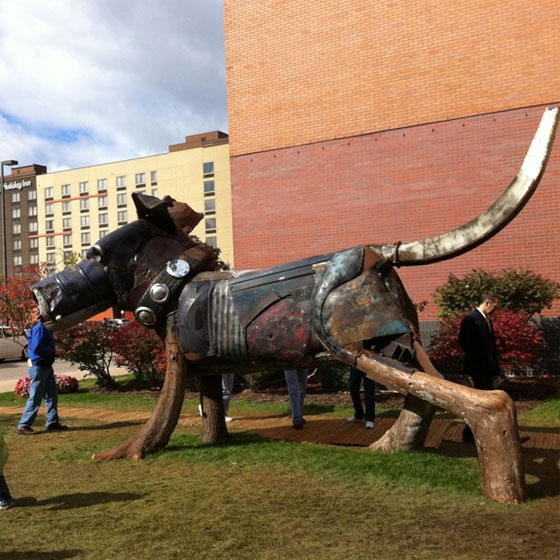
"Rusty," my pick for the 2011 ArtPrize
Back in early January, Carolina Miranda, John Powers and I had a twitter debate over the merits of ArtPrize, the self-proclaimed grand experiment in Grand Rapids, MI, in which large monetary sums are awarded by popular vote. Carolina was suspicious, John thought ArtPrize could do artists better, and I decided the event was great. Hoping to hash this issues out a little a more in person, John Powers and I spent close to two hours with ArtPrize’s Kevin Buist, discussing its various merits and detractors. The result: 18 sequential YouTube videos documenting our conversation, idea by idea. Each video contains a single conversation point, so that readers can easily toggle back and forth between the positions that most interest them. I’ve labeled them below.
1. Introduction: John Powers, Kevin Buist and Paddy Johnson discuss ArtPrize, the world’s largest art competition in terms of the amount of money given. [Link]
2. Model of support: Kevin Buist explains how Artprize proposes an open model of funding that might foster more innovation than the closed, application-based system. [Link]
3. Clarity of Criteria: John Powers points out that there is no place to explain your vote; just saying “yes” or “no” to an artwork is not enough. [Link]
4. Did people like this year’s winner? How long does discussion continue after the prize is awarded? [Link]
5. Cheating: The location fosters a clash between religious groups and art fags, and both groups will try to find a way to game the system. Minimalism was born out of artists gaming the system. [Link]
6. Audience Involvement in Contemporary Art: Immediately after the first Artprize in 2009, juried awards were added alongside popular vote. Buist explains that many people coming to Artprize have little or no exposure to contemporary art and are now looking at a diversity of practice. “How can you stir the pot in an intelligent way,” he asks, “that can guide and deepen it, rather than ‘some people like this?'” [Link]
7. Jurors Get Compensated, But They’re Better Off Than Artists: Awkward. I really hated this. John Powers asks how much ArtPrize pays its jurors, who, he says, probably aren’t working three jobs and struggling to maintain a studio space. Powers suggests that they earn their pay by trying to convince the crowd to vote for their picks. Artists complained this year that booths closest to the bar got the most votes. [Link]
8. I Say No: I say the assumption that the jurors (this year, myself included) are financially (or otherwise) on a different playing field is not fair. John doesn’t accept this as a basic points, even though I myself am evidence that his starting point is incorrect. [Link]
9. Need For More Creative Risk: Kevin claims that the traditional model of support is build to avoid failure. There should be places where people are encouraged and rewarded for taking risks. This means some work will fail. [Link]
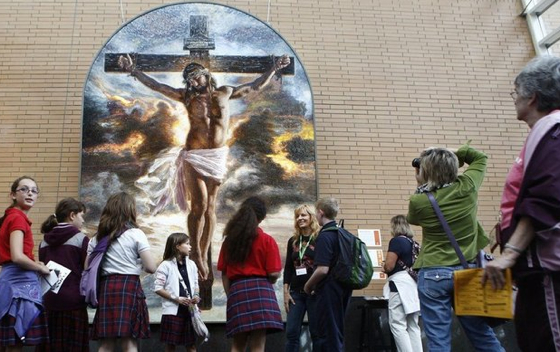
Winner of 2011 ArtPrize: Mia Tavonatti's "Crucifixion"
10. But This Is ArtPrize: John’s suggestions are for a different event, says Kevin. People are inspired by ArtPrize to start their own models, and he’s happy about that. John says that his suggestions are not to make ArtPrize something other than it is, but just to “make it less onerous”; at the moment, he says, it’s a desperate competition. [Link]
11. Is an Open System Inherently Flawed? Kevin asks John: are you saying that it is simply not okay to provide an open system where people are challenged to figure out how to do it on their own? Artists chose their venues. We’re not prescriptive. [Link]
12. Regulated Markets Are Good: “The appearance of being unfair is being unfair,” says John. You already appear to treat artists and jurors differently; what we’re talking about is giving the appearance of making things fair. Rebuttal: “we just want to be really simple and open.” [Link]
13. Commercial Galleries Give Their Artists an Unfair Edge: Paddy: Based on comments on this blog, it seemed an uneven system in which commercial galleries were allowed to promote their artists, while those without representation were left to fend for themselves. [Link]
14. Artists Should Not Come For Free: John: art is a revenue generator. This comes on the backs of artists. The city brings in a ton of money from the event, and ArtPrize should help artists get there. [Link]
15. But Those Are The Facts of Life: Paddy: Not every piece of art that’s made deserves compensation. Sometimes you do things because you care about them, knowing you’re not always going to get compensated. [Link]
16. More on Free Labor. (Warning, the conversation gets a little circular at this point and the next video). [Link]
17. Artists are Happy (Slaves): John: Right now, most of the artists involved are providing the labor for free. Kevin: Overall, it’s a reportedly satisfactory experience for artists. We’re still trying to find ways to increase those numbers. John: That’s not my concern- I’m saying that artistic effort has value, and people need to be compensated for their work, and our labor is of real value. Too often we’re exploited for benefits, competitions, and free work. [Link]
18. Conclusion. John: all of my suggestions are geared toward the same thing– making sure people are treated with dignity, and that the people doing the most work are getting compensated. This could be a moment to teach about the value of artistic labor. [Link]


{ 29 comments }
I appreciate John Powers important questions offered in the hopes to improve ArtPrize. Kevin Buist’s position remained one of sticking to the standard AP sound bits as if AP is run by a team of art hipsters. But no one gives $500,000 a year to fund a cause for no reason and AP is not run by hipsters but rather the Devos family, scions of the AmWay/Alticor Corporation empire. AP is founded and funded by a evangelical, ultra conservative, politically active family that has supported national campaigns against LGBT rights, and in favor of religious school vouchers along with giving $22.5 million dollars to the Kennedy Center to form the Devos Institute of Arts Management.
AP’s model of “simple and open” is free market capitalism that makes artists live or die like any other little entrepreneur in society. While Powers kept suggesting that Grand Rapids pay artists something for using them as an economic development ploy Buist stuck to the party line which allowed Grand Rapids to garner $15 million dollars in tourist money off the back of artists last year. Â
Buist may be right that AP isn’t a referendum against the established art world but it is a referendum toward a world of art used as enterprise and the Devos’s, who some have called the Koch brothers of the Midwest, are positioning themselves to managed that asset.Â
Richard, I have family in Grand Rapids, Evangelical Christians among them. And while I tease Kevin for having a “Jesus Problem”, the problem isn’t that the biggest Jesus won, its that the evangelical christians have a long history of successfully taking over school bordas and other elected bodies by voting as a block. Conversely would-be-participants know if they do the biggest flashiest Jesus they can count on the evangelical christians to vote for them in block. Art Prize is going to degenerate into a popular vote for a 900 foot Jesus – that the art world doesn’t recognize as art, much less good art. That would be a shame.Â
As I told Kevin I don’t feel the answer is to make ArtPrize into something its not by adding a venere of juried judgement (the professional jurors only serve to throw the popular vote into greater doubt), but to look for ways to embrace the existing model more perfectly – make voting less open to gaming by block voters by offer prizes for “influencers” and venues – or voting as caucuses…Â
Richard, I have family in Grand Rapids, Evangelical Christians among them. And while I tease Kevin for having a “Jesus Problem”, the problem isn’t that the biggest Jesus won, its that the evangelical christians have a long history of successfully taking over school bordas and other elected bodies by voting as a block. Conversely would-be-participants know if they do the biggest flashiest Jesus they can count on the evangelical christians to vote for them in block. Art Prize is going to degenerate into a popular vote for a 900 foot Jesus – that the art world doesn’t recognize as art, much less good art. That would be a shame.Â
As I told Kevin I don’t feel the answer is to make ArtPrize into something its not by adding a venere of juried judgement (the professional jurors only serve to throw the popular vote into greater doubt), but to look for ways to embrace the existing model more perfectly – make voting less open to gaming by block voters by offer prizes for “influencers” and venues – or voting as caucuses…Â
SWM, I’m more worried by what AP is than what it is not. The reason AP will have a big juried award next year is a direct result of the fact that a 13ft Jesus won. And while I don’t think they will say so it kills them to have to do it because from the start this event has been focused on populism over knowledge. Â In todays political and social mess, thats a scary thing.
Actually, by your own logic its not scary at all. A million years of giant Jesus 1st place winners won’t “shift the public discussion of art” – if it would, there would be no need to add the jury. The Jury is an admission that they don’t believe in their model of free-market direct democracy.Â
I can imagine a future in which Grand Rapids is mentioned along side Venice and Basil as an important landmark within the artworld. It won’t be because of a juried prize however, it will be because artists like you and I admire the pool of artists competing, and want to compete with them.Â
For that to happen doesn’t mean they have to abandon their free-market model, but it does mean they need to make sure it is working for all the artists who participate, not just the few who win. Â
I feel like it would be useful to talk to more artists before jumping to the conclusion that it doesn’t work for them. You want your labor paid for, and frankly, that would likely happen for you were to participate. You’d apply for a venue at one of the museums, and these are the venues with shipping budgets. Â
As I mentioned in the discussion, not all labor is equal. I don’t think it makes sense to treat it as though it were.Â
As for why AP will have a big juried award, I think it exists for the reasons Kevin says they do: a desire to stir the pot intelligently. That means building a nuanced model  that isn’t the pure democracy you describe. I don’t see any “admission” of failure here, just intelligent work.Â
As for religion, no one I have ever spoke to at ArtPrize has ever mentioned christianity and if the organization was as zealotous as Richard claims I doubt the gay staff members they have would ever have been hired. I just don’t see anything substantiating this noise.Â
Hey these are all issues artists have to ask themselves  before they decide to participate. Personally I don’t think it’s noise.
 Why have a competition where some get paid and others don’t. Bottom line GR makes a boat load of money by AP dangling a big carrot.If the goal of AP is intellectual pot stirring the popular vote is still worth twice as much as the juried vote. Make them equal and we can have an intelligent discussion.
And it’s a personal choice I guess whether you are a  gay AP staff member and want to work for for an organization where it’s founders work on a state and national level to keep you in the closet as a person.
OY!
The Devos and VanAndel “family” politics aren’t in anyway influencing Art Prize. There’s no evidence of it whatsoever. If it were, it would be a competition open only to religious art that supported their religious points of view. So stop muddying the waters with issues that aren’t really related in anyway other then being a convenient opportunity for Richard to self identify which side he’s on.
Grand Rapids is a conservative leaning community, one in which I grew up in, but haven’t lived in since 1989. I should point out however that Kent County voted for Obama by a whisker in the last Presidential election.  I left town when the most exciting thing art wise was the giant Calder and the Campau Square re-creation at the former Grand Rapids Art Musueum.
Since then, Meijier Sculpture Garden has opened up a world class collection that they add to every year, GRAM has been rebuilt, UICA has built a new facility and continues to build on its reputation, and Kendall is pumping out solidly trained artists every year. A lot of money is spent every year buying, transporting, and exhibiting artwork in Grand Rapids on a scale that just did not exist 25 years ago. In fact, if you add up everything that does get paid for, it dwarfs the $500k that ArtPrize dangles in front of artists every year.
I point this out because the other institutions are doing the right thing by paying the freight. That’s what it takes to be taken seriously and that is what ultimately is at stake for ArtPrize. Do they want to be taken seriously and do they want to exist twenty years from now?Â
They are on to something.  In my opinion, what makes ArtPrize unique in the art world is the popular vote and I wouldn’t touch that. Leave it alone, live with the results. The empowerment that the general public feels, that for perhaps the first time in their lifetime, they get to choose the artwork engages them in a way that seems unprecedented. Thousands and thousands of people come downtown to see the work and consider it enough to then go online and vote. There isn’t another art event like it. Keep it. There are plenty of other events that are juried, curated, or otherwise chosen by professionals.
However, there’s a flip side to that coin. Artists are desperate to sell there work, especially outside of active markets like New York. Trading on that desperation, leveraging a “prize” is unconscionable when you understand fully what it costs to design, make, transport, install and retrieve a large scale work. Installing Isa’s Rose on the front of the New Museum cost $95,000 not including shipping. Just the installation. That’s what it is worth and that is the type of value ArtPrize is getting over and over again.Â
Paddy’s line about how “all labor isn’t equal” makes my blood boil. To apply it to the world of writing/blogging would be equivalent to saying not all of it is Tolstoy so we shouldn’t feel any obligation to pay for any of it. To hear her say that, one of the creative class no less, made me snort wine out of my nose. And I’m a fan, still.
Kevin’s points about not wanting to be “prescriptive from the top down” is nonsense. They are being prescriptive by setting up a system that exploits the desperation felt by so many artists that they are willing to do anything to have a chance. I agree with keeping the vote. Don’t toy with that, but be a human being for crying out loud. I’ve said it before, set up a huge messy diverse jury. make it so big that the selections piss off both the professionals and the public. Pick twenty sculptures and twenty non sculptures. Fund all forty with an honorarium that subsidizes those chosen. THEN! let the venues bid on who they want to exhibit at their location.  Make that a competition. See who values/benefits from having the most attention grabbing, crowd gathering, work of art. They should own the traffic, not get it for free.
In short, pay the artist. That’s the only way to be taken seriously. Sustainable efforts only go forward when it is good for everyone. ArtPrize is good, it just needs to be much better, dare I say more democratic, dare I say more Christian in its “prescription”.
This takes my words to an absurd extreme. All I’m saying is that there is a difference between professionals and amateurs. Hobby-ists often don’t expect to get paid for the thing they do on the side for fun.Â
Its curious Paddy, that is exactly what I thought when I read your comment below. Nothing I have suggested would treat all artistic labor as if it were the same. I have repeated pointed to the possibility of an “opt out” for both artists who want to spend their own money in order to gain a competitive edge, and for venues, who want to participate, but don’t want to take any financial risk on the artist they host beyond opening their vacant space once a day. Likewise there is nothing to stop a venue from offering more than what I am offering,Â
For ArtPrize to dangle such a large prize, and crow about the $15.4m in “economic impact” while only paying 15 lucky artists anything at all, that treats all artistic labor as if it is worth nothing at all. If their numbers are correct ArtPrize is going to be imitated by other cities the way the “cattle on parade” was. Right now it is an unsustainable model for artists. If Grand Rapids is a city that cares about art and artists beyond their annual financial impact, they should find a way to support the efforts of those who help bring so much money to their city each year.
I guess I don’t understand everything you’re proposing. What constitutes an “opt out”?
As for ArtPrize, I don’t think there’s anything wrong with applauding the $15.4m in economic impact. I realize this probably isn’t what you’re saying, but it reads as though they are making that money. ArtPrize is a non-profit organization. No one makes a lot of money there. And if they want to award only 15 artists why is that a problem? It doesn’t seem so far outside what other granting organizations do. Â
By “opt out” I mean whatever parameters ArtPrize sets up for venues reimbursing participating artists for their expenses, it is a simple matter to add an “opt out” button, so if a venue doesn’t want to share an artist’s financial risk they can press “opt out” – the only artists they will eligible to choose from are artists from the immediate area around Grand Rapids, who have no expenses, or artists from outside the area who also press “opt out.” Presumably artists who want a better chance at finding a venue to host them, and can afford to self-finance, will “opt out” in order to increase their chances of being able to compete.Â
As for applauding the economic impact of ArtPrize, you’re right, that is not at all what I was saying. Perhaps because Kevin has fallen silent you have cast yourself as an apologist for all things ArtPrize. As I understood it, this was not a for-and-against discussion. I thought we we’re discussing how to make ArtPrize better. It is great that the business and real-estate owners in downtown have profited so much from art prize. It is not great that it has come at the expense of artists.Â
Here is my prediction: If ArtPrize sticks to its current model – which is unsustainable for artists – they will draw an increasingly weaker and more desperate pool of participating artists. Within another couple of years their audience will recognize to decline in quality and their funders will move on – after all the point is (in part) to “change the conversation” – the conversation is art, not arts&crafts. Right now the artists I know don’t feel ArtPrize rises to the level of a legit art event – they look for the participation of any artists they trust, and they find a bunch of strangers.Â
The best way to “change the conversation”would be to attract artists who are already part of the conversation. That isn’t going to happen as it stands.
So by that rationale, they aren’t paying for anyone’s labor, and therefore are directing this competition toward hobbyists? So the professional art world can just keep moving, “nothing to see here folks”.
I hghly doubt that. I think that ArtPrize wants to be taken seriously. I think they want professionals involved. I hope that they do take ownership of the model they have “prescribed” and improve upon it so that it is around twenty years from now.
Would you recommend to any artist that they invest $25,000 dollars in an attempt to compete for this prize as it is now conceived? I wouldn’t.
Of course they want to be taken seriously and I think they’ve already achieved that. I saw art from some great professional artists. It never seems to win anything, but that’s the nature of the prize.Â
Out of curiosity, where is the $25,000 number coming from? I wouldn’t recommend anyone invest $25,000 to compete in any art competition. I would however encourage everyone who has an art idea they believe in that requires $25,000 to try and make that happen in whatever ways they can.Â
In your first paragraph you are reinforcing the point about being taken seriously. Unless they alter their “prescription” they won’t be taken seriously. Not for long anyway. Can you imagine say Tara Donovan entering this competition? And listing it on her CV? Along side a show at the Whitney? I like the backend of ArtPrize. It’s worth preserving, but if they hold onto “Simple and Open[ exploitation of desperate artists]”, this will desolve into Jesus on Parade.Â
In the second paragraph you are performing a semantics double gainer. Your saying “no I would never, but yes I would encourage them in anyway they can”.Â
The $25k number is a fictional number. One look at that dog though and it isn’t hard to believe that the scrap metal cost alone, not to mention the professional time, shipping and installation cost got there.
Again, I like these guys, I like their mission. It just needs to altered to make it more equitable. They have nothing to lose by doing so, and everything to gain.
Please don’t put things I didn’t say in quotes as though I did say them. I didn’t say that, it’s not what I meant, and it shouldn’t be interpreted as such. Just because professional artists aren’t winning, it doesn’t mean the whole contest is a sham. There’s a process to figuring out what the city likes, and Grand Rapids is doing this.Â
Tara Donovan is an interesting example because given the biases of the public I think her work would do very well where she to compete. Would she compete? It’s unlikely. She doesn’t need the money and this competition, as I see it, seems more for emerging contemporary artists (whatever their age) than it does established artists.Â
Anyway, there’s nothing wrong with taking a position that’s not totally black and white. I happen to think the best art is made when artists feel they have to make it, outside of any venue options that may be available to them. I’m certain that dog would exist with or without artprize.Â
Uncle! To paraphrase a favorite movie [you think we are fighting and I think we are finally talking], but I’ve hit a wall.Â
Thanks for hosting the discussion and being you.
Paddy, I would be interested for the sake of discussion what if anything you see as bad in the AP model?
There’s a lot that could use work.Â
1. voting biases: Large, immersive installation is too easily rewarded. Small works don’t stand a chance.
2. Artists who spend all day shilling their work. Voters stop looking at the art.Â
3. Jesus problem? I’m guessing John’s right about the evangelical community but I’m not sure.Â
4. No online art showcased or voted on.Â
Did anyone attend Chicago’s Art Loop Open? It seemed to be an experiment in the Artprize public-vote vein, with some varied parameters:
  * Only local artists
  * Juried entries
  * Limited venues
  * and a smaller prize
A big difference in the ALP was the aspect of juried entries. There were a limited number of venues and works making it a possible to actually see everything ‘the show’. Here in Chicago it still had it’s critics that picked at it as an American Idol type spectacle which I think is justified but I think it was better in concept and better in the foundation behind the event.
Because some artists competing are professionals and others are not. This idea that we have to pay everyone the same regardless of their level of investment is ridiculous. People train all year for marathons but only a small fraction get paid. Everyone pays the entrance and they don’t complain that they’re being exploited when the city benefits from their presence.Â
Can you tell me who came in 543rd place in the Boston Marathon? Â That’s not why we watch it do we? Â AP is asking the public to be the judge and jury of everyone who applies.Â
Is making a game of pitting the amateur against the professional a good thing? Â And hasn’t the entire populist rhetoric used by AP been to dispel the notion of a difference between amateur artists/professional artist, non-art venue/art venue, knowledgeable opinion/personal opinion? Are they now changing course?
Can you tell me who showed at the Amway Grand Hotel last year? That’s not why we go to visit. In its ideal form ArtPrize asks a pool of participants to compete with themselves — to make better art work independent of the crowd. I saw countless entries made by artists who surely couldn’t have thought they’d win. The venue was important to them though.Â
The populist rhetoric of artprize simply applies the American Dream to art. Anyone can be a great artist. We all participate in a system that gives us the art we want. Do I think that idea actually works? Almost always the answer is no, but I think, a kind of naive belief in these kind of bald ideas like can be really important, because it encourages us to be better than we already are. The point isn’t to break down the difference between amateur artists and professionals, but create a vision that allows a few of us dream bigger than we already are.Â
Not quite the same, but in 2005 the media story was that blogging was tearing down traditional publishing. Anyone could publish themselves and it was transforming everything. Now we see that that myth wasn’t entirely true, and never really was. Â You don’t start a blog now with the dream of getting famous. In 2005 though, I bought a myth. I couldn’t write then. But that false narrative is what puts me here today so maybe one more isn’t such a bad idea after all.Â
Touche. First at the risk of coming off as just being argumentative let me say I really appreciate what you have to offer and I’m glad you bought a myth. In the midst of the NEA battle of the early 90’s author Fredrick Turner proposed a solution to abandon any public support of the artist and just let the country go through a decade or so of mediocrity. His suggests was a bottom up approach to learning and appreciating the arts as opposed to a top down approach. I think that is a sad comment on the arts. It’s a “fuck’em they’ll figure it out” attitude that would never be applied to science or money. It’s a societal position that says art is just entertainment. When Rick Devos says that he just wants to see “crazy crap” all over the streets of GR or when Kevin Buist says they just want to” throw stuff out there” I get a sick feeling in my stomach that reminds me of Turner’s suggestion.Â
When all is said and done is there anything wrong with a Amway red,white and blue, American dream opportunity to be an artists(other than the political money trail of the founders) in this midwest town in Michigan?…well no. But will it help the masses gain a better understanding of the importance of real art? Â I think there is a argument to be made there on both sides.
Thanks for this response. I’m not sure I have anything to add, past saying I like  and appreciate it. Â
I’ve not once said anything on this thread that apologizes for ArtPrize so lets stop the name calling. I’ve simply tried to find a way that describes artprize in a light that makes sense to me.Â
Otherwise, you’re right: brainstorming ways to make artprize better is the most productive use of our time and this thread.Â
I think the opt out button is good idea. I assume it will simply add greater transparency to the system, which, to my mind is smart. It adds legitimacy to the prize.Â
I guess my question for artprize is will the conversation improve if it’s a national event? I have such a hard time wrapping my head around that as a reality. Getting artists to Grand Rapids seems cost prohibitive if we’re shipping objects. To my mind, the best opportunity to engage artists nationally lies in developing an online venue. Getting an artist to Grand Rapids is a lot less expensive than a sculpture, and frankly, they could be doing a lot more with their site. It’s barely even designed, let alone set up to host any online based art.Â
Sorry, it hadn’t occurred to me that apologist would read as a derogatory name. I should have written “defender” – that is all I meant. Pointing out that $15.4m in economic impact isn’t organizational profit felt a bit heavy handed; unnecessarily defensive on behalf of ArtPrize — not a role you should have to take. After all ArtPrize isn’t underattack.
Okay, I see that.Â
Comments on this entry are closed.