

Screenshot from "Son of Sam and Delilah," 1991, Charles Atlas (courtesy openvault.wgbh.org)
Marginalized culture loves to watch the mainstream played out on its own terms — to make itself visible within the imagery that bombards us. It was fitting, then, that last night's screening of seven videos by upcoming Whitney Biennial artist and longtime documenter of queer culture, Charles Atlas, took place on a small screen in the empty nave of the Judson Memorial Church. A queer congregation of at least sixty* young professionals chatted and contentedly sipped beers as we pulled up rows of plastic chairs; like church, most people seemed to know each other.
Atlas’s videos, displayed through a projector from a laptop, read as loosely-scripted stream-of–consciousness fantasy narratives confronting a less glamorous reality. Because of its structure of steady crescendo, the first and most staged video, Son of Sam and Delilah (1991) stands best on its own. When viewed together in a certain order, the rest of the works achieve the same effect.
Son of Sam and Delilah opens with an extreme close-up of a white man’s homophobic, racist rant. It lasts a few minutes, then the camera slowly zooms out; suddenly he is shot in the head, prompting a surge of audience laughter from the church. Blood and brains spill out onto a linoleum floor.
From there, seemingly disconnected scenes are intercut: a beautiful queen, played by visual and performance artist John Kelly, the central figure throughout – embodies a beautiful female opera singer on a theater stage, in a voice that is that seems far too high to be her own. Another pair of drag queens ham up the role of chain-smoking, Diet-Coke-and-toast-subsisting 1960s housewives. Two butches – Anne Iobst and Lucy Sexton of DANCENOISE, a post-punk feminist collaborative – in white slips do a combative dance with black, headless dummies. A group of 80s dancers vogue in front of a sparkly dollar store curtain. A slender, long-haired man in a leather jacket, the titular Samson, wrestles with his Doberman. Inevitably, Samson’s gun enters from the corner of the frame and shoots most of the dancers, bright red blood gushing from heads and stomachs; because of the humor and irony, it strikes the viewer that the presence of a sparkly backdrop makes death unfathomable.
As in Son of Sam, in which we frequently hear the director’s “action!” or see a clapboard, most of the following videos infringe even more on reality with variably less lighting, home video quality, and a dissolution of the set.
Hyper-sexy drag queens in hooker leotards walk the streets of the meatpacking district in the video Butcher’s Vogue, which had been made for a 1990 MTV music video competition for the Madonna song. A policeman shines a threatening flashlight at the sexpots, and they retreat into a nearby diner where two dancers in leotards are voguing to the pop song. The girls attract a man in a leather jacket, lure him to the basement, and beat him up. Reclaiming the gay, street-invented ball dance as their own, they lip-sync Madonna in close-ups and, for an instant, in breathing tubes. They return to the streets and reclaim those, too.
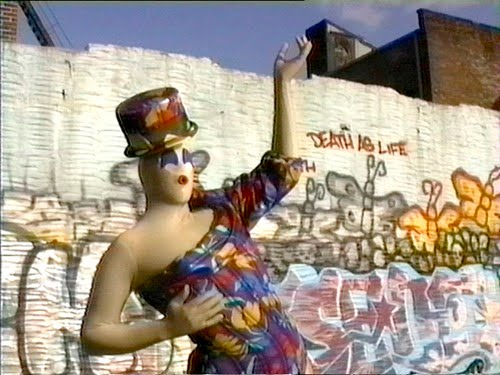
- Still from “Mrs. Peanut Visits New York,” Charles Atlas, 1992-99
In Mrs. Peanut Visits New York, (1992/99), performance artist Leigh Bowery parades around New York as a reinterpretation of Mr. Peanut: what resembles a blow-up doll in a nude bodysuit, wearing a Chiquita Banana pants-dress and a top hat. As her costume and swagger literally halt traffic, Mrs. Peanut is accompanied by a mash-up of old Peanut-related pop tunes.
Atlas’s foray into porn (under the name of “Jack Shoot”) opens with a skinny, mohawked man in a tattoo parlor giving a Tom of Finland-clad young he-man a stick-and-poke on his bulging pec. According to the tattooist, the symbol will initiate him as part of the Staten Island cult; on a close-up of his eyes, we hear, “Sometimes you just have to open up your wormholes, you know what I mean?” The hunk nods. The same symbol, a snake-like coil topped with a nubby ginkgo leaf — the seven-headed cobra for the Symbionese Liberation Army, famed for murders, bank robberies, and kidnapping and brainwashing Patty Hearst– flashes in multi-colored neons from a TV in the corner.
The porn segment is both gratuitous and off-putting. No longer is the cult initiator present, but we slowly assume that he becomes the silent cameraman. The hunk, now making eye contact with the camera, models homoerotic porn costumes — thin football pants, a boxer’s gloves and Everlast cup, a leather, front-zip thong — performing slow pull-ups in the tattoo parlor’s back room. The tattooed symbol flashes from a television screen in the corner as the stud-kitten is seduced by his own body. It culminates in masturbation, on a couch, in front of a mirror and the TV. The porn soundtrack distorts and unravels near the point of ejaculation. Curiously, this was the only video throughout which the church was utterly silent.
It seems that Ryan Trecartin (who was shown with Atlas in Amsterdam last year) is indebted to other works; in The Draglinquents (1990), drag queens lip-sync two different songs — the slow, mostly-spoken “Maybe,” by The Three Degrees, and Dolly Parton’s high-speed “Travellin Man” — two diva ballads from the 60s and 70s about longing for men. The queens are both beautiful, thin, and heavily made-up, and they pose in front of cheesy green-screened American landscape footage and horse corrals; increasingly, they pixellate, becoming overlapping after-images, and the speed of the music spirals out of control.
By far the weirdest addition, though, was the videotaped concert performance of I Fell In Love With A Dead Boy from the 2012 tour of Antony & The Johnsons. In what looked like a late-night VH1 segment, the band's pale, androgynous front man sings in front of an enormous video of a young woman's rotating head. The contrast in the backdrop video becomes extreme at times, blackening the shadows under her cheekbones, making her pass (almost) for a drag queen; at the end of the performance the singer repeatedly warbles, “Are you a boy or a girl?” The slow, deliberate study of a woman’s bone structure made what would have otherwise been unwatchably conventional a logical completion to the series. The lights went up to roaring applause.
Our host (who could not have been older than his mid-twenties) introduced Charles Atlas himself, wiry, white-haired, and briny-voiced. When asked about the content of his work, Atlas responded frankly that there is not much of a plan. He mentioned simply that:
[Son of Sam] was unusual because I had people to help, and I didn’t know where it was going at first. I only realized after I made it what it was about- all my friends who were dying of AIDS…There was so much homophobia in the 80s, I really wanted to shoot someone, so that’s what I did in a film.
This may not be the apex of queer cinema. The spontaneous, expressive approach to narrative makes for a lot of waffling (the most dead-end example of which might be the indie porn feature Shortbus), and I’d hate to imagine a future in which we deem every half-staged YouTube video as equally relevant. But if the goal is not to integrate into pop culture–rather to make something simultaneously unusurpable and interwoven– then Atlas has opened at least a few doors.
The screening was part of Dirty Looks, a monthly platform for queer experimental film and video. Come February, Dirty Looks will tour Los Angeles, San Francisco, and Portland.
[CORRECTION: The original version of this text did not identify the beautiful queen as John Kelly, the combative dance partners as DANCENOISE, or the logo of the Symbionese Liberation Army. Thanks to our commenters for pointing these omissions out. Meaningful criticism makes ours better. 1/29]
* One commenter believes there were two hundred people in attendance. It was a large crowd, but 200 is the maximum possible estimate.


{ 15 comments }
Dropping in as a member of that marginalized culture. Solidarity, my friends. Imagery here rocks. First time, but we’ll be back.
This is a really patronizing piece, written by someone with Republican parentage.
Again, would you please elaborate? If you’re offended, let’s have a discussion about it. Â
It is unfortunate that the opinions of a writer who exhibits so little research or knowledge of a subject are deemed publishable. It seems impossible that the editors of Art Fag City do not know who John Kelly is? Dancenoise? Florent or the SLA logo? This is not marginal cultural history, it’s just history.
This comment is not helpful. If you think John Kelly and Dancenoise should have been referenced, you need to tell everyone why. Being snide and condescending only makes people feel bad.
I agree, this article made me feel bad for the same reasons you mention, which is why i commented. John Kelly and Dancenoise are referenced, just inaccurately and dismissively. I thought it was the author’s job to know who and what they are describing. The writer implies that the singer (John Kelly) could not be singing in her own voice. Isn’t this just a fact-checking question?
I’ve made corrections thanks to your comments. A few issues:
It’s unrealistic to demand I recognize the logo of a group of sixteen people that was active for two years in the 1970s and not mentioned anywhere in the press release. It is the job of the venue to make sure we have all the relevant information, and that was not done. This is also the case for the name of the diner (Florent), John Kelly’s role in “Son of Sam,” and the crowd estimate.Â
Either a) some one else is as clueless as I am or b) these names are not as central to the work as you’re making them out to be. Not even in the photo caption of John Kelly’s face is John Kelly’s name cited. Here’s a quote from John Kelly:
“Does it matter who’s in my audience? Sure it does, I’d like to think that my works can speak in a universal tongue, even convert the novice. But if I could control the map of my audience by adjusting my choices to what I think would lure them in, I’d be making commercial theater. Long ago I decided that it’s my job to engage an audience—and the job of presenters to frame my work so that it appeals to as large an audience as possible without pandering.”
I am not a presenter writing a press release. I made some oversights because I’m not on a face-recognition basis with a certain group of people. Similar to your critique, the accompanying interview with Charles Atlas repeatedly attempts to position his importance in terms of who he hung out with, and I don’t think that’s fair or relevant when evaluating an artwork.
 Â
I watched the videos, and I reported what I saw. Yes, I have a duty to learn more, but I have the disadvantage of not having lived in the meatpacking district in the 90s; I went to that screening hoping to expand my knowledge. It seems like this has less to do with you feeling bad than about taking a jab at me. Â
John Kelly is referred to as perform “a voice that is far too high to be her own.” that is in fact her voice and representing her a lip syncing queen paints a very distinct picture of her. Additionally a failure to recognize the SLA emblem is a failure to address the significant politically farcical elements that Atlas was able to insert into a commercially available pornographic film.
With queer historical referents limited to the 21st century (Ryan Trecartin and Shortbus), the author of this article does not generate any precedent or historical knowledge of the works at hand. This is not a snide comment, this is an attempt to correct certain historical facts that are misrepresented in the above post, which is to say nothing of a depiction of an evening that was vastly different that many of the descriptors above.
Alright, well, we fucked up.  I appreciate that you and Liagang said something. The post is being amended.Â
I apologize. In the context of “Son of Sam,” Kelly appears (to an outsider) to perform as drag queen, and his voice is incredibly high: that’s testament to his skill and my lack of familiarity, not a cruel dig. His work in general might be better described as character study. Of a performance piece based on Joni Mitchell, Ann Powers of the New York Times once wrote: ”There’s drag, and then there’s transformation through spiritual osmosis, and that’s what John Kelly accomplishes…†Based on his performance in Atlas’s video, I would say that’s more accurate.
Hi Liagang,Â
In no way did I mean to imply that this is marginal history. Â It’s not. Â I only use the phrase “marginalized culture” to describe a group of people (of which I am a part) who are not widely reflected in mainstream media. Â
And I admit, I could have given more background for this piece. I appreciate your comment, and in that respect, I failed to do my job. But does my inability to identify the performers (yes, my bad) disqualify me from looking at the work? Â And if so, could you please elaborate?
Hi Liagang,Â
This is not marginal history. I mean no offense by the use of the phrase “marginalized culture”; I only mean it to describe a group of people (of which I am a part) who are not widely reflected in mainstream media.
And I admit, I could have given more background in this piece. Â I appreciate your comment, and in that respect, I failed to do my job. Â But does my inability to identify performers (yes, my bad) disqualify or exclude me from looking at the work? Â And if so, would you please elaborate? Â
And AFC’s editors are not to blame here. Â I was the only one who saw the work. Â
Actually, this is not being mean, Paddy. This is expecting the same journalistic integrity that one should expect from any publication. The writer’s description of the SLA logo as a snake like coil topped with a nubby ginko leaf is not representational of the piece and detracts from the poignancy. The description of a 200 person crowd as 60 folks pulling up chairs is clearly patronizing and the mention that Kelly’s voice could not possibly be his own is clearly incorrect.
Ignorant, yes. Patronizing, no. I found the whole event genuinely uplifting, and I meant no offense by my miscalculation of people or naivete of content. I appreciate the feedback, and I’ll amend the piece accordingly.
Comments on this entry are closed.