
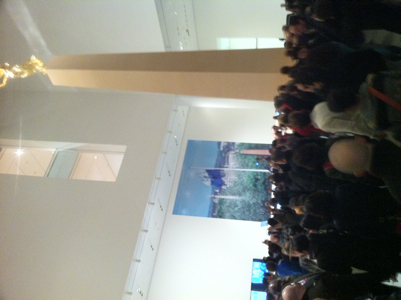
Occupy Museums meeting beneath Sanja Iveković's "Lady Rosa of Luxembourg"
On Friday night, Occupy Museums — in conjunction with Arts and Labor, 16 Beaver, and Occupy Sotheby's — conducted an exceptionally clear and efficient GA under Sanja Iveković’s controversial feminist monument Lady Rosa of Luxembourg, while a small group from Arts and Labor demonstrated with OWS banners and a flugelhorn outside the museum. Though “this isn’t Wall Street” was the general response from museum visitors, articulate speakers pinpointed specific issues. Feasible goals were set. The crowd, of about fifty people in the atrium and a combined sixty looking down from MoMA’s three landings, included a notable increase in women and academics.
Using the people’s mic, Occupy Museums co-organizer Natasha opened with the remark that museums often display the spoils of colonialism, explaining why there is so little gender and racial diversity amongst artists shown.
Another man read the first paragraph of an Occupy Museums statement:
…art is the inheritance of all people to be shared equally. Art is not a luxury item, but twenty-five-dollar admission fees are a luxury item. We call on MoMA to extend its free hours and make art accessible to all.
The decision to meet on a Target-sponsored Free Friday not only allowed everyone to meet within the museum, but also marked a historic concession made between the museum and an artists’ protest. Free Fridays are the result of a campaign by the Art Workers’ Coalition in the early 1970’s for free museum admission; MoMA eventually granted one day per week, which is now Target-sponsored.
A middle-aged woman in glasses addressed this:
I would like to know why we have to depend on the beneficence of an entity like Target. What kind of economic system lets one company or person amass so much wealth that they get to decide what is free and what will cost? Who gets health care? What African countries get aid? What diseases get researched, who gets educated, what kind of technology forms our culture? Can we imagine an economic system that would be based on something besides amassed wealth and the concentrated power that now proceeds therefrom?
Many snaps and woos followed.

Soon after, a large banner was dropped from the third floor balcony; I did not catch what it said, but it resulted in a few rounds of “All day, all week, occupy Wall Street.” In response to this action, Noah Fischer announced:
…we would like the lock-out of the art handlers at Sotheby’s to end today. The Museum of Modern Art has the power to do that. There are two people on the board of trustees at MoMA who are also on the Sotheby’s board. This is a conflict of interest, but it could also be an opportunity. Put our brothers and sisters back to work. We are calling on this lock-out to end today, Friday the 13th, 2012.
Earlier in the evening, I had asked a member of the Arts and Labor group whether he saw any progress made in the art handlers’ negotiations. His answer was no, but Sotheby’s is now spending almost as much on security as they would on paying unionized art handlers.
We then broke into small groups to discuss the prompt: “What kind of resistance will be necessary to alter the trend of corporatization of public institutions, including institutions of art?” After ten minutes, the crowd reconvened.
A former Cooper Union professor brought to our attention the fact that Cooper Union may soon begin charging students. A younger, student-aged girl in her group noted that “institutions are composed of students, workers, and professors – none of whom are the institution themselves” and wondered:
[h]ow can each of these members – artists who want to talk to other artists – insert themselves in the institution so that they do not become prey to it?
An older, heavily accented European man in their group mentioned that over a million people have now signed a pledge refusing to pay back their student loans. “[Education is] a resource that is not scarce,” he said. “You shouldn’t be paying for it.”
Nato Thompson of Creative Time then addressed transparency in large institutions:
Part one: …Does anyone know where the money is coming from? Part two: Even if we do accomplish free museums for everyone, how do we educate our children to be ready to exploit these free entries to the museums and culture of our cities?
Nato, toward the end of the meeting:
I work in a non-profit, and I want to clarify that the problem of the one percent being in cahoots with non-profits is extremely structural. It’s the way the system is built. If we want to change that system, we have to radically get rid of the non-profit idea entirely. And simultaneously, the one awesome thing about non-profits is their mission statement to serve the public good. If there is a conflict of interest where the actions of that institution do not meet that mission statement, it’s a strategic opportunity to strike.
The assembly then discussed alternative spaces; a young woman noted that “if a big institution doesn’t serve the community, then it shouldn’t have a 501c3. There should be no tax write-offs,” and suggested that the group “occupy an alternative space, like CHARAS in the East Village.”
A young man then addressed the institutionalization of alternative spaces. This comment resonated most of all:
She mentioned CHARAS, an alternative space that's closed on the Lower East Side. I wanna point out it's actually contained in this museum in an exhibit in the contemporary art wing that includes flyers from alternative art spaces like CHARAS and ABC No Rio from the Lower East Side in the 1980s. That is dead history. The question, it seems, is how to activate that history. It’s here in these halls for our taking and activating- we just have to make use of it.
An older women:
….The fact that private public spaces like this are iconic like Liberty Square … these kinds of public conversations and provocations and actions need to happen everywhere. We invite you to participate in generating a new, living civic society.
Those last two comments felt especially poignant, given that we were surrounded by newspaper headlines and television broadcasts around Sanja Iveković’s monument, which, only ten years earlier, had prompted a widespread public debate about freedom of speech and women’s rights.
When I asked Occupy Museums co-organizer Harrison Magee about Occupy Museums’ focus, he replied that he hoped that artists would raise their expectations for basic workers’ rights. “We think we’re supposed to work for free until someone hits the jackpot, but that’s just because of the way our system is built.”
Magee also confirmed hopes to expand support to more strikes and lock-outs in the future; he mentioned that, aside from Sotheby’s, 114 workers are currently locked out of the City Opera. “We want working people to know that they can win with our help.”


{ 9 comments }
Interesting! I lobbied MoMA very hard to have them present their “Ab Ex” Show in a non-racist way and include the story of how influential Native American art and culture was on Pollock and particularly, Rothko. I provided all the research. They ignored it as did the art press. The National Gallery of Art continues to ban all discussion of this well documented research which they have had for over four years.
Hraq Vartanian even censored my interview. Good luck to “Occupy Museums!”
Noah G. Hoffman
Director
Mark Rothko Southwest History Project
For all the supposed intellectual horsepower implied with
” Professors, Artists, Workers, and Activists” of the title, the naivety
and ignorance of  basic economics, and
policies of the museums quoted in this article, are shocking. A new age requires a new language, new
approaches. If making the most beneficial
changes for the future is the ultimate goal, why keep echoing the failed rhetoric
of the 1960s? Â
Â
“…[M]useums often display the spoils of colonialism,
explaining why there is so little gender and racial diversity amongst artists
shown.” Really? Though things aren’t perfect (you want a
quota system?) a brief glance around recent and upcoming exhibitions in New
York reveals an astounding amount of  “gender
and racial diversity” (Check out
the Whitney’s 2010 and 2012 Biennials and the New Museum’s “Ungovernables”.)Â That aside, I’m all for protesting the
exhibition and collection practices of institutions if one feels short schrifted.
Â
A more troubling direction that the OWS’ers are promoting is
expressed in these quotes: “Can we imagine an economic system that would
be based on something besides amassed wealth and the concentrated power that
now proceeds therefrom?” and “What kind of economic system lets one
company or person amass so much wealth that they get to decide what is free and
what will cost?” Of course, any compassionate
individual would “imagine” a system with greater equality but, haven’t
we just spent the last twenty-five years watching the collapse of Marxist
regimes all over the world? Isn’t much
of the current economic instability being caused by the extravagance of socialism’s
unattainable promises which are bankrupting nations? Â Â ” …[T]hey
get to decide what is free and what will cost?” Wake up, nothing is free, someone has to pay
for everything. How can an organization
state that museum workers should have job protection “fair pay,” and benefits,
yet expect them to donate a considerable amount of their time so privileged  “Professors, Artists, Workers, and
Activists” can have “free” access to their labor?  Â
Â
To avoid taking all day to critique and question all the
various points brought up in this article, I’ll simply close for now by asking,
if the private sector is too greedy and controlling, is delivering total
control of cultural matters to a far from perfect government a better solution?
      Â
Just to take the low-hanging fruit:
“Isn’t much of the current economic instability being caused by the extravagance of socialism’s unattainable promises which are bankrupting nations?”
Uh, no. I’m pretty sure it was the sudden loss of confidence in trillions of dollars of debt. I think that’s what caused the current economic instability. Ireland is in crisis because it guaranteed its banks, which failed because of the sudden loss of confidence in trillions of dollars of debt.  Belgium is in crisis because it guaranteed its banks, which failed because of the sudden loss of confidence in trillions of dollars of debt. Â
Italy has had a sovereign debt:GDP ratio around 1:1 since about 1990, but actually – fun fact – if you take the debt payments out, they’ve been running a net surplus for a while.Â
Portugal and Greece are, admittedly, run by idiots, and have overspent for years. Coincidentally, we only noticed this when the rest of the world began to melt down as a result of – no points for guessing – the sudden loss of confidence in trillions of dollars of debt.
Meanwhile, any number of socialist havens like Norway, Denmark, Sweden, and the Netherlands are doing just fine. There is also, one notes, a giant socialist country which is doing very well (economically) and which we regularly blame for stealing all our jobs/money/etc.
“If the private sector is too greedy and controlling, is delivering total control of cultural matters to a far from perfect government a better solution?”
This is a false choice. To even present this as an option, you have to ignore the majority of countries in the world who have settled upon some middle ground. The UK has much more heavily government-funded museums, which are therefore somewhat less beholden to private donors; it also manages to have some of the most successful commercial galleries in the art world. That’s not a bad model.
Will, I am  in agreement with your dismissal ofJames Kalm [nothisrealname?]’s disingenuous post, including silly red baiting, which falls just short of saying an oft-heard retort to Occupiers, namely, go back to North Korea! And the daft effort to blame socialist (European) governments for the recent fully US/UK (but non governmentally engineered) global financial crisis. But you inexplicably have chosen to respond as though you were  some guy in a bar, or  an undergraduate. Not all your fun facts are correct, including your assessment of say the Netherlands. Denmark until very recently has had a right of center government, and Sweden has now had one for 2 terms. Netherlands is in the middle of a disaster, which anyone involved in  art should be aware of.  As is the UK, for that matter— where the successful commercial galleries  you mention are a reflection of their point one percent in finance dominating London and the whole UK economy. And you have decided that Portugal and Greece are run by idiots? Which idiots do you have in mind, and why are they idiots, exactly?
There are many reasons to argue against the control by super rich trustees at institutions like MoMA and many many reasons to cheer the temporary MoMa occupation. Ignoring distractions like James Kalm’s seems to be a good option; trolling is an internet hazard, and I am guessing other readers know what to ignore.
I love the quote “education is a resource that is not scarce, you should not be paying for it.” The whole art MFA industry is predicated on the elitist pretext of the schools themselves. This elitism is marketed to the students. Tell a student that his or her school’s program is not selective and “will let anyone in” and you will get a ringing defense of standards. Laughably desperate to be elite, to be the one percent.
There are some people who relish Target Free Friday, and for OWS to come and ruin that experience for them is unforgivable. MoMA and other museums operate on a mission to display artwork to the public, in order to preserve it. If the art is taken off the walls and given away, then that defeats the purpose–it becomes private. Open your eyes OWS, a lot of places are supported by big name companies (such as Target). In a time when people can’t afford to eat, they can’t afford to support art. There will always be someone who is willing to pay $25 to come and see the art that inspires them. If OWS wants to protest the art-world and the amount of money involved in it, why don’t they protest at galleries? Yes galleries, which are free to enter, but which help set the prices on art work, galleries that won’t show artists they can’t profit from. Protest the art fairs that come to town and raise all that money. Protest the real problem. Protesting at MoMA is lazy because MoMA is not the enemy. And throwing stink bombs is juvenile at best. Grown up OWS!
Wake up? How about get informed ‘Oh Please’! Just because Target et al ‘support a lot of places’ doesn’t mean we should blindly accept the handout. There are few philanthropists in the world and Target isn’t one of them.
Also, no one’s advocating ‘Free Fridays’ be taken away. The issues are much more complex then whether the publics ‘Free Fridays’ are at risk.
It is fascinating to me how dim Loren (Lames Kalm) Munk’s reactionary response to OWS continues to be. He continues to reveal himself as a desperate relic from the ‘better dead than red’ era….with little imagination. Although you don’t need to read into his politics to draw that conclusion. His paintings make it perfectly clear.
I wrote a piece about this a few months ago:Â
http://www.artfagcity.com/2011/10/21/why-karen-archey-is-wrong-about-occupy-museums/
In brief, the issue is that MoMA has a stated obligation to the public, and private galleries do not. There’s nothing wrong with galleries or auction houses making money off of art, but there is something wrong with our public institutions operating in collusion with those companies (by, for instance, being run by trustees with clear conflicts of interest).Â
The idea that OWS in any way “ruined” the experience of museum-goers is wildly overstated. They did a bit of yelling in a few areas of the museum, particularly the more open areas (rather than the actual galleries). That’s about it. Frankly, also, I would find it a bit odd if anyone were interested in looking at contemporary art but not in hearing the thoughts and opinions of contemporary artists.
Comments on this entry are closed.