
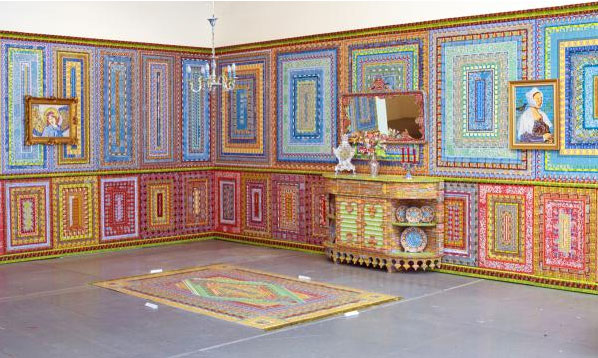
Lauren Was and Adam Eckstrom’s Ghost of a Dream, ($70,000 worth of discarded lottery tickets, cardboard, foam, wood, mirror, and metal) was narrowly shut out of the ArtPrize top ten finalists. (cc: William Powhida)
Over at WNYC, Carolina Miranda takes issue with my naming of ArtPrize as one of the year’s best exhibitions. Frankly, I’m surprised it took this long for someone to say something. The contest doesn’t exactly meet the standard criteria us Chelsea folk use to evaluate art; experts (and collectors) do not determine the worth of a work but two rounds of public voting will. You can imagine the quality of these results. Plus, ArtPrize promotion is the hokiest of hokey. Using a formula that exalts the power of democracy by invoking both American-Idol and Internet 2.0 euphoria, the “radically open” contest rhetoric couldn’t be more grating.
All in all, there’s good reason to ask why on earth I’d think this prize was at all significant. I answered a lot of those questions in a post I wrote from Grand Rapids in September, though a more heated conversation is currently taking place over twitter. A summary of what’s been discussed thus far:
cmonstah: I agree that popular events like that can be good in the didactic sense. but is it a best? and what made it important in 2011?
artfagcity: The amount of participation [ArtPrize] saw this year basically melted their servers and they had to extend voting. That was specific to 2011, as I think “groundswell” aided by technology was a major theme.
cmonstah: i think WoA may have generated more thoughtful discussion (materials/concept). artprize is voting contest.
artfagcity: Artprize has a speaker series of 9 guests including Anne Ellegood, senior curator @ the hammer & Reed Kroloff, Cranbrook Director. They also hosted a critics panel (disclaimer I was on this), which packed a large auditorium. ArtPrize didn’t generate conversation in NYC. But that doesn’t mean it wasn’t happen on mass elsewhere. Also, architects compete for prizes all the time. [Editor’s addition: Also, they’ve created a series of videos which feature experts talking about the art]
starwarsmodern: The issue I have with ArtPrize is didactic. I don’t like the lesson it sends about the worth of artistic labor. I have never thought of art work as ‘professional’ & being an artist is too risky (i.e. harebrained) to be considered entrepreneurial. A wealthy institution, run by salaried staffers should not be asking artists to self-fund decorating downtown Grand Rapids.
hragv: But isn’t that true of any exhibition? Do you guys get paid when you exhibit your work at a museum, for instance?
artfagcity: Also, all the work is for sale and the contact numbers are given on the labels.
pghLotus: Public votes often end up being popularity contests rather than people actually voting for the best.
artfagcity: That’s why they don’t allow top ten winners to enter 2 years running.
starwarsmodern: A wealthy institution, run by salaried staffers should not be asking artists to self-fund decorating downtown Grand Rapids.The problem with ArtPrize (and WoA) is its a purse of gold hung over a hungry throng. The lesson (or in the case of WoA,the entertainment) is that artists are desperate fucks who’ll jump & claw for the a chance at the gold. and “exposure” is NEVER a form of payment – BUT especially when artists are asked to pay all their own expences. Wealth and celebrity are inseparable. There is no more damaging truth to be told about a celebrity than they’re broke.
powhida: I’d say it, the prizes, reinforce a lotto mentality, winner takes all. The status quo.
diggingpit: Winner does not take all. Just being part of such a big open event/dialog can be of value. Seems like this more about the value of experts, degrees and critics. The market of collectors, dealers and curators is a contest of sorts. This lets more people in the door.
manbartlett: I’m in a np show next month where I’m getting paid a small honorarium AND work is for sale. [BRIC arts media.]
Star Wars Modern makes a lot of compelling arguments for artist wages, but that problem is larger than ArtPrize. Should museums and nonprofits pay museum fees? Of course. Does the government mandate fees be paid and stipulate what they will be? In the US, no. The result is that we have a system that does not adequately compensate artists for their work. This isn’t an ArtPrize problem, it’s a structural problem best addressed by policy makers.
I’d add to this the observation that the inclusivity of ArtPrize means that a lot of art will be displayed around the city that no one other than artist should pay for. I don’t think it’s reasonable to expect the organization to compensate everyone. What we should be doing if we don’t like ArtPrize results is pushing the organization to find ways to better encourage self-education. They’re doing a lot of this on their own — every time I talk to their staff they say need to mine the data they get from the website — but they can also look beyond that. This country is full of professionals whose only desire to produce and talk about art. It’s time to more actively tap those resources.


{ 21 comments }
I’d suggest that ArtPrize had a big year in 2011. After all, writers who once scoffed at it… and at competitions of this nature in general (I know first-hand — some praising competitions like ArtPrize now would not give me the time of day when I was Senior Editor of Myartspace… even with the free to enter annual $16,000 art scholarship competition we offered to art students worldwide.. which was sadly dropped after three years. Hell, MAS was ignored even after a partnership with SCOPE). For whatever reason some writers/bloggers are starting to accept ArtPrize for what it is. It is interesting to observe how attitudes change.
As for the Chelsea crowd (I do love the scene)… it is high time for them to realize that NYC is not the end all, be all of art in the United States. There is a lot going on in art throughout the country. You are either naive, arrogant or ignorant if you honestly feel that what goes on in Chelsea is the standard for what is going on in art at this time throughout the whole of the US. That is my opinion.
Brian, I can attest to the way Art Prize was scoffed at the first year. I was one of a handful of artists in Detroit who participated the first year, and people thought I was nuts. It’s been amusing to see people who were utter snobs about it the first year turn around and take it seriously in subsequent years. Reed Kroloff sitting in a panel? Never would have happened the first year.Â
On the whole, it was not a great experience for me. I was placed in a venue that was nothing like what they described on the web site, and got nothing in the way of support from the venue’s owners. I was the only artist in the venue who had any real experience exhibiting my work, and had other artists bugging me to install their work. All travel, shipping and other expenses were out of pocket. The venue was not promoted at all by ArtPrize, and received almost no traffic. Over the course of that week, I saw some of the most abysmal “art” it has ever been my misfortune to encounter. I also saw some outstanding work that was all but ignored by the public due to poor promotion, placement, signage etc. Artists who had the benefit of having their work placed at UICA, the Old Federal Building, and a few other choice venues had good exposure, and a good experience overall. Hundreds of other exceptional artists amounted to just another face in the crowd. Worst of all were the truly awful artists who were sponsored and promoted by lousy commercial galleries who poured money into promoting them, and got all kinds of media attention.Â
I haven’t been back since. I’ll consider it when they waive entry fees and find some way to offset some of the travel and shipping expenses for artists who aren’t local. Changes in the judging protocol for next year are promising.
Hi Mary — thanks for this input.  I agree that the venue is everything.  I participated in 2010, and my venue was a great gallery that did a good job of promoting and installing the art, yet they were not in the city center, so I don’t think it received solid foot traffic.  I am impressed that ArtPrize has listened to and tried to address criticism  every year, which I find amazing for such a large event.  I might try to put a piece together for next year . . . .  I feel that I have a better idea about what are and are not good venues.  One thing I found scary was that the money and the past winners seem to encourage gimmicky art — portraits made out of wine corks or push pins, etc.
It is like an elaborate art fair where you see good art and bad art, but it is on a grander scale — bad art 100 x its original size.
The great thing about the NYC art scene is that if they had and ArtPrize I thankfully don’t think a 13ft tall mosaic of Jesus on the Cross would win the $250,000 first prize like it did in Grand Rapids. You can’t have a discussion about “the public” without defining who that public actually is because the NYC public and the Western Michigan public are quite different.
“Public votes often end up being popularity contests rather than people actually voting for the best.”
Fair enough. That said, you could be critical of other aspects of ‘voting’ within the mainstream art world. For example, top art publications — and some art blogs for that matter — have long faced allegations of ‘buddy-system’ writing OR determining what to write about based on ad sales. True, that is not ‘voting’… but it is just as misleading as what you suggest… if not more so because these writers set the pace for what ends up documented from a historical standpoint.
The art world in general is no stranger to popularity contests.
I think the initial voting is a mix of a pure popularity contest and artistic critique, and then when it gets down to the final voting people really take it seriously.
Thanks for taking the conversation off twitter Paddy. You did a great job of editing the thread. And I am glad you raised the subject of the Prize (again). Although not something I am informed about in the way you are. But there is an important point that you skipped:
ArtPrize should offer support for any project that is made a part of the competition. No one offered a space should pay shipping. ArtPrize is what New Yorkers call a “vanity show” – no one takes them serious because ethically they are a step below a Ponzi scheme. It’s a con…
This is the real crux of my complaint. I’ve been to Grand Rapids to visit family and like the city, but have never been there for ArtPrize. That is why I am not commenting on the quality of the work (awarded and otherwise), or the mechanism of awarding the prize. But just like a vanity show in NYC, I don’t care how good the work is. I don’t want to support an institution that takes advantage of artists while presenting themselves as supporting the arts.
Ah, I wasn’t sure where you were going with the shipping so I skipped that part. Since most artists are local shipping wouldn’t be a major issue I’d guess, but I think it’s worth asking ArtPrize what kind of resources the museums offer to artists who are installing. I don’t know the answer to that question so I’ll send out an email.Â
A lot of the discussion seems to be why New York artist aren’t more interested in participating. If all Grand Rapids wants is a make it a “shopping show” that cherry pick existing work from local artist’s studios -in this case the metropolitan area of Grand Rapids – the ArtPrize organizers should do the minimum PS1 did when they organized the “Greater New York” shows (which were shopping shows): sending out trucks, installing work, manning galleries.Â
If they want artists from outside the region (and they really seem to want to be a player on the national level), they need to do the sorts of things Kohler, the Walker and other nationally important regional players do when mounting group shows: provide artists with additional funds for packing and shipping, pay for commissioned work – and, if artists need to be on site for installation, provide for their accommodations and travel expenses.Â
As for the New York vs Midwest resentment this subject inevitably raises – I am advocating that Michigan adopt best practices when it comes to artistic labor, and not allow itself to treat cultural workers as “right-to-work” state.Â
It’s not really a shopping show: Imagine an OkCupid like website. Artists can page through venues to see which most appeal to them, and venues can do the same for artists. They chose each other.Â
I would imagine New Yorkers don’t participate as much because the burden of shipping falls upon them. If they want that to change, clearly they’ll have to put more resources into making that happen.Â
It’s worth mentioning that while this event is, in a lot of ways about building the cultural identity of Grand Rapids. As such work about Grand Rapids often does better, and seems to favor artists who the city’s residents know about; either through previous competitions or because they are local. Â
Why has something like ArtPrize — on the same scale — not already happened in NYC? The resources are there. I know when I interviewed Rick he did hint that there is a possibility that ArtPrize will expand to other cities. Would the NYC art community welcome ArtPrize in their own backyard?
So /should/ New Yorkers be talking about this show more? Is the lack of New York artists participating a negative?Â
The only problem with ArtPrize seems to be New Yorkers don’t care about it enough, but maybe that is a good thing. If they made it more attractive to NYers it might ruin it.Â
On the other hand, making is less despicable and more dignified in the way it treats the artists involved would only strengthen the event.
Vanity show? Vanity shows are the bread and butter of Agora in NYC. I don’t think you can compare ArtPrize to Agora. I mean, ArtPrize does not charge you thousands to show with them. (True, shipping costs can be the nail in the coffin… but the artist should consider that before entering). Gagosian Gallery stroking the ego of some celebrity who fancies himself an artist is a better example of vanity in my opinion. Should we take Gagosian seriously?
The key issue here is that artists need more opportunities. I wish something like ArtPrize existed in every major city.Does it have flaws? Sure — but it is better than nothing. There are only so many art galleries throughout the United States… and art museums, in my opinion, have failed to really capture what is going on in art. There are great works of art that will likely never be put on display in a mainstream art gallery or museum. They have a very narrow scope — and limited space. ArtPrize has opened doors in Grand Rapids that would not have otherwise existed. We need more doors to be open…
Re New Yorkers and #ArtPrize, Ran Ortner is a New Yorker who won the first ArtPrize, and he entered because his New York gallery suggested that he enter . . .Â
Full disclosure: born and raised in Grand Rapids, my last job there was working for the Amway Corporation. Â It was a fantastic place to be a kid.
I doubt Paddy or any of the guest curators and lecturers would have showed up if they hadn’t been paid, sent an airline ticket, and been put up in the Amway Grand Plaza Hotel.I left town in 1989 prior to Grand Rapids having discovered the power of art and specifically sculpture to attract a crowd and transform an area- the one exception being the giant Calder in the center of downtown.  Side note- the crowd hated that sculpture when it was put up and now it is the symbol of the city.  Another side note- there is one of Robert Morris’ first commissioned land artworks on the outskirts of town too from the early 70’s.Frederick Meijer gets a ton of credit for reviving the latent interest in sculpture and art in general with his Meijer Gardens.  It’s perhaps the best sculpture collection in the Midwest and I try and wander the grounds every time I am there to see family.  Full disclosure- I’ve received numerous coupons from Fred personally over the years for his famous “Purple Cow” (a grape soda ice cream float) AND had the privilege of mowing the grass at his modest house twice but I can assure you this has in no way influenced my recommendation.  Go see this collection next time you are in town.  It’s what the wealthy should do with big piles of money.Since then, the Grand Rapids Art Museum has been rebuilt, UICA is in a new building, the art programs around the region are pouring out BFA students, and now we have Art Prize.  The interest in Art abounds in Grand Rapids in a way that didn’t exist, nor could I have ever imagined it existing when I left 25 years ago.  The Devos and VanAndel Families get a ton of credit for this because they were the first to really believe in downtown Grand Rapids.  They have invested BILLIONS of dollars in hospitals, stadiums, developments and hotels in the downtown core and have created and maintained a legacy that is beyond reproach.  Their politics are not a homogeneous platform as a family and are totally beside the point in this discussion. The problem with Art Prize however,  is it is all so “They Shoot Horses Don’t They”.  It trades on the desperation of artists to survive by waiving the possibility of the biggest payday any of them will ever possibly achieve and hundreds and hundreds of artists pour their guts out on the dance floor that is downtown Grand Rapids.  The public loves the spectacle, but all I see is the desperation of conceiving, making, transporting, installing, maintaining, de-installing, transporting, and storing the largest, gaudiest carnival ride of a sculpture the artist can come up with in hopes of getting that bag of gold.  There is no other profession (well…PGA Golfers…) that the default assumption, all too often reinforced by the professionals themselves, is that they are speculative enterprises that the public is not beholden too.Just because you can, doesn’t mean you should.As it stands now, ten of the contestants win along with every business and real estate owner in the downtown core.  Hundreds of artists lose, and lose big.What can they do?  It’s simple:  create a jury…make it huge…make it comprised of one part online voting…one part art professionals….one part John Q Public.  Accept proposals from all the thousands of contestants and make up your mind about the 20 best sculptures and the twenty best non-sculptures….then make it a public vote in both categories.  All forty contestants get funding to make, bring, and perhaps take home their works.  The winner in each category leaves their work behind because it gets purchased.  The ArtPrize crew is on to something, it is a phenomenon. However, if they don’t modify this structure to benefit the entire creative community, my prediction is that they will be handing out checks to a string of chrome and neon bejeweled Jesus sculptures.
Hey Steven,
I like your thoughts, though I should clarify that I was not paid to participate. ArtPrize paid for the airfare and the hotel, but I paid for most of my meals on my own, and received no honorarium. In fact, the reason I was there at all was because I had told them I was interested in the event and asked if there was any way that they could help me see it.Â
I can’t speak for what anyone else’s arrangement was, but that was how I got there.Â
The ArtPrize hatred is rampant here in Grand Rapids, you just have to talk to the local artists and not the local media. Our media would have you think they are one in the same, but it’s a pretty segregated city with a few passionate people, and a whole bunch of upper middle class socialites running around pretending to be important.
It’s a joke here. Each year, a bunch of grand rapids artists participate out of some weird obligation, and decide to never participate again. Venues too. We hate the voting system, the distribution of financing, the fact that 5 venues get 99.99% of the traffic, the gaudy, gimmicky shit that fills our streets (or rather, we like laughing at that, until it places in the top 10), the fact that every local news source and publication puts out 500 “where are they now” stories for months after the event is over, etc etc. We know that the venues that get 2,000 visitors an hour make tons of money while other venues lose money because they don’t get that many visitors for the ENTIRE EVENT. We know that some Christian pieces will place because we are a staunch Christian reformed city, not because the art was any good. We know there will be a rubiks cube sculpture of MLK and a penny made of pennies and cars covered in junk and that people will eat it up while some gorgeous paintings collect dust in a pizza place that spent $1000 to participate and didn’t see any increase in traffic. I need to stop now, I could complain till my fingers hurt.
In short, tons of people in Grand Rapids hate ArtPrize and everything about it, but disliking it doesn’t do the city any good, so you won’t hear about it
Here is another perspective.
 OWS has showed us that it is good to question power structures and how we participate in what they want us to partake in. I would suggest artists take a look at the politics behind the people that bring you ArtPrize and what their thinking is about art.Unlike Steven Mesler’s  view of The Devos Family, I as an artist and free thinking individual see them as the evil Koch Brothers of the Midwest. ArtPrize is funded by The Dick and Betsy Devos Foundation, an evangelical foundation that is politically active in the fight against LGBT rights and pro religious school vouchers. They are anti-government regulations and pro Christian in their political capital. Dick and Betsy Devos are the heirs to the Alticor/Amway corporation a company that makes billions of dollars a year selling soap and beauty products through a multi level marketing program. Rick Devos, son of Dick and Betsy is the founder of ArtPrize and sits on the board of the Grand Rapids Art Museum and the UICA. The Devos Foundation has supported or still does support ultra conservative think-tank institutes like the CATO Institute, the Acton Institute and the Heritage Foundation. When Dick Devos ran unsuccessfully for Michigan Governor he ran on a platform of intelligent design being taught in schools, voluntary environmental regulations, anti-prochoice, and a ideology that public opinion should trump governmental expertise. This ideology seems to have carried over into the cultural area where public opinion about art is favored over professional knowledge about art in this American Idol type art competition. This point has been tempered over the last years because of critical complaints and they have added  panels of speakers to appear more education oriented. Last month it was announced that the $250,000 grand prize was going to be reduced and a professional juried award would be added to the competition, a welcome addition that might have been deemed needed by the organizers after a 13ft mosaic of Jesus on the Cross won the grand prize.Â
The Devos families reach into the manipulation of cultural ideas is national. With a $22 million dollar gift they established the Devos Institute of Art’s Management at the Kennedy Center which leads management training to arts administrators and arts institutions across the country. Lets all hope that their radically conservative religious and political views don’t manifest themselves for I  fear that old saying that whoever controls the context by which art is talked about or exhibited can control the content of what is talked about or shown.
To read more about what is behind ArtPrize see my Facebook Note at https://www.facebook.com/note.php?note_id=407928732254
I think a contest like this would look really ugly in NYC. We’d see galleries campaigning for artists and those with the biggest names and money would win.Â
Chicago tried something a bit smaller-scale and “professional” with Art Loop Open.
I think a national discussion about ArtPrize is positive — national participation not necessarily so.Â
As for the shipping: I’ve heard back from the artprize folk. They say since many of the museums consider ArtPrize their fall show, they help artists with such costs (shipping, installing, honorariums etc.) It varies from venue to venue though, so there’s not one standard.Â
Comments on this entry are closed.