
In this week’s finale of Work of Art, Bravo has finally loosened its reins on the show’s three remaining artists: Kymia Nawabi, Sara Jimenez and Young Sun Han. The harsh time constraints that have hindered work in past challenges have been lifted, and the artists are given three months to produce an exhibition from the comfort of their own studios.
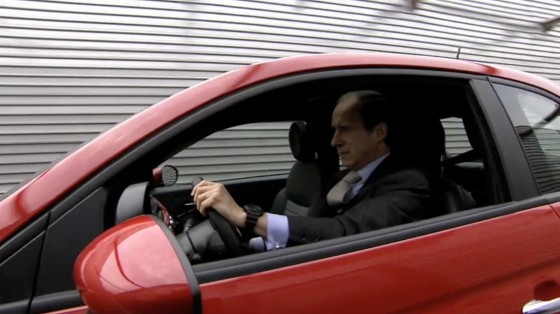
The show follows Simon as he scuttles between the artists’ places of residence in at least two Fiat 500’s, two months into the challenge. He meets their boyfriends and suffers through some small-talk, the best of which is saved for a later montage in which a clip of Simon emulating a motorboat is sandwiched between such musings as “it would be terrible if people were chicken slaves” and “as a DJ, I press the science a lot, I put that song on, I let everybody on the dance floor instantly!”

Young has somehow spent two months coming up with the following banality: the guards that protect South Korea’s president stand in rectangular prisms, so Young has created a similar rectangular prism which he plans to take on a road trip to the Brooklyn Museum, taking photographs of himself in said prism along the way. Because he wants to be in the Brooklyn Museum. Simon does not even try to entertain this idea, and instead directs Young to the casual pile of objects relating to his father’s death on the other side of the studio.

A typical day in South Korea.
Kymia has drawn a bunch of ghosts, because she has no religion. Simon is suitably aghast, however after their earlier exchange over some Nawabi family photos (“my father passed away on this lake actually”), it is agreed that Kymia’s drawings would do better as a ‘dead father’ piece too.
Sara’s spent her time soliciting people in a plague doctor costume (or maybe a stork?), asking them to write down their worries and drop them into her satchel to be later adapted into sculptures. Simon nixes the obvious (boyfriend’s fingernails glued to a spiderweb, clay penises wrapped in pantyhose) and bids her adieu.
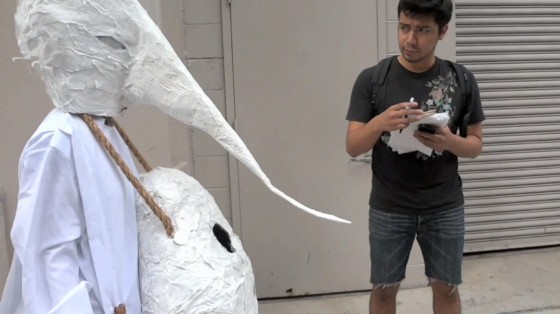
Sara's costume facilitates the worrying process.
A month passes, and the three artists reunite in the gallery space to install their final pieces, despite the horrifying realization that Young hasn’t had his eyebrows threaded. After some minor (but dramatic) technical setbacks, the shows are ready and the galleries open to a slew of familiar faces: all of this season’s contestants and guest judges, as well as last season’s Abdi Farah, now the Penultimate Great Artist.
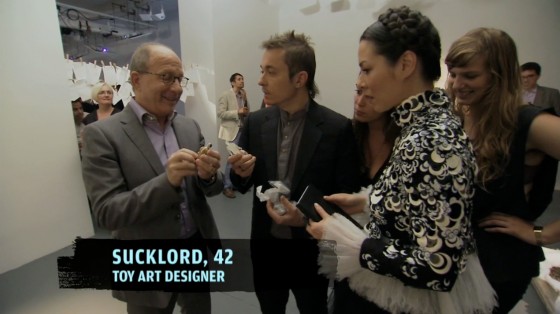
Sucklord, holding a Jerry Saltz action figure: "It's sort of a thing in the toy world to do glow-in-the-dark versions of bald, Jewish art critics."
Young’s subject matter has passed predictable and become Pavlovian: China Chow bursts into tears before even entering the gallery. The exhibition’s title is Bool-sa-jo, the Korean word for ‘phoenix’ and a term used by his mother in reference to his dying father. No attention is paid to the theme of rebirth and the fact that most of the pieces in the gallery have nothing to do with his father or the exhibition’s narrative never gets a mention. The stacks of candy and Chapsticks that represent the candy and Chapstick Young found in his father’s pants could easily refer to any of the billions of other people who buy candy and Chapstick, and no explanation is given for the wall-sized photograph of Young’s boyfriend that was also included in his show.
The bland wooden box from Young’s original idea has somehow made it into the gallery, because the strung-up plaid shirts with pictures of his boyfriend sewn on just didn’t look bad enough on their own. Young’s invitation to climb into the box is somehow not voiced until after the opening, and his speech about how his work might be too risky because people might not want to “experience these emotions” is an insult to basically everyone. However, we soon see why Young’s ideas resonate so disproportionately with the judges: China Chow breaks down and talks about her mother’s death with a sincerity that surprised even me.
Sara’s exhibition, Anonymous Contemplations, has a few new additions since the studio visit: a silhouette of herself left by skin cells on clear tape, a cilice-style set of lingerie made of hair, and a new spiderweb with shreds of journal entries instead of fingernails. (Lola, Episode 2’s hot glue web expert, doesn’t find it up to her standard.) It’s a solid show until Sara unveils a more uninspired ‘thousand paper cranes’ sculpture and refers to every work as “harmoniously together.”
Bill Powers’s complaint that the show reads as more of a “collection of short stories” than a narrative is on point, however his quip that the work is “expositiony” makes me wonder whether he’s been paying attention this season. This week’s guest judge, contemporary artist Kaws, tries to hide his tears as he emotes over the tape silhouette.
Kymia’s show, Not for Long, My Forlorn, keeps only two or three of the drawings seen in the studio visit, and replaces her original awful E.T.-style sculptures with a set of three burial mounds. Bill Powers seems to think that the mounds should be “edited out,” eroding not only the fourth wall but Jerry Saltz’s patience. The chef-d’Å“uvre is a drawing of a boat, alluding to Kymia’s father’s death in a jet-ski accident. Kymia recounts this story to the judges with tears in her eyes, but China Chow is bizarrely stoic. I guess she just doesn’t connect with jet-ski stories.
We all breathe a heavy sigh of relief as the verdict is read: Kymia is the winner of the challenge, the $100,000 from Fiat, the spread in Blue Canvas Magazine, the auction of her work by Simon de Pury, the solo show at the Brooklyn Museum and the near-limitless power that now surges through her veins as the Next Great Artist.

They grow up so fast.


{ 5 comments }
So… a few parting thoughts on the WoA. Â First I’m glad I was on first season, when it seemed kind interesting to talk about the pros and cons of the show, albeit mostly cons. Â The only pro for me remains my own crazy fun experience….sorry. Â Was it just me or did it all go by this year without much remark? Â Anyway, Bravo didn’t take any of my advice (which they solicited)….to develop the show around real live crits, to replace Simone with an artist (maybe a great art professor…I recommended Mark Greenwold who would have been phenomenal), or put more artists among the judges. Â The show lacks artists!….how can the show reflect art making without really finding people with experience in that life to take part. Â
Second….Enough with dying fathers or mothers or other personal sentimental stuff. Not that I don’t like knowing someone’s story, but it’s what you do with it…otherwise it’s just a fucking story, a dime a dozen….so don’t wear it on your sleeve. (literally Young!) Â No more tears…give me some anger, some humor, some rebellion. Â
Finally….No more anointing of who is, or isn’t, a “true artist”….by the judges.Â
Wow I never would have thought Gretchen Weiners would pull through.
So I hope the producers of the show weren’t looking at afc’s comments section as a cue for a third season. I would have commented more but finding the episodes online was difficult this year, a sign not many were paying attention.
So Kymia won. I have to think this was the a curve ball to viewers, who obviously thought Young had it in the bag. I have to say I’m happy that execution trumped concept. I agree with Ben in that Young’s work was bland as hell, but it had a “professional” quality that is all too excusable in the art world today. I’m sure his project statement would have been more impressive.
I did think Young was the most talented at digesting challenges and inventing interesting concepts. Funny how more time can help falter your process. Honestly I thought Sarah and Kymia were often lost, at least Kymia had solid technique. Can you imagine the work they would have produced if Simon didn’t give them a reality check. Stockings stuffed too look like penises don’t belong anywhere but an undergrad foundation class.
Can we talk about the studios? I don’t understand how Kymia can afford a studio in Manhattan and have “50 dollars to her name”. Sarah Jimenez studio seemed ridiculously huge, what type of no-name can afford that much space in bushwick.
Anyway I’m just griping about studios in NYC.
All in all, once I got over critiquing the concept and faults of the show, I was just left with artist challenged to make work they never would think to make in a very short amount of time. I found some level of respect this seasons artists, partially because they were better than last seasons (sorry Judith). What they had to do was crazy difficult and way outside of the comfort of making work for themselves. Were they making great work? I don’t know. But given the constraints, I’m not sure I could do much better.
I was wondering the same thing about Kymia having a studio when she had barely $50 to her name — but maybe she used the money from Bravo to rent out studio space. They were all given about $7,000 (not sure the exact amount?) to have 3 months to create works for the final exhibition showing.
Thank you, Macaulay, for recapping the season with a blend of lightness and seriousness so I don’t feel like I’m the only one marveling over oversized buttons on China’s head. I personally felt like the finale was a letdown and disappointingly anticlimactic (reality show writers, where is your narrative arch?)
Personally, I find viewing pieces of art through reality TV like viewing the ocean through a pinhole, making it difficult to review/judge on my own and leading me to admittedly be persuaded more by the compelling or annoying personalities at times more than the work itself (who can be truly objective anyhow?).
I think Bravo should further question and examine the art and ethics of the reality TV show in a separate series (no, not the reunion episode style) and make a meta-move to examine the Hawthorne effect on artists… or for that matter, any of the reality TV shows that they write and create, including the most controversial one of the death of Real Housewives of Beverly Hills husband.
Perhaps such an examination of the process of reality TV is impossible since the camera has to be “on” for us to see it, but the Work of Art series highlights how certain the process– and artists– are changed by the context of how they are viewed– a concept that may be even more interesting to explore than who “wins.”
-nycgallerygirl (www.nycgallerygirl.com)
Comments on this entry are closed.