
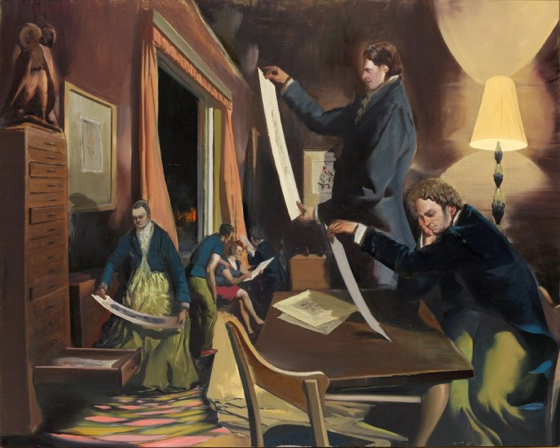
Neo Rauch, "Ware," 2011. oil on canvas
“What passes for imagination today is often just a recontextualization of cultural signs,” David Salle observed in a recent issue of Artforum. When I read this, preeminent painter Neo Rauch immediately came to mind. His show “Heilstätten,” or “a place of healing,” at David Zwirner comprises a bronze statue and several paintings, small to mural-sized. Each depicts a panorama of characters and symbols from pre-1960s East German propaganda.
As always, the paintings read as shadowy dreamscapes. Lifeless figures are posed in collaged studio spaces, barren landscapes, and provincial European towns. Steely surreal sculpture, gasoline jugs, paintings, owls and winged people, women in plain 1950s dress, remnants of World Wars, and men in military garb and posture appear in clusters throughout. Based on the compound-style buildings, Rauch's “place of healing” might refer to a sanitorium or a decrepit outpost. Often, something or some one is enveloped, either by overlapping compositions or costumes that seem mid-transformation: in Die Warte, for example, a landscape is swept up by a floating woman's green dress. Subjects are aware of their paintinghood; in Ware, 19th century academics examine prints in a dingy study. In Das Kreisen, paintings meld into the background of a studio space.
Gender and time are not ambiguous, just mixed-up. Das Kreisen, a large-scale painting on the back wall of the second gallery, contains a formidable bearded man whose knee-length skirt reveals smooth, bare legs; he is not androgynous, he is half-and-half. Figures wear specific period clothing from the early-mid 19th century and the 1950s. Time has stopped by 1961.
Rauch draws repeated criticism for his “lack of personal style,” but if anything, his show at Zwirner is very consistent: hurriedly painted, chalky, and lifeless. Take a wide view, and you see chunks of the same colors and tones, systematically overlayed with quick, sketchy details. They're utterly formulaic; Rauch might have instructed a group of hired workers to make a wall mural in a day. The smaller works resemble dime-a-dozen 1950s postcard paintings. His moldy skin tones and acid greens over murky purple are nauseating.
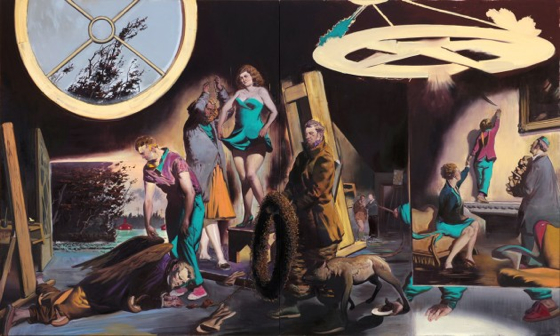
Neo Rauch, "Das Kreisen," 2011. oil on canvas
Ugly homogeny, though, serves Rauch well. The all-over quality and speed intentionally hides some of their weirdest moments, which one almost has to read aloud to notice. From my notes: “a fallen angel guy lies on the floor bound by legs and arms by something- hooks? lumps? There are meat chunks on a barbed wire in front of him that look tantalizing- a dog comes over.” This is only a minor event in Das Kriesen: the main stage is occupied by artists' models, flanked by smaller paintings– one landscape and one a family around a fireplace– both of which melt into the “real” space. A large, circular window reveal blowing treetops which replicate those of the painting below. The right half of the composition extends into a long, dark hallway, leading only to another empty doorway.
Suppressed sexuality pervades: in the mini-painting Pakt, thick, hasty brushstrokes reveal at closer inspection a sliver of paint which suggests a soldier's open fly, cupped hand resting below genitals. In the hallway of Das Kreisen, an older man invitingly lights the cigarette of another in short shorts. The artist's hand, which juts from behind a painting, points a denunciative paintbrush at them. A woman lifts up her dress, revealing only a flat shadow.
The act of viewing these is the same as undertaken by Rauch and his subjects: trudging through piles of historical information in order to resolve them. This is the task of any culture-maker who is confronted with chore of both understanding the present and moving forward. “Heilstätten” does not present historical narrative, and the people are not intended to be life-like; this is what the present collective memory of East Germany might look like, and it's not pretty.
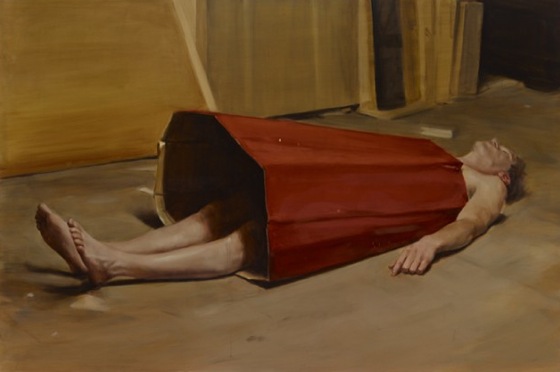
Michaël Borremans's "The Devil's Dress," 2011. oil on canvas
Whereas self-proclaimed conservativism works for Rauch, it bankrupts the adjacent show at Zwirner. Michaël Borremans's “The Devil's Dress” comprises a series of ocher-colored portraits, mostly solitary nudes in what is likely his studio. In scale, composition, figuration, and paint handling, these aspire only to something between mannerism and American impressionism. The Loan, a painting of a headless woman in black tights, black heels, and a black satin dress, is particularly evocative of the Belle Epoque. The swift and highly controlled marks aim for a Sargent or Richter-like elegance and ease; in The Devil's Dress, Borremans uses wider, looser, strokes to express an out-of-focus face, a shorthand technique employed often by both painters.
Contemporary cues are bare and arbitrary. Borremans adds something mundane to each painting to justify the bland set-up: one woman lies under a floating board. Another has length of red sheeting arranged like a cylindrical tent around his torso. A body in a party dress doesn't have a head.
While Rauch forces us to slog through conservative language in order to reach meaning, Borremans perpetuates conservative language to eliminate meaning: actively upholding complacence in a field best suited to broaden the mind. If the intent in showing these artists together is to elevate the latter, it only expounds the importance of slogging. Entering “The Devil's Dress” from Rauch's historical stockpile is like hitting “reset” on all of the intellectual struggle of the past century. Within ten steps' reach, it's as though nothing ever happened.


{ 12 comments }
wow harsh review. Regarding Rauch, while I didn’t find the paintings as  formulaic as you, I did see the sculpture as a failure. It was interesting to see his tropes unable to stand on their own when realized in 3 dimensions. Do you have an opinion on it?
I didn’t mind the tropes so much- I thought they made the paintings really interesting because they mask the weird stuff. I also didn’t mind the sculpture in the context of the paintings; they’re so jammed with information that adding a three-dimensional figure just helps extend that environment. And formally, meh, but I think all of this is supposed to look a little stale. Â
I’m so tired of seeing the “conservative painting” broadside haphazardly tossed at any contemporary artist who happens to paint representational images. It’s a lazy, virtually meaningless insult (the “hipster” of the art world?) meant to extinguish thought. What, at this moment, could be more conservative than a monochrome painting or a minimalist object? Abstract & non-representational works have been embraced and institutionalized for at least the past 50+ years, which is of course totally great. But I never see Amy Sillman, say, maligned as a conservative.Â
This isn’t to say that there aren’t a ton of hacky painters making utterly banal, reactionary work. Just that Borremans isn’t one of them, and to be so immediately dismissive of the form short-circuits any possibility of really engaging with the work. I liked the Rauch show with reservations, but I thought the Borremans was the far stronger of the two.Â
And yeah that Rauch sculpture was truly awful.Â
Clearly I have no problem with representational or conservative painting; this piece is entirely in favor of Neo Rauch, a representational, *self-proclaimed* conservative painter. Â
I just spent ten paragraphs explaining why I feel Rauch uses conservativism to great effect, so I agree, to insult some one as “conservative” point-blanc would be lazy and virtually meaningless. Kind of like dismissing any work as “truly awful” without any follow-up. Â
And I’m interested to know: what do you feel is engaging about Borremans’s work?Â
Thanks for responding. It’s a terminological quibble I guess, but in the era of Fox News, “Conservative” will always be perceived as an insult by a lot of artists. It implies an out-of-touch, reactionary backward-looking, a refusal to live in the present, etc. Whether an individual artist embraces the term or not isn’t really my concern. I just feel like it’s inherently dismissive and suggests that there are valid and invalid ways of Making Art Now. Didn’t we spend the whole last century trying to get away from that?
The Rauch sculpture is awful because it doesn’t do nearly enough to escape it’s generically surreal subject matter. Without the evocative color choices, weird scale and perspective-shifts and confusing internal relationships of his paintings, it looks like a subpar entry to Artprize. At the opening I thought: this is what happens when you get too famous to listen to anyone.
The Borremans show was to me the real prize. Subtle, highly charged paintings suffused with an atmosphere of magic and dread. Completely drenched in nostalgia, sure, but in a sort of David Lynch via northern Europe way. The figures all look hollowed-out, blankly opaque as they’re measured and observed. They are subjects in the most clinical sense, devoid of agency, fragile under the weight of history, the viewer’s gaze. They inspect the dehumanizing processes of categorization, as the language and logic of systems overtake their very practitioners. They suggest that the nightmares of the 20th century aren’t so far behind us.
You say that Borremans perpetuates conservative language to eliminate meaning, and that his work suggests the intellectual struggles of the past century never happened. I would say that he works in a historical style (if a currently unfashionable one) to re-engage and re-articulate those very struggles. Have we really come so far as a culture since then? Or our we still basically groping around in the dark, locked in our own subjectivity and manipulated by forces outside of our perception or control?
what do you mean by historical style? I find his brand of figurative painting closest to late 20thcentury figurative academicism. Personally I see very little mystery in Boremans’ Â work; both in subject matter and technique I find it lacking in transformative power.
Yeah technically it’s pretty academic, I don’t think anyone would argue with that. I just don’t like the conservative jibe, I don’t think working in an academic style should bar a good artist from being taken seriously. Mystery and transformative power are pretty subjective things, I guess.
Hey Jeremy,Â
Thanks for your thoughtful response.
If “reactionary and backward-looking” is bad, I don’t see what can be good about conventional portraits that reveal nothing more than Borremans’s own skill. I think of Borremans’s paintings as you do of Rauch’s sculpture: they do not do nearly enough to escape generically surreal subject matter. I don’t find subtlety in props that aid only the aesthetic of the painting, and I don’t think “working in a historical style” is enough to re-engage any struggle.
Style is incidental, but this particular style probably isn’t fashionable in contemporary art because figurative impressionist painting is so fashionable in auction houses. And style is basically the substance here; the gallery itself describes these as empty figures, empty settings, and empty titles which “offer little help unlocking the narratives.” They’re empty, and we can fill them up with our own projections. Is there anything more lazy and exhausted than offering only emptiness? The press release adds that these “emphasize the tension between representation and empirical reality,” which is only to say that he’s magically making the paint look like other things. Most of his accolades just sound like a celebration of representational art in general. Rauch at least offers us something. Â
Borreman’s doesn’t seem to be interested in critical theory and therefore an art critic who is writing from a perspective based in critical theory will not be tuned to the same wave-length and have little to say about it. This is not meant as an attack on either the critic or the painter, they are just different worlds which is probably for the best as I think spelling out the work in the Borreman’s show would be robbing it of its power. The meat in the Rauch show is extracted by interpretting the cultural/historical signifiers and giving them real-world (as opposed to the world within the painting) implications (as executed nicely in the above review) while the meat in the Borreman’s show is extracted from and based upon feelings evoked from the work more so than specific references i.e. the child in The Wooden Dress standing atop the same beige square as the figure in The Loan implies a connection that will be different from person to person and not without impact or merit but probably not important to the general critical discourse of art.
Dürer korrigiert / Durero corregido
http://www.youtube.com/watch?v=WFjTU0keNvY&feature=related
Hi Eric,Â
I agree, people are moved by different things, and that reaction is legitimate whether or not I happen to feel the same about the work. I’m just saying that every subject and style has a sub-text. Art has traditionally been used to objectify women, exoticize non-Europeans, function as status symbol, and promote the agenda of those in power; only recently has it been allowed to do something else. This doesn’t mean it has to provide a code of signifiers for art critics, just that I hope it’ll continue to aspire to more than re-enforcing the norm.Â
Hi Whitney! Just felt like saying I totally agree with you here. I really liked the Rauch half a lot more (even though the Borremans part was impressive in terms of his skill). Great to see some more Rauch stuff in person, even though the sculpture wasn’t up to par with the paintings. Hope you’re doing well!!Â
Comments on this entry are closed.