
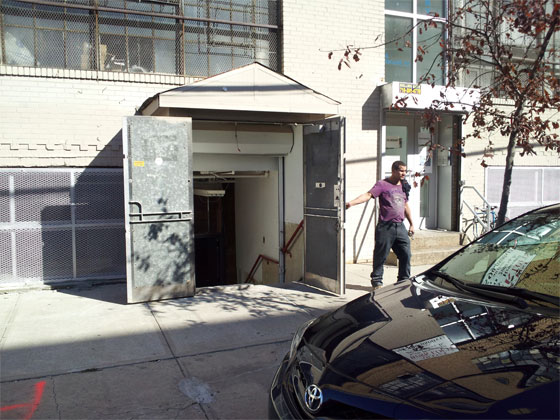
56 Bogart Street. Image via: NurtureArt
The history of gallery migration in New York is by now well-known, even if its particulars are not. Often it starts with a single artist-friendly building, that becomes the hub for community and neighborhood development. This gets interesting when there are circumstances where the failure of manufacturing is the stimulus for the rise of arts. A case in point; back in 1971, dealers Leo Castelli, Andre Emmerich, Ileana Sonnabend and John Weber opened quarters at 420 West Broadway — a former paper warehouse they bought outright — thus opening Soho to the galleries of 57th Street. Chelsea's early days have a similar history: the manager of 529 West 20th boasted in 1997 that “twenty-two galleries had signed up” to fill former storage space. In Dumbo, it was the long-running art support at St. Ann's Warehouse that propelled the neighborhood to prominence.
Bushwick's 56 Bogart St. is beginning to experience this same transformation. In the past nine months, the building has rented space to Momenta Art, Agape, Interstate Projects, Studio 10, Salon Bogart, and CCCP (Creative Curators Collective Project). NURTUREart recently moved to the building from its old location on Grand Street. Theodore:Art is slated to open next month. Both find the location across from the subway and the draw of Roberta's Pizza compelling.
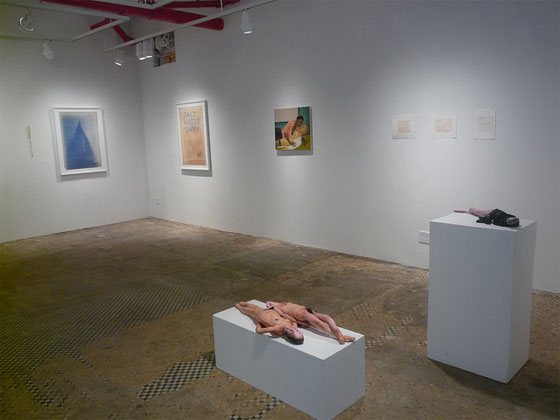
Retelling at NurtureArt. Curated by Melissa Levin
Sharing more with the first buildings in Dumbo, which were artist-centric rather than the gallery-focused addresses of Soho or Chelsea, Bogart attracts artist run spaces. “We are the people that we support.” declares Carol Salmanson, vice president of the non-profit NURTUREArt. “We are about emerging artists and emerging curators.” says Salmanson.
The landlord, Ted Hovivian actively encouraged artists to move in. “He really wanted us here. He told me personally that he finds it so much more pleasant to have artists and arts organizations as tenants.” Salmanson explained. It's an interest that's both business and pleasure.
Hovivian says, “We've owned the building since 1983. We had a lot of needle trades in the building. As manufacturing started to the leave the United States we had a void. At that point there was a calling from the art community for space. As the art community has developed there's come the galleries.”
Galleries and artists have another advantage: they're low-risk. After a business that rented two floors of another property Hovivian owned left without notice, he began to rethink his rental strategy. “By renting the building out in smaller sections, if one or two tenants move out, it's not a major financial disaster”. A stable income from an established non-profit shouldn't hurt either: NURTUREArt has already signed a ten-year lease.
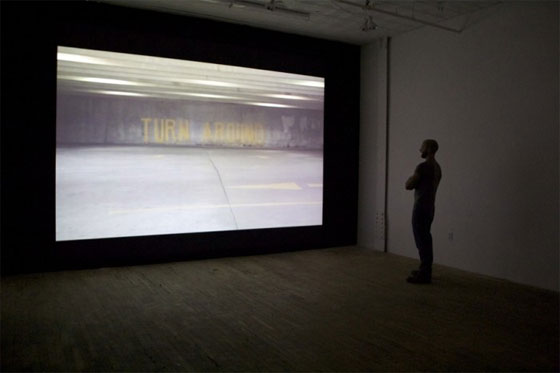
Installation view of Jesse McLean's Trust Falls at Interstate Projects
Only recently, though, has the neighborhood been able to support such an endeavor. Hovivian and his wife first bought the building in 1983, but the area was too dangerous then to support even manufacturing. The building's transition to the arts has been quick. Momenta Art secured a spot first, followed this March by Interstate Projects. Interstate director Tom Weinrich operated a small woodshop next door, and took the space over from his neighbor Jenny Holzer, who ironically furthered the process when she moved out.
Not surprisingly, foot traffic has steadily increased, though the numbers aren't yet impressive. “I'd say on the weekends we get maybe 20 people, and during the week it's quiet” Weinrich told AFC. This month Jesse McLean's “Trust Fall” received an ArtForum review.
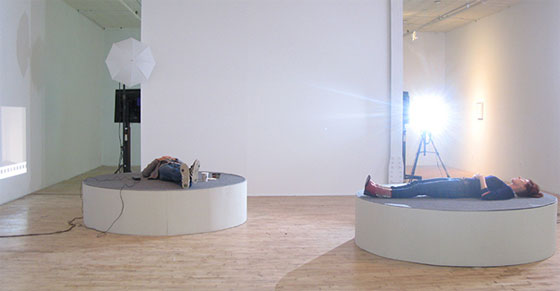
Ahram Jeong at MomentaArt
Still, those in the building enjoy the vibe. When I asked Momenta Art founder Eric Heist why they moved from their Williamsburg location, his answer was simple: “Momenta's always been about serving the community and so many of the artists that lived in Williamsburg had moved. It's a lot more convenient for the artists.” Like NURTUREArt, Momenta rents out its extra space as studios, at below market-rates. The gallery has also been discussing the possibility of residency program, though the project is still in its early stages. In the meantime, Heist has opened a new, more commercially-oriented gallery dubbed Agape across the hall. “The reason we liked that space was the chandelier, drapes, and one wall that's wood panel.” he told us. “It was an old office.”
It's possible Bushwick and the building itself will soon see more of these commercially-driven spaces, with the much-anticipated arrival of Chelsea giant Luhring Augustine this winter. Both Heist and Salmonson mentioned the gallery's move as significant. Heist sees potential, explaining that during the Williamsburg boom days, many wondered whether the scene would eventually attract blue-chip galleries. It never did, but Bushwick has thus far proved more appealing to at least one outfit. NURTUREart Director Marco Antonini, believes Augustine’s artist resources are of most value. “[Augustine's] going to transport its library into this location, and make it accessible.”
Weinrich expresses more skepticism. “Until they actually open and you can actually go in it, I'm not counting on anything.” he told us, noting that the building isn't listed on their website. Such pessimism isn't coming out of nowhere; the gallery's slated date for launch – November 5th – came and went without mention.
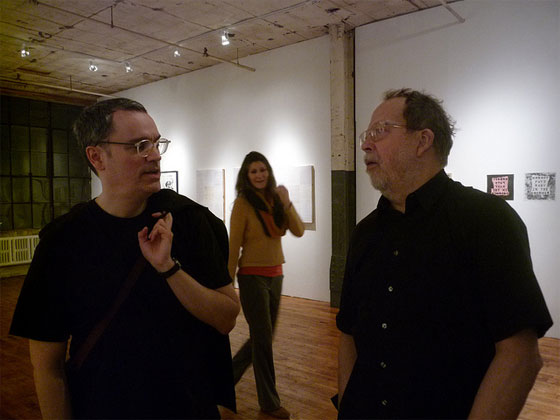
Barry Hoggard and James Wagner at Studio 10 in 56 Bogart
Augustine's direction largely seems in keeping with the sensibility of those in the building, a point we were reminded of when we ran into James Wagner and Barry Hoggard during our Sunday tour. Known for their longtime commitment to fostering emerging artist communities, the bloggers and collectors immediately noted the debt owed to the now-defunct artist-run space, Pocket Utopia. Later, over email, Wagner reflected almost wistfully, “While [Founder] Austin Thomas wasn’t the first Bushwick art presence (we were doing artist studio visits in the area before Pocket Utopia)…I can’t think of the building – or of the larger Bushwick art scene – separate from her magical space and its mission”.
The space's website describes the project as one that “initiates community by connecting artists.” Looking around at the collective activity at 56 Bogart, those principles seem very much at work.


{ 9 comments }
Artists don’t just fill the void when manufacturing leaves, they cause small business owners to be pushed out. Greenpoint is full of examples of landlords that kicked out their light manufacturing to draw in the art crowd. Artists hurt small businesses in need of space by running up rents, the landlords certainly don’t care as they make more money.
The main problem here is that a large number of NYC artists seem to be independently wealthy hobbyists whereas light manufacturing is an actual business. Rich hobbyists make it impossible for profit seekers to compete in real estate.
Thanks for the article. I have had a studio and office in the building for 2 years and am also now a Trustee of NURTUREart. The whole neighborhood is bubbling as are the next few stops east on the L train, and over towards Ridgewood. It’s exciting.
Don’t Bogart that art my friend… It’s funny that people believe the artists are the end of the line in this cyclical real estate evolution.  They, just like the small manufacturers and bodegas, will in turn be pushed out by boutiques and luxury condos.  I’ve been writing about the ‘wick for eight or nine years now, but am still amazed by the speed with which the transformation is occurring.  Enjoy ridding this wave, but don’t wait until you hit the rocks to bail. Â
One more comment, on manufacturing spaces becoming artist work spaces. The obvious comparison is Soho in the early-70s. Light manufacturing moved to new spaces in LIC and New Jersey, as the business owners wanted large horizontal spaces and not vertical spaces. The buildings became empty, artists moved in (George Maciunas and the Fluxhouse Cooperative probably the best known, though I am told Yvonne Rainer was one of the first to occupy Soho). Then Robert Moses decided to flatten Soho and build a 10-lane highway through, saved ultimately by locals and most notably Julie Finch, Don Judd’s then wife, and inspired by Jane Jacob’s book, “The Death and Life of Great American Cities.” Neighborhoods and buildings shift, get repurposed. Sometimes they get eradicated for entirely new developments (i.e. Lincoln Center).
This has happened in the East Williamsburg Industrial Park neighborhood of Brooklyn, which is where this building is. Bushwick, technically, is on the other side of Flushing Ave. The EWIP is one of eight such neighborhoods in NYC, managed by the East Williamsburg Valley Industrial Development
Corporation (EWVIDCO), a company founded in 1982 with the goal of
revitalizing East Williamsburg by attracting new businesses, providing
business assistance to existing firms and grow overall job opportunities
in the neighborhood.
Most of the artists I know out there scratch a living together by making and trying to sell their art, working day jobs, and really just scraping by.
Pocket Utopia… AND Ad Hoc Art, which was another really good space (on Bogart) that closed and never seems to get mentioned. big space they had huge openings and good fun art.
Those who complain about gentrification can go move to Detroit and live off the land! I have lived in so many different neighborhoods and have enjoyed being a part of them as they flourish and fall a part. It is natural selection and part of the creative process. If galleries stayed in one place it would be quite a boring world and lack of a buzz.
As ‘Nammack’ stated, It is important to note that this is not Bushwick. Why does this willful ignorance continue? Distinctions between neighborhoods still matter, especially when you are talking about commercial shifts and changing demographics.
By the way, I just wanted to say that I’m NOT advocating the move of commercial galleries to Bushwick. I just wonder how things would have developed differently had that happened in Williamsburg. Artists are always fodder for development, paving the way for yuppy/hipster sanctuaries like Williamsburg. Did I really say “blue chip” on the phone, Paddy? Please slap me if I did.
I don’t think you ever said the words blue chip — that’s my paraphrasing. I think you just said, “Chelsea galleries”. I can change that if you like.Â
Comments on this entry are closed.