
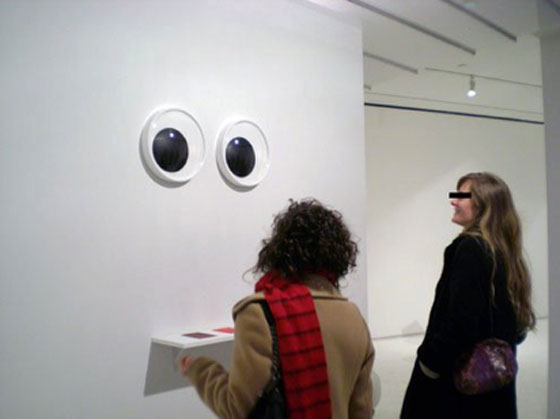
Two recent MFA grads look at some art.
I lean towards “no” on this one, but in an effort to provide a balanced opinion to students, I’m providing both the cons AND the pros. First up, the cons.
In return for slim job prospects, even the most inexpensive MFA will run a student over 35k in this country. And what does the degree qualify graduate students to do once they’ve finished? Here’s a table detailing some of the jobs my class of 2001 art school comrades currently hold.
Job |
Degrees Required |
Salary |
| Art Handler/Artist | None, but it’s hard to get hired without a BFA. | 35,000-60,000 a year |
| Elementary School Art Teacher | BS in education. These jobs are no longer in demand. MFA not required. | 64,500 a year |
| Vice Principal | Master’s or doctoral degree in educational administration or educational leadership. MFA not required. | 71,000 a year |
| Gallery Assistant | BA or BFA, though galleries tend to prefer the former. MFA not required. | 25,000-35,000 a year |
| Visual Arts Professor | I’d estimate roughly 10 percent of my graduating class took this road. There are very few positions available these days. An MFA is required unless you’re a successful artist. Then you can teach anywhere, though tenure may be difficult or impossible to achieve without it. | 50,000 -80,000 a year |
| Full-time Artist | I know about three people who do nothing but work in their studios all day, though many many more have representation. An MFA isn’t necessary to achieve this level of success (hello Cory Arcangel), but it doesn’t hurt either. | 47,000 a year, but this can vary greatly. |
| Librarian | Masters Degree in Library Science. MFA not required. | 84,796 a year |
| Yoga Instructor | An unusually popular profession amongst fine art graduates, though no one I know is still working in the field. MFA not required. | 45,000 a year |
| Art Critic | BFA or BA, though an MA is helpful. Good luck doing this full time. | 30,000-60,000 a year |
| Commercial Photographer | Pounding the pavement for gigs can be hell. MFA not required. | 35,000 |
| Graphic Designer | It’s relatively rare for fine art students to take these jobs. It requires a kind of dedication difficult for most artists who want to be focusing on their studio practice. MFA not required, though an MFA in graphic design is probably useful. | 60,000 a year |
| Full-time Mom | Most female graduates can expect to take off at least a couple of years to raise kids. Those years are unpaid. | Unpaid |
So why should students get their MFAs when the job prospects for graduates even ten years down the line aren’t that great? I’d estimate that about 15-20 percent of my graduating year at Rutgers have paid off their student loans entirely, and I attended a cheap state school. In these conditions even an unpaid internship can seem like a better bang for your buck. Still, there are a few pros to the degree that could set off my giant table of cons above:
- Two years solid, just to dedicate to the studio. This kind of focused effort in combination with regular feedback from professional artists and teachers speeds the maturing of any artist. It can also help students establish a routine in the studio, though most dedicated artists I know didn’t need to go to school for that.
- Hunter isn’t a bad racket if you can get in, as students can go to school part-time and maintain a studio in the city. A three year program providing prime studio space isn’t a bad deal; plus, a lot of critics and gallerists attend their open studios, so it’s possible to make that school pay for itself.
- Scholarships – obviously getting one of these should make the decision about going to school a no-brainer. Free school is almost always worth it.
- Building a network. Grad school’s an expensive way to get this done, of course, but you’ll meet a bunch of people you’ll keep running into forever. Teachers never forget their students, and the friends made during these two years will last a lifetime. Going to school to get some friends, though, is probably a flawed way to look at the value of an MFA.
- Teaching. There aren’t many jobs out there, but if that’s the career path calling your name, that’s a good reason to get an MFA.
Overall, unless students are entering with the goal of teaching in mind, I don’t think the degree is worth it. And that’s new; in 2001, I would have come to exactly the opposite conclusion. Part of that was naivete, and the last few years have probably shaken that out of everyone: in this economy, paying back art school loans will consume the next thirty years of many students’ lives. Given the amount of income this career track promises, it’s hard to believe MFA programs are offering much bang for your buck.


{ 67 comments }
You’ve pretty much covered all the pros and cons, there is no reason to come out of an MFA program with $100+K in debt (hello Columbia, Yale…), there are many fine public schools with great MFA programs (UCLA, UCSD, Hunter, Brooklyn College) and others that cover costs (Hi, Northwestern). The ability to focus for 2+ years on your practice is nearly priceless, but it shouldn’t put you in the hole for the rest of your life. Lastly, if your decision to to go to grad school is tied to earnings potential, well that’s just about the dumbest thing I’ve ever heard.Â
PS. And let’s not kid ourselves, Cory Arcangel is the exception, if not the small minority of young artists with a strong gallery/exhibition record (if that’s why you referred to him earlier) that didn’t got through an MFA program. For every Corey I’ll throw in Wade Guyton, Jules de Balincourt, William Powhida, Omer Fast, Katerina Lanfranco, Kristine Moran, Jessica Mein…  and that’s just from Hunter.
It’s true – I probably should have included that in the post, mostly so I could say that I think that’s a trend that’s will change. I mean really, why do an MFA so you can graduate to a one to two year program of internships?Â
I’d say going to Columbia helped someone like Dana Schutz. It helped people like me — I wouldn’t have moved here from Canada without it — but I don’t think it’s worth the money without providing students with a better way of making a living.Â
I know this is a really old thread, but I hope you’ll see this anyway, but can you elaborate on how Columbia helped Dana Schutz, but might not help everyone who can get in? I personally am concentrating on sculpture first, then painting – so any help I can get to learn how to use materials that I wouldn’t feel comfortable experimenting on my own with is worth the money – but wouldn’t Dana Schutz still be as talented if she just sat in her studio and painted on her own? I’m really trying to figure out the answer to that.
I think it might just be that when you’re in a certain school you are prepped to be seen ….you’re in the area where a lot of art activity is, and if your work hits a sweet spot its possible it can catapult you. I don’t think every student in an MFA program is going to get this treatment. i think it’s more of the very talented and very lucky who just happen to have work that catches the imagination at that time…Lol that’s pretty much how I think most artists made it though. A lot of talent , a lot of luck, and it was the right time for their particular idea.
and we could argue that the top students in these top schools would have been seen anyway (though maybe it would have taken them longer who knows )
I guess in general a MFA does not a famous artist make, but one shouldn’t enter a program with those expectations either…
Nice rundown, and I’d agree on most points. College jobs are few-and-far between, and a lot of private high schools prefer or require art teachers to have an MFA, at least at my current employer. Also, with the emergence of the new Phd in art practice, University-level jobs are going to be even harder to snag in the future…will the MFA become less terminal? That’s probably a whole other conversation thread.
Shit be changin’.
I keep hearing about this allusive Phd program in art practice. Is anyone actually doing that other than Slade? I think there’s a Phd program on the west coast for new media too, but I can’t remember the name.Â
I’d say that the MFA req for private high schools is positive. I was not aware that this is the case.Â
I keep hearing about this allusive Phd program in art practice. Is anyone actually doing that other than Slade? I think there’s a Phd program on the west coast for new media too, but I can’t remember the name.Â
I’d say that the MFA req for private high schools is positive. I was not aware that this is the case.Â
UCSD
http://visarts.ucsd.edu/node/view/530
RPI – http://www.arts.rpi.edu/pl/doctor-philosophy-electronic-arts (a lot of their former MFA students are doing it)
Thank you so much for the chart! Why can’t all of life’s decision’s be laid out in chart form?
More and more I think we are seeing artists, including myself, attending graduate studies but getting an MA in Art History or Curatorial Studies because it somehow seems more likely that it will get us a job that can be our bread and butter while we continue working away in the studio. Over half of the students in my small graduate program at U of T are actually artists that would rather make art for a living than critique or teach others. I’ve too many friends with MFAs that are struggling to feed themselves. The amount of friends with MA, marginally less.
Michael Vickers
ps. You are making us proud in Canada.
add to the pro list: aside from the studio time and critical environment there is also a further level of education and learning, and studying outside the u.s. there are free or low tuition alternatives
Had to start my MFA to realize I currently don’t really prefer professorship as a longterm job goal; learning is an active process. #life lessons
The new trend amongst undergrad art/media departments is to require an MFA from adjuncts. If this continues, an impact will be felt in the community… although not many artists teach full-time, many supplement their income through adjunct positions. This is not necessarily an argument pro getting an MFA, just a related observation.
I am in the last phases of my MFA in Wellington, New Zealand. I was very dubious about doing it at all, and it has been a real struggle. But unquestionably worth it.
Of course, NZ student loans are nowhere near as bad as US student loans. Still a mortgage without a house but.
That’s funny – I often think if I were more concerned with money I would have stuck with art because you can sell more. I’m not made for administrative work of any sort, though I expect there are a lot of sort of thinky positions for art people online there have been in the past. I’m thinking jstor, and this sort of thing.Â
Also, aw thanks. My mother will be especially proud to see this comment.Â
I work at a private art school and have this to offer: Unless you plan to teach at the college level you really don’t need an MFA. It is a degree for the independently wealthy who don’t need to work or worry about paying off loans. If this isn’t you don’t get one.
It’s a degree for people who want to develop their work and get feedback from professionals. I think you have a wrong view on this as there are plenty of scholarships/assistantships available. It’s not about getting a job after it’s about being an artist after-who has a complete solid body of work and understand what they are making is about
A couple years ago, I emailed several artists whose work I
admired and had graduated from various (but strong) MFA programs. I was
thinking of going myself. I asked them: Was it worth it? What did
you get out of it? What did you think of the program? Are you a
full time artist? Only two worked full time on their art. The
others admitted to having difficulty getting into the studio as their day jobs
(only two had art related day jobs, adjunct teaching), which were paying for
the loans, took up most of their time. There were many, “Unless you
want to teach, it’s not really worth it” comments. There were quite
a few “it helped me learn to speak about my work” comments. My
conclusion: The MFA isn’t for me: it costs too much and guarantees nothing
(unlike a Masters in say, IT or engineering). I am doing the
residency/open communication/take every opportunity/apply apply apply
route. The simple fact is the work must be good, if not, no one will care
what degree you may or may not have. If you truly want the experience,
then go for it! Would I go for free? Absolutely. You’ve most likely
already seen this but check out this link
http://www.huffingtonpost.com/jane-chafin/mfa-is-it-necessary-the-d_b_895753.htmlÂ
Good luck to your students! A few other successful non MFAers: Jen Stark,
William Betts, Will Cotton, Eric Yahnker, David Ratcliff, Leonardo Drew, Jean
Shin, Devorah Sperber, Polly Apfelbuam, and Aurora Robson.
Oh hey thanks for that link. I didn’t see it! And yes, applying for residencies is another route to take — and one you’d likely do as an MFA grad anyway.Â
What was worth the cost for you?Â
Across the various NZ schools, tuition fees are around NZD $15000 – $20000 (US $12000 – $16000) for the 2 year program. Under current government policy, student loans are interest free for as long as you live in New Zealand.
Also, speaking from a New Zealand context (and quite possibly elsewhere), the think the general reason many people would do an MFA is about the networks and connections made. In the small art pool, it can be seen as a way to jump the ladder. Many of the most influential art professionals are academics and teach or are involved with the institutions. Careers can be made through MFA programs simply because of visibility.
There is another reason to go for an MA which is that sometimes, for some people, the way practice & theory come together in an MFA program can be a really bad fit. 2 years is not a very long time when you consider that you are supposed to be reading/writing & making in concert, and the two modes are supposed to synthesize in your thesis. You have to write a major paper and do an exhibition. The art isn’t supposed to be just an illustration of the theory and the paper isn’t supposed to be just an explanation of the art, but they are supposed to be interconnected and you have to be able to articulate how. For many people, 2 years just isn’t enough time to internalize concepts and synthesize it all. Top that off with the pressure to emerge as a ready-made art star and
you’ve got a recipe for crazeee (for some people…like me…I wouldn’t
do it).
Going to school is great, though, because you get to learn all kinds of new things that you wouldn’t necessarily come to research on your own. Being challenged intellectually is an amazing experience. If you can get some funding so you don’t lose any $$ then it’s a pretty good contract gig.
This of course depends on the program. Some MFA programs don’t make students write any more than a page on their exhibition. I had to write 20 pages, but it would have been better if I’d had to submit papers on my work more regularly than I did. Rutgers, at the time had a reputation for being intellectually rigorous, but given the number of seminar courses they offered I don’t think that was really the case at least while I was there.Â
yes, thanks Paddy. definitely depends on the program. But even still, there’s a dichotomy that’s sort-of false and fully-weird, even in the term “intellectually rigorous.” As artists, we know that art making can be intellectually rigorous without the need to be validated/authenticated with reading & writing, but in a university, where departments have to defend their existence across disciplines, that understanding kind of goes out the window a lot of the time, or just rides along as a subtext, a kind of nodding&winking in the hallways (“I love your new piece…how are you going to write about it?”). Of course one can read&write lots of theory about non-linguistic modes of knowing… not a bad strategy as long as all the Catch-22s don’t get you down.
most people going for MFA’s shouldnt have gone for a BFAÂ
i know i would rather have the government pay for my schooling so that ill have the studio i want to work in, then paying for the space myself #loopholes #freestudio #occupystudios
#ilikethatsomepeoplehashtaggedtheirpostsÂ
hell yeah if I can get a full ride why the heck not XD; *doubts that is gonna happen*
Without MFAs, there would be no Academic-Curatorial-Military Complex, so I dunno; job killer to tell people not to bother, but it might finally put an end to some really bad and art and art writing if they didn’t.
I think the game changes for new media / digital media artists as a few programs out there allow you to really expand technical knowledge & bridge the gap for traditional studio artists to get out of the gallery-art world and into other creative fields that perhaps pay more or at least offer alternativesÂ
although I agree the traditional MFA is quite strange, I think any education should be pursued to round an individual out and provide new tools & strengths rather than build on things already known
for example if you’re a painter interested in the figure and human forms perhaps it would expand your knowledge and round you out more to enter into a contemporary dance program rather than relying on known methods and continue painting the figure from observationÂ
So the shift in your opinion on the utility of an MFA in the last ten years is only partially from past naivete? What else has caused you to change your mind?
I teach in an MFA program at a private school. By the simple yardstick of “what do I get for each tuition dollar?” then yes — no MFA degree make sense. But in reality, I see students having experiences EVERY DAY that are priceless.
That sounds like a Mastercard commercial. Young people will have experiences every day anywhere that are priceless.Â
Paddy, I think this debate about MFA can be useful and harmful. I have worked in the artworld for 20+ years with a BFA. Returning to a low residency MFA art program made a difference for me, but as I said, I returned to school 20+ years later. Now you may say something snarky in response about this, but this time, money, and investment was worth the debt. I didn’t go just to have it in my satchel to teach, but to develop my work further and to work out the chronic problems I faced with making art, and to understand further how I can use my other chronic state of marginalization to my full advantage.Â
It’s probably different for everyone. For me, my MFA was worth it,
because it brought me to New York. I wouldn’t have gotten here otherwise
because of my state of mind at the time: I wouldn’t have seen a way
were that seemed plausible (much like how now, I can’t imagine moving).
If, at the time, you needed to do an MFA for personal reasons that made
the investment worth the debt, I totally get it. I just think that the
number of people for which that makes sense is probably a lot smaller
than it was say 20 years ago.Â
Some of the best schools in the country have great financial assistance leaving people seeking an MFA little or no debt. Â A little debt is worth it for the feedback and development of your work that is unattainable most often outside of school. Â Professors speeding up your development is key, it’s not about teaching. Â Yes, we can all name a few people who are “famous” without an MFA but look at what percent of gallery represented artists don’t have the degree and tell me it’s not at least riddled with MFA’s…It’s about developing your work not getting a job. Â School provides the means to make great work (hopefully) it’s not their responsibility to push your work and continue to grind it out after you’re done with school.
But you can develop your work just as efficiently by focusing on getting a high paying job you can do part time to support your art practice. The idea that one should have to pay $50,000 dollars on the gamble that history will give a shit seems crazy to me.Â
i wouldn’t discourage anyone from getting an MFA. but think that the discussion of getting a job on the basis of it may be practical, is actually not the point for getting more education. almost always i ask, but how does this person make a living? for example: David Shrigley? no mention of his ‘day job’ -suppose he teaches? or at least did right after getting his degree? classmates of mine from as far back as high school, with MFA teach in colleges. it’s been a good living for them, families, houses, etc. but talk about few and far between! 7 years after receiving my BFA in mid-70’s, I figured working in warehouses in Anchorage, or driving cabs in Phx just was not cutting it at 30 and decided to go back to school for b/m arch -6 years. did finally pay off that school debt, by refinancing my house just before the crash, and that’s gone now too! so no guarantees in anything. Â you will find a way to make a living, and if you keep doing your art, you at least will be doing something with your life that gives it meaning. i like this site, Paddy, good to read intelligent discussion of the arts. too bad she doesn’t write about architecture, the writing in the mags is unreadable, especially by the architects themselves. btw: my best year as a one man shop was about $80k. i hated managing people, a 5 man firm. way way down from that now.Â
MFA’s are not good or bad in and of themselves, but it depends on the criteria which we use to evaluate their worth. A more relevant question is, if you’re thinking of getting an MFA, what do you want? It’s hard to know this sometimes, as if our desires were actually of one mind (we contain multitudes!). I went to MFA school because it allowed me to concentrate on my work for a couple concentrated years. Afterwards I continued to work labor jobs, but then I did end up getting a teaching job.
I agree with some of the posters up there, that an MFA is not really about the job market. If financial stability is what you want, study graphic design or web design. If meeting people and learning stuff and having time to work on issues that matter to you (and possibly only you), are what you want than I recommend an MFA program.
Hey Paddy, I thought I would weigh-in (albeit belatedly) on this question, seeing as it’s quite a perennial favorite amongst my artist friends. I have a BFA only, I’m north of 30 and I’ve maintained an independent studio in Bushwick for over 5 years. I’m in a studio space where folks are doing great work and the critical dialogue of the scene is very satisfyingly engaging. I have pretty much zero interest in getting an MFA.
As you mentioned, survey says the two main reasons for getting an MFA are development and connections. Two years of studio focus with an eye on development is of course all fine and good, but more often than not I’ve heard MFA students say that they’re just doing it for the connections. Any sociable and reasonably intelligent person can network without the forced mingling of an MFA program. Likewise, if you can’t muster the focus to make studio development a priority outside of the privileged time of a master’s program then, in my opinion, you will be helplessly unprepared when you are inevitably cut loose from the MFA Never Never Land (unless you have a wealthy family, in which case do whatever the fuck you want).
During years of working day-jobs and having the possibility of a white collar career be an everpresent and comfortable “out” to maintaining a serious art practice my work has ripened under the sun of the real world in a way not possible under the shade of art school shelter. As an artist and financially self-sufficient adult, art asks that you sacrifice much of what others take for granted at its altar, relaxation, most free time, relationships, disposable income, etc. But for me the mark of a serious artist is someone who maintains a practice for an extended time in the face of these real world difficulties.
Even though there are cheap(er) MFA options, you still have to manage food and rent. For 2 years this can add up. At best, by my calculations you need roughly at least $50K to do an MFA in the City, all expenses. If in the end you get roughly 30 new facebook friends (er, professional contacts) that’s about $1,600 per new contact. You can save a lot of money by just showing up to shit and making good conversation.
Sorry for the tirade, but this is in response to everyone who has ever insinuated that having a BFA and not heading for an MFA is tantamount to not being serious about studio practice.
Anyway, great table of comparisons above!
Â
Are there really so many people who suggest that having only a BFA is a problem? I’ve never once asked an artist whether they have a BFA or an MFA in the studio.Â
Are there really so many people who suggest that having only a BFA is a problem? I’ve never once asked an artist whether they have a BFA or an MFA in the studio.Â
You wouldn’t ask that, it’s not an interesting question and rather tactless - especially in the context of a studio visit. For me though, in casual converstaion with many artists, the topic has come up frequently. Perhaps my comment above made the question seem more contentious than it is, but I’ve encountered a somewhat dismissive attitude many times because of my professional outlook from folks who deceded that an MFA was necessary for their career. While this certainly isn’t a fistfight worthy disagreement, or even a pervasive opinion, I have been rolling my eyes for years encountering MFA elitism in one form or another.
Hi Paddy! Wow, I don’t know how I missed this great post, but I am getting to it right now. Such a great great topic. I am working on a short guide and blog post on the pro’s of an MFA with a focus on studio art ( but not limited to ) I would love to chat with you about it a bit more. ( especially since you are coming to visit us at LIU this fall )
if you want your mind blown go to a good art school. If you want save money go work for citigroup.
Paddy- One category missing is Curator- Income- $0.00
If you can’t get into a program that’s fully funded, making the degree a 2 year residency/fellowship, then don’t go! I actually legitimately feel sorry for suckers who pays zillions for second rate schools with formerly “fancy” names like SAIC. Except they’re often more likely to be narcissistic assholes who think they’re too good for public schools…
What’s wrong with SAIC? Â Just curious.
Send me where to apply. I do want to teach. I have been a studio artist for years. I have BFA in graphic design with a minor in painting. I’m a fine artist at heart so I never used my graphic design degree. I taught public school art a couple of years but I really missed being around other artists. With all this said I was thinking the solution could be teaching higher education. I have two children to support so it would have to be a reasonable idea. What’s your opinion?
Phd in Visual Arts at York University in Toronto, http://futurestudents.yorku.ca/graduate/programs/Visual_Arts/
Overall, higher education seems like more of a Ponzi scheme these says. Compare that salary column with the price of an undergraduate and postgraduate degrees. The hole you dig may trap you forever. When a high school kid asks me about getting into art, I tell them to get a library card. I tell them to take classes at the local art center for a $100 instead of spending $35,000 at the art institute. I tell them to actually go out into the galleries and studios and don’t bother with the classrooms.
Of course, some of us couldn’t afford to get an mfa anyway. I know from experience that it’s a disadvantage when going for art- (and teaching-) related jobs, but that the skillset and artistic process of those with an mfa is not necessarily superior. I also noticed that this wasn’t an issue 5 years back. It’s only now, when the younger generation is amassing so much debt from their undergraduate degrees that the mfa is suddenly not so necessary.
I received my MFA from a local public University in 1994. I have been teaching as a part time lecturer/adjunct for 18 years. When I went back to school for an MFA I had been a working artist since receiving a BA in 1978. I continued to work on commissions and some construction work during my MFA. Some how I managed to accrue minimal debt. The trade off was four years in school as opposed to 2. Read Dave Hickey if you want to get another slant on earning an MFA.
Yes adjuncts today will not make the paper screening without an MFA, and if you are looking for the rare tenure track job, it is a must. The trend in America’s higher education is a teaching force of 75% part time adjuncts. That’s right. We are paid about 40% of a tenured professors salary, even after 18 years of service,
BUT, ironically, teaching is not why I went back to school for an MFA. I was ready after ten years of working in the studio to “up” my game. It was fortunate that a very well recognized artist in my field had just accepted a tenure track position at my local University. It seemed like a no brainer to go back and get that MFA.
I came intos the program ten years older than most of the students, and found my cohort to be extremely naive and sheltered about no only he world of Art, but life in general. I was quickly disillusioned about the dialog and quality of feedback from my peers in my particular area of emphasis.
Fortunatley the professor was quite well connected and she brought in a tremendous variety of visiting artists for workshops and lectures. I am still friends with some of them today. We also made a trip to NYC and got into the backdoor of some high end galleries and talked to prominent curators in the field. That ended up leading to my first exhibition in NYC.
Bottom line, those connections and the network created during that time have been invaluable. The education……eh. I think I came out of the program less focused, than when I came in. I have told many people it took me two years to shake off grad school and really get back to my work.
Hi, just to counter your experience a bit; I am an adult, who after working in the commercial art industry (animation-special effects in Hollywood) for many years without a degree, decided to go back and get a BFA. My husband and I moved away from LA and I found myself pretty much unemployable outside of Hollywood. Anyway, I got accepted into Bard’s returning to college program. I am probably the only older adult that has moderated in studio arts. I can honestly say that the experience has been invaluable. It has helped me play on my strengths and strengthen my weaknesses. The professors are great, however, I value the input I get from my fellow students. What many lack in real world experience (which I have tons of after working ing the NYC club and art scene of the 80s and in Hollywood in the 90s) they offer a fresh perspective, which I think keeps my work fresh. It is because of that, I feel I would benefit from an MFA program.
That is the problem….. Too many now have an MFA and does not make them a stellar artist!!! Most do it to teach in Higher Education. The problem is; is that most who teach the arts have had very little exposure or experience with the professional art world that we are then teaching mediocre approaches and understanding of innovative and quality art to the future generation.
Glad you linked back to this. Art Critic : “30,000-60,000 a year”. I’m in that range — above the min anyway… and I did it with a BA (though I don’t think those who employ me care either way), no art world contacts at the time and having never been published in an art magazine (though I have been published since). If it were not for the Internet and blogging I would have never been able to achieve what I’ve accomplished.
Those who go to school dreaming of a job in art writing often think of the big magazines… they should start thinking about well funded art sites. There is money to be made if you have something to say. True, I may never be respected by critics working in traditional print… but what does it matter as long as I can provide for myself doing something I love.
And for the comments about artist MFA holders having a boost within the mainstream art world… out of the 500+ artists I’ve interviewed since 2006 I’d say about 300 of them have shown in Chelsea or at one of the big international art fairs — in other words, they have had ‘notable’ gallery representation at one point or the other. Of that… I’d say only about 50% had an MFA. Having an MFA does not necessarily mean that you can jump hurdles. True, that is just the group I’ve interviewed… but it is a wide range of artists.
I’ll add that the Internet is changing everything. It has changed art writing and criticism — I’m proof of that… Paddy is proof of that… we would have likely not had a chance prior to the Internet. If not for the Internet I would have been working at a rural factory — I would have been the guy with the ‘unhealthy’ addiction to art. LOL The influence one can establish online has been a game-changer.
The same goes for artists… I know that some art dealers will give an artist a second look if he or she is aware of the following the artist has online. Galleries are really starting to look at numbers… and how ‘word of mouth’ online can be just as beneficial — if not more so — than ‘word of mouth’ in the traditional sense.
I have a BFA and teach art at a high school. My only motivation to get an MFA was to move over on the pay scale. I quickly found out an MFA was a money pit and that simply getting a MA in Education (much much cheaper and quicker) would move me over in pay and reflect better on my career in the district and I would be entitled for some reimbursement. I wanted to be an art snob five years ago. But when I look at all the contemporary art I like and respect…it has nothing to do with and MFA degree. In fact when I did take a few MFA courses, I found that instructor ego was a big obstacle. No respect on their part…basically they all thought their sh+t don’t stink.Â
I agree….I had the same kind of instructors. They were very snobby and played favorites. On top of that they were only nice to the rich kids. So rather than spend an extra 2 years with these people, I decided to pursue an MA instead at a cheaper school where the people are kind, humble and down to earth. Every day I pray that when I do become an instructor at a university, I never end up like the instructors I had before.
I’m still undecided even after applying, being accepted and reading this but thanks for posting.
Just letting everyone know I’m working on my BA right now and I want an MFA to teach a college level art course…… I’ve shown in a few small galleries and have just started figuring out what mediums i like best…. I’m 22. I just got grilled about wanting to be an artist. But reading everything on here makes me feel better. It may not be ranked highest in demand or not even a career that earns the most money, but its the one that would make me happy even if I end up struggling to find a job. I think it would be worse to go to school and take a job in the math or science field like I’ve been told to do,only to realize that I’m not even happy with what I’m doing.
I’m entering a program for MA English and Creative Writing and there is a professor job on the table. How can I tell the school to hire me anyway? I have published two books and some articles and taught k-12 for seven years.
No. Let me repeat. No it’s not worth it. Don’t do it. Graphic designers and 60k? On what planet? Quit design, pick a job that hasn’t dissolved into nothing, like design.
I want to teach, and there is Loan Forgiveness for teachers. So I’m balancing the risk of more loans, and the forgiveness down the line. Would the MFA be better to teach or a MS in Teaching or Education?
Genuinely curious: If I’m considering the residency, grant, public work track, wouldn’t an MFA beef up my credentials to stand out from the competition? Especially if it has a concentration in social practice and environment studies? Also, wouldn’t an MFA look good when pitching projects for crowd source funding?
Comments on this entry are closed.