
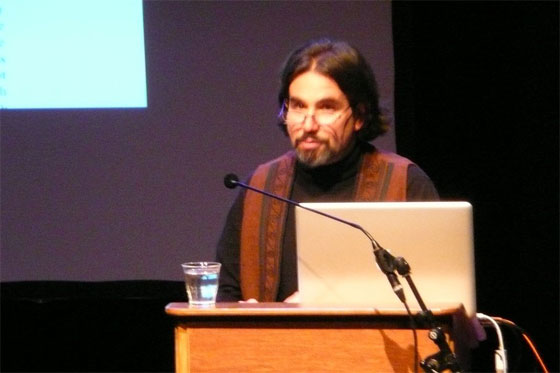
Edward Shanken lectures
Edward A. Shanken, the award-winning author of Art and Electronic Media, had a few things to say in the comments section of last week’s post asking whether new media has been accepted in the art world. Since the comment itself is autonomous and substantive enough to warrant its own post, I’m republishing it here in the main section of the blog. It’s worth reading. Twice.
As historian of photography John Tagg (1993) has noted of the reception of an earlier “new media,” the more experimental aspects of photography were not well-assimilated and the impact of the discourses of photography and contemporary art on each other was highly asymmetrical: the latter changed very little, while the former lost its edge in the process of fitting in. Ji-hoon Kim (2009) has further observed that despite the extraordinary assimilation of video by MCA, much experimental film and video, particularly the sort of material championed by Gene Youngblood in Expanded Cinema (1970), and its progeny, has been excluded from mainstream museum shows, while being celebrated in exhibitions held in new media contexts. Inevitably, new media and the longer history of electronic art will be recognized by MCA as well, once a potential market for it is developed and promoted. Proactively theorizing the issues and stakes involved may play an important role in informing the ways in which that merger unfolds. Needless to say, many in the NMA community are wary of losing this critical edge in the process of assimilation”¦
At a panel I convened at Art Basel in June 2010 with Bourriaud, Peter Weibel, and Michael Joaquin Grey, the gap between NMA and MCA became increasingly clear. One obvious indication of this gap was demonstrated by the simple fact that Weibel, arguably the most powerful individual in the NMA world, and Bourriaud, arguably the most influential MCA curator and theorist, had never met before. Citing the example of photography and Impressionism, Bourriaud argued that the influences of technological media on art are most insightfully and effectively presented indirectly, eg. in non-technological works. As he wrote in Relational Aesthetics, “The most fruitful thinking ”¦ [explored] ”¦ the possibilities offered by new tools, but without representing them as techniques. Degas and Monet thus produced a photographic way of thinking that went well beyond the shots of their contemporaries.” (p. 67). On this basis, he states that, “the main effects of the computer revolution are visible today among artists who do not use computers” (p. 67). On one hand, I agree that the metaphorical implications of technologies have important effects on perception, consciousness, and the construction of knowledge. But on the other hand, this position exemplifies the historical, ongoing resistance of mainstream contemporary art to recognize and accept emerging media.
Peter Weibel astutely picked up on Bourriaud's distinction between direct/indirect influences and pointed out the hypocrisy of valuing the indirect influence of technology while ignoring the direct use of technology as an artistic medium in its own right. Weibel accurately and provocatively labels this “media injustice.” Indeed, the implicit/explicit dichotomy that Bourriaud constructs serves only as a rhetorical device to elevate the former member of the pair — the lofty, theoretical ideal – at the expense of the latter — the quotidian, practical tool. That epistemological logic of binary oppositions must be challenged and its artifice and ideological aims deconstructed, in order to recognize the inseparability of artists, artworks, tools, techniques, concepts and concretions as actors in a network of signification.
If indeed there is a growing number of exhibitions that include work by artists who employ new media tools in one way or another, very little has changed. There remains a more or less autonomous new media artworld (what I call NMA) that has its own institutions, galleries critics and historians, journals and university departments. The NMA is rarely invited to the mainstream contemporary artworld (MCA) and when it is, it is generally those works that already obey its rules that get tapped.
MCA does not need new media art NMA; or at least it does not need NMA in order to justify its authority. Indeed, the domination of MCA is so absolute that the term “artworld” is synonomous with it. Despite the distinguished outcomes generated by the entwinement of art, science, and technology for hundreds of years, MCA collectors, curators, and institutions have difficulty in recognizing NMA as a valid, much less valuable, contribution to the history of art. As Magdalena Sawon, co-founder/co-director of Postmaster Gallery notes, NMA does not meet familiar expectations of what art should look like, feel like, and consist of based on “hundreds of years of painting and sculpture.” It is deemed uncollectible because, as Amy Cappellazzo, a contemporary art expert at Christie's observes, “collectors get confused and concerned about things that plug in.” (quoted in Sarah Thornton, Six Days in the Artworld)
Citing Inke Arnes, Domenico Quaranta asks, How can we “underline New Media Art's 'specific form of contemporaneity'” in a way that does not “violate th[e] taboos” of MCA? I'm compelled to take issue with the tone of this query. Violating taboos has played an important role in the history of art. One of the key contributions NMA can make to art in general is in drawing attention to and contesting the status quo. This has a lot to do not just with the explicit use of technological media but with challenging the museum and gallery — or any specific locale — as the privileged site of exhibition and reception. If NMA lies down and accepts assimilation on the terms of MCA, then much of its critical value will have been usurped. But this strident resistance, which is NMA’s strength, is also what makes it reprehensible (if not uncollectible) by MCA.
The operational logic of the MCA — its job, so to speak — demands that it continually absorb and be energized by artistic innovation, while maintaining and expanding its own firmly entrenched structures of power in museums, fairs and biennials, art stars, collectors, galleries, auction houses, journals, canonical literature, and university departments. This is by no means a simple balancing act and each of these actors has a vested interest in minimizing volatility and reinforcing the status quo, while maximizing their own rewards in a highly competitive environment. Their power lies in their authoritative command of the history and current practices of MCA and in promoting consensus and confidence in the market that animates it. As such, their power, authority, financial investment, and influence are imperiled by perceived interlopers, such as NMA, which lie outside their expertise and which, in form and content, challenge many of MCA's foundations, including the structure of its commercial market. Witness, for example, the distress of the “big four” labels of the music recording industry over the incursion of new media into established channels of distribution. From this perspective, there are substantial reasons for the old guard to prevent the storming of the gates, or at least to bar the gates for as long as possible. Typical strategies include ignoring interlopers altogether or dismissing them on superficial grounds.
We live in a global digital culture in which the materials and techniques of new media are widely available and accessible to a growing proportion of the population. Millions and millions of people around the world participate in social media, and have the ability to produce and share with millions and millions of other people their own texts, images, sound recordings, videos, GPS traces. In many ways early NMA works that enabled remote collaboration and interaction, such as Ascott's La Plissure du Texte (1983), can be seen as modeling social values and practices that have emerged in tandem with the advent of Web 2.0 and participatory culture. Now a YouTube video, like Daft Hands, can delight and amaze 50 million viewers, spawning its own subculture of celebrities, masterpieces, and remixers. In this context what are the roles of the artist, the curator, the theorist, and critic? As Brad Troemel provocatively asked in an Artfag City essay, What can relational aesthetics learn from 4Chan? What do professional artists, theorists and curators associated with NMA or MCA have to offer that is special, that adds value and insight to this dynamic, collective, creative culture? Why care anymore about MCA or NMA, per se? What is at stake preserving these distinctions and in distinguishing such artistic practices from broader forms of popular cultural production and reception? Do such distinctions merely serve to protect MCA and NMA from interlopers by preserving a mythical status to their exclusive, lucrative and/or prestigious practices?
Ed Shanken, 5 Sep 2011
I have elaborated these arguments further in my essay, “Contemporary Art and New Media: Toward a Hybrid Discourse?”


{ 8 comments }
Thanks for this lucid argument. This is hinted at already, but I’d like to argue that just as MCA (to use the author’s abbreviations) is invested in protecting status quo, so are the institutions, curators, and artists involved in NMA. As an artist and instructor engaged with topics and practices around electronic media (and someone who could be said to be active in both contexts), I have gotten the distinct impression that NMA as a context is simply not interested in work that doesn’t fit the dominant aesthetics or areas of inquiry. Ultimately, I think a convergence of the two worlds is necessary, in order to support and facilitate the amazing work being done by young artists who have no need for such distinctions. MCA galleries and curators need to buy computers and figure out how to show and discuss projections and other electronic works. NMA curators and festivals need to step outside the box and support interdisciplinary work that is messy, personal, and doesn’t fit into a project proposal/budget box. There is nothing particularly special about artists+computers at this stage of the game.
There is a whole generation of artists who are dabbling in all areas, and until the MCA and NMA circles can find a way to incorporate these diverse practices into their narrative, the most challenging and progressive work will continue to find its outlets in esoteric corners of the internet, warehouses, parties, social media sites, and pop-up spaces.Â
Your strategy will inform your content, as well as how it’s written and where it’s placed. Remember when you enter the social media sphere you need to keep feeding interesting writing in a non-sales format to your audience. For example, consider writing a blog on the art of crocheting the perfect tea cozy like the one granny used to make. Don’t write a sales pitch on the merits of Acme Tea Cozies Inc. and pound away at the company brand. If only sales messages are delivered you will annoy and, in the worst case, repel your potential reader/customer. Like telemarketing or e-mail blasts, it will make your customer hate your brand. And, worst of all, you won’t develop the golden following who will pass on your content and drive traffic to your web site, blogs etc.
Though ze is a bot, Media Companies makes a strong point by treating New Media Art (NMA) as a brand. In order for Mainstream Contemporary Art (MCA) to get NMA, NMA needs to reconsider the pros and cons of its brand, i.e. the label “new media art.” I would have to agree in that I think that the term NMA is detrimental to itself – it separates itself as a different form that requires a different approach – and thus distribution model etc. New media can only be New so long, after that it’s just media.
Aw, now my comment makes no sense. There was a bot giving blog branding tips on here that almost made sense in context.
And on the Seventh day in the Art World God created New Media.
… in her own image.
Andrew’s point is well-taken. In fact, artist Jane Prophet pointed out in her talk at the 2011 annual conference of the College Art Association, that after her NMA success (eg the web-based A-Life environment TechnoSphere, 1995), she found herself (and her work) limited to a very narrow range of presentational strategies by NMA curators, who expected “traditional” new media works from her. Podcasts of Prophet’s talk (and those of the other panelists) can be found here: http://www.hybridge.wordpress.com Refined texts of these talks are forthcoming in the online bilingual (English/Spanish) journal Artnodes later this year.
As Andrew suggests, certainly more could be done (both by artists and curators) to present NMA more effectively in traditional museum and gallery contexts. But I also believe that one of NMA’s most important critical prongs (shared by other experimental modes of art production) strategically interrogates the high alters of art exhibition and consumption. To capitulate to the dominance of such conventional contexts runs the risk of throttling vital aspects of NMA that could invigorate contemporary art in general.
Or asking a variant of the same question every 10 years after a batch of “new[er]” technologies and subsequent art made with them emerges.
Because in most institutions this hasn’t been framed in any other way than about technology, its (often positive) social affects or its inherent properties.Â
I suppose the postinternet crew (that is, those who believe/identify with the term and the condition) would aspire to nonchalantly incorporate more tech-inspired works into contemporary shows.
Comments on this entry are closed.
{ 1 trackback }