
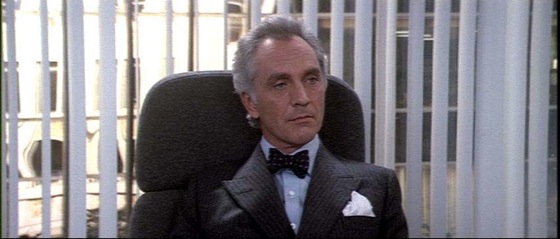
Sinister gallerist Victor Taft in the movie "Legal Eagles," a comedy based on the Rothko Case
“…[A]pparently it's more important to like your father's memory than to like your father,” writes David Levine for Triple Canopy. In case you missed it, Levine gives an elegantly woven account of the avalanche that consumed his father following Mark Rothko's death. Partly in a malicious move against his own children, the AbEx ego left practically everything to the Mark Rothko Foundation. Levine's father Morton Levine, an anthropology professor, fellow painter Theodoros Stamos, and Rothko’s accountant Bernard Reis were named executors of the will. Levine describes the scandal that ensued when the executors sold the paintings to Marlborough for an extremely low price, which the gallery quickly sold at low prices but high profits. The inevitable suit from the children led to the utter chewing-up-and-spitting-out of Rothko's friends by the press, the art world, and investigators. Notably, his father's name appears nowhere in collective memory, history, or his article.
The facts of the case are still unclear, as evidenced by general inconsistencies and bias in most accounts. However, in comparison to David Levine's account of his father's legal punishment, most stories indicate that the Marlborough Gallery received only a gentle slap on the wrist while making massive profits. According to Roberta Smith's 1998 obituary of Marlborough Gallery owner Frank Lloyd, the executors and gallery were fined a total of $9.2 million; Levine states that his father ended up with $6 million in liability. The executors sold or consigned all 798 Rothko paintings (which could then sell for between $50,000 and $180,000) to the Marlborough Gallery at a drastic discount: 100 paintings sold at an average of $12,000, which was likely, in part, the result of Stamos and Levine's father's ignorance. Levine writes that, by the time the suit was filed, the gallery had sold thirty-six paintings, for a total profit of $2,474,250.
The children did win back half of their father's 2,000 paintings, but two years after the ruling, Lloyd was indicted for altering gallery records, to appear that he had sold paintings that he still owned. Lloyd remained a fugitive at his vacation house in the Bahamas for several years, putting gallery business in the hands of his son, until he emerged for trial in Manhattan in 1983. Instead of serving four years in jail, he was sentenced to set up a scholarship fund and give art lectures to high school students.
However light the sentence, Frank Lloyd and Marlborough paid severely in reputation. Fellow art dealers ostracized Lloyd; Richard Feigen, a longtime critic of the gallery, commented, “The whole case is bad for the art business and for the reputation of art dealers in general. Marlborough has besmirched us.” Once the facts of the case became unavoidable, the gallery was expelled from the highly prestigious ADAA (The Art Dealers Association of America), despite close professional ties to then-director Ralph Colin.
Decades later, the legacy continues to haunt Marlborough. Months after Lloyd's 1998 death, Judith H. Dobrzynski wrote a piece for the Times, titled: “A Betrayal the Art World Can't Forget; The Battle for Rothko’s Estate Altered Lives and Reputations.” In it, she asserted that, not only did Marlborough lose its pre-eminence in contemporary art, and that Frank Lloyd “never recouped his reputation,” but “even the public lost some innocence.”
In fact, the only person who did benefit, aside from Rothko's children, was Rothko himself. Dobrzynski and Levine both point out that the case only further cemented his place in history. William Powhida's recent performance at Marlborough, titled POWHIDA, seemed to poke fun at this history. When I visited the gallery the day after his opening, an actor portraying POWHIDA (whose name was painted in huge caps in the gallery entrance), was still in character, lounging with groupies on VIP-style leather chairs, in front of a larger-than-life self portrait, pounding beers. The actor, who wore Powhida’s signature Aviators, continually reiterated that he fired his ghostpainter, due to a clash of egos. At one point, he exclaimed with dismay at a miniscule stain on his button-down: “What is that? Better not be paint!” It was most important, however, that we all understood just how much money this person's indulgence was wasting; he kept asking the intern how much that morning's cab back from “bumfuck” cost the gallery, and assuring me that beers were on Marlborough. All I could think when leaving was that the show made a good story, but up close, a not-very-interesting experience. It was calculated, with one-liners and anecdotes tailored for the press. In theory, it was good move for the Marlborough Gallery to appear self-aware enough to get the joke, but I got the sense that most people weren't laughing.
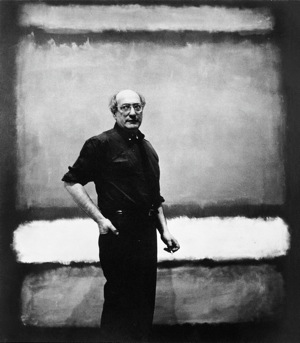
Portrait of Rothko

POWHIDA's July performance at the Marlborough Gallery


{ 9 comments }
Hi, Paddy. I hope that you’re flourishing.
2 questions about this piece:
1. I read somewhere that the Powhida at Marlborough wasn’t actually William Powhida, but an actor portraying the artist. Do you know if that’s true?
2. I read the Triple Canopy piece by Levine and found it distressing, if excellent. But I wonder how much of a fine Marlborough got hit with; do you know? If Morton Levine had $6 million in liability, $3.2 million was shared by the gallery and other 2 executors. Given that the gallery’s profits from the sale of the Rothko’s were around $2.5 million, it is possible that the fine saw them breaking even (or almost, if they received the lion’s share of the $3.2 million in liability). Thoughts?
Hey Chris,
In answer to your questions:
1. Yes, he’s actually an actor portraying the artist. That was actually in Whitney’s final draft of the piece, but it looks like wordpress ate it so we’ve put it back in. Thanks for adding that.Â
2. This is an interesting question, though not one I have an answer to off hand. Maybe Whitney knows a little better?Â
Thanks, Paddy. And my bad for not reading the byline! 😉
Ironically, about the same time the Chelsea Art Tower opened,
in which Marlborough Gallery is a co-developer and current tenant, a Rothko
painting was hammered down at over 60 million dollars, making it roughly equal in
value to the Tower. While David Levine’s tragic tale of his father’s involvement
in the Rothko case is poignant and heart breaking, it bares considering that
without the suicide, legal case, media mania blowback and its attendant
mythology, the current valuation of the paintings would not exist. While Marlborough may never live down it
reputation for trying to screw Rothko (recent dealings with other artists haven’t
helped), during the POWHIDA performance, a gallon bucket of gray enamel paint
was kicked over and traipsed  around the pristine
gallery, leaving a sticky, spontaneous reminder that we painters haven’t forgotten.Â
so you think rothko’s prices are a result of hype?
Can’t hurt.
but is not as relevant a reason as u suggest. your choice of words was harsh, unless you just don’t like rohtko’s art.Â
The “actor” actually asked the sales director about the cost of the cab, which is much funnier.
Type your comment here.  hype is hype. that is to say, it’s bullshit. rothko’s prices are the result of speculation.  it’s no secret his work is a favorite among the banking and real estate classes that have assiduously inflated the value of their holdings since at least 1993, following the first big dive of the post-cold war era.  if anything, the artwork-as-commodity, seen on one hand as antagonistic to the modernist discourse that it helped usurp, and on the other as a withering parody of the vagaries of subjective judgment, pictures a prescient move towards corporate synergy where artworks are assigned variable worth similar to the way in which a fiat currency decoupled from fixed standards functions in a statist economy, or more to the point, how speculative interest inflates the perceived value of any commodity at a given time. By the end of the ’70s, the substantive line that tethered the concrete image to the fact of its making was severed from within artistic practice itself, and reinscribed upon a free-floating symbolic plane subject to manipulation from without. This was a collusive activity, and is as accurate a description as any to how works of whatever medium are regarded in the contemporary art world, a fellowship that has its roots in the transnational neoliberalism of the late ’70s. This is the true legacy of postmodernism, especially as it’s understood in its relation to the present technocratic state. The sovereignty of the networked institution as governing body, following the personalized and independent autonomy of practice and thought emblematic of the postwar era, is apparent everywhere today. So are the obvious faults appearing in the authority which constitutes a foundational claim on which the entity rests, one that disregards hypothetical imperatives in pursuit of the infinite expansion of its leveraged prerogative.  what powhida’s performance at marlborough most accurately demonstrates is the absurdity of the wile e. coyote moment, the one just before the bottom inevitably drops out.
Comments on this entry are closed.