
Date: WEDNESDAY, MAY 18TH 2011 – SATURDAY, JUNE 25TH 2011
Venue: Lombard-Freid Projects, 518 West 19th Street
AFC’s Rating: 6/10 (Will Brand)
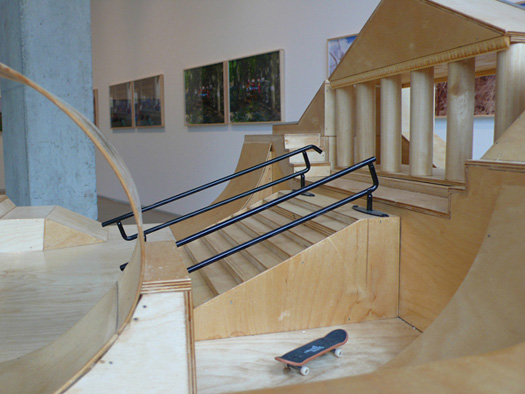
Entering Lombard-Freid Projects, I saw something that gave a generational thrill: an exquisitely equipped eight-by-four-foot fingerboard skatepark. Eight boards, arranged in a neat line, called out. Being a good journalist, I made my way to the desk to ask a hard-hitting question: “Can I play?” “Of course you can!” I was told, and so I got to work, trying to remember how to ollie on the centerpiece of Cao Fei’s exhibition Play Time. Sandwiched between its quarter-pipes and rails were loose models of the Minaret of Samarra and a Greek hexastyle portico, tiny odes to ancient architecture doubling as sweet ramps. Their authority and history naturally fades away as you grind on them with a toy skateboard, which is exactly what Cao’s after. This is an exhibition that’s not content to use play as a subject; here, it’s a medium, and critical to the operation of the works on view.
Surrounding the skatepark, the walls of the front gallery are mostly occupied by six sets of paired photographs depicting characters from CBeebies—the BBC’s channel aimed at preschool children—outside the plush pastel forests of their television home. Here, they’re on the move, and possibly on the run: one work titled Escaped From The Garden shows them luggage-in-hand, while in others they sleep beneath overpasses, peek out of tents, and wash themselves in muddy pools. In one, Papa’s Funeral, they bury their dead, before returning to “The Garden” once more. It’s a narrative about play—its ghettoization and its slim chance for survival in the adult world—delivered in the form of play: each pair of photographs is actually a spot-the-difference game. Disappointingly, though, the differences themselves don’t tell us much. They’re incidental details, not elements of any narrative or symbolic value, so my effort and engagement were wasted on noticing that a towel had changed color, or that a hand was moved slightly. Cao has introduced into art an ingenious tool for directing the viewer’s attention, but leaves its potential largely unused.
East Wind, a video centered on a truck to which the artist attached a Thomas the Tank Engine façade, has similar issues. The familiar playful face at the front of the truck is repudiated by the matter-of-factness with which the truck goes about its business—transporting rubble from a construction site to a dump—but beyond that, there’s not much happening here. The series of reactions I saw in passerby in the video—interest, then laughter, then disappointment—ultimately mirrored my own.
A set of three videos, Shadow Life, complete the exhibition. Made up entirely of elaborate shadow puppets, the videos tell simple narratives of urbanization and the Cultural Revolution. They’re engaging and beautiful, but it never becomes clear why shadow puppets were chosen; yes, they’re fun, and let Cao tell moral stories in an unpretentious way, but she fails to show here what novel ideas we might arrive at with our new vocabulary of play. As with the rest of the show, we’re presented with a finely-crafted tool, just waiting for a purpose.


{ 5 comments }
the written review sounded more like 4 out of 10, which is what i wouldve given it. The skate park piece didnt work either, so what did u give her extra points on-effort?
the written review sounded more like 4 out of 10, which is what i wouldve given it. The skate park piece didnt work either, so what did u give her extra points on-effort?
I get what you’re saying, and I don’t think a 4 would be out of line. Still, I erred in Cao’s favor, because I really was sucked in by the work – as a sort of tech demo of play as a way of interacting with art, it did well.Â
I think the skatepark piece was the best work in the show. I’ve can’t tell you how many times I’ve heard some academic or artist drone on about reimagining the city, layering alternative possibilities on top of it, escaping this or that bad thing about our current understanding of buildings, etc. At worst, they’re complete nonsense, and at best, their alternatives rely on a hypothetical system of interactions with technologies and spaces without giving us any route to achieving that system. Cao Fei proposes going about that more naturally, with a system we’ve all used as kids – “Okay, now that portico is base.” It’s not the figure of classical achievement weighing over us, it’s base. I like that. It’s a nice fit.
It does piss me off that the portico doesn’t have a pediment, though. Maybe I’m just a dork.
Would have been cooler if she designed a level for a Tony Hawk game instead. Â The skatepark is a great idea, but one of the most important parts of play is the ability to temporarily accept the rules of play as a reality separate from reality, and as a toy miniature for adults in a gallery setting it seems difficult to take that mental leap. Â RMB City worked perfectly because the framework of Second Life allowed the mind to accept those hypotheticals. Â I think the skatepark metaphor is strong, though, but the piece doesn’t set itself up in a way that the viewer actually feels him/herself calling that portico base. Â Imagine it made into a real skate park though!! Â With kids actually being able to call that portico base! Â I mean she’s already proven that actualizing these hypotheticals can be both beautiful and effective with her cosplay reenactments.
Comments on this entry are closed.