
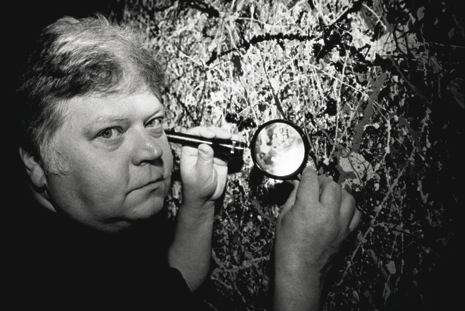
Peter Paul Biro investigates
The New Yorker’s Mark of a Masterpiece tells me its time to re-evaluate a couple opinions I expressed about that so-called Jackson Pollock I wrote about back in 2006. Thanks to a documentary called Who the #$&% is Jackson Pollock?, I wasted a fair bit of ink on why I thought the International Foundation for Art Research should take another look at a garish painting that didn’t look much like a Pollock. Forensic scientist Peter Paul Biro had produced fingerprinting identification and matched paint samples though, and that evidence seemed rather compelling. So I pushed aside a few pesky details, namely that it followed the basic rule of forgery: The less plausible the fake, the more involved the narrative and documentation becomes. This one reached absurd levels, with truck driver Teri Horton’s big thrift store find and Peter Paul Biro’s research even spinning its own documentary.
Now however, David Grann sheds considerable light on some of the forensic scientist’s more questionable authentication techniques. From the article:
[Theresa] Franks [of Global Fine Art Registry, a company crusading against fraud] became particularly interested in Biro's methods after Frankie Brown, an artist in California, told her that he had seen a photograph of the Teri Horton painting, in People, and wondered if it might be his own work. Franks hired as an expert Tom Hanley, the chief of police in Middlebury, Vermont, who had more than two decades of experience as a fingerprint examiner. Hanley told me that he approached Biro, who had previously stated about Horton's painting, “My work is (and has been) available for evaluation to qualified experts.” Yet Biro declined to share his evidence, saying that Horton had objected to the idea.
Hanley was thus forced to rely on bits of information that Biro had posted on his Web site, several years earlier. The online report contains a photograph of the partial fingerprint that Biro said he had found on the back of Horton's painting. In Hanley's judgment, the impression lacked the kind of detail—the clear ridges and furrows—that is necessary to make a proper comparison.
After Hanley revealed his findings to Franks, she raised questions on her Web site about the reliability of Biro's fingerprint methodology. Biro then inserted a clarification to his online report. It said:
For security reasons, several images in this report are watermarked in a way that is not apparent to the observer. The fingerprint images have also been reduced in resolution so as to render them unusable except for illustration.
I advise against evaluating the fingerprint images illustrated in this report as if they were the actual source material. Any attempt to do so is pointless.
Biro told me that such secrecy protected the privacy of his clients and prevented anyone from misusing the fingerprint. To Hanley, this was baffling: what forensic scientist avoids peer review and even admits to doctoring evidence in order to prevent others from evaluating it? “If what he found are truly fingerprints, why isn't he sharing?” Franks asked me. In any case, Hanley, unable to examine Biro's evidence firsthand, had reached a dead end.
Then Ken Parker [a man Biro also produced a controversial Pollock authentication for] told Hanley and Franks about his drama with Biro. Parker said that Hanley was welcome to examine his painting. For the first time, Hanley was able directly to observe Biro's fingerprint evidence. He noted several fingerprints on the back of the picture, including two on the wooden stretcher frame, which were black, as if they had been made with ink. Looking through a magnifying glass, Hanley focussed on the most legible fingerprint, which appeared to be covered with a clear finishing coat, like a varnish. Parker said that before giving the painting to Biro he hadn't noticed a fingerprint on it. “I don't know where it came from,” he said. He said that Biro had told him he had used some sort of “resin process” to make it more visible. Hanley had never seen a print developed in this fashion. Based on the clarity of the impression, Hanley thought that the fingerprint had to be relatively new—certainly not from half a century ago, when Pollock was alive.
Those are pretty damning words. I spoke with Peter Paul Biro on more than one occasion during the promotion of the movie, and while he didn’t offer a lot of insight on the movie itself he did go to great lengths to explain that his reputation was his livelihood. “This is not a risk I would take if I were not certain,” he told me. Foolishly, I believed him.


{ 12 comments }
 Actually, Hanley brought in Pat Wertiem an internationally recognized expert in fingerprint forgery and fabrication.
What an absurd article. Classic example of the blind leading the blind. You watch the Teri Horton movie, form an opinion, then read Grann’s article, and you form another knee jerk opinion as if the New Yorker is the Holy Grail? I hope not because, as you may know, the rag-mag is being sued for $2-Million in Federal District Court in NYC for Grann’s slipshod journalism-ala-fiction style. What opinion do you have now Paddy? Another article perhaps brewing?
Paddy, I have always liked your take on my story…you have always been fair….paying no attention to the BS. I am really disappointed that you have let the “Grann” article sway your good judgement….shame on you.. The truth be known, Grann gleaned the majority if his malicious allegations from Thresea Franks CEO if Fine Art Registry. He stepped right into her lair. At one time she had a partner named “John Golfis” who has a very shady past, which Franks was aware of [they no longer are partners] Golfis posted the following on Techdirt right after Grann’s article came out.
False StoryJ. Golfis, Jul 30th, 2010 @ 2:28pm
According to reports, David Grann jumped on this story as a result of Theresa Franks, an art dealer and CEO of Fine Art Registry, who had a supposed Pollock painting, sent it to Biro only to find that no prints, as she hoped, were on the painting. She paid Biro thousands of dollars for his professional services via a third party named Anthony Cooke. When the painting came back to Theresa Franks as inconclusive, she chose to go on a tirade against Biro on a ruthless and carefully calculated smear campaign. Mr. Biro was also physically threatened according to Canadian police reports.
Theresa Franks hired a fingerprint examiner named Pat Wertheim who has made a career out of challenging law enforcement’s latent fingerprint examinations. In 2006, Pat Wertheim accused Danny Greathouse, the former Section Chief in the Latent Fingerprint Section of the FBI of falsifying evidence. These accusations were later found false and Mr. Greathouse is now with the Division of Homeland Security.
In 2007, Pat Wertheim was PAID by Ms. Franks to fabricate a fingerprint by use of a rubber stamp. Then, he claimed Biro may have put it there. However, Pat Wertheim later admitted that he in fact forged the fingerprint but said it was for research purposes. Biro was never charged with anything.
According to at least one law enforcement official and several art experts, Theresa Franks, CEO of Fine Art Registry currently has fake Pollocks for sale on her site. http://www.fineartregistry.com/search_results.php?keywords=&submit=submit&artist2=Jackson Pollock
Of course, David Grann chose to ignore this in his article. But then again, as mentioned in previous posts, the New Yorker is known for churning out such false, libelous “news”. They are the Mad Magazine of journalism.
LAFFERTY….Great comment
Cheers,
Teri
Teri Horton
Paddy …As I said before …you have always been fair in your comments about my story.
I also told you “Shame on you” for taking Grann’s article as fact. …now look at the mess it’s caused you.
Next time always stay witjh your first gut feeling ….had you done that ….I need say no more.
Happy Holidays to ALL
Teri Horton
PS Paddy….Damn I hate to see you in the same category as that evil B—- Theresa Franks
she deserves to be called out….”What goes around, Comes around” Wish it had been sooner
Teri Horton
PEDDY ??!!!>> YOU ARE TELLING LIES !
  PADDY …..???!!!   ALL YOU ARE SAYING ARE LIES !!!!
Idi, I’ve approved the first of your comments, but all other comments complaining about the moderation have not been approved. Keep in mind that all comments are approved by actual humans, so if we’re not looking at our email the second you post the comment it won’t be approved instantly.Â
Second, trolling is not permitted on the blog. If you can make an argued point it will be approved. No comment you’ve written thus far meets that criteria.Â
WHY YOU ARE NOT POSTING MY COMMENT ???!!!!…………….. THIS PADDY IS TELLING ALL LIES !!!!!……?????????????
THIS – ART FAG CITY ….. WHAT IS THIS ??/!!!… XA -XA IS NOT POSTING MY COMMENTS ???!!!!…
Mr. Daniel Grant, I know the 1961 publication of the Print Council of America. As I recall, this was only a recommendation of the directive of original graphic prints. Isn’t it so, that it gives several reports about it, that in an original graphic print the entire printing process must be performed by the artist himself! Wouldn’t it true that thus an increase of 90% of all known artists including Picasso thus would have had problems? And this with the monitoring by the artist is just a trick by the art trade? And what was with the duplication? Again, there are many different opinions! Manual handpress or manual machine, this with the machine would be however industrial, right? But it is not so, that an artist with his originality of the creator without the use of designated criteria of others or those of conventional printing techniques “to create originals” be able. But I come back to Salvador Dali. Dali offset graphic ‘Biblia Sacra Rizzoli “: How? The original edition of Rizzoli was award-winning in 1965 as Dali graphic print, and this with the support of Salvador Dali himself! Salvador Dali himself has rated the importance of this issue in his graphic oeuvre very high! Salvador Dali has added in 1978 an edition of the Biblia Rizzoli with a dedication and handed to the Spanish king during his visit to the Dali Museum in Figueras. About it there are documents from the former media reports from Spain. How? Theresa Franks FAR has publicly allege since circa 2008 that these leaves are simple posters and this people, who have had purchased these prints, would have been deceived. This raises the question of which is deception going on here? I know three books from the years 1984, 1988 and 2003, which describing these sheets in their manufacturing technology. In one of these is described as follows: It is reported that Salvador Dali had created the templates exactly for this offset process! It is further reported that the Rizzoli master printer with the artist Salvador Dali have had collaborated closely! It will describe that through the use of all special typographic possibilities, that a variety of up to 15 mats and glossy impasto (pastosen) and transparent colors was applied. And this is heightened in part, complemented with gold and bronze! The author writes: Dali exhausted all graphic tricks and created somewhat completely „outstanding“. Incidentally, the above book author has received in his home country, the Honorary Cross for Science and Art. Further, he has including books on Picasso, Ernst Fuchs and, of course, about Salvador Dali written. Theresa Franks FAR noted in a video that halftone dots are present on the Biblia Sacra and Rizzoli and has therefore referred to these papers as posters. What Theresa Franks, however, conceals its readers, is the fact that the Biblia Sacra Rizzoli has to be interpreted in their entirety and not only selectively by a small section under a microscope. If Theresa Franks in their video would have published one of the cutouts under the microscope, which the pastosen or which show increases also gold and bronze, and explained that Salvador Dali also worked closely with Rizzoli and its master printers together, then another impression would have developed over this printing graphic product Dalis. How? The spectators were deliberately misled by the video!
Biblia Sacra Rizzoli IIThis means further, that it is to say that Salvador Dali in his own lifetime all grafic reproductions of the Biblia Sacra Rizzoli were be known and the original drafts would never been called into question, as the liar Theresa it suggests the readers of the website Fine Art Registry since years!Dies bedeutet ferner, dass es zu sagen, dass Salvador Dali zu seinen Lebzeiten alle Grafik Reproduktionen der Biblia Sacra Rizzoli bekannt waren und die ursprüngliche Entwürfe nie in Frage gestellt, wie der Lügner Theresia es suggeriert den Lesern der Website Fine ist Art Registry seit Jahren!Fact is, the Salvador Dali himself evaluated the place value of this graphic prints product after presentation in his graphic oeuvre very high.This is in the fact that he devoted specimens of the Biblia Sacra Rizzoli the Spanish king and gave him!All other statements according to the graphic prints product are defamations of the artist Salvador Dali.
I think each of the publications of the email between myself and Fine Art Registry – David Phillips – has read it, is themselfs conscious that “Theresa Franks” already at the beginning of Campania against Park West Gallery – Albaretto – Les Heures Claires – “not” truthfully informed its readers.The fact is that companies and individuals must be against protected, that through this “not truthful” information at websites such as Fine Art Registry will be harmed them!How as this protection is guaranteed and what penalties are imposed must courts decide.However, in order to understand this is exactly the case of Theresa Franks, however, requires years, since the context of inaccurate and incorrect statements are hardly understandable for laymen!That’s why the jury of Michigan in the short time was not able to see through these connections.So scribbler of 01 November 2011, a question for you:Why Theresa Franks has at the beginning of Campania against the family Albaretto (April 22, 2008) does not inform their readers accurately, and has thus acted against his better knowledge?I await your answer!The fact is, this Campania would had yield differently if Theresa Franks would had started their Campania correctly with the truthful information “No fakes of Albarettos in Germany”.But let me turn now again to Germany:Fact is, Ernst Schoeller tries to be a small media star in the German investigators art scene in Germany!In the case of “Dali” he tries due to inexact informations – and here in particular of the printed graphic products Albaretto collection – through the medium of German media to profile!This is evident in several former publications in German media and on this side of the Fine Art Registry.A German lawyer aptly describes it all:The reports are owes due well-known “publicity-addiction” of the Commissioner.
Fact is, Ralf Michler had from the beginning of 2001 about 200 of Dali’s forgeries (forgeries of originals) let produced and they “personally” signed with Dali.Ralf Michler was in the year 2006 convicted in Germany and is thus one of the great Dali forgers.What the U.S. is not as well known, however, is as follows:Ralf Michler was a close associate of Ernst Schoeller up to 2004th.Ralf Michler was with Ernst Schoeller, the pivotal person in the seizure of printed graphics products from the collection in Germany Albaretto.And here, specifically, he had declared before the German prosecutor, that the type signature on the printed graphic products of the Albaretto collection are forgeries.This means the person (Ralf Michler), who testified in Germany, it would be incorrect signatures on the printed graphic products of the Albaretto-collection, was one of the largest of Dali forgers ever.Accordingly, are all his information about alleged forgeries from printmaking-products of the family Albaretto not tenable.However, in order to know what the interconnections between Schoeller – Michler and their statements to interpret Dali’s graphic art products is, the must spend years to study to understand for example, that in Germany Schoeller has power of intimidation.And he (Scholler) needed Ralf Michler in the past to impound Dalis, because he (Scholler) could not und wanted not for the “publics” position itself as a Dali expert, but only as a policeman.For him (Schoeller) the position as a police officer is much more important!
On the one hand, he thus has a high immunity in Germany. On the other hand, is the door for prosecutors and judges therefore far opened.And by exactly through this Sybiose could the duo Schoeller- policeman / Michler-expert in the matter of printed graphic products of Dali’s in Germany doing things how they wanted.And because Ralf Michler is not longer credible, it was also with a attempt to positioned Nicolas Descharnes as an expert about Dali’s signatures on the printed graphics-products, and this especially for the European space!Only this thing was going backfired, because Nicolas Descharnes could not suppose that I came into possession of a transcript by a German district court, in whose content the statement by Nicolas Descharnes says that he stood at a federal court in the United States as an expert about the signatures Dalis.In the U.S. media is however to read up on that the statement by Nicolas Descharnes is wrong and he was never an expert in the United States.But readers of this site, this is just the tip of the iceberg!
Rainer Schickedanz
Comments on this entry are closed.