
Forget in Ten Parts is a ten-part weekly series by AFC’s Curatorial Fellow, Guy Forget, focusing on the aesthetics of impermanence. This week Forget interviewed Dr. Fernanda Person, adjunct professor of philosophy at Beaufort College. Dr. Person did her dissertation in the history of aesthetic theory in Western philosophy.
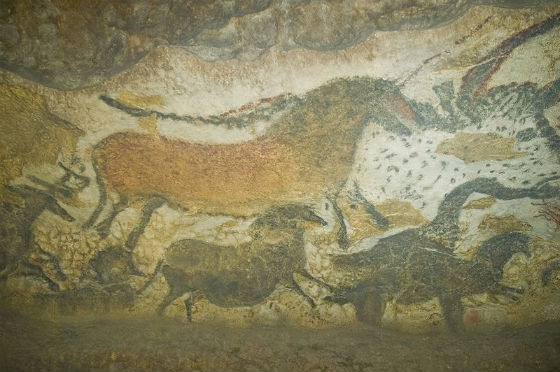
Image from Lascaux II, a replica of Lascaux. Near Montignac, France. From Wikipedia.
Guy Forget: Do you think there’s such a thing as an “aesthetics of impermanence”?
Fernanda Person: I think there can be an aesthetics of anything.
GF: So that’s a yes.
FP: Aesthetics for me is the way that we, as human beings, engage our environment. It’s decidedly non-practical and non-utilitarian. There’s a long history — actually it’s not that long — of “the fine arts” being separated out of everyday aesthetic experience. This started in the eighteenth century. The fine arts or “high arts” was a relevant category when things were still categorized regularly, where enlightened pursuits included very specific things like painting, sculpture, poetry, ballet. These distinctions aren’t that important anymore, when artistic practice has no defining feature and can be anything.
GF: So you don’t think art has a defining feature?
FP: If there is a defining feature, it’s a secondary one, which is strange. As open as art has become, it’s still very much constrained by one very conservative characteristic. That art is only art insofar as it is accepted into the art system, or at least expressly wants to be part of that system. By this I mean it’s art if it’s in a gallery or a museum, or it’s art because a gallery or museum is where it belongs. It’s a work of art if it’s validated or presented as such. I’m talking about visual arts.
GF: So if I just do something that I consider art and left it in the street, it’s not art? It wouldn’t be identifiable. I mean, it wouldn’t be a painting or something, maybe a pile of sticks.
FP: Your pile of sticks would be art since you consider it art.
GF: Why, because I say so?
FP: Sure. You’re the one validating it.
GF: Like Duchamp or whatever. So a creative gesture that’s self-aware is art, even if I’m the only one who ever knows about it.
FP: More or less. If a tree falls in the woods, does it make a sound?
GF: I always thought it would. I never understood that one.
FP: Most times the creator is looking outside of herself for validation of their creative act, where in fact, should she have the strength to recognize it, her work is work insofar she deems it so. It just gets more complicated when other things come into play, like wanting to be recognized by an acceptable audience or to sell the work or whatever. A lot of it is ego driven.
GF: To go back to what you were saying at first, aesthetics is how we engage our environment.
FP: I think we’re conditioned to employ an “aesthetic attitude” in certain situations, like in front of a painting. That’s great and good for us. But that’s precisely where everything goes wrong. The so-called aesthetic attitude is problematic because it’s something we’re supposed to turn on and off, and turn it on in the least relevant places, like a museum.
GF: Why are museums irrelevant?
FP: They’re not irrelevant. I don’t want to be misleading on that point. My belief is that by separating out what is to be considered aesthetically, society — civilization, rather — has institutionalized another aspect of human existence and this is very irritating, to put it lightly. What did Gandhi say? How did that go?
GF: He was asked what he what he thought of Western Civilization.
FP: He said, “It would be a very good idea!” Well, in a lot of ways he’s right, and it’s all so nebulous that I don’t want to generalize any further that I already have. The aesthetic attitude — of course we’re going to get distracted by things, like routines and work, family, things like that that snap us out of a ecstatic engagement in our lives.
GF: But that should be the exception.
FP: “Should” is a problematic way to talk about things like this. This isn’t a prescription. It’s not Lipitor. I believe that we, culturally, emphasize practical matters, and if anything, promote an aversion to aesthetic consideration.
GF: Would you say, to use the same language, an aesthetic attitude is a type of self-awareness?
FP: To the extent that your “self” includes everything around you, your world. So the people around you, the earth, the city, whatever your environment. If that is your definition of self, then, yes.
GF: What about an aesthetics of impermanence?
FP: Impermanence is open-ended, and I think that’s an important quality.
GF: Yes, but I think — well, I think it’s good in a way, but I don’t want it to be inconsequential. And I think when things are too loose — well, when they’re too loose, they’re too loose.
FP: Glib.
GF: Yes, glibness isn’t something I’m interested in. Well, I’m interested in it, very much actually, but only as an observer. I don’t want to add more of it to the world.
FP: I think the most useful distinction is to understand it through human existence, but broadly. So, for me, for us, impermanence is meaningful. As individuals, our lives are impermanent, that’s one way to look at it. The only permanent thing is eternity — and we don’t have direct access to that.
GF: To consider — to contemplate the eternal, that’s something that’s available to us.
FP: Sure. In a similar way impermanence is available to us as well. Everything returns to the world. Ashes to ashes, dust to dust.
GF: In one way or another.
FP: There’s nothing to indicate all the things we find so important will hold any importance, when we view it from a certain vantage point, albeit an abstract one. Cosmological time, for example. What’s a million years? To us it’s an absurd figure.
GF: But an aesthetic engagement with the world is something we can carry out every day.
FP: And in a way that has a permanence — to be aware is to be a part of the world, to be a part of time, to be a part of eternity. For our understanding of time, to understand where we come from, to try and understand how we engage our environment — I’m not just talking about greenhouse gases or plastic bags, but the totality of our environment — me, you, this tree here, those kids over there, everything. The air, the bird, the sun, the moon — did you see the “super moon” the other night?
GF: It was amazing. I often feel like I’m depriving myself of something primordial by living in the city. That was one of those times.
FP: I’m sure.
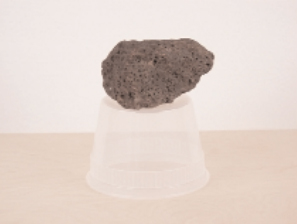
Tony Feher, "Untitled", 2004. Image from Chinati Foundation newsletter, vol 9.
GF: That reminds me of something I saw, but didn’t fully appreciate when I was in Texas. There was this object — it was a volcanic rock, something found, found out in the landscape down there, put on top of a plastic deli container. It’s a beautiful thing, this basically prehistoric rock on top of a contemporary thing that is purposely disposable, but is, out of disinterest or efficacy or whatever, is engineered to last “forever.” The permanent quality is just a secondary quality of producing something cheap.
FP: Who cares, right?
GF: Exactly.
FP: As far as art goes, I know conservators are having fun because a lot of recent work uses materials that are very difficult to preserve. Eventually we’ll probably figure out this idea of art as permanent totem to our culture isn’t as permanent as we think.
GF: I was hoping that this discussion would lead somewhere more concrete.
FP: It’s not, is it? I will say that not every culture found it necessary to make their creative acts permanent. And it is precisely these cultures that are more likely to employ an aesthetic attitude in whatever they do, and if you took them to see something we call art, you’d probably recognize that we’re not that sophisticated.
GF: What do you mean?
FP: I mean, does contemporary art — because I think certain things will resonate universally — have a universal place in human understanding? I’m pretty sure Lascaux, for example — which of course survived for millennia, and is now in jeopardy since modern man discovered it — will be intelligible and perhaps beautiful to every human being past, present or future. I’m not so sure that holds for what we call art today.
GF: What do you mean?
FP: I think that we’re so sophisticated culturally that our own output is at least partly driven by the desire to impress the most sophisticated among us. It will always be ahead of its time, and I think we may reach a point where it’s not even intelligible to us. Maybe from this place we’ll find ourselves returning to a more basic aesthetic attitude. As soon as the money dries up.
GF: I’m not sure I understand.
FP: I think putting a pile of sticks in the middle of the street is a good idea.


{ 8 comments }
I really liked to read this….. but, what did she say that hasn’t been said for the last 3 decades ( I say 3 decades because of my age, when I started to hear all this ).
Isn’t this too old and too 20th century?
GF: So you don’t think philosophy has a defining feature?
FP: If there is a defining feature, it’s a secondary one, which is strange. As open as philosophy has become, it’s still very much constrained by one very conservative characteristic. That thinking is only thinking insofar as it is accepted into the academic system, or at least expressly wants to be part of that system. By this I mean it’s philosophy if it’s in a peer-reviewed journal, or it’s philosophy because a journal is where it belongs. It’s philosophy if it’s validated or presented as such.
GF: So if I just do something that I consider philosophy out in the street, it’s not philosophy? It wouldn’t be identifiable. I mean, it wouldn’t be a book or something, maybe a rant through a bullhorn.
FP: Your bullhorn rant would be philosophy since you consider it such.
GF: Why, because I say so?
FP: Sure. You’re the one validating it.
GF: Like Timothy Leary or whatever. So thinking that’s self-aware is philosophy, even if I’m the only one who ever knows about it.
FP: More or less. If a tree falls in the woods, does it make a sound?
GF: I always thought it would. I never understood that one.
FP: Most times thinkers are looking outside of themselves for validation of their ideas, where in fact, should they have the strength to recognize it, their work is work insofar as they deem it so. It just gets more complicated when other things come into play, like wanting to be recognized by an acceptable audience or to get tenure or whatever. A lot of it is ego driven.
What do you mean?
I’m not sure I understand.
Why should her critique of the art field be presumed more valid than an artist’s critique of hers? If you had suggested that her quest for philosophy accreditation was the result of ego-driven striving, she would probably be upset. But it’s fine for her to say that about artists.
The reconstituted interview has a little clearer frame here: http://www.tommoody.us/archives/2011/03/28/philosophy-student-interviews-artist/
The intro reads: “GF, a philosophy student, interviews FP, a visual artist with an MFA in studio art who shows in top museums around the globe. In his studies GF has come to think that contemporary philosophy, whether of the British analytical or continental post-structural model, is specious nonsense, so he seeks out an artist who famously scoffs at his discipline as it is currently practiced, to get her thoughts:”
I added Ann Rand to Timothy Leary as an example of a thinker operating outside the academy who acquired a significant following.
Your critique of FP’s statement, as it reads, is justified. I know she didn’t mean it as a derisive thing (the ego comment), and in fact views it very much as a way towards empowering artists and other creative people. I’m confident, from other discussions and things I’ve heard her say, she believes that looking outside of ourselves for validation is detrimental when it’s given undue weight, when it’s a priority. This doesn’t necessarily apply to everyone, and perhaps applies to no one. As an erudite man once said, “If you chase popularity, you’re chasing a moment, you’re chasing a puff of air.” Looking outside of ourselves for validation is like chasing popularity.
Obviously academia has it’s lame bureaucracies and egos, but, in my opinion, the art world is worse if for no other reason that socializing and being cool carries weight. I know one of her favorite philosophical models is that of Socrates, who was poor and just wandered around the streets in rags talking to and annoying people.
Art and aesthetics are not the same thing. I agree you can have an aesthetic experience of anything, including art. Museums and other art contexts are places where aesthetic experience is staged and performed by artists and audiences. That’s by and large a good thing. Art and its contexts introduce a self-reflective pause so we can recognise an aesthetic experience as such and engage in it willfully if we so choose. Not everything in the art museum is going to generate an aesthetic experience for everyone who sees it, but all of it is art.
Very very unsure about the universal as a criteria for permanence (or sophistication). Did the library at Alexandria contain artifacts with universal value? What about the museums in Baghdad? Yes or no — you could go back and forth on that one forever. Anyhow, they both got sacked.
An aesthetics of impermanence…like what? (and…why not?)
The only way you can make a tree fall down without producing vibrations is if you do it as a thought experiment.
Agreed that socializing and being cool carries weight, but only in the short term. (As Dan Colen recently found out, I think.)
Comments on this entry are closed.