
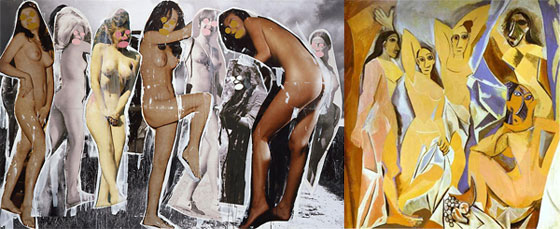
Richard Prince give a nod to Picasso's Demoiselles d'Avignon evidencing more meaning to the work than court afforded. Images such as the one featured above are far more representative of Prince's exhibition than the image that lead to a sweeping conclusion that the entire show was a copyright infringement.
Bad news for appropriation artists and anyone else who’s ever produced a collage. Last Friday, Judge Deborah Batts ruled against famed artist Richard Prince in the case of Patrick Cariou v. Richard Prince, Gagosian Gallery, et al 08 CV 11327 (S.D.N.Y. March 18, 2011)(Batts, J.), finding that the artworks in Prince’s Canal Zone exhibition – held at Gagosian in 2008 – constituted copyright infringement. Greg Allen put it best, yesterday, saying,
it seems obvious to me that Prince and Gagosian were operating under the transformative work/fair use assumptions of Blanch, where changes in scale, medium, context, and color, along with process, editing, collaging, or other process-related elements, are used to identify a transformative work. Judge Batts doesn’t even address process, or any relevance of Blanch to the transformativeness; instead, she makes a blanket assumption that all 29 Prince paintings are infringing because they include Cariou’s Rasta images in some way.
According to the ruling, Prince’s appropriation of Cariou’s work failed to meet standards of fair use on four specific grounds. Those headings and notes below:
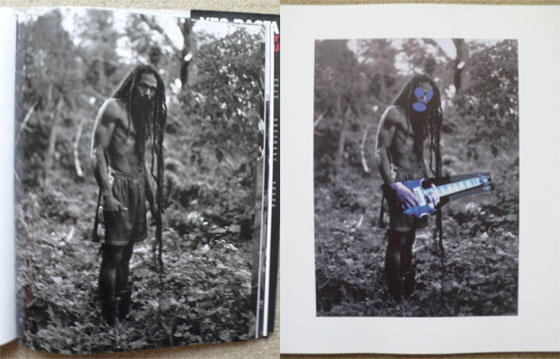
LEFT: Patrick Cariou RIGHT: Richard Prince
1. The Purpose and Character of Prince’s Use of the Photos
- Transformative Use (Does the new work transform the original, adding something new, altering the first expression with another). According to the court, the answer to this question is no. Prince used Cariou’s photographs with minimal alterations and testified that the work had no specific meaning. The court found on the side of the plaintiff, saying that only works that offer meaning and critique constitute fair use.
To my mind, this is one of the most problematic parts of the case. Andy Warhol repeatedly told the press he didn’t know what his work was about and that it wasn’t about anything, and, as far as I know, was not sued for his reproductions. Under this ruling, Warhol’s now-canonical “Green Car Crash” would not have lasted long. This suggested a couple of things to me initially, namely that when an artist reproduces an unaltered photograph in paint, it will be taken more seriously than a reproduction in ink. This, however, was before I remembered the show, which is largely made up of painted collages, most of which have been significantly altered. These are not the reprinted photographs-of-photographs the artist became famous for producing. Also, as noted by Greg Allen more than two years ago, the process is central to these works, as described in the press release itself:
[the paintings] are, literally, “put together,” like provisional magazine lay-outs. Some images, scanned from originals, are printed directly onto the base canvas; others are “dragged on,” using a primitive collage technique whereby printed figures are roughly cut out, then the backs of those figures painted and pasted directly onto the base canvas with a squeegee so that the excess paint squirts out on and around the image. On top of this are violently suggestive swipes and drips of livid paint and scribbles of oil-stick crayon which, together with the comic, abstract sign-features that mask each figure’s face, add to the powerful push-pull between degree and effect. This has become a completely new way for Prince to make a painting, where much of what shows up on the surface is incidental to the process.
Even in cases where little alteration has occurred, the process itself is distinctive enough to show difference. Notably, the case Allen cites supporting Prince and the case Judge Batts used to rule against Prince share a defendant – they were Blanch vs Koons and Rogers versus Koons, respectively.
- Commerciality (Does the work serve a commercial purpose or a non-profit educational use? If it’s the latter Prince has a better case.) Gagosian placed ads in seven magazines and grossed $10,480,000.00 in sales. Seven other paintings were exchanged for art for an estimated $6-8 million. While the court recognized the inherent public interest and cultural value of public exhibitions and access, it found use of the photos to be substantially financial.
Gagosian and Prince took home millions of dollars for a show I remember being shockingly ostentatious. This doesn’t sit well with many people and it’s not particularly surprising Cariou felt left out of a windfall. Still, was there not a windfall for Cariou as well? More on that in section four.
- Bad Faith Prince acted in bad faith by failing to specify the intended artistic use when he requested a copy of Cariou’s book. The gallery acted in bad faith by being “aware that Prince is an habitual user of other artists’ copyrighted work, without permission…the record is equally clear that the Gagosian Defendants neither inquired into whether Prince had obtained permission to use the photos contained in the Canal Zone Paintings nor ceased their commercial exploitation of the paintings after receiving Cariou’s cease-and-desist notice”
The most frightening part of the verdict by far. No suit was ever lodged against Prince for his flat appropriation of ads, though the work was recently lauded in a retrospective at the Guggenheim, one of America’s most important public institutions. Still, Gagosian staff were acting in bad faith because they didn’t have the good sense to share Judge Batts’s un-rendered verdict on a non-existent case. The artist too was considered working in bad faith, his reckless theft of copyrighted material resembling that of a drug addict.
2. The Nature of Copyrighted work
- From the verdict: Judges should consider whether the protected [work] s of the creative or instructive type that the copyright laws value and seek to foster.” Pierre N. Leval, Toward a Fair Use Standard. Judge Batts describes Cariou’s work as highly original and creative works, thus falling within the realm of copyrightable material. This weighs against the claim for fair use.
A debate over whether originality means anything at all in the age of digital photography could be had, but it’s a little outside this case. Judge Batts quotes extensively and structures her response according to Leval’s paper, which goes on at length about how transformation must occur for fair use to apply and offers only literary examples. Batts draws heavily from this paper to produce the structure of her own verdict.
3. The amount and substantiality of material used
- The court must examine not only the quantity of material but its importance. Richard Prince uses the central figures in Cariou’s body of work in his own. This also weighs against fair use.
This is partly about transformation again, as there’s an assumption that by focusing on an auxiliary portion of an artist’s work there will be more area to explore and the product will therefore be more distinguishable. The point of appropriation, however, is to use the central figures. Would Warhol’s Green Car Crash work if he’d excluded the car?
4. The Effect of Use Upon The Potential Market For or Value of The Copyrighted Work
- The fourth fair use factor requires courts to consider not only the direct losses suffered by the plaintiff, but potential losses in such arenas as derivatives. The court found harm to the potential derivative market against the plaintiff and dismisses protests that Cariou did not market his work more aggressively.
A real failure on the part of the court exists in understanding how Cariou can and will benefit from Prince’s work. Surely the value of Cariou’s derivatives has increased with the Prince show. What’s more, Cariou holds the original negatives for Prince’s source material. Certainly that’s worth a significant amount of money now.
It warrants mentioning that if the Prince paintings survive, they now will be worth a fortune. Even on a very small scale, we’ve watched as Jeff Koons’s recent threat to sue a bookend manufacturer resulted in a massive increase in sales. These aren’t Prince’s best works, but they are now part of a very compelling narrative that has the potential to shape American art in the future.
Related links:
Greg Allen: Two years ago, yesterday, and a deposition between Cariou’s lawyer and Prince.
CORRECTION: The lead image originally labeled photographs by Patrick Cariou that were not his.


{ 31 comments }
“….but they are now part of a very compelling narrative that has the potential to shape American art in the future.” not just American art, but global art markets as well, considering the value the sales from the north america. Also what liability do artists (and their galleries) have on images used in there works that are sold for profit. Interesting times ahead indeed
Koons won Blanch in part because he made the case he had to use the photographs he did, or photographs of a similar genre, to make the point he intended to make. All it took for him to establish it is to explain why it was the case. As I’ve seen it reported Prince explicitly denied that the source material was in any way necessary to the art being made. He didn’t even TRY to make a case based on the established case law. Blanch isn’t the controlling precedent here, as it uses the exact same case law used in Prince’s case, with the exact same criteria.
Prince put on a terrible case and lost. This does nothing to change any laws and making statements about this instituting a new reality of pre-licensing all work beforehand is far-fetched.
Well, that’s the speculation — that Richard Prince and Gagosian must have lodged an incredibly bad case. That said, I don’t think the fault can’t all lie in Prince’s defense. Judge Batts claimed even Gagosian acted in bad faith because they knew Prince had appropriated in the past. That’s not the kind of conclusion you reach if you have any respect for the practice.
In any event, I don’t think anyone here said anything about the laws being changed. The problem is they are vague, so precedents like this are not good. Judges and lawyers will look at the ruling, not every detail that went into the proceedings. Hopefully there will be an appeal.
With the money involved an appeal will definitely follow, but the higher you go the more you risk the precedent controlling future cases.
What I meant by “changing laws” is kind of a reference to greg.org’s conclusions (I couldn’t see how to comment there). Precedent is a sort of law in itself, but as a district court summary judgment, this isn’t going to control any future decisions (as set precedent), just like Blanch didn’t. They both examined the cases according to the same 4 point criteria laid out in the same earlier cases and law, but because the facts were different, the outcome was different.
I’m not an attorney and this isn’t legal advice, but my understanding is if you appropriate something, be ready to explain why that appropriation was necessary to the intent of the artwork. As the NYT put it: “Judge Batts wrote that for fair-use exceptions to apply, a new work of art must be transformative in the sense that it must ‘in some way comment on, relate to the historical context of, or critically refer back to the original works’ it borrows from.”
That leaves a LOT of room for coming up with an explanation, even if you wait until the trial begins to formulate it. From what I’ve seen, Prince had room to do so, but his legal team apparently never prepared him to do so.
Only after that transformative element hasn’t been met (and the case has essentially been lost) would the bad faith element arise, as I read it.
“Judge Batts wrote that for fair-use exceptions to apply, a new work of art must be transformative in the sense that it must ‘in some way comment on, relate to the historical context of, or critically refer back to the original works’ it borrows from.”
That leaves a LOT of room for coming up with an explanation, even if you wait until the trial begins to formulate it. From what I’ve seen, Prince had room to do so, but his legal team apparently never prepared him to do so.”
I absolutely agree, and was pretty disheartened to read the sentence from Paddy’s write-up: “According to the court, the answer to this question is no. Prince used Cariou’s photographs with minimal alterations and testified that the work had no specific meaning.”
I just can’t believe that Prince and/or his attorneys did not, at the very least, suggest one of many possible meanings for the work. I assumed, perhaps incorrectly, that Prince would be able to rattle off something about his works’ meaning and how his intent differs from that of Cariou……disappointing.
They already cost a fortune. Don’t think they’ll increase that much beyond what they already cost.
the part that is most shocking to me is that he REQUESTED the book!! he couldn’t buy it? do rich people ever pay for anything? that’s the most douchey part of the whole thing.
hey don’t forget gagosian lawyers went after eric doeringer for reproducing elements of John Currin paintings, or when Louis Vuitton – having recently collaborated with Richard Prince – sued artist Nadia Plessner, writing “as an artist yourself, we hope that you recognize the need to respect other artists’ rights and Louis Vuitton’s Intellectual Property rights…”. that was rich.
ps i LIKED that Prince show
We don’t know for certain he didn’t pay for the book. I hope he did, but requested does leave some ambiguity. If the defense was actually poor (and it seems likely it was) maybe it was because their lawyers don’t actually believe the case they were presenting?
As you’ve told it, Gagosian acts a lot like other evil corporations, mercilessly suing artists for any money they can collect.
oh yeah i was just assuming the request meant no pay…
maybe an argument can be made that acceding to a request for images from prince implies tacit approval, given prince’s reputation among pro photogs.
Prince testified that he purchased the book, Yes Rasta, in St. Barts, according to Daniel Brooks, Cariou’s attorney. I wasn’t sure this had been cleared up yet.
I adore your blog and thought you’d want to know Warhol was sued over flower paintings:
http://www.warholstars.org/chron/lnx/flowrs64.html
That’s interesting but the copyright law in question is the Copyright Act of 1976, so I don’t know how much changed between that and the 1964 Warhol case.
41 photograghs stolen,end of the story !!!!!!!!!!!!!!!!!!!!!!!
Not good news.
Paddy:
A couple of things. First, your image at top, captioned “Richard Prince uses Patrick Cariou’s photographs to give a nod to Picasso’s Demoiselles d’Avignon…” actually shows naked ladies that are not part of Cariou’s work. Cariou photographs Rastas, not cheesecake. I have heard that many of the naked babes come from Prince’s buddy Richard Kern’s photographs, who has established himself in that particular genre of softcore punk porn.
I wasn’t there in court, but Cariou (in his ArtInfo interview) mentions that Prince and Gogo strutted in like King Kong, as if the verdict was never in doubt, as if Cariou should be honored to be used in the work, and that their most pressing decision was where to go for lunch. Within the higher precincts of the art world, Gogo and Prince DO hold all the cards over someone like Cariou. But that’s not where the case was decided. Moreover, judges are very sensitive to the posture of arrogance in their courtroom, and this could not have helped the defense.
Certainly, the judge was not particularly interested in helping define the uses and limits of appropriation in the art world. But there is another factor. What we have here is an Afro American judge deciding on which white man “owns” the images of black men. Although justice is supposed to be blind, I find it hard to believe that this played no part. The judge might have been inclined to side with the more honest, rooted, documentary effort and against Prince’s hothouse white boy exoticisms about Rastas and music and sex.
My gut on this: I do not mind Prince/Gogo getting their comeuppance – the schadenfreude quotient is high – but Prince is just the tip of the iceberg when it comes to appropriation, and this ruling by Batts muddies the waters and complicates conventional artistic practice across the board. It sets a dangerous precedent, and also ignores several recent rulings (Blanch vs Koons) that expanded the definition of transformation to include issues of process, scale, medium and context that Batts fully ignores.
Batts’ decision places the burden of proof on the appropriating artist and the gallery showing this work. Obviously Prince/Gogo will appeal, but for the moment, as Greg notes, “If visual artists and the art market have been operating in some kind of an appropriation bubble, this decision would pop it. Artists would have to adopt the sampling, licensing, and rights clearing practices and infrastructures of the music industry, or the entertainment industry.”
I’ve corrected the caption on the lead image. Thanks for the tip – I’d looked at Cariou’s images online and wondered where those images came from.
Since we’ve only read Cariou’s description of Prince and Gagosian’s demeanor in the court room I don’t think there’s enough evidence to draw any conclusions about whether arrogance played into the ruling. Obviously there is a lot of class tension here, but that really should exist outside the ruling.
To honest, I’m not greatly interested in appropriation art, but I do think it’s important that artists be able to sample as much art as they can. I think this ruling poses a threat to that.
The obvious problem is the Judge Batts has no clue about the uses of imagery and the parameters of appropriation that pertain in the art world. Her judgment was based on Rasta imagery from Cariou that she could recognize in Price’s work – that unless it was sufficiently “transformed”, it did not constitute “fair use” – and alternately, on the fact that Prince was not commenting directly on Cariou’s “original”, that Prince was using Cariou’s images without “commenting” on them. The fact that Prince could be using the imagery but shifting the context from the specificity of Rasta subculture to comment on the history of modern painting and cultural transmissions in general, never occurred to her. So we are left with an opinion that penalizes Prince for not specifically commenting on Cariou’s imagery, while all too specifically “borrowing” the imagery without sufficient “transformation” to disguise it. Prince’s reprinting and re-registration of image, his changes of color, scale and position, his layering, conflating and collaging of images from various sources (not only Cariou) and his overall appropriative process – none of this registers with Batts.
You’re right, I cannot testify directly to Prince’s or Gogo’s demeanor in court, but I have heard from someone (identity withheld by request) who attended a group dinner, during which Prince mentioned the case, said they had offered Cariou $ 100K to get lost, and essentially demeaned the pesky nature of Cariou’s claims, as if it was a mosquito that needed to be swatted away.
Judge Batts, like any judge, can only consider very specific things: The specific legislation: The Copyright Act of 1976, and case law: Campbell v. Acuff Rose. http://www.law.cornell.edu/supct/html/92-1292.ZS.html
Campbell applies because it is a supreme court decision. Blanch is a lower court cummary judgment (like this Prince case). It will continue to be the controlling law. Campbell specifically lays out the “transformative” argument in such a way that requires commentary on the original. Judge Batts HAD to consider that.
Similarly, Batts could only consider the factual evidence record (such as depositions) as to how it applies to that law. She can’t decide the case (especially on summary judgment) based on what interpretations occur to her. It was Prince’s duty to offer evidence of the interpretation that his work was transformative. When he refused to do so, he essentially plead no contest.
This is why I put the entirety of this result on Prince and his legal team.
Since both Blanch v. Koons and Cariou v. Prince defer to both the 1976 copyright act and also to a Supreme Court decision, I find it interesting that the Blanch decision manages to cite different criteria and seems to recognize different definitions of “transformative” and different applications of “fair use”.
No artist likes to discuss the intentions of the work. The work is supposed to speak for itself. Offering up exterior explanations can be seen as pandering to the audience or disturbing the sanctity of the artwork’s existence. In this context I am inclined to agree with you. Koons, who was a commodities trader and once made a performance of selling MoMA memberships, seems more willing to wade in and perform, to do his own PR. He is probably a better showman than Prince in discussing the work. Prince might have been sullen and retreated to the artist’s typical ivory tower. But his disavowal of the artwork’s intentionality has a distinct pedigree. Warhol was famous for noting that his art was not “about” anything. If Warhol was before a judge like Batts for violating the design copyrights of the Campbell’s soup can or Brillo box designs, who knows what would have become of the last 40 years of art history?
It circles further, now you can buy a Greg Allen after a Richard Prince after the Marlboro Ad by Sam Abell, somebody probably already has a painting in the making of this http://www.20×200.com/art/2010/06/untitled-300-x-404.html
Exactly. Personally, I think just about any appropriated art can create a transformative defense if they’re creative and try. That doesn’t mean they’ll be rich enough to survive the trial or that the judge will favor them, but Prince didn’t even try.
I think this case is unfortunate on a number of levels:
1.) This could have been avoided from the outset of making the Canal Zone, had Prince phoned Cariou to ask for permission. But in a subsequent interview by Prince, he said that he probably would have used them anyway.
2.) This case is filed by one artist against another artist and will most likely change precedent for other artists.
3.) The photographs in question are documentary photographs. The field of photography is part of the art world, no? Is this another conflict between painters and photographers??
4.) When Shepard Fairey settled with the AP, they agreed on sharing the rights to the Hope image.
5.) When Warhol was caught in copyright issues, he gave his originals to the parties who complained.
6.) Why did Prince not extend himself and settle this case outside of court? Agree to an undisclosed monetary settlement with co-authorship? Had he done so, or something like it, this case would not have gone to trial and therefore be so public.
7.) In that light, how has the lack of a mutually agreed upon settlement done a disservice to those who would like to keep using appropriation in their work?
8.) Should artists try to collaborate more, rather than battle their egos and try to snuff out the other one who is lesser known?
Why is the artworld exempt from laws that are applicable to everyone? I am tired of this defense, the artworld of Gagosian is a BUSINESS and should abide by business practices. IMHO any time an artist makes money off someone else’s image they should pay for it. In music, people have to give a co-ownership (I believe) when they use samples in a song. Oh I forgot, “Art” is deeper and mightier. I can only imagine what a slap in the face that must feel for the photographer, seeing those million-plus paintings of his own pictures…Give me a break!!!! It’s the rationale that is used for the rich not paying taxes. I saw that show. All I saw were Rasta images that are exactly like the photographer’s. Please.
The fact that more artists have not been sued for stealing other artist’s work is interesting.
First, the photographic knockoff looks more like what musicians refer to as ‘quoting,’ and notwithstanding that the picasso is several orders of magnitude the superior work , it is executed in an entirely different medium and any references to the original are superficial. the defaced rasta photo, on the other hand, is a straight out theft.
I’m going to have to mull this over for quite a while.
The “Correction” at the bottom was the best part.
thank you for explaining this so thoroughly, there were many things to try & understand with the case.  The case is something that will impact visual, performing, recording & cinematic arts. It’s a lesson to me to get all of my information first before making judgements first.  I truly enjoy RP’s work, but don’t feel comfortable hearing about how the work may or may not have been acquired with the first artist stating he didn’t want any involvement with the other artist.   It would be a shame if the case has a negative impact on other artists that want to do similar work which may add value to a previous work & would be restricted because of legislation.    After reading your article I came away seeing  Cariou’s viewpoints of the case ( a very complicated case – of which we may not have all of the details; but certainly enough to be empathetic to the artist’s cause.)   This may change the way we do many things in the art world, litigiously, unfortunately.  It would be wonderful if we could just ask first and, get approval & keep the court out of the galleries & museums.   Watching closely to see how the story unfolds in 2012.  Thanks so much for a wonderful article / blog post on this subject.Â
Here’s the link to the Blanch v. Koons opinion. (I apologize but it’s not OCRed so I can’t quote)
http://cyberlaw.stanford.edu/system/files/Blanch+v.+Koons+Opinion.pdf
From page 13-15 is where they explain using the Copyright Act of 76, Campbell and “transformative,” then they examine Koons’s work according to this criteria. The money quote is at page 18, line 12, and this I’ll type out:
“Koons is, by his own undisputed description, using Blanch’s image as fodder for his commentary on the social and aesthetic consequences of mass media.”
Koons won because he described his work correctly in an affidavit. Worth noting, Prince’s mistake came in deposition. The difference is your attorney can write an affidavit for your signature while Prince had to perform. His attorneys still should have prepped him though.
I understand artists not wanting to explain themselves, but once in court, I think they should come up with any description that works (and I find it a fun game to try to imagine different explanations for different appropriated situations).
My much much much bigger concern is that the average artist won’t be able to afford to pursue their own defense as well as they can. In which case, all these other questions don’t matter. The big copyright owner (like Damien Hirst) can just bully whomever.
Well, Prince does talk about the guitar saying, “He plays the guitar now. It looks like he’s always played the guitar, that’s what my message was.â€
Looking at the collaged image though, of course you know it’s not true. It doesn’t look like he’s always played the guitar, it looks like he’s playing the guitar now because the instrument is collaged in. It’s not hard to understand why that wouldn’t sit well with a judge or anyone else.
But yes, in a case like this it feels good to Prince get some payback for making a killing of shitty work, but in the long run it could be very dangerous.
He is such a lousy artist and so cavalier in his “appropriations”, that even as corrupt a field as the flogging of contemporary mutterings as art should blush. But I fear that the second oldest profession is beyond the blush. The thing that pleases me about all of this, however, is that the wealthy with great need for affirmation of the self, paid gobs of money for this crap that will only be of socio-historic interest in the twenty-second century.
Comments on this entry are closed.
{ 4 trackbacks }