
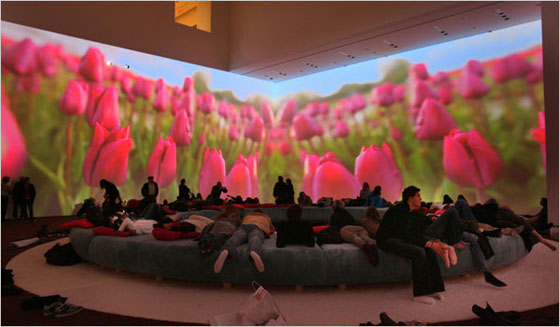
Paper Monument’s How to Behave in a Museum reminds me a great deal of the N+1 conversation two years ago, What Was The Hipster. Both are conversations about what middlebrow means. From Timothy Aubry’s text:
…trying too hard to show off your expertise is a dead giveaway that you haven’t got as much status as you’d like. But in previous decades there was still a belief that those who took advantage of inexpensive museum fares, public libraries, and so forth were elevating themselves. For my generation, say those born around or after 1968, the sign that you’re at the top of the hierarchy is a readiness to acknowledge that the high ground you’ve come to occupy isn’t actually higher than any other ground.
This is very American. Our purported populism has always made us wary of those claiming, by virtue of their position or education, to know better than everyone else. One thing that’s changed, though, is that this populism, often disguised as the heady skepticism of continental theory, has managed to sneak into the very bastion of elitism, into the places where the aspiring intellectual first learns how to be a pompous snob: academic humanities departments. The institutionalization of deconstruction, identity politics, and Marxist criticism, in other words, has replaced the pious attitudes of previous eras with a different set of now-habitual postures: distrust of the canon and the institutions that preserve it. Whatever their merits, these frameworks have created enough ambivalence to make art appreciation a vexing enterprise for a generation of well-educated museumgoers. Because if you don’t believe in high culture, then what are you doing at a museum?
Although it may sound obvious, it’s worth mentioning that one of the few ways we afford expertise in a culture that rejects the canon is by demonstrating that we have more work experience than others. This is very similar to other fields, though fine art takes it to an extreme. We look down upon artists or any other professional who maintain hobbies, anything less than complete dedication to the field is unacceptable.
A few common examples:
- The WoodmansIn this movie family members speak with open distain about hobbyism. They believe being an artist means dedicating your life to it, and they want to be remembered for it. Maybe there’s no actual aura around art, but we still want history to remember us for what we do and say.
- Want a show at a gallery? Don’t tell them you have a full time job. Gallerists might think you’re not dedicated enough to the practice.
- Jerry Saltz sees between 30 and 40 shows a week. I don’t actually believe this, but it imparts the same point as The Woodmans. Don’t do or see anything else but art. The same goes for Twitter personalities. I’ve watched Hrag Vartanian and Museumnerd tweet constantly about the art they’ve looked at over the weekend, but where are the tweets from their weekend sejourns at Applebee’s? I don’t see any. [Update: This goes for me too. It’s not meant to be a jab, simply an articulation of the ethos of the art world]
As Aubry mentions earlier, certainly, the highest ground we can occupy is that which acknowledges that there isn’t any, but that may simply be because we value visible consumptive volume of art more than we ever have. The ability to discern quality is useful, but not essential in today’s social climbing.


{ 23 comments }
so in other words there is no space between the absolute devotee and the blissfully ignorant?
In the art world, I don’t think there is a lot of space honestly.
If there is not so much space between the devotee and the blissfully ignorant, why is this your profession? You certainly must bite your tongue a lot if you must suffer idiocy for the sake of social advancement.
It seems to me that this appearance of middlebrow posturing is a new type of elitism; “I’m seeing it all” will become an ironic “I’m loving it all,” and then just “I’m loving it.” Consumption over sincerity is depressingly cynical. What am I missing?
I guess the hope of the devotee, is that in all this activity, you’ll eventually see something that really moves you.
And I generally think people are sincere.
Perhaps you ignore all my tweets on politics, media and other topics? The fact that you only see my art tweets reveals a major blindspot in your viewing.
That could have used a little explanation, but the point, really is that to be a good professional you have to be doing whatever you do all the time. In your case and mine, it’s simply consuming as much media as humanly possible. And yes, I think that’s middlebrow, though it’s not something I’m excluding myself from.
Between Th 2/24, Sat 2/26 and Sun 2/27, I saw around 45 shows. I do not include the 4 shows viewed on F 2/25. So that’s half a week’s regiment.
I hope that does not make me the Crown Prince of Middlebrow.
Yup.
As Rainer Werner Fassbinder said to me once: “Vell, dat’s your opinion!”
As far as middlebrow, I could easily give you both a summary of the work and a dulcet aperçu for each show.
Won’t this result in alienation and insularity? If your seriousness is measured by your devotion to a single field, you necessarily give up interests in other fields. Therefore “serious” art becomes a feedback loop, only commenting on itself at the expense of discussion regarding every other major development across disciplines.
Isn’t this what people already complain about in fine art though — that’s it’s a totally insular field.
Seems like an unjustified complaint, too. As far as I can tell most ‘serious’ disciplinary pursuits are, in fact, expansions of ‘native’ feedback loops. I’ll go middlebrow: without organizing its means into something other than art, what can art hope to comment on other than art? Art-the-knowledge-producer in the interdisc. trajectory always gets the service jobs.
Really? Art can comment on anything there is to comment on. Here’s an article about theoretical physics commenting on art:
http://www.newscientist.com/article/mg20928015.500-theoretical-physics-and-the-art-of-the-abstract.html?full=true
Here’s art giving visual form to computer programming tools (both articles from today’s online newscientist mag):
http://www.newscientist.com/blogs/onepercent/2011/03/jacob-aron-technology-reporter.html
A feedback loop without initial outside input is silence, and will remain static unless more input is introduced to the system. A discipline that only communicates with itself is, by definition, irrelevant.
Agreed and I think I’m veering away from your original point, but what I meant is that I understand that when art makes comments outside of art, it isn’t making art ‘as such’ anymore. It’s using existing means found within its feedback loop to insert into ‘comment-making’ practices to generate up commentary. Art-making can only ever make art – the same way knowledge-making can only ever make knowledge. Art can’t make comments. Comment-making makes comments. Comment-making can incorporate art as a means to give form to its comments, but that is comment-making using art, not art using comment-making.
The making vs using distinction might sound a little pencil-dicked, but I think it’s useful to draw if arts internal commentary/feedback loop is the way art expands the means of art. This would expand it as a resource that can be ‘applied’ as a visual-form-giver to computer programming tools or theoretical physics etc. A discipline that only communicates outside itself will also remain static and become irrelevent. I don’t think it’s an either-or – just that all disciplines tend to expand their empty feedback loops to stay vital as sense-makers. I like to at least have the option to participate in that knowingly.
Mostly I’m taking the position that, if ‘describing reality’ is a guiding value, then insularity seems to be a helpful condition for all disciplines to become more comprehensive and relevant. If people accuse art of doing ‘insular’ more than other disciplines, it’s probably because they don’t even know what the theoretical physicists are up to.
anyone got some links to the CAA Conference Lectures?? Couldnt attend this year and there pricey to buy.
There is also this thing “if it dont happen in NY it dont happen”, adding to the insularity mentioned in the thread. But in the long run, things sort themselves out. See: Salon de Paris.
As a current art student who works in Photomedia, I’m pretty much seeing a tendency for young people who are training to become artists to be LESS pretentious than previous generations. Hipsters haven’t gone away, they are the same people with somewhat older and wiser values.
At least that’s how it works in Australia. I suspect nobody truly latched onto hipster culture down under because, Good Lord – have you even HEARD an Australian hipster’s accent compared to American ones? It’s so… WEIRD – it’s like they’re speaking entirely different hipster dialects and the Australian one is so divorced from the Hipster straw-man (depicted in media as usually an American liberal, which means something entirely different overseas) they’re actually easier to bear.
Me, I do a lot of things unironically because I can’t pull off irony very well. It’s one of those situations where people around me have stopped faking because even they figured out it was empty. I guess Photomedia art students feel a bit humbled compared to the Painting students, which is part of it.
I think that grad school really screws people up in terms of a certain level of pretension. After a bombardment of theory in your coursework, you pretty much have one of two options:
1) Make incredibly esoteric work that can only be understood by a handful of people who have read and memorized exactly the same chapter of “Being and Nothingness” as you.
2) Try to make really dumb work to unlearn all of the useless theory that you paid way too much money for with tuition that costs as much as a mortgage payment.
i think what is happening (what has been happening for a long time, and not just in art) there are social “systems” in place whereby you think you are in control of your life but you’re really only partially in control. so while i may be sincere for the most part, i’m acting within the limitations of my milieu, so my sincerity is also limited. in other words, that i’m sincere in the art world is not that strong a statement.
I like the devotee approach and I don’t think it implies isolation, limitations, or elitism…it just means that everything you do is primarily driven by the expansion of one main interest (art in this case), and absorbed through a filter of art thinking. It gives meaning and purpose to everything else. Even a night of wild dancing, or dining out…will feed the art thinking /making/ looking…not consciously, but because those are not the priorities. It’s not elitism to see the distinction between hobbyists and devoted full time artists. I mean, if it is compared to scientists, or doctors, mathematicians, or other arts…like dance…or writers….these people are completely absorbed in their work. Often people who are all over the place in their interests express discontent and basically long for the focus that artists (or anyone with a clear vision of their purpose) have.
I like the devotee approach and I don’t think it implies isolation, limitations, or elitism…it just means that everything you do is primarily driven by the expansion of one main interest (art in this case), and absorbed through a filter of art thinking. It gives meaning and purpose to everything else. Even a night of wild dancing, or dining out…will feed the art thinking /making/ looking…not consciously, but because those are not the priorities. It’s not elitism to see the distinction between hobbyists and devoted full time artists. I mean, if it is compared to scientists, or doctors, mathematicians, or other arts…like dance…or writers….these people are completely absorbed in their work. Often people who are all over the place in their interests express discontent and basically long for the focus that artists (or anyone with a clear vision of their purpose) have.
If highbrow means conflating education with intelligence, and lowbrow means not having access to art & art ideas then I’ll gladly take middlebrow.
That said, there’s nothing wrong with specialization. Choosing a defined area of interest to spend most of your professional time on is sanity-producing. The global village creates a fallacy that it’s possible for one person to meaningfully absorb every aspect of contemporary culture. That’s crazy-making.
I used the term “comment” on, and accept the distinction between “Making Art” and “Commentary.” What I hope I never implied is that “describing reality” is a necessary goal. That’s a loaded concept in and of itself, I don’t want to accept or reject it fully without all it’s connotations mapped out as you mean it.
What I did mean to emphasize is communication between disciplines. It doesn’t have to take the form of commentary, or any form of explicit message. Simply “using” the tools of another craft toward the “Making” of art becomes on the one hand an internal reflection with the art world as well as a signal there to be read by a potential viewer from outside the discipline in question. Within that discipline they may “respond” in an undirected way within their context of choice. While still engaging in the singular feedback loop of their discipline, they are also avoiding insularity.
So where I think we may overlap is, if the middlebrow obsessive direction is still active as one learns of other disciplines because those disciplines can still be applied back to the art (therefore those non-art activities are still art-activities), I don’t have a problem with that. It’s when “describing reality” or commentary are considered the end goal and that the only worthy subject to describe or comment on is other items within that narrow field.
Comments on this entry are closed.
{ 2 trackbacks }