
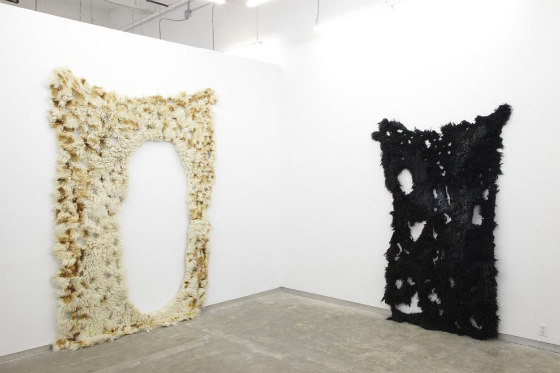
Installation view of Anna Betbeze, Moss Garden. L to R: "Hoarfrost" and "Nightshade", both 2011. Image courtesy of Kate Werble Gallery.
It’s been a rough couple weeks, with all the anticipation and all — but Art Club is finally here. Time to talk about Anna Betbeze’s Moss Garden at Kate Werble. I came away from the show with a few things on my mind, and I suspect others did too.
Since this is Art Club, I think there is a communal implication, like in a book club, where we edify each other with our differing opinions. It’s like multiculturalism. And while I don’t actually ever ask myself these questions, it eventually boils down to this, one way or another, assuming the work(s) are worth thinking about. Three Questions:
Does it look good?
Is it conceptually interesting?
Would I want to live with it?
Although these look like “yes” or “no” questions, they’re not, and they’re not straightforward at all. For example, what does it mean for something to “look good”?
That said, here are a few thoughts about Betbeze’s six works that comprise Moss Garden.
a. Moss Garden needs to be seen in person. It’s basically impossible to appreciate the tactile quality of the pieces from images alone.
b. As objects, there are obvious things going on with Betbeze’s work, the most obvious being that they were once a unified ground (flokati rugs). The works in Moss Garden are arrived at by adding and subtracting elements to the ground, using a variety of means, including pigments, cutting, burning.
c. Before I saw the show I had thought they might have a grungy appearance, but they don’t, despite the destructive elements in their creation (including the selectively burning of sections). They are in fact very “clean”. Pleasing to look at.
d. I liked the back room better. I had the most trouble with Lacuna (all works from 2011). Lacuna, from the front room, is one of the largest works in the show, and was unique in that so much of the original ground was removed. There is a large section removed from the center, leaving a lot of negative space, which unfortunately reminds me of a rabbit head. Due to the extent of what has been cut out (I would estimate that roughly 50% of Lacuna is negative space), I think it would look different, more at home, in a larger space, against a larger wall, where the scale of the piece could be better accommodated and comprehended. Scale and size are two different things.
e. These works are somewhere between painting and sculpture. Their physical presence is critical to what they are. In her New York Times review, Karen Rosenberg mostly interprets Betbeze’s work as a continuance and exploration of art historical developments in abstract painting, citing Helen Frankenthaler and Lucio Fontana, among others, which are certainly useful comparisons. Although Rosenberg does consider the works’ materiality, I don’t think their materiality should be a secondary element of interpretation, as an aside to their painterly qualities. I thought of El Anatsui — but where he creates unified large-scale abstractions by accruing smaller, preexisting elements, Betbeze removes and alters an already unified (and preexisting) element. This might sound like opposites but I think they are related.
f. All the works in Moss Garden are sculptural (they also partially rest on the floor), and I think the tactile quality of the material is inherently complex, more so by Betbeze’s interventions (cutting, burning, dyeing, etc.).
g. My favorites are the two monochromes, Hoarfrost and Nightshade, and Moss, a multicolored piece. Moss is the least altered, in terms of actual ground removed. These are my favorites as they are the most unified, visually (the first two in color, the latter in “field”) — unified in contrast to the complexity of the works’ materiality, both inherent and as a result of Betbeze’s myriad interventions. The aggregate processes acted on these three works can be appreciated more easily (to their benefit) because of the more fundamental visual unity (relative to the other works).

Anna Betbeze, "Second Ocean", 2011, wool, acid dyes, watercolor, 96 x 52 in. Image courtesy of Kate Werble Gallery.
h. Michel Foucault’s “Of Other Spaces” (1967). This writing (formulated as a lecture) was mentioned in the press release as a basis for the name of the show, “Moss Garden”. Rosenberg, the NYT critic, was happy, felt that it was “fortunate,” that Moss Garden didn’t appear overtly serious or theoretical, which I thought was strange, especially since, by my reading, Foucault’s lecture is actually a beautiful, hopeful piece. And the section on gardens is hardly burdened by theory. The lecture is on what Foucault calls “heterotopias,” places where cultural relations are represented in real spaces (in contrast to unrealizable utopias); variously exclusive spaces where a society’s culture is in some way reflected. These heterotopias take on different forms for different cultures and in different instances. According to Foucault, one of the first forms of heterotopia is the garden. He writes:
We must not forget that in the Orient the garden, an astonishing creation that is now a thousand years old, had very deep and seemingly superimposed meanings. The traditional garden of the Persians was a sacred space that was supposed to bring together inside its rectangle four parts representing the four parts of the world, with a space still more sacred than the others that were like an umbilicus, the navel of the world at its center (the basin and water fountain were there); and all the vegetation of the garden was supposed to come together in this space, in this sort of microcosm. As for carpets, they were originally reproductions of gardens (the garden is a rug onto which the whole world comes to enact its symbolic perfection, and the rug is a sort of garden that can move across space). The garden is the smallest parcel of the world and then it is the totality of the world. The garden has been a sort of happy, universalizing heterotopia since the beginnings of antiquity (our modern zoological gardens spring from that source).
It’s interesting that the two pieces that I had most difficulty with have the most to gain from this passage. Lacuna, with its void as the center of the world — a nothingness? — and Second Ocean, where Betbeze has cut out this “umbilicus” only to replace it, altered.
These are discussion points and not “art criticism.” Would love to hear viewer thoughts.


{ 9 comments }
After leaving the exhibition, what left an impression on me most was how process-driven these works are: the ground of the flokati rugs have been shaved, singed, and sliced. And then shaved, singed, and sliced again. The problem that I have is seeing these works as more than process-driven. I want to see a garden, but all I see is the action that went into producing these works.
What’s wrong with emphasizing process? Process in art, particularly in terms of paintings – and I will argue, her rugs are paintings – already has a loaded history, especially in relationship to painting and the entire “death of painting” argument. This is one reason why Karen Rosenberg cannot escape Fontana’s slashes when discussing Betbeze’s work, as Guy Forget brought up in his post.
Until process becomes secondary to some of Betbeze’s other concerns, I just think that we’re going to continue having the same discourse about the death of painting – until something else comes to the fore. I am hopeful that the terms of this discussion will change through the introduction of an aesthetic element, something that Betbeze is doing with her swirls of color.
And yes, with “Lacuna,”all I saw was a Ray Johnson bunny: http://4.bp.blogspot.com/_pq4H_U9ozEg/SdnNO_9JSNI/AAAAAAAAALo/BkRUK6GyeFs/s400/ray_johnson_bunny.gif
I found that these works had tremendous impact when viewing online. Once I viewed the exhibition in person I felt that the work did not quite transcend it’s own materiality. These works possess many exciting possibilities for future iterations. So, I suppose I totally agree with Corinna’s first paragraph, although generally I have no problem with purely process driven work, as I feel like the best transformations occur during said process.
Jason, I’m curious: What was it about Betbeze’s works that you liked better when viewing them online?
Hi Corinna,
I suppose the installation did not allow me to ‘not see’ that the works were rugs. Online they held my interest because they are very serious and funny simultaneously. They speak about Ab Ex, Arte Povera and Feminism but also about a delight in the object and the pleasure of manufacturing in the studio. Once I went to the gallery, as I mentioned earlier, I found that the work did not transcend it’s own materiality. I really like the work, but the magic disappeared.
For reference here is an image of Lacuna:
http://www.katewerblegallery.com/index.php?/exhibitions/current/2/
paddy- that link didn’t go to Lacuna (for me at least), this should work
http://artfagcity.com/wp-content/uploads/2011/02/62_kwg-betbezelacuna-2011.jpeg
image from Kate Werble Gallery website.
Wow. I love your website. The information you put together is fun and easy to read. I will check back in a week or so to read more of your stuff. Great job and happy I found you.
I just came across this cool canvas art website. Maybe you like to do a review on it also.. http://www.art4love.com
thanks to everyone for their thoughtful comments. belatedly, i feel it’s my responsibility to respond to my own questions, albeit simplistically and ignoring my own caveats:
-does it look good? yes
-is it conceptually interesting? somewhat
-would i want to live with it? yes
by way of comparison, Marclay’s The Clock (i saw 6-8am).
-does it look good? somewhat
-is it conceptually interesting? yes
-would i want to live with it? no
I think Moss fairs better in reproduction than it does in person. I was bothered by the tied-dyed hippie feel to Moss when I was in the gallery, though now I don’t see that as an issue at all.
Generally speaking I think the need to see the work in person shows up in two ways:
1. The sculptural nature of the work. There’s a real heaviness to the rugs that simply isn’t imparted through documentation. As Guy mentions, the subtractive and additive process is important to situating the work as between painting and sculpture.
2. Also mentioned by Guy, but the work is quite clean in person even though the texture of the rugs can get quite nappy. I really liked the black rug titled Nightshade. Parts of this rug were stuck together, and looked like grey ash just not as fragile.
Generally speaking, the closer the relationship the material had to the natural world — earth, plants etc — the more successful I thought it was.
Comments on this entry are closed.
{ 2 trackbacks }