
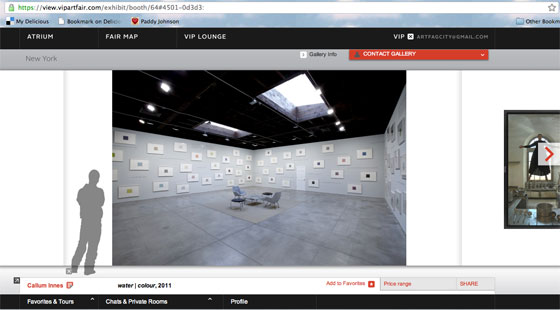
Me checking out an image at Sean Kelly Gallery before I changed my scale figure icon to "Ms. VIP II"
The VIP Art Fair was down for maintenance when I checked Twitter this morning, a bad sign amongst countless bad signs. Since the fair launched this weekend (it runs through January 30th), the first and only online art fair, has been riddled with problems ranging from connectivity to disappearing chats and navigational problems. I’ve heard rumblings from many dealers wanting their money refunded, and many collectors claiming they aren’t going to deal with the site any longer. “[It] was a complete day of collector torture,” collector Mike Mao told me over Facebook the day of the fair’s debut.
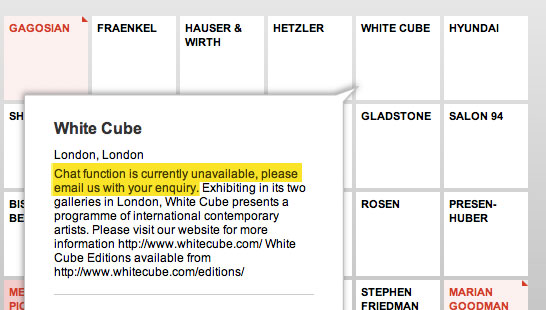
"About White Cube" - the gallery's info text on the VIP Art Fair's main navigation page
Just what are these issues? The most glaring one is that the site’s had slow load times and even downtime. According to Jane Cohen, one of the site’s co-founders, VIP received many more visitors than they anticipated, bringing down the company’s servers. Given the slim margin of error the site is working with — it is, after all, only up for a week — it’s surprising that they didn’t purchase far more space than they needed in order to prevent this issue. As of Sunday, my typical chat lag time was 30 to 40 minutes, a serious challenge to the term “instant message”. Apparently White Cube got wind of the situation and adjusted the text in their “about the gallery” description on the main navigation page of the fair. As pictured above, the first line describing the gallery currently reads: “Chat function is currently unavailable, please email us with your enquiry.”
Past this, most problems seem to be the result of a concept that would have been difficult for even the best web development professionals to overcome: launching a perfect website upon delivery that by design would be untested. A few pluses and minuses of the site below:
1. Slow image load times, and site down time. This is the worst problem and likely a deal breaker for future iterations of the show. If a dealer can’t make a sale, the fair’s worthless.
2. Navigation. It works, but is difficult to use. I like Internet sites with big navigation buttons so I know where to go. There’s none of that on this site save the chevron button moving the user from work to work. It’s not even easy to find the sign in page on the front page of the site! Still, it’s very nice that as you visit galleries, the site remembers and colors them for you; it’s a little feature that keeps the user running through the site.
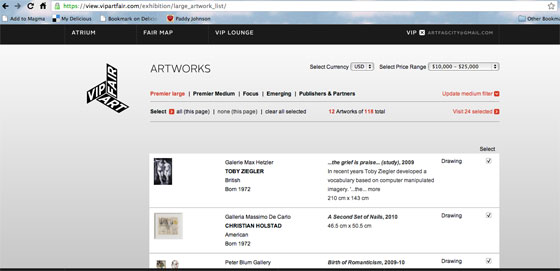
VIP art work search page
3. Artwork search function. This is a step forward for the art world — only a few sites offer comparable services, artnet being the most well known — but not without a few bugs. It allows users to search by price, medium, and artist, which is great, but I’d like to see color, size, and date added. 20×200 does a much better job in this respect. More pressingly, however, is the issue that I still have not been able to figure out how to move from one page of search results to the next.
4. Website display scalability. This could have used some work. The fair design was not optimized for smaller screens, such as my 13 inch laptop. The info bar had to be minimized to view the images properly, and even then, it was impossible to see the images as well as I would have liked. Artist Man Bartlett, artlog's Dylan Fareed, and I discussed whether the lack of a mobile version was a deal breaker over twitter — I’m not sure any of us thought it was a dealer breaker. I wish I could have bookmarked favorites, but as Dylan Fareed noted if the site worked properly I doubt anyone would care about whether it could be used on a phone. It would likely just be placed in a “things to look forward to” category.
5. No purchasing ability. Earlier this week I mentioned we’d have to wait until people were ready to buy hi-ticket items online — a mistake, since immediately afterwards I spoke with a well-known gallerist who chose not to participate because users couldn’t purchase online. The source, who wished to remain anonymous, also mentioned that the limited time concept made little sense to them.
Paddle 8, an online art-specific marketplace billing itself as “a series of online exhibitions curated by cultural innovators” (ew), was cited as more desirable, but until it launches in April we won’t know how it sizes up. More promising is 1stDibs.com a highly successful online market place for antiques, which now hosts fine art as well. If the drop down menus and ads are any indication of this site’s clientele, I'd say the giant ad placed by VIP and the default search price of high to low suggest they're targeting collectors. The site also allows visitors to build virtual portfolios and make offers on items. Of course, unlike the furniture section, which has almost all of its prices listed, almost everyone in the fine art section lists “contact dealer” as the default.
6. Privacy issues? According to Art Review, the default privacy settings allow galleries to view your email every time you look at a work. This seems to be not particularly useful for anyone. Galleries don’t want to add people who aren’t curious about their programming to an email list, and viewing is not an indication of interest. Users don’t want to be subscribed to lists they do so themselves.
7. Galleries can’t make any links from within the site to relevant outside sources. This is just stupid.
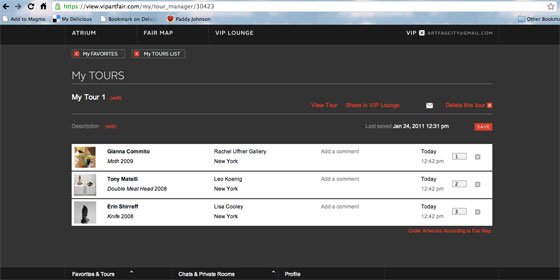
VIP tours. Apparently none of my comments were saved
8. Tours, Favorites and Sharing. It’s good that VIP has made sharing over Facebook, Twitter and email easy, but that’s straight forward. Only eight people have shared their tours in the Lounge, and I know why: it’s very difficult to figure out how to use them. First, users need to favorite individual art works; then, they can drag and drop those images onto their tours. The thumbs are too small to do this easily. Also, don’t click on the large tour icon image if you want to view what you’ve made. For that, only the tiny link below it will take a user to see their collection. Here, users can arrange the work they’ve viewed and provide commentary. This would be useful were anyone using it. Even the best designed sites take time and patience for users to learn how to use them, and in this case, a week perhaps just isn’t enough of either. Still, I’d be more inclined to learn if I could share my collections with friends, and I can’t do that. Instead I’m presented with searching through a list of tours by people I don’t know. Not fun.
9. Staying power. I’m not a shopper, so my experience on the site is probably a little different than that of a collector, but there weren’t a lot of attributes to the site’s design that made me want to spend time on it. I got bored of looking at jpegs, which is a problem for a fair that only lasts a week. Part of this is the structure of the fair itself, which offers no indication how quickly art is selling unless it comes up in a chat with the dealer. The art world likes this, of course, but even Art Basel has plenty of red dots, and the nature of the fair means that generating visible hype should particularly be on the organizer’s minds. Gilt.com, for example, does a better job of generating the kind of anxiety that comes from limited quantities of luxury goods: there’s a real fear, when their daily newsletter comes out, that deals will disappear if you’re not quick. Sure, some of that difference is down to operating in a different market, but a lot of it is good old-fashioned sales technique.
Galleries could do a better job in drawing collectors in, too, as there are a fair number who don't arrange jpgs well or simply could have prepared better. Gagosian is showcasing chairs for sale that look totally out of place in their showroom, and Galerie Peter Kilchmann chose to start with an image so small the male viewing icon VIP uses for scale is ginormous. Limoncello took this to an extreme, uploading a series of images that are teensy-tiny – or are they just far away? Maybe it’s some sort of statement about lacking the physical boundaries of the other fairs; ARTINFO commenter “Bear”, who brought it to my attention, seems to think it’s intentional [Update: apparently it is intentional – a statement is up on their site). Indeed it has a whiff of the Urs Fischer Gavin Brown collaboration at Art Basel whereby the gallery emptied the booth to show a crane pulling around an empty box of cigarettes by a string but at least that provided more pointed commentary on the frenzied booth. I’d like this more if it didn’t look like a mistake. Lisa Cooley, on the other hand, has a great-looking booth, but provides very little information on the artists. If this sort of accompanying information is what’s gained by using a website — and it is — it seems a waste to present so little.
Ultimately, VIP and its customers would be more successful if it were more attuned to what moves people on the Internet. I find it promising that the site exists at all — the art market is clearly ready to expand online — but as collector, artist, and co-CEO of Heavy.com David Carson told me over Twitter, this was “a good opportunity squelched by terrible execution”.


{ 48 comments }
Great Review! I had such trouble navigating the VIP website I just gave up. Thanks for letting me know I didn’t miss too much.
Great Review! I had such trouble navigating the VIP website I just gave up. Thanks for letting me know I didn’t miss too much.
Great Review! I had such trouble navigating the VIP website I just gave up. Thanks for letting me know I didn’t miss too much.
Great Review! I had such trouble navigating the VIP website I just gave up. Thanks for letting me know I didn’t miss too much.
Re Limoncello it is intentional, as they explain in their info section: Limoncello presents a group show of works documented by polaroid camera, to utilise the VIPs scaling function and associated function where viewer information is given when clicking on the tiny works.
Re Limoncello it is intentional, as they explain in their info section: Limoncello presents a group show of works documented by polaroid camera, to utilise the VIPs scaling function and associated function where viewer information is given when clicking on the tiny works.
Re Limoncello it is intentional, as they explain in their info section: Limoncello presents a group show of works documented by polaroid camera, to utilise the VIPs scaling function and associated function where viewer information is given when clicking on the tiny works.
Re Limoncello it is intentional, as they explain in their info section: Limoncello presents a group show of works documented by polaroid camera, to utilise the VIPs scaling function and associated function where viewer information is given when clicking on the tiny works.
#7 – Why make anything on the Internet if you can’t link? Grumble grumble.
I have related questions about the display of work – I will give them kudos for the avatar thing, it’s a decent band-aid for the scale problem – but how does it work? (disclaimer: not gonna register.) Are there only male and female silhouettes, or are there more choices? Could someone snag me a link or a good screenshot of one of them? 🙂
Here’s an image I uploaded for you:
http://artfagcity.com/wp-content/uploads/2011/01/scale-icon.jpg
Thanks! 🙂
I updated the post to indicate that. Thanks!
Late to the party, but for future generations:
It’s also most likely a reference to a Gene Davis exhibition at Fischbach Gallery in 1966 called “Micro Paintings 1966”, where everything was, well, really tiny. It’s referenced in “Inside the White Cube” as being important in making the structures around it – in particular, the wall – obvious, and giving them thing-ness and objecthood unto themselves. In retrospect, it seems like it wasn’t a bad idea at all on Limoncello’s part, they just shot really, really high in terms of estimating people’s knowledge of this stuff.
VIP – very inactive page
The whole thing is insane; I know more and more, collectors are relying on jpegs, but really, what does it say about art that someone would be willing to drop thousands, or tens of thousands, on something that they haven’t actually seen in the flesh? You might as well be talking about the Sharper Image catalog or something. What it says to me about art is that it no longer has any value whatsoever outside of being a ridiculously expensive impulse buy. As a critic, however, it suggests my job could become a lot easier: If you don’t need to see the art in person anymore to buy it, why would you need to see it anymore in person to render a judgment about it?
Who would want to buy art online? The roar of the greasepaint, the smell of the crowd. The human contact, the press of the flesh that distinguishes the art fair experience – all missing. This central lack eclipses the details of slow loads, tough navigation, poor legibility etc.
Which is not to say that selling art via jpgs is dead on arrival. It’s certainly of value in a one-on-one situation, especially when a gallery wants to communicate with a potential client on the other side of the world and present images of work, especially if this is followed by the real experience of viewing the work. But not in a group context like the one presented in the VIP fair, which is bloodless and ill-founded.
Obviously more and more will take place on the internet, but ultimately we will still have real food, kids, kisses, drums, dancing, rain, octopii. Personally I would like the art to stay in the real world.
@Hhalle @StevenKaplan I think it says that buyers have a lot of money. If buyers prefer buxom nudes and bright colors in art work and those attributes don’t have that much connection to the merit of an art work, I don’t see why we need to get up in arms about collectors buying from jpegs. We’re not evaluating art by the same standards many collectors do, so we still need to see the work in person.
The problem with this fair is not that it can’t replace the IRL version, but that the site doesn’t work well on the terms of the internet. If I were the Cohans I would be very upset with their developers. This has to be very embarrassing for them and a lot of the problems they’ve had are hallmarks of poor site development. Of course, I would imagine the Cohans lack of knowledge about the business of the Internet didn’t help either.
Paddy: The fair seems to have attracted many top galleries, both in terms of $$ but also in terms of sophistication, reputation and clout. How much did it cost them to participate? If very little, or if there were sweetheart deals for certain key players, then I can understand the elite participation. But those elite dealers are not looking to sell “buxom nudes and bright colors”, are they? (Unless you wish to apply the term to John Currin, Lisa Yuskavage and your mascot, Eric Fischl).
So my central critique remains.”Poor site development” and “lack of knowledge about the business of the Internet” still take second place to a defective realization of what is possible and what will work in the haute art marketplace.
I believe it cost between $5,000-$20,000 depending on the size of the booth. It’s expensive.
And every elite dealer has their bread and butter art work. It doesn’t mean they aren’t interested in the merit of art as a whole, it just means they want to eat.
Ninety-eight percent of gallery staff know next to nothing about the internet. Hell, most of them don’t even know the difference between a TIF and a JPG. I’m sure that a lot was lost in translation between the organizers and their developers.
Ninety-eight percent of gallery staff know next to nothing about the internet. Hell, most of them don’t even know the difference between a TIF and a JPG. I’m sure that a lot was lost in translation between the organizers and their developers.
Ninety-eight percent of gallery staff know next to nothing about the internet. Hell, most of them don’t even know the difference between a TIF and a JPG. I’m sure that a lot was lost in translation between the organizers and their developers.
Ninety-eight percent of gallery staff know next to nothing about the internet. Hell, most of them don’t even know the difference between a TIF and a JPG. I’m sure that a lot was lost in translation between the organizers and their developers.
Also, an amusing exchange on the subject at a dinner party I threw Saturday:
“What’s the point of holding a fair online if you get rid of all the parties and networking?”
“That’s the best argument I’ve heard for VIP yet!”
Most participating dealers will be happy with the attention their brand got worldwide. Or does anybody think the site crashed under the load of collectors in a buying frenzy? Fried air, nothing more. They don’t care as long as their name is in the media. Too bad the poor developers of this great attempt were used as colateral. Even worse is that trully great initiatives in the pipeline will have a very hard time getting noticed after this. This is not worth the attention it is getting.
Very few dealers participate in fairs exclusively for the advertisement. It’s a very expensive form of marketing, particularly when there’s an opportunity to make money.
Also, yes, I do believe that the load of images, staff and collectors crashed the site. VIP has been much easier to navigate in off-peak hours. I don’t think that’s an accident.
Truly great initiatives won’t have a hard time getting noticed after this. Social media marketing works because its user base believes in the product just as much as its founders. In other words, if the product is good it will sell itself.
Given the amount of money invested in this project both by its developers and as rented real estate, VIP is absolutely worth the attention it is getting.
Were there not booths available for roughly twice the cost of a full-page ad in Artforum? The cost of entry really was not that high. If the fair had been a success, the organizers could have raised the rates next year. I guess they can forget about that.
Were there not booths available for roughly twice the cost of a full-page ad in Artforum? The cost of entry really was not that high. If the fair had been a success, the organizers could have raised the rates next year. I guess they can forget about that.
Were there not booths available for roughly twice the cost of a full-page ad in Artforum? The cost of entry really was not that high. If the fair had been a success, the organizers could have raised the rates next year. I guess they can forget about that.
Were there not booths available for roughly twice the cost of a full-page ad in Artforum? The cost of entry really was not that high. If the fair had been a success, the organizers could have raised the rates next year. I guess they can forget about that.
“They don’t care as long as their name is in the media.” There’s a cheaper way than participating in an online art fair. Fly out an “art reporter” from one of the major blogs, wine, dine and hotel her, and behold: your pic taken and your name spelled correctly in artforum.com.
I did not mean to imply that not every effort and cost was made to build this site. I am convinced that the site went down under the heavy user load. Only those users are not buyers. Or shall we suggest to eBay that they get rid of the “Buy it now” button too and instead let seller and buyer skype?
I fail to see the substantial “innovative” difference between the online catalogues of prominent galleries on Artnet and many of the same galleries at the VIP “exhibition”. I think we all want this to work but let’s not exaggerate. Anyway, the site seems to be working much better now and I am sure they will improve it over the next weeks.
I’m not sure I follow: Are you saying that you think it’s mostly art enthusiasts that were using the site, not collectors or simply that collectors can’t buy works off the site and therefore won’t? I haven’t talked to any artists who have perused the site save for one geek, so I’d be surprised if it’s filled with art nerds. And I’m sure people will buy off line – just not in the numbers they need. Jane Cohen reported “more than a dozen galleries” making sales. Those are scary bad numbers. I think a buy it now feature would have helped actually.
Artnet offers a shitty website for galleries in exchange for being searchable in their database. The image handling capabilities of VIP are significantly better and so is the amount of information they can handle. I think the site’s a huge step forward in that respect.
Sounds like the people working on the website could have been under immense pressure from people who really know nothing about web design and think it’s all something that could be done in an hour. Those who think that about web design are very wrong. It’s a long tedious process, and could probably have done better if they would have run it through a few times to see the bugs. I’m assuming they didn’t get that time, as there was a deadline and the problems just couldn’t be fixed on time. Don’t get mad at the programmers, they spend 10-16 hours a day coding these things. Web projects like this need time to get everything correct.
I say kudos to the programmers and the visionary who came up with the idea.
This is just exchanging one generalization for another. I’ll take back my “be furious with the developers” if you take back your “furious with no-nothing dealers”.
It’s not like they couldn’t have changed the fair date. If there are problems that need to be fixed you move the launch date back. Nobody likes to do it, but it is common.
Bored Now… is this what the art world has come to? sniveling critics.. no wonder I never bother with any of it anymore.
Bored Now… is this what the art world has come to? sniveling critics.. no wonder I never bother with any of it anymore.
Bored Now… is this what the art world has come to? sniveling critics.. no wonder I never bother with any of it anymore.
Bored Now… is this what the art world has come to? sniveling critics.. no wonder I never bother with any of it anymore.
I have to side with the developers on this one. The amount of code/ interactivity/functionality going on VIP is intense- trust me, those developers are rockstars.
I think VIP suffers not from bad developers, but from a bloated vision. VIP is a beta site- it was waaay over developed for an initial launch. As a non-technical founder of a soon-to-be tech art startup, I can tell you that when you begin initial designs- when you imagine what your final site/product will look like and how it will be used by the people who visit, it’s about 80% too much. It’s much smarter to follow someone like Eric Reis’ “Minimum Viable Product” model- the “make the smallest thing that can be considered a complete product and ship it” idea. Why? Because you don’t know if your implementation/ beta version of the idea will work, what people really want/need (as listed in Paddy’s article), bugs or how x number of users will affect traffic speeds. You need data, data, data and I’m actually surprised that they launched so large on the first outing. Better to have an ugly site that works than a beautiful site that no one can see. You can see this model being followed by young technical founders at incubators like YCombinator etc. Functionality always comes first, and most of the sites are ugly as sin when first launched. You can always make the site look better- that’s the easy part.
This is just my opinion, but to someone faced with the same issues it looks like the Cohan’s got exactly what they wanted- if anything, they’re probably upset that they couldn’t cram even more features into it. I know because I had the same problem with my designs for an upcoming site. You want A-Z, you think you can settle for A-K, and if you’re smart you’ll end up with A-B and test the crap out of it. We had to take a deep breath, step back and take an ax to almost everything. Thank god for low budget bootstrapping 🙂
Either way, you can bet that VIP next year will work 100% better- if it doesn’t, then we can switch blame to the programmers 😛
I guess my opinion on the matter is that if you hire someone to develop a site for you, it’s their responsibility to tell you if your expectations are unrealistic or over reaching. If a developer needs data to launch a site properly, then they need to tell their client, and put their foot down about it. The Cohan’s did an excellent job selling this site to everyone and their dog. They can’t afford to have it not work.
Far more labor went into this fair then the cost of an ArtForum ad and that’s not free. This is much more expensive. I also don’t see the galleries’ participation as a particularly effective form of advertising. The site went down a lot (though it seems to be stabilized now), so the bulk of viewers wouldn’t see the galleries — most of them come on the first day and given the troubles wouldn’t come back. Also, that’s a lot of galleries to go through. After a while they all start to look the same — that’s not good for advertising.
Just a note that anonymous comments will not be approved. I’m talking to you, Ballgagmaster4you
Thanks for the review. Having recently launched an online art site myself (artsicle.com) I have been eager to hear feedback on the VIP Art Fair. We’re in beta now, but will certainly be using what we can learn from these mistakes to improve the online art viewing experience.
I’m collecting feedback and a wish list for a great experience here if anyone would like to add his or her two cents: http://blog.artsicle.com/post/2948108197/vipartfair
An unauthored comment:
People buy luxury vehicles online, real estate online, million dollar deals are done 24/7 online so why do so many people question the idea of selling art online? If I know the artists work I have no problem buying online. I’d prefer to buy it from the website of the artist though. Case in point, Anthony Lister. I own three paintings by Lister and would love the opportunity to purchase more of his work online instead of waiting for the off chance that an exhibit of his art will take place near enough for me to attend. If I buy directly from Lister he ends up with more money to create which results in me having more to choose from if I want to add another of his paintings to my collection. If I buy from a dealer I know that Lister stands to lose 50% of the profit just so some snug bastard can feel that he is just as important as the artist behind the art. Art dealers are parasitic no matter how you try to approach their business. Since so many lack basic understanding of online promotion you really have to ask if they are of benefit to an artist in this day and age outside of keeping other parasitic professionals working just as they have always done. If the galleries go under the art magazines will go under and if the art magazines go under art critics will be out of work. Don’t say it can’t happen. Auto magazines were once the most published type of magazines in the United States. Now there are only a handful to choose from because most of the information covered can be found online. It will be the same way for art magazines.
Many useful comments for next time. I can’t imagine they won’t do this again.
My $0.02:
I think many people don’t know how a lot of art is actually sold. It’s not always the “doggie in the window” or even anything else in the show that gets sold. It’s jogging someone’s memory or hitting a button that makes a light go on. That’s why not being able to chat with the dealers was a blow to the dealers. A guy is looking at a William Kentridge and next to that piece is something that really strikes a chord…and they only want how much? Or maybe the guy thinks maybe he can afford a Kentridge and this gallery is accessible. Or, like someone else on this thread suggested, you see this cool emerging artists and you go to their site. So contact is ignited that way.
When it comes to the sale, a lot of things come into play and money is not the only thing. There is location, location. location, a matter of who’s asking, what does the collector really like and there is negotiation. I really don’t think some of the objects on display this time were actually available for sale.
“Real” vs “Virtual” art: Why is it so bad to look at art this way? If you see a pricey outfit or great car online and you are able to go to a store and see if you like it before you buy, don’t you do that? Don’t you look online to see what the deal is with something and the best price before you go shopping? If not, you should! Aren’t shows, or at least the artits in them, often put together from slide registries? I saw so many artists and work that I didn’t know about before and did it in far less time than I would have been able to “live”. Now, if I see a book or an upcoming show that features them, I will check it out.
I was surprised this thing was as good as it was. The ambition was delerious and they came really close on the first try. I look forward to next time!
When I said location, I meant that most dealers will not sell an important work to just anybody. The collector has to have some kind of capacity to maintain the prestige of the work, like an important collector, museum connections, non-schlock celebrity, no danger of work getting repossessed by a credit card company, etc. Not my rules but they are the rules.
Comments on this entry are closed.
{ 9 trackbacks }