
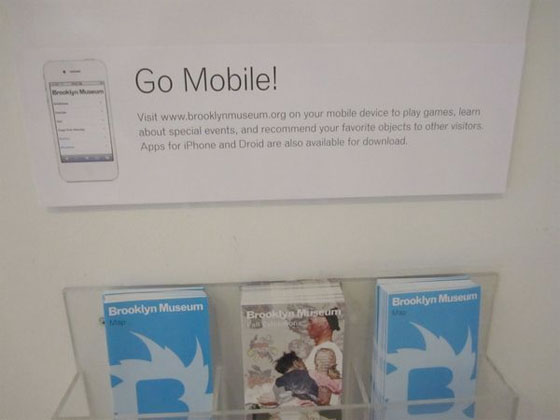
Image via: The Brooklyn museum
What are we really talking about when we discuss “the dangers” for museums now embracing technology? Arianna Huffington expressed some reservations on the subject of institutions working with tech yesterday at The Huffington Post saying “…museums deliver what has become increasingly rare in our world: the opportunity to disconnect from our hyper-connected lives, and the possibility of wonder.” she writes, adding, “the danger of social media becoming the point of social media — connection for connection’s sake, connection to no end — is one museum’s need to particularly guard against.”
Although Huffington never explicitly mentions it, the underlying belief behind her argument is that art is better understood when seen in person. If we’re all looking through our phones, is the value of our experience lessened? Since viewing in the gallery is usually different than what I see on the computer, there’s probably some credence to this thought though of course it should be applied on a case by case basis. I use my camera obsessively when I visit museums because I don’t have a very good memory, so while the act may disrupt my experience during the show, I write better reviews for it. My chief technology complaint is usually that I don’t use it enough.
Ultimately though Arianna’s concerns don’t have to be about technology at all. Imagine the same conversation, this time applied to wall labels, and we can start drawing a few parallels. People don’t look at the art, they read the wall label (technology distracts). The wall label is only intelligible to art professionals (only tech people can figure out how to use this app). The wall label tells me too much (technology makes us stupid). Huffington didn’t speak too much on the second point, but the other two feature prominently in her article.
The fundamental problem museums are grappling with isn’t whether they should use technology, but how to make people look harder, and be more curious. I’m not sure there is a cure-all solution, but trying new technology out doesn’t hurt. As Shelley Bernstein, the Chief of Technology at the Brooklyn Museum of Art, writes, “The curated content is already on the walls in the form of object installation, labels and didactics, in-gallery multimedia and gallery design. The power of the device means we can provide something else, something more unique.”


{ 11 comments }
I was disheartened when I went to see the Ab-Ex show at the MoMA recently and noticed people constantly walked up to a painting, photographed it, and walked away without spending any significant time looking at it. I felt that their experience was seriously diminished, particularly since many of those works don’t reproduce well, and most were specifically made with the intention of being experienced physically (not by touching, but by standing close and contemplating).
This is not to say that we should ban photography in museums (or to reduce technology, which would be incredibly counterproductive), instead, museum officials should carefully consider how to communicate to visitors how to look at art.
I think it’s a genuine problem that people will willingly replace looking at the work for an image, though I expect many of these people wouldn’t be looking closely at an art work to begin with. I’m really not sure how to fix that issue.
Maybe better art education at a younger age? I was educated in the public school system and it took me a very long time to realize the difference between seeing something in a book and in person, partly because I’m a slow learner but also because I didn’t have an art history course until I elected (aka paid out of pocket) to take one in college.
For now, it’s better just to go with the flow than to propose some controlled “way” to look at art. And also, I hate to say it, but museums are a catchall. Not everybody is going to have communion with the great artworks on an equal level. If some people take a snap and walk off, it’s not a problem. A compelling artwork may not always be so, all art pieces and periods have long gone in and out of favor. Finding what is compelling to an audience from today is a real task, especially for artists.
Wouldn’t you agree with Huffington, though, that at some point technological mediation diminishes “the possibility of wonder”? I suspect that to assume that “trying new technology out doesn’t hurt” is to prepare the way for a Faustian bargain.
I really don’t see a problem about it . One thing doesn’t exclude the other. Museuns and art institutions in general should give to the viewer all altternatives and the viewer choose what is more apropriated. Sure that the experience of being in a museum can’t be substituted by any digital “refige”. But the new media makes it more democratic.
When I am in a Museum , I dislike any interference and want to have only a close relationship with the work. But dislike even more people choosing for me how I must to get in contact with art.
“But dislike even more people choosing for me how I must to get in contact with art.”
Well, then, you probably shouldn’t be going to museums.
Does technology really diminish the “possibility of wonder?”
I can imagine it doing the opposite – opening more windows of interest; revealing yet more unknowns and potentialities.
Curators could learn from the tangental media-flâneurism of tumblr bloggers and Wikipedia crawlers, whose insights are far more reflexive than most static object-art displays.
To your question I would say, yes at a superficial level, it does diminish wonder, as technology has the tendency to override a reflective attitude in the moment. This may be an unintentional commentary on contemporary art or art in general, but when a piece is particularly powerful it should elicit moments of immediate reflection upon viewing. A sort of ‘wow factor’ ; this type of moment of pause, in my opinion is diminished by the intermediary of technology. It ends up becoming a filter through which the actually piece becomes secondary to the equation rather than the primary experience.
Granted, the inclusion of technology to the display of art has the possibility of adding other dimensions and layers to the work, it also seems that technology’s presence also allows for a greater degree of detachment from that work. It seems to be a slippery slope. I couldn’t really say either way which is better, but my feeling is that an increase in technological inclusion is simply inevitable. It really becomes a discussion of HOW that technology is deployed and instrumented.
We shall see, eh?
I’m honestly kind of bummed out about the article that Arianna wrote and this discussion. Let’s look at someone like Andre Malraux and specifically his Museum Without Walls. He was essentially discussing this very idea that Huffington brings up however 60 years ago and in relation to the dissemination of the image in the publication of books rather than on the internet or on iPhone apps. Although one could argue that there is an overabundance of image reproduction now, I don’t believe that it is any more “threatening” than it has been since first recognized in the 20th century.
Furthermore, Arianna looks at this issue, and some people here in the comment section do as well, the same way Benjamin did with the idea of the loss of aura from the dematerialization of the art object. Well, didn’t people like John Berger point out that it’s the exact opposite? That the image reproduced in media actually is hypertrophic for the objects aura?
So it’s not the fault of the museum’s use of the internet, image production or iPhone apps for people simply snapping photos of an art object. We in fact should be thankful that a flanuer in a museum feels compelled to “keep” what they witness in an exhibition, whether it be ephemerally placed on a memory card in a digital camera.
If the proliferation of the image does anything it increases the chances of inviting someone to walk into a museum and appreciate the work of art, rather than not bother to even look at it all. I’ll be damned if anyone can name a single work of art that they felt underwhelmed them because they “saw it so much on the internet”. (with the exception of internet and online video work of course)
More education at a younger age. I think the biggest issue with my non art friends is that they are intimidated by the experience of going to a gallery or museum.
Not “getting” a piece of fine art makes them feel dumb or uncultured and can create the feeling that most of us feel when we are made to feel stupid: resentment. It creates separation instead of bring people together.
So more apps! They came into a museum for christsake! Give them a break! They may come back!
Comments on this entry are closed.