
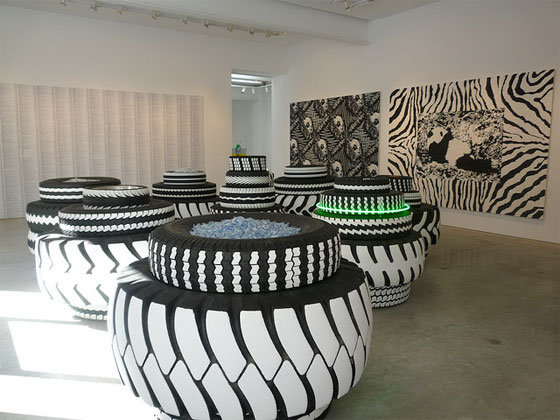
Rob Pruitt's Pattern and Degradation at Gavin Brown. Installation view
Thanks to Howard Halle’s end of the year list nominating Rob Pruitt as one of his top ten exhibitions of the year, I revisited Halle’s review of the show over the holidays. The money quote from Halle:
At once insipid kitsch figure and boyhood madeleine, the panda makes its return in this new exhibit, after a considerable absence. It serves as a touchstone for the show's hilarious if slightly mean-spirited unpacking of our current culture, and how it impacts the branding of artistic identity.
That critter, along with its similarly colored cohort in the animal kingdom, the zebra, appears in numerous paintings, which are sometimes flocked with glitter. But more interestingly, its black-and-white scheme extends to a phallanx of tire planters filled with M&M's, cigarettes and other goodies, all free for the taking. In one fell swoop, Pruitt seems to be calling bullshit on the faux populism of Richard Prince's down-on-its-luck Americana, and the faux generosity of Felix Gonzalez-Torres's candy giveaways. But Pruitt hardly spares himself. His doleful mug stares out from a series of large paintings based on the old Surrealist exquisite-corpse game, in which a piece of paper is drawn upon, then folded and passed to another person who repeats the process. The resulting visual non sequitur is transmuted here into photo silk-screens on canvas, featuring the artist's countenance fissioned into horizontal identikit bands. There's one at Maccarone of Pruitt in a Mouseketeer cap, sucking on a lollipop while sporting one of those T-shirts with COCAINE spelled in Coca-Cola lettering. At GBE, a group of them faces rows of chairs of varying style and vintage, each wrapped in chrome foil as if they'd died and gone to heaven. The congregational feel of this arrangement, combined with Pruitt's slippery views of himself, suggests that any artist, if they're going to be good at all, must be a synthesis of prophet and fraud.
There is a whole lot more here—Amish quilts rendered in graffiti spray paint; weird Day-Glo color-field compositions, sweetened with crudely drawn smiley faces; cute “monsters” created from recycled stacks of cardboard, with googly eyes made from wall clocks—all buoyed, perhaps, by a dark recognition that when a high culture with all the marbles borrows from a low culture left with nothing, the results are more cringe-inducing than anything else. But then, Pruitt's work has always been predicated on the hard art-world truths that the extended hand is always balanced by the one with the knife behind the back—and that self-abasement can bring with it a shiver of self-knowledge.
Meanwhile, I jotted down a few of my own thoughts for Art Agenda, offering a different take on the matter.
Rob Pruitt’s joint exhibition at Gavin Brown’s enterprise and Maccarone, “Pattern and Degradation,” presses a few of my buttons. Even before stepping into the gallery I had some concerns—the notion of filling over 8,200 square feet with two years of new work without compromising quality seems a stretch, so naturally the show’s theme is about excess. According to the press release, the work is informed by the Amish tradition of Rumspringa, a two year rite of passage in which Amish teenagers are allowed to indulge in all the excesses of modern life before returning to a more modest existence. Pruitt’s exhibition posits a world in which he lives in a “Permanent Rumspringa,” a concept that sounds suspiciously like a marketing ploy to explain over-production.
Seeing as how only two rooms of eight directly deal with Amish culture, there’s not much reason to think otherwise even if indulging in contemporary excess is likely to occasionally exclude a lot of the religion. At the far end of Gavin Brown, rows of both modernist and traditional Amish chairs coated in silver weakly gesture to the religion, as do a number of large patterned paintings referencing traditional Amish quilting. The basic gist of these pieces seems to be “What if my tablecloth could be large and bold enough to create optical vibrations?”
As one might imagine, there’s a fair amount of art exhibited that appears to have no other purpose than to be sold. This is particularly true at Gavin Brown, the weaker arm of the exhibition. A room full of exposed, stretched linen provides a surface for illustrative renderings of “Rob Pruitt” t-shirts. The same shirts hang just inside the office, only they can be worn and aren’t nearly so pricey. Add to this, the artist’s inbox printed out and affixed to the wall, a giant grid of faces and names drawn from his Facebook profile (at Maccarone), and his goofy Warholian self-portrait paintings—these works are characterized by gratuitous self-absorption: a problem the theme of excess is meant to excuse.
In an email last week, Halle tabled the idea that Pruitt’s work achieved a state of grace through superficiality, an idea he tied to spirituality and religion. This made sense to me until I realized that when Christians ask for the grace of the Lord, and the Amish indulge in Rumspringa, they are seeking presence not absence. The spirit of Lord should be with us, the Amish will achieve greater awareness through the process of Rumspringa. And there’s a practical purpose to this — that presence gives us greater agency.
There can be no grace in an exhibition that so successfully embraces the ugliness of excess. Perhaps I’d do well to laud Pruitt for this — he did after all achieve his goals — but I can’t. The exhibition re-enforces a stagnancy I think is corrosive to society as a whole, and I just don’t think it’s a good idea to get behind that.
Related: Urs Fischer at The New Museum.


{ 5 comments }
What excellent, thoughtful commentary by paddy.
(nice revamp/redesign of the site too)
It seems to me that the issue with Mr. Halle is his desperate attempt to stir up- to drum up interest- in himself.
Trying too hard is all too pervasive in Art Blogdom. Maybe Mr. Halle’s time is best spent writing fiction but alas will people read a book, short story or script by someone who is so
obviously bored with them self?
Sure! Just look at how Rob sugar coated his own lack of awareness, lack of originality; his own conflicted life of boredom/success into a another press clipping/Blogbite.
This show seems only slightly more thoughtful than Dan Colen’s tipped over motorcycles and gum paintings.
Anyone know if anything ever happened with those people from threadless who’d been protesting Pruitt’s use of their panda image? They should go in and take all the free cigarettes and candy if they still feel like he owes them something.
I don’t think the work is quite as empty as you guys don. I think the Felix Gonzalez Torres critique is solid for example. The thing that really bothered me was his emails affixed to the wall — that was a Dan Colen equivalent. Why is Pruitt’s inbox so important that it should be a wall piece?
what leads you to think that christians and amish see grace as “the spirit of lord…with us?”
grace is a lot closer in definition to “mercy” than anything else in the christian tradition and, if we take mercy to be one sparing another punitive action, absence is entirely appropriate to cite. unfortunately, so far it’s an irrelevant term in this discussion or rob pruitt’s work.
FYI:
I can’t speak for the amish (though I do think that indulging in rumspringa is unrelated to seeking grace), but I am the son of a minister and the call for christians to be “in the world but not of the world” leads me to believe that any idea of grace that we can have through our day-to-day material experiences cannot involve literal attachment or presence in the terms of anything material we know (things like, the poetics of art, f’rinstance). every presence should be as an absence to christians and I personally see this as a rarely spoken link between christianity and eastern religious practices.
I realize I’m like, what—two weeks late?—in responding to this, but I feel like I should. I’m not trying to convince anyone with respect to Pruitt’s work; it’s true, I have a platform for now, so it seems to work out that way, but my intentions—as always with my writing—is not to drum up interest in myself or to write fiction, but rather to give an honest appraisal of the art I see and make arguments for my reaction. Are my arguments full of holes others can take issue with? Sure. All arguments are, that is the point of arguing—or to use a favorite art-world phrase, “dialog.”
There were a couple of things I saw going on with this show that convinced me it was one of the year’s best, and of course, readers of both my original review and my subsequent Ten Best/Worst List are free to disagree. For one thing, let’s start with the title, “Rumpspringa,” which in Amish culture is the spiritual quest undertaken by everyone coming of age—in this case, 16—to challenge themselves in world beyond their spiritual community. The point being: to see if they really want to remain within its strictures. The term entered popular culture thanks to stories of young Amish gone wild—dealing drugs, for example. People were captivated by those reports precisely because they ran contrary to the sober square image of the Amish. That irony is Pruitt’s entry into using rumpspringa as a reference, but it’s not the point of the show, nor is the idea of Amish culture itself, despite his inclusion of quilt-patterned paintings created with spray paint that is specifically marketed to graffiti artists.
Rather, the show is Pruitt’s own version of a rumpspringa from the community he belongs to—or rather aspires to, and that would be the art world, or more to the point, the tippy-top of the pyramid where collectors and institutional gatekeepers own the playing field. The line separating it from the huge percentage of artists desperately craving recognition but never receiving same is one that, oddly, Pruitt seems to be on either side of simultaneously. Or he seems himself that way—as both outsider and insider—and that situation, his place as an artist precariously positioned between success and failure as defined by the art-world elite, is the thrust of his work. Now before we all go, “Hear that sound? It’s the sound of the world’s tiniest violin,” let’s allow that the place I describe above is real enough: It’s decadent, and unfortunately, given the current balance of power worldwide between haves and have-nots, unchallengeable for the foreseeable future. (Here, by the way, is a link to an article that describes exactly the situation that I posted recently on my FB page: http://www.theatlantic.com/magazine/archive/2011/01/the-rise-of-the-new-global-elite/8343/.) It’s the reason why an artist like Dan Colen can get such an immense show for so little talent; his work, and more importantly, his own persona, plays to the vanities of the art-world elites, or to enough of them, anyway.
Now there’s is no question question that Pruitt’s work is possessed of a certain quality of hollowness or superficiality that resembles Colen’s, but I’d argue there’s a difference. Pruitt to my mind makes his own complicity in art-world fatuousness abundantly clear; I’d argue it’s a form of institutional critique, which is where I’d take issue with Paddy’s point that the show is purely an exercise in excess. I think taken as a whole, the show is a critique of excess. There’s nothing like that level of self-consciousness in Colen’s work; merely emptied-out signifiers of “edgy.”
And yes, Pruitt’s show is full of borrowed tropes, but again, used to satirical effect, most notably in the tire-planter pieces. But there’s plenty of his own imagination on display, especially in the recycled cardboard people with clocks for eyes staring at trays of Cinnabon treats. One could even argue that work alone would have constituted a show, but it’s message—about the 24/7 world of consumption we all inhabit—would have be too limiting. Pruitt’s real target, I would again submit—are the elites who are the beneficiaries of the world economy in all of its manifestations (including the stock-market valuation of Cinnabon).
Paddy mentioned my email exchange with her where I proposed that Pruitt shares with Warhol a search for the spiritual within the superficial. It’s easier to see that in Warhol’s work: He was a devout Catholic, and the church’s investment of power in icons is easily seen in his work. He’s also lived in a time when the line between high and low culture was still sharply drawn. He opened the floodgates between the two, and the resulting tide is one that artists like Pruitt have been swimming in ever since. The trick is to do so without completing losing one’s sense of being an artist, working ultimately for yourself. That is the presence he seeks within the boundaries of the game of art as it is now being played. That’s the state of grace he’s trying to achieve, the goal of his peculiar rumpsringa. One can argue that the particular path he’s chosen to take in the show—the celebration of excess Paddy notes—can only lead to failure in this regard. But I appreciate the fact that he’s trying.
Comments on this entry are closed.