
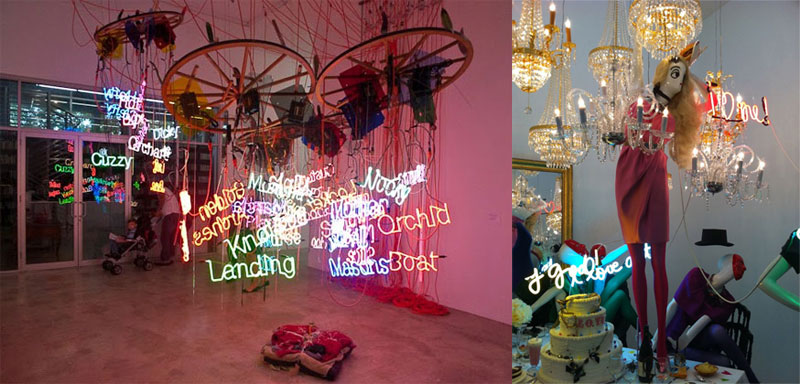
LEFT: Jason Rhoades, Untitled (Chandelier), 2004. Glass, wire, neon, Plexiglas, fabric and plastic. Via: Harlan Erskine RIGHT: Lanvin Paris display
You know what looks a lot like the Jason Rhoades sculpture above? The “window” display for Lanvin Paris [pictured above], an international fashion house and sponsor of The Rubell Family Collection’s latest exhibition. The two installations are stationed only a few feet away from one another, Lanvin in an an alcove usually dedicated to art. Admittedly it’s a nice display, but I’d like to see a little more separation between the real art and the fake art. There’s far too much blurring these days, Chanel’s sponsorship of Rumsey Playfield in Central Park two years ago amongst the worst. That ill-advised pairing asked artists to make a Chanel inspired art ork!

Time Capsule, a project by Jason Rubell
The sponsorship is just one of many choices likely to grate on visitors. “Time Capsule”, a small exhibition on the first floor showcasing the work Jason Rubell collected between the ages of 13 and 21, likely won’t sit well either. At the age of 13 no one is producing culturally valuable material, and purchasing power alone need not be lauded. The full narrative here is a little more complex though, as Mr. Rubell put the collection together for his thesis at Duke University and claims the experience greatly informed the opening of the Rubell Family Collection in 1994. This is a worthy theme for an exhibition, so I wish it had been explored. Instead, we’re given a re-staging of a 95 piece thesis project, with little to no explanation for why the works were purchased or the criteria by which they were chosen for the show. Little attempt to produce a time line is made either, so the growth of Mr. Rubell as a collector mostly remains a mystery.

This Cady Noland piece was on view last year, so technically not every work in the "How Soon is Now" is a "previously unseen work" but who cares. I'm glad this piece gets a little extra time.
“How Soon is Now”, fills the rest of the museum, an exhibition of previously unseen works in their collection, most of which were purchased within the last few years. How Soon Is Now doesn’t have much more to offer conceptually than a “recent acquisitions” show, and doesn’t look very different. In fact, the only visible distinction between two lies in The Rubell’s purchasing power, which is a lot greater than the average museum. A few highlights below.
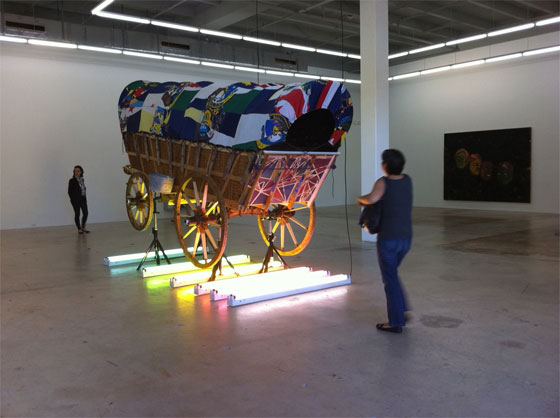
Matthew Day Jackson
Matthew Day Jackson’s work takes up the entirety of the largest first floor gallery. I’ve always enjoyed Jackson’s work, but I may be biased. I went to grad school with the artist.
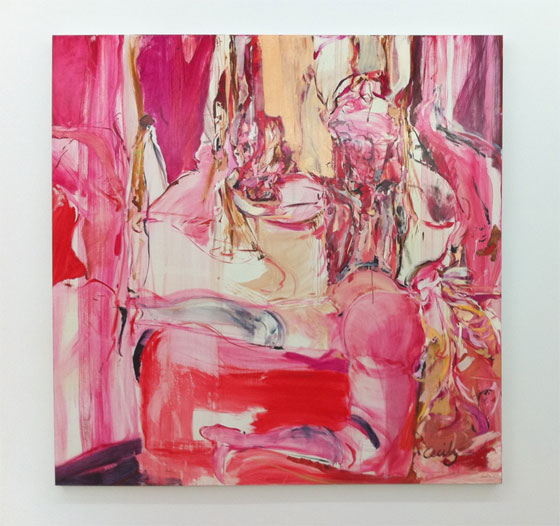
Cecily Brown, Service de Luxe, 1999, Oil on Linen, 75 x 75 inches
Cecily Brown’s produced a lot of work since her heyday in the late 90’s and early 2000’s. but I’ve seen few paintings since that are as compelling as her pornography-inspired works (see above). Strangely, I never see her work at art fairs. I don’t know enough about that market to know why.
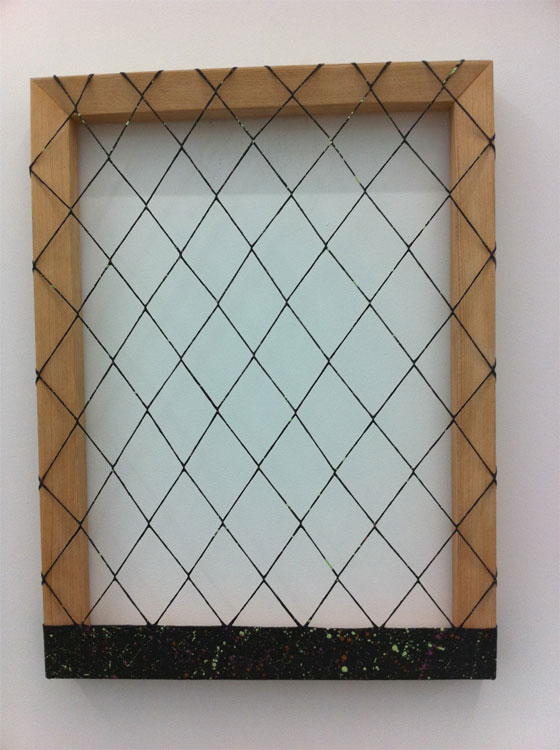
Dianna Molzan, Untitled, 2010, Oil on canvas on fir, 24 x 18 inches
Clearly the Rubells have been reading AFC (or visiting the Miami art fairs)! Last year I named Dianna Molzan’s work at NADA notable and included her work in my L Magazine summary of hot art trends. The work above takes a little less from fashion than some of her earlier works, but the impulse to use cut fabric as a compositional device remains consistent.
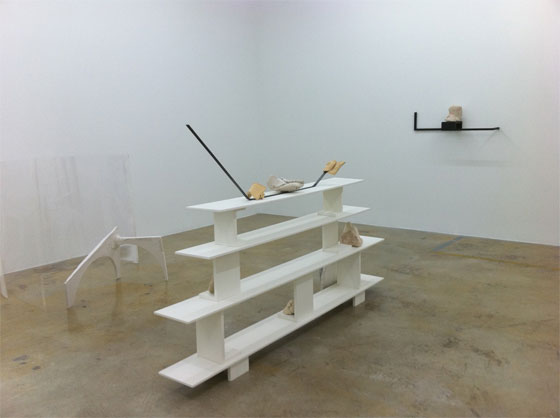
Thea Djordjadze, Ohne Titel, Deaf and Dumb Universe (Regal), Pythagoras
Shelf art is pretty popular these days – blame Liam Gillick? – but I’m a fan regardless. In this work I like how simply following the directional lines within each form moves the eye around the entire room. Related: Dan Fox on Djordajadze


{ 6 comments }
I want to add my favorite parts of “How Soon Now” (aka “What Fuck This”): there were two notable video installation rooms, one featuring the films of Natalie Djurberg in a good pride-of-place gallery at the top of the stairs; the other dedicated to the videos & installation work of cutie pie Ryan Trecartin. I plowed through most of the rest of this show but was thrilled to hang out in both these rooms by two of my favorite moving-image artists…
That Lanvin Paris display made me sick to my stomach. Wasn’t really sure why (it wasn’t the oatmeal). It just made me feel…gross.
I don’t think you can separate the Lanvin display and the Jason Rhoades when there’s such a profound similarity and they’re placed one next to the other. Rhoades is either incredible stupid to allow this to chip away at his fabulous artstar cred or incredibly self consciously composed to allow the grossness to step forward with the comparison. I’m giving him the benefit of the doubt and assuming that he’s a better artist than I had previously thought (by allowing his low bar work to get even lower.)
Maybe it was the Lanvin thing, or Jason’s acquisitions show, but more than any other year, it felt like the RFC’s presentation conflates curation and consumption. Shopping is curating.
@clay Jason Rhoades died August 1, 2006.
HELLO! Maybe you should google him Clay! He’s passed away a while ago. I’m sure its not his decision to put it there.
Comments on this entry are closed.