
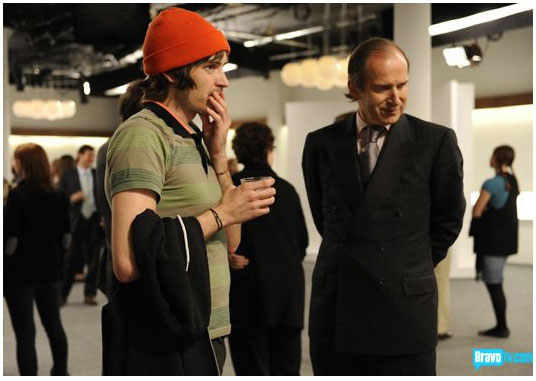
Ryan Shultz looking forlorn and standing next to Simon de Pury.
“Welcome to Soho, one of the central art districts in the world” explains auctioneer and mentor Simon de Pury to Work of Art contestants, his own company located in the actual central art district, Chelsea. De Pury gave artists a tour of the Kenneth Cole lined streets for this weeks episode, his voice over adding relevant information about the neighborhood’s art scene in the eighties. All of this is presumably done to cover up the fact that their destination — the Children’s Art Museum — is of no relevance to most contemporary artists.
Undoubtedly the dullest episode yet, this week Bravo invited artists to use the museum’s materials to create a work of art exploring the experiences that led them to art making. An obvious ploy to get artists talking about their sordid past, predictably, almost everyone followed the cliche and determined that this happened as a child.
With almost all the Bravo descent-ers eliminated, almost nothing was offered by way of show critique. “I don’t want to go home for not knowing how to use popsicle sticks.” Miles timidly whined, a half-comment on the lameness of the project.
From here we watch endless footage of Ryan, [SPOILER ALERT], who up until now had received very little camera time. Even before the audience sees anything he’s made they know he’s going home. We also watch Miles appear to seed the idea that Nicole should make eight of memory trays — (no argument ensues), and a bunch of petty bickering over whether Miles is cheating for recreating a similar piece 9 months ago. Um, why is this an issue now? Peregrine remade a piece a couple of challenges ago, and no footage of contestants complaining about that was offered up.
These issues were brought up by Mark, who continues to offers an array of grating comments, “I never really had quote unquote art supplies.” he tells us, as if his life somehow challenged the notion of traditional materials and the role of the artist. “I decided to make a book about my life and how I got to be quote unquote an artist.
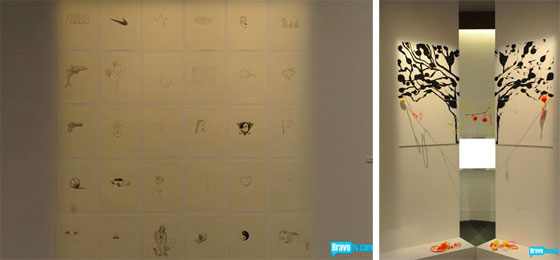
LEFT: Abdi Farah's Straight Line RIGHT: Jaclyn Santos' Untitled
This episode Simon de Pury expresses a few more critical thoughts in the studio, a welcome addition even if his comments made Abdi switch from one bad idea to another. I was sick of his super hero drawings the minute I saw him, so I’ll take his final poorly edited grid of symbols. Notably, he barely mentioned the “pipe cleaners and fluffy material” to Jaclyn Santos as something to use, and the next day the artist had integrated the suggestions into her work. It’s unclear if Santos is simply filled with too much self-doubt to generate her own ideas or they simply don’t exist, but whatever the case, this is not the kind of problem that easily disappears.
Cut to the crits, and painter Will Cotton is introduced as the guest judge. Like Richard Phillips, Cotton makes an excellent case for casting an artist in a permanent role judge, as he out performs all the regulars. Bravo also doesn’t task itself with giving him the lines they make Chow utter, “This looks like a child did it and no more” she pronounces of Ryan’s work before moving on. This isn’t substantive feedback.
I generally agreed with the judges decisions this week, but since I have something to say about nearly every work I’ll do the usual run down.
THE WINNER
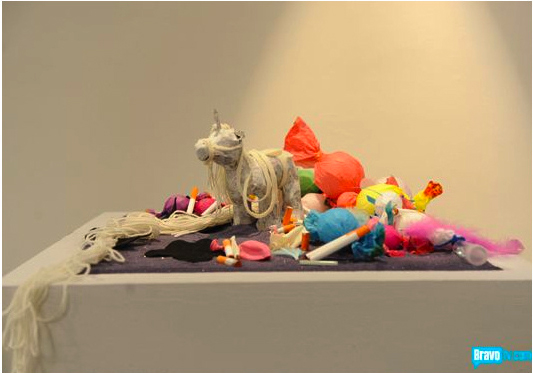
Peregrine Honig's Rainbow
Peregrine Honig’s bowl of candy, drugs, fake cigarettes and a x-rated My Little Pony was clearly the winning work, and possibly the best work produced this season. Placed high upon a pedestal a child approaching her sculpture would only see the edges of it, which as Bill Powers writes mimics “the way we only get glimmers of our parents’ indiscretions when we’re young.” The piece spoke of her experiences growing up in an art commune in which she witnessed much of this. Honig described the piece as a memorial to many of her adult friends as a child, who later died of aids. It was a very touching piece.
THE LOSER
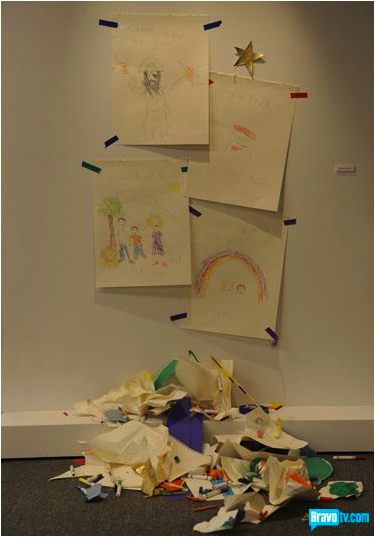
Ryan Shultz' Drawn Excavations
I would have liked to see Jaclyn Santos go home this week, but Ryan Shultz managed to create a work with even fewer ideas. Still, I ultimately see more promise for for Shultz. His work is too literal minded, but at least he’s aware of it, and expressed frustration with his own performance during the show. He’ll return to his studio and make better art.
NICOLE NADEAU’S STYROFOAM LUNCH PLATES
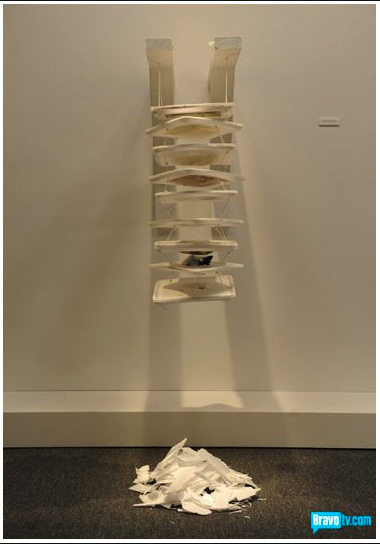
Nicole Nadeau's Surfacing Memories
This work sounds okay by description, but as a friend told me over email, they still look like a bunch of styrofoam lunch plates. Also, it’s hard to see what they really looked like. I have my doubts about this piece, but since almost all the other work sucked it still stands out as a better work.
THE UNSEEN ART WORK
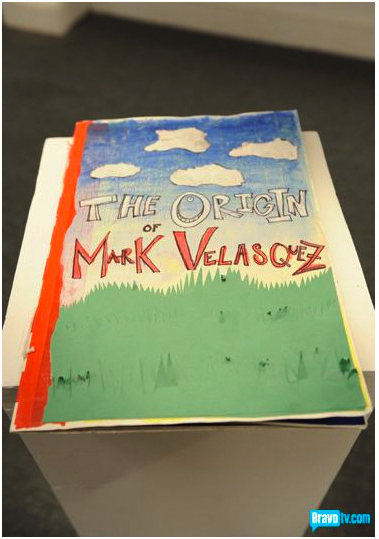
Mark Velasquez' The Origin Issue
Speaking of work that’s impossible to judge because the audience never sees it, Mark’s autobiography could have been anywhere from amazing to awful. He’s not much of an idea guy, but since his twitter writing’s okay even if the drawings sucked (and it looked like they did), the book was probably passable.
BEST QUOTES THIS EPISODE
As a kid I really liked to climb trees. It was definitely a way for me escape and deal with my feelings of isolation. – Jaclyn Santos
I’m putting construction paper on the floor and dishevel it, like I do to my own hair. – Ryan Shultz
UPDATE: COMMENTERS CHOICE FOR BEST QUOTE
These two paintbrushes represent me and my sister. – Nicole Nadeau


{ 90 comments }
Great recap. This episode was supremely dull and most of the art was a snore too. The art wasn’t great last week, but at least there was some solid reality t.v. drama in the mix. It feels like producers don’t understand the artistic process well enough to create interesting assignments with dramatic content.
Great recap. This episode was supremely dull and most of the art was a snore too. The art wasn’t great last week, but at least there was some solid reality t.v. drama in the mix. It feels like producers don’t understand the artistic process well enough to create interesting assignments with dramatic content.
I’ve never seen a reality show until this one, which I started watching because I like watching artists make art. Pity that most of it is crap. Look at Shultz’s web site, though. He’s a decent artist so it must be the format that’s responsible for lackadaisical pieces. Santos’ web site shows that she can draw but not with inspiration. Nice tits, of course.
I’m a (relatively) old fart and own Bellows, Rauschenberg, Burchfield and several hundred contemporary works and it’s with chagrin that I’ve fallen into Bravo’s trap of getting caught up in inconsequential personalties. My asshole-detector is pretty good, though, and I’d put Miles and Jaclyn in that category.
(I can’t believe I care enough to post this. What’s next, soap operas?)
I’ve never seen a reality show until this one, which I started watching because I like watching artists make art. Pity that most of it is crap. Look at Shultz’s web site, though. He’s a decent artist so it must be the format that’s responsible for lackadaisical pieces. Santos’ web site shows that she can draw but not with inspiration. Nice tits, of course.
I’m a (relatively) old fart and own Bellows, Rauschenberg, Burchfield and several hundred contemporary works and it’s with chagrin that I’ve fallen into Bravo’s trap of getting caught up in inconsequential personalties. My asshole-detector is pretty good, though, and I’d put Miles and Jaclyn in that category.
(I can’t believe I care enough to post this. What’s next, soap operas?)
I thought the 3 “losers” in this group, and everyone to some degree, were failed by the producers as much as by themselves. They were put in an environment many of them admitted was alien (though I don’t see how colored pencils can be a difficult medium to re-learn) and given an incredibly vague goal. “Recapture what led you to become an artist” with an emphasis on Childhood. Peregrine and Nicole were the only 2 people who could create a reasonable idea out of that. Mark went incredibly literal with it, Miles ignored it completely (without consequence), and the other 3 all suffered searching for a connection to the vague instructions.
Peregrine was able to create somethign worthwhile because she truly connected to it, clearly nobody else was that invested, and it showed. This is the huge flaw in the show. These artists are trying to impress others in the subjects the others have defined. Going to the first episode where “Portrait” was so literally defined that Nao almost got kicked off for having a creative take on it the producers have not encouraged the artists to go their own way. Now they give them very little to go on, and lo and behold get very little in return.
To make it worse they have Simon go in at the halfpoint and tell them their work was going in the wrong direction. That’s only going to increase the confusion. And confusion in the art making process- especially a shortened 2 or 3 day process- is fatal. I’m not the biggest Jackie fan but sympathized with her here. She had no connection to the theme at all, finally found one and was told to look elsewhere by Simon. Yes she should be more assertive in her “vision” but what signals is she being given?
Finally in the end when the judges complained about the sincerity they didn’t feel from the 3 losing works, I don’t know how to blame the artists. Their only sincere reaction was confusion (with the exception of Ryan, who did seem profoundly affected by recalling his childhood (and possible substance abuse??)) to the instruction given.
The loser in this episode to me were the producers, who are exactly what have plagued this series from the beginning.
I thought the 3 “losers” in this group, and everyone to some degree, were failed by the producers as much as by themselves. They were put in an environment many of them admitted was alien (though I don’t see how colored pencils can be a difficult medium to re-learn) and given an incredibly vague goal. “Recapture what led you to become an artist” with an emphasis on Childhood. Peregrine and Nicole were the only 2 people who could create a reasonable idea out of that. Mark went incredibly literal with it, Miles ignored it completely (without consequence), and the other 3 all suffered searching for a connection to the vague instructions.
Peregrine was able to create somethign worthwhile because she truly connected to it, clearly nobody else was that invested, and it showed. This is the huge flaw in the show. These artists are trying to impress others in the subjects the others have defined. Going to the first episode where “Portrait” was so literally defined that Nao almost got kicked off for having a creative take on it the producers have not encouraged the artists to go their own way. Now they give them very little to go on, and lo and behold get very little in return.
To make it worse they have Simon go in at the halfpoint and tell them their work was going in the wrong direction. That’s only going to increase the confusion. And confusion in the art making process- especially a shortened 2 or 3 day process- is fatal. I’m not the biggest Jackie fan but sympathized with her here. She had no connection to the theme at all, finally found one and was told to look elsewhere by Simon. Yes she should be more assertive in her “vision” but what signals is she being given?
Finally in the end when the judges complained about the sincerity they didn’t feel from the 3 losing works, I don’t know how to blame the artists. Their only sincere reaction was confusion (with the exception of Ryan, who did seem profoundly affected by recalling his childhood (and possible substance abuse??)) to the instruction given.
The loser in this episode to me were the producers, who are exactly what have plagued this series from the beginning.
Ryan engaged personally with the assignment and would not be surprised if someone was destined to be eliminated for making a work that ‘looked as if a child had done it’. That was prescriptive.
The poor fellow had to leave huge parts of his process behind when he entered this show, which can be terribly disorienting. This piece was clearly a growing pain in more than one way. He succeeded to engage on a more personal level than many of the other artists. The piece did, at least, have a reason to be made. Had I been on the panel, I would have kept him in the competition and encouraged him. But I guess that is what mentors are for, not judges. A good mentor of mine once said that ‘sincerity will get you mocked.’
Ryan engaged personally with the assignment and would not be surprised if someone was destined to be eliminated for making a work that ‘looked as if a child had done it’. That was prescriptive.
The poor fellow had to leave huge parts of his process behind when he entered this show, which can be terribly disorienting. This piece was clearly a growing pain in more than one way. He succeeded to engage on a more personal level than many of the other artists. The piece did, at least, have a reason to be made. Had I been on the panel, I would have kept him in the competition and encouraged him. But I guess that is what mentors are for, not judges. A good mentor of mine once said that ‘sincerity will get you mocked.’
Thoughts:
— What happened to Mile’s “nap time” now that he was finally in the appropriate place? Especially after snack time.
— Ryan’s throw-away-crumpled-up pieces spoke to his being “thrown away” by his mom. This could have led somewhere.
— Mark’s book could also go somewhere if he dared to address “not judging a book by it’s cover”. He didn’t go there…that we know of. (camera work please?)
— Mile’s doing something obsessive worked for me as what is often at the heart of getting started as artists. Most kids who like to make arty stuff get obsessed, fully engaged with some activity. I do NOT think the contestants should be held to “knowing and explaining what they are doing exactly”….beforehand…or afterhand. So in a way I liked this piece best of Mile’s work so far because it was less story telling. I personally don’t like when work is an illustration of some personal narrative.
— Which is what bothered me about Peregrine’s piece. I did like the cigarettes though…and as poetic expressive objects they would/could have worked on their own.
— Jackie should have stuck with rorschach tests. Or maybe body impressions.
— Nicole….was there a moment (edited in) where Miles was suggesting she add more layers? I don’t think she should be listening to her competitor…because it may have led to having to hang it in a gallow-ish way. Watch out Nicole!!
When I saw the segment between Miles and Nicole, I wondered if Bravo made it appear as though Miles had given her the idea. The clip was clearly a fragment from a much larger conversation, and there seems to be a fair bit of work going into establishing Miles as the visionary.
Jaclyn talks about “dealing with her feelings of isolation” which seems pretty far away from the core issues. I mean, she was isolating herself, which means her isolation was a response to a problem, not the problem itself. If she has emotional depth, she’s unwilling to reveal it, so it would have been better for her to run in that direction. She should have created an empty space — anything that suggested the vacantness she talked about.
Peregrine’s piece was an illustration of a personal narrative, which typically I don’t like either. I make an exception with Honig though, because it was as if the objects themselves were playing naughty dress-up. I think this is a very powerful mirroring of her own narrative for a piece in which she’s prematurely exposed to adult excess.
I really don’t know where Ryan’s thrown away paper like his mother threw him away could have led. It’s just such a simplistic idea. Ryan was one of the more likable characters on the show, but he himself offered much more depth than his art. I think he should have been eliminated a long time ago, but in a lot of ways I’m sorry he didn’t stick around for longer. I have the impression he would have gotten a lot more from the judges had he been given the opportunity than most of the cast.
Good Point on the Miles advising Nicole EDIT. Not as sabotage but as Miles the visionary. And of course we don’t know the bigger picture. Hey… Bravo may have put it in to read both ways…they are just sooooo trickee! Re Ryan…I’m sure I’m defending him because 1) his actual studio paintings are really serious (though I haven’t seen them in person I am impressed). Lots of people take photos of the youth culture he paints, but I don’t know of anyone painting them the way he does. 2) He is an interesting guy, a classical music and history buff. 3) His sense of humor…ie your AFC favorite quote…and his mimic of miles making coffee. No one else has his kind of wit and I’ll miss that.
Ryan’s studio paintings are a little too a + b = c for me. Youth culture and excess + classical paintings = contemporary art. Meh. I haven’t seen them in real life, but from the reproductions, I just don’t see how the work could be executed well enough to be compelling.
Woah. Judith stop for a sec. Your totally mis-interpretting that edited clip. I can understand how, but honestly I was making multiples of the plates to begin with (main structure had to do with achieving a perfect rectangle, so the layering went from the beginning of an attempt of perfect to perfect, in which there were 8 plates or so). What Miles was suggesting in the clip was to make one of those plates with the salamander deeper to look like it was recessed even more in the plate: It did not fit within the overall form of the work, and I did not take his advice. However minor it was. Do not confuse this with me not having my own ideas please, or just taking advice without processing my own thoughts.
The way the show was, people treated it like a studio, every contestants were always giving feedback and critic-whether you use it/give it or not is to your own detriment.
Thank you,
Nicole
@ AFC @Judith
Sorry I didn’t read the entire feed before responding. But I think you nailed it with the editing @ visionary thing.
@ Nicole: My first reaction was based mostly on my distrust of Miles…not lack of confidence in you. But I guess I think even us badasses are vulnerable!
Pretty dumb of me to momentarily forget about the editing! As though I was watching reality, instead of reality TV!!
You are doing a great job and holding your own! xo Judith
@Judith: vulnerable badasses, love it 😀 thanks judith! xo nic
@Judith: vulnerable badasses, love it 😀 thanks judith! xo nic
@Judith: vulnerable badasses, love it 😀 thanks judith! xo nic
I know they’re trying to make it look like an intense romance is about to occur, but really it just seems like two people bouncing ideas off eachother. aka a normal thing to do.
I gots questions:
Do the contestants do their own lighting? If not, were you guys happy with the job they did setting up the work?
Looking at the pictures on the Bravo site, why are they cropping these images so bad? Is it too much to ask for to see the entire pony’s tail?! Is the pony’s tail not a part of the work?! And while I’m on the topic of documentation, why aren’t there any images of the inside of The Origins of Mark? bleehh.
PATPATPATPAT: We don’t do any lighting…well not when I was there. You are right about the Bravo photos, they need some professional help with that for sure. The times spent on what they think is cool or catchy, should be spent on showing the work better.
PATPATPATPAT: We don’t do any lighting…well not when I was there. You are right about the Bravo photos, they need some professional help with that for sure. The times spent on what they think is cool or catchy, should be spent on showing the work better.
PATPATPATPAT: We don’t do any lighting…well not when I was there. You are right about the Bravo photos, they need some professional help with that for sure. The times spent on what they think is cool or catchy, should be spent on showing the work better.
Thoughts:
— What happened to Mile’s “nap time” now that he was finally in the appropriate place? Especially after snack time.
— Ryan’s throw-away-crumpled-up pieces spoke to his being “thrown away” by his mom. This could have led somewhere.
— Mark’s book could also go somewhere if he dared to address “not judging a book by it’s cover”. He didn’t go there…that we know of. (camera work please?)
— Mile’s doing something obsessive worked for me as what is often at the heart of getting started as artists. Most kids who like to make arty stuff get obsessed, fully engaged with some activity. I do NOT think the contestants should be held to “knowing and explaining what they are doing exactly”….beforehand…or afterhand. So in a way I liked this piece best of Mile’s work so far because it was less story telling. I personally don’t like when work is an illustration of some personal narrative.
— Which is what bothered me about Peregrine’s piece. I did like the cigarettes though…and as poetic expressive objects they would/could have worked on their own.
— Jackie should have stuck with rorschach tests. Or maybe body impressions.
— Nicole….was there a moment (edited in) where Miles was suggesting she add more layers? I don’t think she should be listening to her competitor…because it may have led to having to hang it in a gallow-ish way. Watch out Nicole!!
When I saw the segment between Miles and Nicole, I wondered if Bravo made it appear as though Miles had given her the idea. The clip was clearly a fragment from a much larger conversation, and there seems to be a fair bit of work going into establishing Miles as the visionary.
Jaclyn talks about “dealing with her feelings of isolation” which seems pretty far away from the core issues. I mean, she was isolating herself, which means her isolation was a response to a problem, not the problem itself. If she has emotional depth, she’s unwilling to reveal it, so it would have been better for her to run in that direction. She should have created an empty space — anything that suggested the vacantness she talked about.
Peregrine’s piece was an illustration of a personal narrative, which typically I don’t like either. I make an exception with Honig though, because it was as if the objects themselves were playing naughty dress-up. I think this is a very powerful mirroring of her own narrative for a piece in which she’s prematurely exposed to adult excess.
I really don’t know where Ryan’s thrown away paper like his mother threw him away could have led. It’s just such a simplistic idea. Ryan was one of the more likable characters on the show, but he himself offered much more depth than his art. I think he should have been eliminated a long time ago, but in a lot of ways I’m sorry he didn’t stick around for longer. I have the impression he would have gotten a lot more from the judges had he been given the opportunity than most of the cast.
Good Point on the Miles advising Nicole EDIT. Not as sabotage but as Miles the visionary. And of course we don’t know the bigger picture. Hey… Bravo may have put it in to read both ways…they are just sooooo trickee! Re Ryan…I’m sure I’m defending him because 1) his actual studio paintings are really serious (though I haven’t seen them in person I am impressed). Lots of people take photos of the youth culture he paints, but I don’t know of anyone painting them the way he does. 2) He is an interesting guy, a classical music and history buff. 3) His sense of humor…ie your AFC favorite quote…and his mimic of miles making coffee. No one else has his kind of wit and I’ll miss that.
Ryan’s studio paintings are a little too a + b = c for me. Youth culture and excess + classical paintings = contemporary art. Meh. I haven’t seen them in real life, but from the reproductions, I just don’t see how the work could be executed well enough to be compelling.
Woah. Judith stop for a sec. Your totally mis-interpretting that edited clip. I can understand how, but honestly I was making multiples of the plates to begin with (main structure had to do with achieving a perfect rectangle, so the layering went from the beginning of an attempt of perfect to perfect, in which there were 8 plates or so). What Miles was suggesting in the clip was to make one of those plates with the salamander deeper to look like it was recessed even more in the plate: It did not fit within the overall form of the work, and I did not take his advice. However minor it was. Do not confuse this with me not having my own ideas please, or just taking advice without processing my own thoughts.
The way the show was, people treated it like a studio, every contestants were always giving feedback and critic-whether you use it/give it or not is to your own detriment.
Thank you,
Nicole
@ AFC @Judith
Sorry I didn’t read the entire feed before responding. But I think you nailed it with the editing @ visionary thing.
@ Nicole: My first reaction was based mostly on my distrust of Miles…not lack of confidence in you. But I guess I think even us badasses are vulnerable!
Pretty dumb of me to momentarily forget about the editing! As though I was watching reality, instead of reality TV!!
You are doing a great job and holding your own! xo Judith
@Judith: vulnerable badasses, love it 😀 thanks judith! xo nic
I know they’re trying to make it look like an intense romance is about to occur, but really it just seems like two people bouncing ideas off eachother. aka a normal thing to do.
I gots questions:
Do the contestants do their own lighting? If not, were you guys happy with the job they did setting up the work?
Looking at the pictures on the Bravo site, why are they cropping these images so bad? Is it too much to ask for to see the entire pony’s tail?! Is the pony’s tail not a part of the work?! And while I’m on the topic of documentation, why aren’t there any images of the inside of The Origins of Mark? bleehh.
PATPATPATPAT: We don’t do any lighting…well not when I was there. You are right about the Bravo photos, they need some professional help with that for sure. The times spent on what they think is cool or catchy, should be spent on showing the work better.
Given that surely everything is recontextualized and skewed in the edits to make television entertainment, whenever I post a comment, I’ve tried to make a conscious effort to not make any remarks about the artists’ works. Yet, given the types of materials at their disposal this week, I was surprised to see just how sedate, constrained and/or uninspired much of the work was. Perhaps it is their youth, the painful childhood memories still a bit too close (or not yet fabricated), that stifled and stymied what could have otherwise been a chance to have some fun regressing and branching out at the same time. Peregrine used her memories and the materials to her advantage, which may be a hallmark of some level of maturity the other remaining ‘contestants’ have yet to grasp.
Given that surely everything is recontextualized and skewed in the edits to make television entertainment, whenever I post a comment, I’ve tried to make a conscious effort to not make any remarks about the artists’ works. Yet, given the types of materials at their disposal this week, I was surprised to see just how sedate, constrained and/or uninspired much of the work was. Perhaps it is their youth, the painful childhood memories still a bit too close (or not yet fabricated), that stifled and stymied what could have otherwise been a chance to have some fun regressing and branching out at the same time. Peregrine used her memories and the materials to her advantage, which may be a hallmark of some level of maturity the other remaining ‘contestants’ have yet to grasp.
What’s with these kid materials? When I was a child I made important FINE ART with OILS. OK, so I didn’t know what important was at the time, but I really only used OIL PAINT for my FINE ART.
What’s with these kid materials? When I was a child I made important FINE ART with OILS. OK, so I didn’t know what important was at the time, but I really only used OIL PAINT for my FINE ART.
I thought this episode was one of the funniest so far. The whole set up was like some kind of perverse Stanley Milgram experiment. Theater of cruelty! I love it.
A suggestion for best quotes: “These two paintbrushes represent me and my sister.”
I howled when I heard that one.
Oh wait, who said that? That is hilarious!
that was Nicole. (worst piece of the episode, in my opinion…way too safe and boring)
I thought this episode was one of the funniest so far. The whole set up was like some kind of perverse Stanley Milgram experiment. Theater of cruelty! I love it.
A suggestion for best quotes: “These two paintbrushes represent me and my sister.”
I howled when I heard that one.
Oh wait, who said that? That is hilarious!
that was Nicole. (worst piece of the episode, in my opinion…way too safe and boring)
I didn’t see the episode, but as I understand it the premise is essentially identical to a spoof reality show a friend of mine made a few years ago, called Arts & Crafts Pro.
http://www.youtube.com/watch?v=ZQKGZP6zOrs
I didn’t see the episode, but as I understand it the premise is essentially identical to a spoof reality show a friend of mine made a few years ago, called Arts & Crafts Pro.
http://www.youtube.com/watch?v=ZQKGZP6zOrs
Much more entertaining is the reality show by artist Chuck Connelly, as he rebuilds his career: http://www.ustream.tv/channel/stream-of-thought
Much more entertaining is the reality show by artist Chuck Connelly, as he rebuilds his career: http://www.ustream.tv/channel/stream-of-thought
Are they ever gonna have a female artist judge, I mean…ever?
Are they ever gonna have a female artist judge, I mean…ever?
I really thought Miles work was extremely bad. Judiths work along those lines is much better (IMHO). The judges got rid of Trong much too early; his work wasn’t as weak as some of the work that’s followed on the show. I only hope that someone besides Miles wins the contest.
I really thought Miles work was extremely bad. Judiths work along those lines is much better (IMHO). The judges got rid of Trong much too early; his work wasn’t as weak as some of the work that’s followed on the show. I only hope that someone besides Miles wins the contest.
I sure as hell Mark gets thrown out, boring, juvenile, and totally cliched. What a bore. When was remaking something you’ve already done “cheating.” Lame.
I guess using the same oil to fry potatoes is “cheating” too, but then again, as a fry cook, he’d probably know that already. Yawn. And his art is totally as boring as a Pringles can, wait, actually that’s more adventurous.
I love the way the producers are pitting certain contestants against each other (Mark against Miles, Peregrine against Mark) although Peregrein’s remarks are totally spot on when it comes to Mark. Which is too bad, since given the judges/producers track record, Peregrine will be axed next week for some reason.
I sure as hell Mark gets thrown out, boring, juvenile, and totally cliched. What a bore. When was remaking something you’ve already done “cheating.” Lame.
I guess using the same oil to fry potatoes is “cheating” too, but then again, as a fry cook, he’d probably know that already. Yawn. And his art is totally as boring as a Pringles can, wait, actually that’s more adventurous.
I love the way the producers are pitting certain contestants against each other (Mark against Miles, Peregrine against Mark) although Peregrein’s remarks are totally spot on when it comes to Mark. Which is too bad, since given the judges/producers track record, Peregrine will be axed next week for some reason.
I sure as hell Mark gets thrown out, boring, juvenile, and totally cliched. What a bore. When was remaking something you’ve already done “cheating.” Lame.
I guess using the same oil to fry potatoes is “cheating” too, but then again, as a fry cook, he’d probably know that already. Yawn. And his art is totally as boring as a Pringles can, wait, actually that’s more adventurous.
I love the way the producers are pitting certain contestants against each other (Mark against Miles, Peregrine against Mark) although Peregrein’s remarks are totally spot on when it comes to Mark. Which is too bad, since given the judges/producers track record, Peregrine will be axed next week for some reason.
“They were put in an environment many of them admitted was alien.”
I thought that this was an excellent challenge. Youth striving to be taken seriously as adults will of course squirm when dumped into an infantile environment for our amusement. I have a theory that more mature artists, perhaps like some of the previous contestants, would be more comfortable with this exercise.
One thing I very much do not like about this show is that the critics/judges all agree with each other. That is completely fake. Smells like bullshitty fake.
“They were put in an environment many of them admitted was alien.”
I thought that this was an excellent challenge. Youth striving to be taken seriously as adults will of course squirm when dumped into an infantile environment for our amusement. I have a theory that more mature artists, perhaps like some of the previous contestants, would be more comfortable with this exercise.
One thing I very much do not like about this show is that the critics/judges all agree with each other. That is completely fake. Smells like bullshitty fake.
That’s a bit odd… Peregrine, Ryan and Nicole’s works all look like piles of refuse. Peregrine’s is just missing stuff on the wall behind it. I see six of the seven pieces as looking fractured. re: Jaclyn’s work, Miles’ piece looks like a Rorschach too. Let the psychologists loose!
As the cast of characters is getting reduced, so is the interest factor.
Simon’s comments seem more on target than the judges’ to me.
That’s a bit odd… Peregrine, Ryan and Nicole’s works all look like piles of refuse. Peregrine’s is just missing stuff on the wall behind it. I see six of the seven pieces as looking fractured. re: Jaclyn’s work, Miles’ piece looks like a Rorschach too. Let the psychologists loose!
As the cast of characters is getting reduced, so is the interest factor.
Simon’s comments seem more on target than the judges’ to me.
Personally, I found it a little strange that China Chow, of all the people on the judging panel, didn’t have a whole lot to say about growing up around people who have since died of AIDS.
I’m not trying to suggest that people never get past their histories, or should never live them down, or have to be haunted by the ghosts of their families or whatever, but umm, really?
Personally, I found it a little strange that China Chow, of all the people on the judging panel, didn’t have a whole lot to say about growing up around people who have since died of AIDS.
I’m not trying to suggest that people never get past their histories, or should never live them down, or have to be haunted by the ghosts of their families or whatever, but umm, really?
Personally, I found it a little strange that China Chow, of all the people on the judging panel, didn’t have a whole lot to say about growing up around people who have since died of AIDS.
I’m not trying to suggest that people never get past their histories, or should never live them down, or have to be haunted by the ghosts of their families or whatever, but umm, really?
I wanted to post first before reading the recap or comments (I really appreciate them but wanted to first give my general perspective).
First of all, I have to say that I do find this show interesting. I don’t know if the format works as well as for project runway, because the type of art on the show isn’t normally associated with the same commercialism as fashion.
However, I have to say that I’ve been impressed at how well some of the contestants manage to create art that does have a clear concept within the framework of what is imposed. I think Nicole deserves high marks, even though some of her work doesn’t always quite hit the mark (for example, her concept for the book challenge worked really well as art, not so well as a marketable book cover).
For this episode, though, I have to call shenanigans. I think Miles should definitely have been in the bottom. The only reason his work has been doing so well is that he makes something that’s unspecific enough to let the judges read whatever they want into it. Also, I have to say that the depiction of his attitude in this episode makes me wonder if he is on this whole show as a slap in the face to reality shows in general.
If that’s the case and he is using the show and his performance on it as a work of art in itself, then this places his comments about Trong’s piece in episode 2 in a more sinister context. In other words, I wonder if he wanted to get rid of a contestant who might have kept referrencing the reality show construct and thus make his own performance piece (his actual appearance on the show) much less original.
Regarding this episode specifically, I’m not surprised that Peregrine did well as her style would seem to suit this particular challenge. I also think that she has proven to be quite thoughtful in her approach to challenges in general.
At this point, I’m hoping that Abdi, Nicole and Peregrine or Mark make it to the end. I think they’ve proven themselves capable artists and haven’t been playing “a game”. Jaclyn’s art is hit and miss and I have to say that she doesn’t seem to come up with her own concepts, that is she needs the judges imput to make good work.
That’s all for now, I’ll see if I have more comments after reading the recap and comments.
I think the judges would have gotten rid of Trong with or without Miles’ feedback. I mean, it’s not like Miles started the criticism. He just wasn’t exhibiting good sportsmanship.
In any event Miles was quite clear that he felt it was important to make your own work fit the parameters of the challenge. He wasn’t duping anyone; he was upfront about his approach. It’s up to the judges to decide if that works for them.
I guess what frustrates me is that the judges really haven’t called him out on not engaging with the actual challenges. To be fair to Miles, I guess it’s also difficult to tell with the editing whether he actually did mean to reference space invaders or another childhood 8-bit game within his actual piece, or whether he just redid work he was comfortable with and respresented him well and let the judges figure it out.
I’m also starting to wonder, since the show doesn’t make it clear, do the judges actually know beforehand who’s work is whose? I mean, in many cases it would be easy to figure out but it seems that this would affect their objectivity when looking at the work since ultimately alot of their judging is about what message they’re perceiving from the work.
Also, China mentioned in the judge discussion that Ryan wasn’t learning from their critiques, were the safe contestants also getting critiques? The way she was talking, it would’ve seemed like he got many but I only remember him being unsafe in the Audi challenge (not counting the group challenge from last week).
Just saw this episode last night & have to agree – the artists definitely struggled with the challenge.
I think Ryan’s work would have been more interesting if he had kept the same structure & childlike drawings, but chose adult subject matter to draw (ie. depicting his frustration with religion, being abandoned by his family, the “sinful” lifestyle choices he’s made & so on). Serious & potentially controversial subject matter drawn by a child could have been compelling. Still, I’m sure he doesn’t feel too badly for being given the boot for work that doesn’t represent his “real” work at all.
Also, Marc’s question/idea is great: “…do the judges actually know beforehand who’s work is whose?”
I really like the idea of having the judges give blind critiques.
Just saw this episode last night & have to agree – the artists definitely struggled with the challenge.
I think Ryan’s work would have been more interesting if he had kept the same structure & childlike drawings, but chose adult subject matter to draw (ie. depicting his frustration with religion, being abandoned by his family, the “sinful” lifestyle choices he’s made & so on). Serious & potentially controversial subject matter drawn by a child could have been compelling. Still, I’m sure he doesn’t feel too badly for being given the boot for work that doesn’t represent his “real” work at all.
Also, Marc’s question/idea is great: “…do the judges actually know beforehand who’s work is whose?”
I really like the idea of having the judges give blind critiques.
Just saw this episode last night & have to agree – the artists definitely struggled with the challenge.
I think Ryan’s work would have been more interesting if he had kept the same structure & childlike drawings, but chose adult subject matter to draw (ie. depicting his frustration with religion, being abandoned by his family, the “sinful” lifestyle choices he’s made & so on). Serious & potentially controversial subject matter drawn by a child could have been compelling. Still, I’m sure he doesn’t feel too badly for being given the boot for work that doesn’t represent his “real” work at all.
Also, Marc’s question/idea is great: “…do the judges actually know beforehand who’s work is whose?”
I really like the idea of having the judges give blind critiques.
I guess what frustrates me is that the judges really haven’t called him out on not engaging with the actual challenges. To be fair to Miles, I guess it’s also difficult to tell with the editing whether he actually did mean to reference space invaders or another childhood 8-bit game within his actual piece, or whether he just redid work he was comfortable with and respresented him well and let the judges figure it out.
I’m also starting to wonder, since the show doesn’t make it clear, do the judges actually know beforehand who’s work is whose? I mean, in many cases it would be easy to figure out but it seems that this would affect their objectivity when looking at the work since ultimately alot of their judging is about what message they’re perceiving from the work.
Also, China mentioned in the judge discussion that Ryan wasn’t learning from their critiques, were the safe contestants also getting critiques? The way she was talking, it would’ve seemed like he got many but I only remember him being unsafe in the Audi challenge (not counting the group challenge from last week).
I guess what frustrates me is that the judges really haven’t called him out on not engaging with the actual challenges. To be fair to Miles, I guess it’s also difficult to tell with the editing whether he actually did mean to reference space invaders or another childhood 8-bit game within his actual piece, or whether he just redid work he was comfortable with and respresented him well and let the judges figure it out.
I’m also starting to wonder, since the show doesn’t make it clear, do the judges actually know beforehand who’s work is whose? I mean, in many cases it would be easy to figure out but it seems that this would affect their objectivity when looking at the work since ultimately alot of their judging is about what message they’re perceiving from the work.
Also, China mentioned in the judge discussion that Ryan wasn’t learning from their critiques, were the safe contestants also getting critiques? The way she was talking, it would’ve seemed like he got many but I only remember him being unsafe in the Audi challenge (not counting the group challenge from last week).
I wanted to post first before reading the recap or comments (I really appreciate them but wanted to first give my general perspective).
First of all, I have to say that I do find this show interesting. I don’t know if the format works as well as for project runway, because the type of art on the show isn’t normally associated with the same commercialism as fashion.
However, I have to say that I’ve been impressed at how well some of the contestants manage to create art that does have a clear concept within the framework of what is imposed. I think Nicole deserves high marks, even though some of her work doesn’t always quite hit the mark (for example, her concept for the book challenge worked really well as art, not so well as a marketable book cover).
For this episode, though, I have to call shenanigans. I think Miles should definitely have been in the bottom. The only reason his work has been doing so well is that he makes something that’s unspecific enough to let the judges read whatever they want into it. Also, I have to say that the depiction of his attitude in this episode makes me wonder if he is on this whole show as a slap in the face to reality shows in general.
If that’s the case and he is using the show and his performance on it as a work of art in itself, then this places his comments about Trong’s piece in episode 2 in a more sinister context. In other words, I wonder if he wanted to get rid of a contestant who might have kept referrencing the reality show construct and thus make his own performance piece (his actual appearance on the show) much less original.
Regarding this episode specifically, I’m not surprised that Peregrine did well as her style would seem to suit this particular challenge. I also think that she has proven to be quite thoughtful in her approach to challenges in general.
At this point, I’m hoping that Abdi, Nicole and Peregrine or Mark make it to the end. I think they’ve proven themselves capable artists and haven’t been playing “a game”. Jaclyn’s art is hit and miss and I have to say that she doesn’t seem to come up with her own concepts, that is she needs the judges imput to make good work.
That’s all for now, I’ll see if I have more comments after reading the recap and comments.
I think the judges would have gotten rid of Trong with or without Miles’ feedback. I mean, it’s not like Miles started the criticism. He just wasn’t exhibiting good sportsmanship.
In any event Miles was quite clear that he felt it was important to make your own work fit the parameters of the challenge. He wasn’t duping anyone; he was upfront about his approach. It’s up to the judges to decide if that works for them.
I guess what frustrates me is that the judges really haven’t called him out on not engaging with the actual challenges. To be fair to Miles, I guess it’s also difficult to tell with the editing whether he actually did mean to reference space invaders or another childhood 8-bit game within his actual piece, or whether he just redid work he was comfortable with and respresented him well and let the judges figure it out.
I’m also starting to wonder, since the show doesn’t make it clear, do the judges actually know beforehand who’s work is whose? I mean, in many cases it would be easy to figure out but it seems that this would affect their objectivity when looking at the work since ultimately alot of their judging is about what message they’re perceiving from the work.
Also, China mentioned in the judge discussion that Ryan wasn’t learning from their critiques, were the safe contestants also getting critiques? The way she was talking, it would’ve seemed like he got many but I only remember him being unsafe in the Audi challenge (not counting the group challenge from last week).
Just saw this episode last night & have to agree – the artists definitely struggled with the challenge.
I think Ryan’s work would have been more interesting if he had kept the same structure & childlike drawings, but chose adult subject matter to draw (ie. depicting his frustration with religion, being abandoned by his family, the “sinful” lifestyle choices he’s made & so on). Serious & potentially controversial subject matter drawn by a child could have been compelling. Still, I’m sure he doesn’t feel too badly for being given the boot for work that doesn’t represent his “real” work at all.
Also, Marc’s question/idea is great: “…do the judges actually know beforehand who’s work is whose?”
I really like the idea of having the judges give blind critiques.
I think that Miles the “participant illusionist” is definitely the David Blade or David Copperfield (for those of my generation) of this TV show as he continues to woo the judges with work that “looks smART” but often fails to truthfully engage in the challenge. I almost suspect that some of his works and ideas were rehearsed as they often fail to demonstrate an artist engaged/ provoked by a stimulus. While his printmaking portfolio and production from this TV show might arguably work well for the Brooklyn Museum Prize, I see other participants on this show being more “artistic” in their vision and willingness to fail. I see Miles as one who only knows and is willing to engage in his own world. Personally, I like his work the best but I find Nicole’s constructs more engaging as works created by the possible limitations of a new studio environment.
This Week:
It could have been interesting if Mark created a work about photographic images as catalysts of childhood memory. I would have loved further discussion of Peregrin’s pedestal and its height or how it formalized the presentation of the work. I personally liked the negative space in Jackie’s installation as it may have suggested a positive form or even tree trunk. Lastly, I think Nicole should have left those structural 2X4′ in their raw state. Painting them seem to deny their pedestrian and clumsy nature (was my favorite piece this week though).
I think that Miles the “participant illusionist” is definitely the David Blade or David Copperfield (for those of my generation) of this TV show as he continues to woo the judges with work that “looks smART” but often fails to truthfully engage in the challenge. I almost suspect that some of his works and ideas were rehearsed as they often fail to demonstrate an artist engaged/ provoked by a stimulus. While his printmaking portfolio and production from this TV show might arguably work well for the Brooklyn Museum Prize, I see other participants on this show being more “artistic” in their vision and willingness to fail. I see Miles as one who only knows and is willing to engage in his own world. Personally, I like his work the best but I find Nicole’s constructs more engaging as works created by the possible limitations of a new studio environment.
This Week:
It could have been interesting if Mark created a work about photographic images as catalysts of childhood memory. I would have loved further discussion of Peregrin’s pedestal and its height or how it formalized the presentation of the work. I personally liked the negative space in Jackie’s installation as it may have suggested a positive form or even tree trunk. Lastly, I think Nicole should have left those structural 2X4′ in their raw state. Painting them seem to deny their pedestrian and clumsy nature (was my favorite piece this week though).
I think that Miles the “participant illusionist” is definitely the David Blade or David Copperfield (for those of my generation) of this TV show as he continues to woo the judges with work that “looks smART” but often fails to truthfully engage in the challenge. I almost suspect that some of his works and ideas were rehearsed as they often fail to demonstrate an artist engaged/ provoked by a stimulus. While his printmaking portfolio and production from this TV show might arguably work well for the Brooklyn Museum Prize, I see other participants on this show being more “artistic” in their vision and willingness to fail. I see Miles as one who only knows and is willing to engage in his own world. Personally, I like his work the best but I find Nicole’s constructs more engaging as works created by the possible limitations of a new studio environment.
This Week:
It could have been interesting if Mark created a work about photographic images as catalysts of childhood memory. I would have loved further discussion of Peregrin’s pedestal and its height or how it formalized the presentation of the work. I personally liked the negative space in Jackie’s installation as it may have suggested a positive form or even tree trunk. Lastly, I think Nicole should have left those structural 2X4′ in their raw state. Painting them seem to deny their pedestrian and clumsy nature (was my favorite piece this week though).
I think that Miles the “participant illusionist” is definitely the David Blade or David Copperfield (for those of my generation) of this TV show as he continues to woo the judges with work that “looks smART” but often fails to truthfully engage in the challenge. I almost suspect that some of his works and ideas were rehearsed as they often fail to demonstrate an artist engaged/ provoked by a stimulus. While his printmaking portfolio and production from this TV show might arguably work well for the Brooklyn Museum Prize, I see other participants on this show being more “artistic” in their vision and willingness to fail. I see Miles as one who only knows and is willing to engage in his own world. Personally, I like his work the best but I find Nicole’s constructs more engaging as works created by the possible limitations of a new studio environment.
This Week:
It could have been interesting if Mark created a work about photographic images as catalysts of childhood memory. I would have loved further discussion of Peregrin’s pedestal and its height or how it formalized the presentation of the work. I personally liked the negative space in Jackie’s installation as it may have suggested a positive form or even tree trunk. Lastly, I think Nicole should have left those structural 2X4′ in their raw state. Painting them seem to deny their pedestrian and clumsy nature (was my favorite piece this week though).
Gallery attendants had brought their children to this show. I installed my piece on a pedestal nose height for a six year old. Adults looked down into the landscape of twisted tissue joints, deflated balloons, and chalk cigarettes. Their children only saw the horizon- a white unicorn and brightly colored candy balls in purple sand. I watched a father lift his daughter for a requested better view and quickly lower her.
Gallery attendants had brought their children to this show. I installed my piece on a pedestal nose height for a six year old. Adults looked down into the landscape of twisted tissue joints, deflated balloons, and chalk cigarettes. Their children only saw the horizon- a white unicorn and brightly colored candy balls in purple sand. I watched a father lift his daughter for a requested better view and quickly lower her.
Gallery attendants had brought their children to this show. I installed my piece on a pedestal nose height for a six year old. Adults looked down into the landscape of twisted tissue joints, deflated balloons, and chalk cigarettes. Their children only saw the horizon- a white unicorn and brightly colored candy balls in purple sand. I watched a father lift his daughter for a requested better view and quickly lower her.
Peregrine’s work was really the only one that got to me this week. I knew when she was decoupaging the sex ads onto her unicorn that I’d relate to it. Her objects reminded me of that awkward time between childhood and adolescence when I stopped playing with Barbie and Ken as bride and groom and started playing with the idea of Barbie and Ken on their honeymoon, the days and nights of lusty, molded plastic debauchery. People don’t want to think about how early little children can start to become intrigued by drug use and sex, but even the most repressed Baptist-raised straight-A student starts to wonder and form ideas about these things and it made her piece pretty much universally touching.
Am I the only person watching that thinks Jaclyn was sexually abused as a child and has not admitted it to herself? I have friends that were molested and have worked with children that were abused and people will sometimes repress what happened for years. Even when they acknowledge what must have happened as adults, they sometimes cannot remember huge chunks of their childhoods. I may only have vague memories of being 10 or of 6th grade, but I can recall key elements like my teachers or the house I lived in or my friends. I have a friend that cannot remember a thing from age 7 to 14 and when she talks about her childhood, she sounds just like Jaclyn. Even children who were very recently molested will repress the abuse and deny it or never bring it up despite the evidence brought to light after a medical exam. I think her body issues, low self-esteem and warped perspective that everyone is looking at her like a piece of meat are a result of some sort of sexual abuse that she’s either not acknowledging or not seeking to resolve. This episode was great if only for the insight into her psyche.
Peregrine’s work was really the only one that got to me this week. I knew when she was decoupaging the sex ads onto her unicorn that I’d relate to it. Her objects reminded me of that awkward time between childhood and adolescence when I stopped playing with Barbie and Ken as bride and groom and started playing with the idea of Barbie and Ken on their honeymoon, the days and nights of lusty, molded plastic debauchery. People don’t want to think about how early little children can start to become intrigued by drug use and sex, but even the most repressed Baptist-raised straight-A student starts to wonder and form ideas about these things and it made her piece pretty much universally touching.
Am I the only person watching that thinks Jaclyn was sexually abused as a child and has not admitted it to herself? I have friends that were molested and have worked with children that were abused and people will sometimes repress what happened for years. Even when they acknowledge what must have happened as adults, they sometimes cannot remember huge chunks of their childhoods. I may only have vague memories of being 10 or of 6th grade, but I can recall key elements like my teachers or the house I lived in or my friends. I have a friend that cannot remember a thing from age 7 to 14 and when she talks about her childhood, she sounds just like Jaclyn. Even children who were very recently molested will repress the abuse and deny it or never bring it up despite the evidence brought to light after a medical exam. I think her body issues, low self-esteem and warped perspective that everyone is looking at her like a piece of meat are a result of some sort of sexual abuse that she’s either not acknowledging or not seeking to resolve. This episode was great if only for the insight into her psyche.
Peregrine’s work was really the only one that got to me this week. I knew when she was decoupaging the sex ads onto her unicorn that I’d relate to it. Her objects reminded me of that awkward time between childhood and adolescence when I stopped playing with Barbie and Ken as bride and groom and started playing with the idea of Barbie and Ken on their honeymoon, the days and nights of lusty, molded plastic debauchery. People don’t want to think about how early little children can start to become intrigued by drug use and sex, but even the most repressed Baptist-raised straight-A student starts to wonder and form ideas about these things and it made her piece pretty much universally touching.
Am I the only person watching that thinks Jaclyn was sexually abused as a child and has not admitted it to herself? I have friends that were molested and have worked with children that were abused and people will sometimes repress what happened for years. Even when they acknowledge what must have happened as adults, they sometimes cannot remember huge chunks of their childhoods. I may only have vague memories of being 10 or of 6th grade, but I can recall key elements like my teachers or the house I lived in or my friends. I have a friend that cannot remember a thing from age 7 to 14 and when she talks about her childhood, she sounds just like Jaclyn. Even children who were very recently molested will repress the abuse and deny it or never bring it up despite the evidence brought to light after a medical exam. I think her body issues, low self-esteem and warped perspective that everyone is looking at her like a piece of meat are a result of some sort of sexual abuse that she’s either not acknowledging or not seeking to resolve. This episode was great if only for the insight into her psyche.
I liked when Abdi drew a straight line “because people don’t know how to draw always say they can’t draw a straight line”.
I liked when Abdi drew a straight line “because people don’t know how to draw always say they can’t draw a straight line”.
I liked when Abdi drew a straight line “because people don’t know how to draw always say they can’t draw a straight line”.
I thought Abdi’s piece was fine. It brought back memories of being in school, being the designated Drawer in the classroom. I thought the concept of indexing the images requested by one’s childhood peers not only a fitting response to the challenge, but a work of art that many could relate to. I wonder if this phenomena is generational (Judith?). I expected people to be amused and wistful, revisiting what it meant to be an in-demand draftsperson, and how that kind of making, and minor fame, informed our ideas about being an artist.
I thought Abdi’s piece was fine. It brought back memories of being in school, being the designated Drawer in the classroom. I thought the concept of indexing the images requested by one’s childhood peers not only a fitting response to the challenge, but a work of art that many could relate to. I wonder if this phenomena is generational (Judith?). I expected people to be amused and wistful, revisiting what it meant to be an in-demand draftsperson, and how that kind of making, and minor fame, informed our ideas about being an artist.
I thought Abdi’s piece was fine. It brought back memories of being in school, being the designated Drawer in the classroom. I thought the concept of indexing the images requested by one’s childhood peers not only a fitting response to the challenge, but a work of art that many could relate to. I wonder if this phenomena is generational (Judith?). I expected people to be amused and wistful, revisiting what it meant to be an in-demand draftsperson, and how that kind of making, and minor fame, informed our ideas about being an artist.
I thought Abdi’s piece was fine. It brought back memories of being in school, being the designated Drawer in the classroom. I thought the concept of indexing the images requested by one’s childhood peers not only a fitting response to the challenge, but a work of art that many could relate to. I wonder if this phenomena is generational (Judith?). I expected people to be amused and wistful, revisiting what it meant to be an in-demand draftsperson, and how that kind of making, and minor fame, informed our ideas about being an artist.
I thought Abdi’s piece was fine. It brought back memories of being in school, being the designated Drawer in the classroom. I thought the concept of indexing the images requested by one’s childhood peers not only a fitting response to the challenge, but a work of art that many could relate to. I wonder if this phenomena is generational (Judith?). I expected people to be amused and wistful, revisiting what it meant to be an in-demand draftsperson, and how that kind of making, and minor fame, informed our ideas about being an artist.
Comments on this entry are closed.