
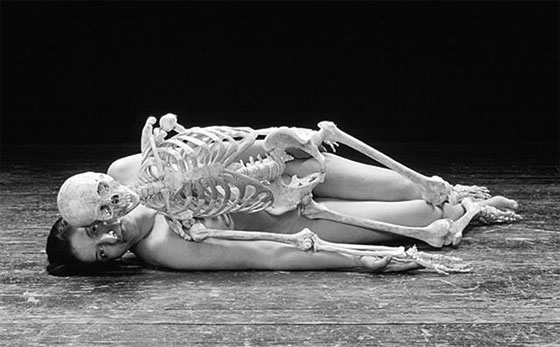
Marina Abramovic
I feel a little regret about picking on an academic paper in progress over at the Tremblings tumblr the other day. Not everyone needs feedback from a know-it-all like me, but sometimes this kind of language tests my patience. It engages in what a friend describes as linguistic privilege — the practice of using big words as means of ensuring the reader (and typically the author) doesn’t know the essay lacks substantiated ideas.
From my tumblr conversation with Tremblings:
Tremblings: This is the only passage that I consistently enjoy reading:
Indeed, all of the performances comprising Seven Easy Pieces seem to be Abramović's take on answering the question of how one remembers. The answer gets increasingly complicated because of the introduction of Abramović's body as a metonym for the performances that she re-performed, standing as a material marker of the interpretive act. How she remembers the performances covered in each segment of Seven Easy Pieces became marked by how she chose to stage each one. Cesare and Joy call this phenomenon “embodied documentation (a re-membering, if you will)”. By reattaching a body to the memory of a past performance, Abramović forces the audience to simultaneously engage the past and present, subsequently increasing our awareness of the impact of memory upon the future.
Me, (being an asshole): Just to be clear this is still awful. The entire paragraph can be boiled down to the following:
Abromovic's Seven Easy Pieces evoke the artist's body as a metaphor for the interpretive act of remembrance. Her arrangement of these performances demonstrates this in its re-enactment and forces the audience to engage with both its past realization and its present. It also increases our awareness of the impact of memory on the art making process (as opposed to future which is not only ambiguous but over stating the matter significantly.)
Still, in the hopes but a friend in academia pointed out last night that this still buys into the language itself. Let’s try this again:
Watching Marina’s performers remind us of her. The artist’s memory and documentation of past performances shapes its re-enactment.
In any event, how is this different from any other performative re-enactment? Response, complete with unsubstantiated arguments and excuses (sorry) here.


{ 80 comments }
I find this very interesting because I recently left an 11-year job in public art to work as a technical writer. The expectations for technical writing are so different than those in the art world but the art world, and probably academia, would benefit greatly from applying the principals of technical writing, which are basically as simple as writing in a way that people can understand. It doesn’t have to be boring. Actually, when you can understand a topic it becomes more interesting. Your exercise above of paring down the paragraph, then having it pared down further is consistent with how technical writing works.
I find this very interesting because I recently left an 11-year job in public art to work as a technical writer. The expectations for technical writing are so different than those in the art world but the art world, and probably academia, would benefit greatly from applying the principals of technical writing, which are basically as simple as writing in a way that people can understand. It doesn’t have to be boring. Actually, when you can understand a topic it becomes more interesting. Your exercise above of paring down the paragraph, then having it pared down further is consistent with how technical writing works.
There is no difference except for one of historical context. What Abramovic did was to upturn the radical intent of performance art as it was conceived in the 1960s and ’70s. To whit: a category of art-making that could not be marketed. By introducing the economics of theatrical spectacle into performance art, she made it safe for capitalism. Now we can all sit back back, and watch as her crappy staring contests and nudie shows are dragged out in perpetuity by institutions like MoMA. For the edification of the museum-going public, of course, as opposed to say, a surefire way of getting people to part with $20.
Nonsense.
Really? and what part was nonsense? that Abramovic’s work is crap? Or that oddly, MoMA chose her as the first performance artist to being given a full retro treatment there because she’s a woman who traffics in her looks as part of the package? get real!
There is no difference except for one of historical context. What Abramovic did was to upturn the radical intent of performance art as it was conceived in the 1960s and ’70s. To whit: a category of art-making that could not be marketed. By introducing the economics of theatrical spectacle into performance art, she made it safe for capitalism. Now we can all sit back back, and watch as her crappy staring contests and nudie shows are dragged out in perpetuity by institutions like MoMA. For the edification of the museum-going public, of course, as opposed to say, a surefire way of getting people to part with $20.
Nonsense.
Really? and what part was nonsense? that Abramovic’s work is crap? Or that oddly, MoMA chose her as the first performance artist to being given a full retro treatment there because she’s a woman who traffics in her looks as part of the package? get real!
The original language is confused because it’s trying to serve too many interests. It makes an interesting claim, though, that’s lost in your translation.
“Abramović forces the audience to simultaneously engage the past and present, subsequently increasing our awareness of the impact of memory upon the future.”
This claim, as I understand it, is not just that we become aware of how Abramović’s memory fits into her art making process, but that our relationship to our own memory is somehow changed by her work. As presented this is totally unsubstantiated, but it’s interesting, at least, and I’d like to see it developed further.
The original language is confused because it’s trying to serve too many interests. It makes an interesting claim, though, that’s lost in your translation.
“Abramović forces the audience to simultaneously engage the past and present, subsequently increasing our awareness of the impact of memory upon the future.”
This claim, as I understand it, is not just that we become aware of how Abramović’s memory fits into her art making process, but that our relationship to our own memory is somehow changed by her work. As presented this is totally unsubstantiated, but it’s interesting, at least, and I’d like to see it developed further.
The problem with academic language is that it seems gratuitous when it’s quoted on a blog. In an academic context, that paragraph is fine. On a blog, you’re right that it can (and should) be boiled down.
But that doesn’t mean that important distinctions aren’t being made by the language used in it’s original context. All academic disciplines require specialized language that seems arcane in any other context. If I were to describe the sun, I could say “It’s a star at the center of our solar system, it’s about 850,000 miles in diameter, and it’s mostly hydrogen and helium.” And that would be great in most cases. But if I were writing in journal dedicated to solar astronomy, that would be way too simple. An academic study of something requires language that differentiates a thing from all the other things that are very similar.
So in the context of art discourse as a whole, parsing out exactly how a re-perfomed Abromovic works seems excessive. But if you’re trying to differentiate it from other discourse about performance art (and even from Abromovic’s own previous incarnations of the same work), some verbal acrobatics are necessary.
This buys into the idea that something more is being said by academics. My point is that in this case, that’s not an accurate assessment.
So you’re dismissing academic writing wholesale based on a fragment of a single essay? I’m not going to delve into a discussion of the merits of tremblings’ statement, since I don’t think an isolated paragraph from an essay in-progress can give a real sense of what he/she is trying to argue; frankly, it seems like you just picked up a random example and used it as an excuse to rail on academic language. It’s one thing to disagree with the content of a specific argument (though, again, I’d argue that you can’t really get a thorough sense of what the argument actually is from a single paragraph with no context), but it doesn’t seem like you’re even necessarily doing that. Rather than trying engage in a meaningful conversation with WHAT is being said, you’re just attacking the style. Worse, you’re making bombastic statements on all academic writing based on one person’s (unfinished!) essay. I get that “The Problem with Academic Language..” is a more attention-grabbing headline than “I Disagree With This One Paragraph I Read on Someone’s Tumblr” but seriously, it’s misleading (and unconvincing) to propose “all academic language is moronic jargon and academics are blowhards” from the paltry evidence you’ve put forth. Condemning all academic writing based on one tiny example is like saying that all art blogs are devoid of meaningful criticism just because this one is increasingly composed of animated GIFs and snark.
I’ve got to agree with Rachel here. I’m not thrilled with Tremblings’ excerpt either, but your “distillation” of the paragraph hasn’t actually led to any greater clarity.
In fact, there are new confusions that your edit has added: “Abramović” becomes “Abromovic” (and by a later commenter, “Ambramovich”), and your final two-sentence edit turns her “performances” into “Marina’s performers,” a word trade that suggests that we’re no longer referring to her “Seven Easy Pieces,” but to something that was presented by her reperformers.
Maybe these were just typos (we’re all guilty of that), but it certainly doesn’t help your case to chastise Tremblings’ apparently convoluted writing by substituting a concise but error-laden snippet (and one that alters Tremblings’ original subjects, however vague).
I prefer pith and snark to floaty, poorly-worded pseudo-academic blathering, but it’s lazy and ignorant for people to use your example – an unfinished paragraph from a mediocre essay – as a solid justification as to why we should dismiss all “academic writing.” Brevity and wit tend to resonate better on blogs than dense treatises, but let’s not throw out the academic baby with the bathwater.
Rachel and Jesse: What I think is misleading is to describe a finished essay as “unfinished”. Tremblings was converting the style of the essay in question to Chicago style — this means the blogger was adjusting punctuation and capitalization not content. Rachel then does the same thing she accuses me of only worse: she proceeds to put her own quotes around something I never said as if I had I written it. “all academic language is moronic jargon and academics are blowhardsâ€. I wrote “sometimes this kind of language tests my patience”. Sometimes is not the same as “all” nor is “academic language” the same as “moronic jargon”.
In other linguistic equivalency quibbles, Abramović becoming Abramovic isn’t a spelling error so grave that a reader won’t get the point and characterizing this as confusing is overstating the matter. Also, Marina’s performers was a purposeful change. Seven Easy Pieces were re-performed by Marina’s performers at the MoMA, and since this was the piece being discussed I changed the language. Of course we could debate whether that was an accurate edit, but as Jesse himself notes the paragraph is very vague for all its verboseness.
Now, I’m the first to admit my post was not particularly generous. In fact, I was being a bit of a jerk AND made a mistake recasting the paragraph, so I think commentors have been right to say that this doesn’t help further my point. I apologize to Tremblings for this. But I wasn’t searching for a random bit of academic-ease just so I could make vast generalizations about the field. I stumbled upon the piece and was annoyed, because after all the work I did to try and figure out what was being said, it turned out to not be anything particularly substantive. Commenters likely a little more familiar reading academic language than myself have corrected my recasting and I like that that has occurred. Still, I’ll note that there are multiple readings of this paragraph and none of us but Brian really buy the core point that the re-enactments are the memory. As far as I’m concerned, my original complaint still stands: If you can express a simple idea simply then it should be done. From there we can discuss the content, which contrary to Rachel’s comment was exactly what I did at the end of this post based on my interpretation.
P.S. This post not withstanding, there’s a lot less snark on this blog than there used to be. That’s intentional. There’s also a lot fewer animated gifs, a problem that needs to be addressed asap. May the floodgates open!
I didn’t realize that the essay was finished. And I probably nitpicked your two-line revision because part of me really wants Maurice Abroomaquiditćh to be an interpretive metonymic material marker (re)performing memory-body. And her name is a bitch to spell (I cut & paste that shit; and the “ć” is just annoying).
I agree that a simple point should be stated simply. I also think that it’s possible for unnecessarily complex writing to be enlightening, but mostly only when the author exhibits self-awareness of how unnecessarily complex they’re being (the Tremblings paragraph does not read as being self-aware of its unnecessary complexity, and it’s not at all enlightening).
I’d prefer for any probing “academic writing” on Abramović to scrap the (re)(dis)mem(ory)berment concerns and try to address, as Halle put it, “the economics of theatrical spectacle into performance art.” Abramović pulled some David Blaine-esque, Flickr’d-out mess up in MoMA – and now she wants to create “Performance Art ©” – and even the “academics” want to gloss over that fact? Marxist critique, y’all. Marxist critique.
My characterization of the essay as “unfinished” was based on your description of it as “an academic paper in progress” in the post. I think calling something “in progress” implies that it’s not finished — it may be an incorrect assessment of the piece, but it wasn’t something I pulled totally out of left field.
Also, I’ll admit that I misread your above comment (the one I initially responded to in the thread: “This buys into the idea that something more is being said by academics. My point is that in this case, that’s not an accurate assessment.”) I missed the “in this case” and thought you were speaking much more generally, hence my very strong reaction to it. I also in no way meant to imply that “all academic language is moronic jargon and academics are blowhards” was a direct quote from you — I figured the somewhat hyperbolic language would make it clear that it was an interpretation of what I gleaned from the overall tone of your post and the comments, not exactly what you had said. Honestly, it never occurred to me that anyone would read it as an actual quote.
With that said, some of my comments still stand — you haven’t actually addressed “The Problem of Academic Language” in this post; you’ve addressed the problem of a particular paragraph that is not especially convincing and perhaps poorly worded. There IS a lot of jargon thrown around in the art world (anyone who has spent a lot of time reading artist statements and gallery press releases can attest to that.) However, I really don’t think that this is a problem with academic language inherently — more the improper use of it.
Also, as I said before, it’s often pretty useless to try to evaluate an academic essay based on a singe paragraph presented without any context. Often in academic essays, a good deal of space is spent early on establishing the specific types of language, theoretic framework, etc. that will be used throughout the rest of the work. I wrote an essay once that drew heavily upon a concept of “historiographic metafiction,” a term coined by literary theorist Linda Hutcheon and described at length in her books. I’m sure if you took some of the paragraphs from said essay out of context, they’d look totally ridiculous/generally meaningless (I dare someone to find a more jargon-y phrase than ‘historiographic metafiction. Seriously.) However, I spent much of the introduction explaining how and why this term would be deployed throughout the paper (and, by extension, that any mention of it should be taken as a reference to Hutcheon.) Part of the problem with taking academic language out of an academic context is that these things aren’t always explicitly clear.
Lastly, in response to your comment: “From there we can discuss the content, which contrary to Rachel’s comment was exactly what I did at the end of this post based on my interpretation.” I don’t think you actually DO discuss the content at the end of the post. “How is this different from any other performative reenactment” isn’t really a discussion — it’s a question. If you think tremblings is wrong and are going to publicly criticize his/her work, why not actually make an argument against it?
Also, in response to your response to Jesse’s comment, I might be wrong about this, but I’m fairy certain that 7 EP wasn’t re-performed during the Marina retrospective; since 5 of the 7 pieces in 7EP were re-performances BY Marina of the work of other artists, it doesn’t really make sense to have hired performers re-performing a performance that wasn’t hers to begin with. There might have been video, however.
These were the performances from “Seven Easy Pieces” : http://bit.ly/8Yx8G2
These were not reperformed by the reperformers at her MoMA retrospective; they only reperformed her work.
The problem with academic language is that it seems gratuitous when it’s quoted on a blog. In an academic context, that paragraph is fine. On a blog, you’re right that it can (and should) be boiled down.
But that doesn’t mean that important distinctions aren’t being made by the language used in it’s original context. All academic disciplines require specialized language that seems arcane in any other context. If I were to describe the sun, I could say “It’s a star at the center of our solar system, it’s about 850,000 miles in diameter, and it’s mostly hydrogen and helium.” And that would be great in most cases. But if I were writing in journal dedicated to solar astronomy, that would be way too simple. An academic study of something requires language that differentiates a thing from all the other things that are very similar.
So in the context of art discourse as a whole, parsing out exactly how a re-perfomed Abromovic works seems excessive. But if you’re trying to differentiate it from other discourse about performance art (and even from Abromovic’s own previous incarnations of the same work), some verbal acrobatics are necessary.
This buys into the idea that something more is being said by academics. My point is that in this case, that’s not an accurate assessment.
So you’re dismissing academic writing wholesale based on a fragment of a single essay? I’m not going to delve into a discussion of the merits of tremblings’ statement, since I don’t think an isolated paragraph from an essay in-progress can give a real sense of what he/she is trying to argue; frankly, it seems like you just picked up a random example and used it as an excuse to rail on academic language. It’s one thing to disagree with the content of a specific argument (though, again, I’d argue that you can’t really get a thorough sense of what the argument actually is from a single paragraph with no context), but it doesn’t seem like you’re even necessarily doing that. Rather than trying engage in a meaningful conversation with WHAT is being said, you’re just attacking the style. Worse, you’re making bombastic statements on all academic writing based on one person’s (unfinished!) essay. I get that “The Problem with Academic Language..” is a more attention-grabbing headline than “I Disagree With This One Paragraph I Read on Someone’s Tumblr” but seriously, it’s misleading (and unconvincing) to propose “all academic language is moronic jargon and academics are blowhards” from the paltry evidence you’ve put forth. Condemning all academic writing based on one tiny example is like saying that all art blogs are devoid of meaningful criticism just because this one is increasingly composed of animated GIFs and snark.
I’ve got to agree with Rachel here. I’m not thrilled with Tremblings’ excerpt either, but your “distillation” of the paragraph hasn’t actually led to any greater clarity.
In fact, there are new confusions that your edit has added: “Abramović” becomes “Abromovic” (and by a later commenter, “Ambramovich”), and your final two-sentence edit turns her “performances” into “Marina’s performers,” a word trade that suggests that we’re no longer referring to her “Seven Easy Pieces,” but to something that was presented by her reperformers.
Maybe these were just typos (we’re all guilty of that), but it certainly doesn’t help your case to chastise Tremblings’ apparently convoluted writing by substituting a concise but error-laden snippet (and one that alters Tremblings’ original subjects, however vague).
I prefer pith and snark to floaty, poorly-worded pseudo-academic blathering, but it’s lazy and ignorant for people to use your example – an unfinished paragraph from a mediocre essay – as a solid justification as to why we should dismiss all “academic writing.” Brevity and wit tend to resonate better on blogs than dense treatises, but let’s not throw out the academic baby with the bathwater.
Rachel and Jesse: What I think is misleading is to describe a finished essay as “unfinished”. Tremblings was converting the style of the essay in question to Chicago style — this means the blogger was adjusting punctuation and capitalization not content. Rachel then does the same thing she accuses me of only worse: she proceeds to put her own quotes around something I never said as if I had I written it. “all academic language is moronic jargon and academics are blowhardsâ€. I wrote “sometimes this kind of language tests my patience”. Sometimes is not the same as “all” nor is “academic language” the same as “moronic jargon”.
In other linguistic equivalency quibbles, Abramović becoming Abramovic isn’t a spelling error so grave that a reader won’t get the point and characterizing this as confusing is overstating the matter. Also, Marina’s performers was a purposeful change. Seven Easy Pieces were re-performed by Marina’s performers at the MoMA, and since this was the piece being discussed I changed the language. Of course we could debate whether that was an accurate edit, but as Jesse himself notes the paragraph is very vague for all its verboseness.
Now, I’m the first to admit my post was not particularly generous. In fact, I was being a bit of a jerk AND made a mistake recasting the paragraph, so I think commentors have been right to say that this doesn’t help further my point. I apologize to Tremblings for this. But I wasn’t searching for a random bit of academic-ease just so I could make vast generalizations about the field. I stumbled upon the piece and was annoyed, because after all the work I did to try and figure out what was being said, it turned out to not be anything particularly substantive. Commenters likely a little more familiar reading academic language than myself have corrected my recasting and I like that that has occurred. Still, I’ll note that there are multiple readings of this paragraph and none of us but Brian really buy the core point that the re-enactments are the memory. As far as I’m concerned, my original complaint still stands: If you can express a simple idea simply then it should be done. From there we can discuss the content, which contrary to Rachel’s comment was exactly what I did at the end of this post based on my interpretation.
P.S. This post not withstanding, there’s a lot less snark on this blog than there used to be. That’s intentional. There’s also a lot fewer animated gifs, a problem that needs to be addressed asap. May the floodgates open!
I didn’t realize that the essay was finished. And I probably nitpicked your two-line revision because part of me really wants Maurice Abroomaquiditćh to be an interpretive metonymic material marker (re)performing memory-body. And her name is a bitch to spell (I cut & paste that shit; and the “ć” is just annoying).
I agree that a simple point should be stated simply. I also think that it’s possible for unnecessarily complex writing to be enlightening, but mostly only when the author exhibits self-awareness of how unnecessarily complex they’re being (the Tremblings paragraph does not read as being self-aware of its unnecessary complexity, and it’s not at all enlightening).
I’d prefer for any probing “academic writing” on Abramović to scrap the (re)(dis)mem(ory)berment concerns and try to address, as Halle put it, “the economics of theatrical spectacle into performance art.” Abramović pulled some David Blaine-esque, Flickr’d-out mess up in MoMA – and now she wants to create “Performance Art ©” – and even the “academics” want to gloss over that fact? Marxist critique, y’all. Marxist critique.
My characterization of the essay as “unfinished” was based on your description of it as “an academic paper in progress” in the post. I think calling something “in progress” implies that it’s not finished — it may be an incorrect assessment of the piece, but it wasn’t something I pulled totally out of left field.
Also, I’ll admit that I misread your above comment (the one I initially responded to in the thread: “This buys into the idea that something more is being said by academics. My point is that in this case, that’s not an accurate assessment.”) I missed the “in this case” and thought you were speaking much more generally, hence my very strong reaction to it. I also in no way meant to imply that “all academic language is moronic jargon and academics are blowhards” was a direct quote from you — I figured the somewhat hyperbolic language would make it clear that it was an interpretation of what I gleaned from the overall tone of your post and the comments, not exactly what you had said. Honestly, it never occurred to me that anyone would read it as an actual quote.
With that said, some of my comments still stand — you haven’t actually addressed “The Problem of Academic Language” in this post; you’ve addressed the problem of a particular paragraph that is not especially convincing and perhaps poorly worded. There IS a lot of jargon thrown around in the art world (anyone who has spent a lot of time reading artist statements and gallery press releases can attest to that.) However, I really don’t think that this is a problem with academic language inherently — more the improper use of it.
Also, as I said before, it’s often pretty useless to try to evaluate an academic essay based on a singe paragraph presented without any context. Often in academic essays, a good deal of space is spent early on establishing the specific types of language, theoretic framework, etc. that will be used throughout the rest of the work. I wrote an essay once that drew heavily upon a concept of “historiographic metafiction,” a term coined by literary theorist Linda Hutcheon and described at length in her books. I’m sure if you took some of the paragraphs from said essay out of context, they’d look totally ridiculous/generally meaningless (I dare someone to find a more jargon-y phrase than ‘historiographic metafiction. Seriously.) However, I spent much of the introduction explaining how and why this term would be deployed throughout the paper (and, by extension, that any mention of it should be taken as a reference to Hutcheon.) Part of the problem with taking academic language out of an academic context is that these things aren’t always explicitly clear.
Lastly, in response to your comment: “From there we can discuss the content, which contrary to Rachel’s comment was exactly what I did at the end of this post based on my interpretation.” I don’t think you actually DO discuss the content at the end of the post. “How is this different from any other performative reenactment” isn’t really a discussion — it’s a question. If you think tremblings is wrong and are going to publicly criticize his/her work, why not actually make an argument against it?
Also, in response to your response to Jesse’s comment, I might be wrong about this, but I’m fairy certain that 7 EP wasn’t re-performed during the Marina retrospective; since 5 of the 7 pieces in 7EP were re-performances BY Marina of the work of other artists, it doesn’t really make sense to have hired performers re-performing a performance that wasn’t hers to begin with. There might have been video, however.
These were the performances from “Seven Easy Pieces” : http://bit.ly/8Yx8G2
These were not reperformed by the reperformers at her MoMA retrospective; they only reperformed her work.
Wow… you feel bad? Don’t feel bad or apologize about this… Trembling’s writing is obtuse as it is empty, which is to say, totally par for course in terms of academic treatment of work like Abramovic’s. Particularly this:
“the introduction of Abramović’s body as a metonym for the performances that she re-performed, standing as a material marker of the interpretive act.”
Use of rhetorical figures (metonym/metaphor/synecdoche/etc) in academic writing is usually unfortunate because it doesn’t actually make any relationships in the work clearer, doesn’t really describe our reception of the work in any sensual terms and, moreover, conceptualizes (and therefore simplifies) what is often most obvious about the work itself. You can probably thank Krauss-Buchloh-Bois et al. for rhetorical figure proliferation – and for such nonsense as “material marker” for that matter. However, your simplification of Tremblings already foggy thinking ends up being no more helpful, as you note. Yeah, Abramovic is re-enacting works she already performed… is the aggregate effect to make us think “impact of memory on the future” (eeeee) or just that “it shapes the re-enactment” — neither of these statements gets beyond what is already just obvious, neither are interpretive in any sense and neither help distinguish this work from any other work that is a re-enactment. That is to say, what is most obvious about the work, and what has here lent itself to conceptual-blabbering, is exactly what we should try to understand for its specificity, the difficulty of trying to make distinctions rather than merely categorize. You can see the no-duh train of thought: bodies –> members –> re-enactment –> re-membering = ugh.
No need to apologize to Trembling, this is exactly the type of “no shit, dude” writing that needs to get called out and tossed out. Why would you need to quote someone just to use the words “embodied documentation” or “re-membering.” Also, if I can just mention another “discourse marker” of lame, it is when the work is described as “forcing the audience” to do something. To do what? To do nothing: to care, to interpret, to understand, to evaluate, to consider, to challenge, to remember — that is obviously up us, and what Trembling has chosen not to do.
Wow… you feel bad? Don’t feel bad or apologize about this… Trembling’s writing is obtuse as it is empty, which is to say, totally par for course in terms of academic treatment of work like Abramovic’s. Particularly this:
“the introduction of Abramović’s body as a metonym for the performances that she re-performed, standing as a material marker of the interpretive act.”
Use of rhetorical figures (metonym/metaphor/synecdoche/etc) in academic writing is usually unfortunate because it doesn’t actually make any relationships in the work clearer, doesn’t really describe our reception of the work in any sensual terms and, moreover, conceptualizes (and therefore simplifies) what is often most obvious about the work itself. You can probably thank Krauss-Buchloh-Bois et al. for rhetorical figure proliferation – and for such nonsense as “material marker” for that matter. However, your simplification of Tremblings already foggy thinking ends up being no more helpful, as you note. Yeah, Abramovic is re-enacting works she already performed… is the aggregate effect to make us think “impact of memory on the future” (eeeee) or just that “it shapes the re-enactment” — neither of these statements gets beyond what is already just obvious, neither are interpretive in any sense and neither help distinguish this work from any other work that is a re-enactment. That is to say, what is most obvious about the work, and what has here lent itself to conceptual-blabbering, is exactly what we should try to understand for its specificity, the difficulty of trying to make distinctions rather than merely categorize. You can see the no-duh train of thought: bodies –> members –> re-enactment –> re-membering = ugh.
No need to apologize to Trembling, this is exactly the type of “no shit, dude” writing that needs to get called out and tossed out. Why would you need to quote someone just to use the words “embodied documentation” or “re-membering.” Also, if I can just mention another “discourse marker” of lame, it is when the work is described as “forcing the audience” to do something. To do what? To do nothing: to care, to interpret, to understand, to evaluate, to consider, to challenge, to remember — that is obviously up us, and what Trembling has chosen not to do.
What’s “different” about Abramović’s “performative re-enactments” (which we’re now encouraged to truncate into “reperformances”) is the manner in which they’ve been authenticated – or so says Abramović. She discussed this at the symposium following her MoMA retrospective (http://bit.ly/9gCdvD), and cited her reperforming of “Seven Easy Pieces” as an enactment of how she believes reperformances should be authenticated, including her own.
It’s fine if people want to get absorbed in writing about her as a “metonym” and discussions about “memory,” etc., but Abramović herself has made it clear that establishing a system of authentication is an essential step in legitimizing the “presence” of her reperformances (and the reperformances of others). She talking about copyrights, branding, granting permissions, etc., as a necessary means to protect and preserve the integrity and authenticity of performance art. At present, no such “system” exists (as it does for music, writing, etc.).
So, if Abramović has her way, “performative re-enactments” can be differentiated by whether or not they’ve been legitimized/approved by those entrusted to uphold those as-of-yet-undetermined protocols.
Exactly. Well said.
What’s “different” about Abramović’s “performative re-enactments” (which we’re now encouraged to truncate into “reperformances”) is the manner in which they’ve been authenticated – or so says Abramović. She discussed this at the symposium following her MoMA retrospective (http://bit.ly/9gCdvD), and cited her reperforming of “Seven Easy Pieces” as an enactment of how she believes reperformances should be authenticated, including her own.
It’s fine if people want to get absorbed in writing about her as a “metonym” and discussions about “memory,” etc., but Abramović herself has made it clear that establishing a system of authentication is an essential step in legitimizing the “presence” of her reperformances (and the reperformances of others). She talking about copyrights, branding, granting permissions, etc., as a necessary means to protect and preserve the integrity and authenticity of performance art. At present, no such “system” exists (as it does for music, writing, etc.).
So, if Abramović has her way, “performative re-enactments” can be differentiated by whether or not they’ve been legitimized/approved by those entrusted to uphold those as-of-yet-undetermined protocols.
Exactly. Well said.
It never ceases to astonish me how often academics restate basic ideas in their writing. In academia, more is always more. You would think with all these presumably intelligent, educated people it wouldn’t be necessary to use words like “metonym” and “material marker” in the same sentence, describing the same thing. But you would be wrong. And this is a comparatively lively example. I would quote some catalog essays that say even less in many more words, but I don’t want to be responsible for the spontaneous lobotomy that would surely follow.
It never ceases to astonish me how often academics restate basic ideas in their writing. In academia, more is always more. You would think with all these presumably intelligent, educated people it wouldn’t be necessary to use words like “metonym” and “material marker” in the same sentence, describing the same thing. But you would be wrong. And this is a comparatively lively example. I would quote some catalog essays that say even less in many more words, but I don’t want to be responsible for the spontaneous lobotomy that would surely follow.
Ever hear about Art Baloney Blog? It’s got excerpts of fabulous linguistic privilege. http://artbaloney.wordpress.com
Ever hear about Art Baloney Blog? It’s got excerpts of fabulous linguistic privilege. http://artbaloney.wordpress.com
I am an academic. Let’s make one thing clear: being an academic is not an excuse for bad behavior. Among the worst behavior that academics engage in is pathetically bad writing. Being incomprehensible is not a virtue ~ anywhere.
I am an academic. Let’s make one thing clear: being an academic is not an excuse for bad behavior. Among the worst behavior that academics engage in is pathetically bad writing. Being incomprehensible is not a virtue ~ anywhere.
PS: Paddy is smart and handsome like me but no relation.
PS2: It is interesting that the passage he uses as an exemplar is “about”Marina Abramovic. My view of her recent charade in NYC is that is was vacuous and that the emptiness has been well hidden by a thick layer of academic jargon and art-world-speak. The performance and the descriptions are symbiotic.
http://www.artnet.com/magazineus/features/finch/marina-abramovic6-3-10.asp
PS: Paddy is smart and handsome like me but no relation.
PS2: It is interesting that the passage he uses as an exemplar is “about”Marina Abramovic. My view of her recent charade in NYC is that is was vacuous and that the emptiness has been well hidden by a thick layer of academic jargon and art-world-speak. The performance and the descriptions are symbiotic.
http://www.artnet.com/magazineus/features/finch/marina-abramovic6-3-10.asp
On some level I believe writers and critics feel the need to ‘out-art’ the artist by using language as a medium. The question I ask after reading most anything is if I would want to sit next to the writer on a long plain ride. Would the smug factor destroy my will to live or do they seem okay. I take an iPod on planes for a reason. That being said: Why is it writing brings out the most inane language that speaking doesn’t?
On some level I believe writers and critics feel the need to ‘out-art’ the artist by using language as a medium. The question I ask after reading most anything is if I would want to sit next to the writer on a long plain ride. Would the smug factor destroy my will to live or do they seem okay. I take an iPod on planes for a reason. That being said: Why is it writing brings out the most inane language that speaking doesn’t?
I personally have to re-look-up metonym every time I come across it (this time being no exception), but it means something different from metaphor and the distinction makes it a useful word. Trembling’s paragraph doesn’t say that Abramovich evokes the body. It says that she presents the body, right there (a material marker), and the body isn’t metaphorically referencing memory in some kind of artsy poetic way but directly standing in for memory which, I might add, is a physiological process that happens in the body (hence the metonym). It’s not the most elegantly written paragraph I’ve ever read but it’s not the worst, and it’s talking about something much more interesting than just the impact of memory in the art making process. It’s talking about attaching memory to the materiality of the present. And by the way, this is how memory works. It always happens in the present, and this has both physiological and narrative implications for the memories of the future. There’s tons of interesting work being done on memory that questions common sense assumptions about what it actually is and what it actually does. Trembling’s paragraph reaches out to that research and Paddy’s don’t.
You might disagree with Trembling and argue that in fact this is not what Ambramovich is doing at all. Or you might argue that the exploration of memory as a material process in the present is just not interesting enough nor relevant to the appreciation of artworks. Or you might simply walk away and refuse to engage with Trembling on Trembling’s terms. But changing Trembling’s argument into something completely different (and less interesting) is playing kind of dirty and also kind of playing dumb.
I agree with Lonestar about the whole “forcing the audience” thing. That construct betrays an insecurity about the writer’s own subjective point of view. One of the more brutal aspects of academia is the pervasive assumption that everything stated must be somehow irrefutable. But it seems like Trembling is working on it: “I don’t think I have all the answers. I don’t want all the answers. I want to fail so that I can relearn things.” That sounds like an excellent attitude to me, and putting academic writing up on a blog is a pretty brave strategy for making it happen.
I personally have to re-look-up metonym every time I come across it (this time being no exception), but it means something different from metaphor and the distinction makes it a useful word. Trembling’s paragraph doesn’t say that Abramovich evokes the body. It says that she presents the body, right there (a material marker), and the body isn’t metaphorically referencing memory in some kind of artsy poetic way but directly standing in for memory which, I might add, is a physiological process that happens in the body (hence the metonym). It’s not the most elegantly written paragraph I’ve ever read but it’s not the worst, and it’s talking about something much more interesting than just the impact of memory in the art making process. It’s talking about attaching memory to the materiality of the present. And by the way, this is how memory works. It always happens in the present, and this has both physiological and narrative implications for the memories of the future. There’s tons of interesting work being done on memory that questions common sense assumptions about what it actually is and what it actually does. Trembling’s paragraph reaches out to that research and Paddy’s don’t.
You might disagree with Trembling and argue that in fact this is not what Ambramovich is doing at all. Or you might argue that the exploration of memory as a material process in the present is just not interesting enough nor relevant to the appreciation of artworks. Or you might simply walk away and refuse to engage with Trembling on Trembling’s terms. But changing Trembling’s argument into something completely different (and less interesting) is playing kind of dirty and also kind of playing dumb.
I agree with Lonestar about the whole “forcing the audience” thing. That construct betrays an insecurity about the writer’s own subjective point of view. One of the more brutal aspects of academia is the pervasive assumption that everything stated must be somehow irrefutable. But it seems like Trembling is working on it: “I don’t think I have all the answers. I don’t want all the answers. I want to fail so that I can relearn things.” That sounds like an excellent attitude to me, and putting academic writing up on a blog is a pretty brave strategy for making it happen.
@sally: Let’s say I change “The artist’s memory and documentation of past performances shapes its re-enactment” to “The artist’s memory and documentation of past performances shapes its re-enactment and its reception”.
How is this different than “attaching memory to the materiality of the present.” Why do I need a whole paragraph about this?
This I very much agree with.
I think Sally (and later Tyler, as well) zeroes in on the problem buried under the bombast of Paddy’s initial post: beyond the post’s problematic and defensive tone one senses a general disregard for subtle–and in the case of “metonym” versus “metaphor,” not so subtle–distinctions. For the record: substituting the name for the thing (in the case of a metonym) has very little to do with the kinds of whimsical associations more prevalent in metaphoric figuration.
Again, if the frustration that Paddy’s own prose seems to evidence comes from what she describes as a resistance to jargon and wordiness, then the real issue has to do with who one imagines their audience to be. If the audience is defined as a general reader, one can slide sloppily between words like “metaphor” and “metonym” and hope that one of these two words conveys the argument. If all one wants from criticism is opinion (“did TONY give that show three stars or four?”), then it is easy to support this kind of middle American resistance to extended critical thought. I can hear the editors and pedestrian art critics complaining, “why do they have to make it so difficult to understand? Even my kids know what art they like and what they don’t.”
Invariably those who take issue with academic writing and its vocabulary often appear to be wrestling with a profound resistance to specialization of any sort—I wonder if they feel the same way about other highly specialized fields like, say, medicine or engineering. In an age where speed appears to define reading and writing about art and culture, we need to encourage the kind of prolonged critical reflection that these specialized discourses provide. How the prose excerpted above is “still awful” isn’t entirely clear to me, that is, unless you view criticism as mere statement of opinion and testimony of personal taste. Unfortunately, that is often the case with popular media/blog outlets that favor frequent posts to in-depth consideration and dialogue.
The dialogue below, especially from Sally and the quote from Eddie Chu, gets closer to the kinds of criticism that matters—where a concentrated consideration of Abramovic’s use of the body as a commentary on certain age-old “absolutes” like space and time–encourages us to return to the questioning of adequate vocabulary that opened this thread. The body as a problematic and provocative signifier seems compelling to me . . . especially in terms of a self-reflexive commentary on MA’s own art and on the interpretive act itself.
Brian: “One” doesn’t sense a disregard for subtle or not so subtle differences, you do. You’ve written three paragraphs expressing negative, generalizing thoughts about blogs, pedestrian critics, and resistance to specialized fields, all of which seem specifically directed at Art Fag City. Please own the criticism if you’re going to lodge it.
Now, I made a mistake in my interpretation of the paragraph, and when it was pointed out I have owned that. However, I’m growing tired of reading that a simple mistake must mean willful disregard, laziness, or purposefully playing dumb. Were that the case, I would not be engaging you here, nor would I have approved dissenting comments. Lump someone else into your thoughts about blog outlets that favor frequent posting to in-depth consideration. Also please provide a substantiated defense of why you think Tremblings prose were clear. Sally herself expressed Tremblings’ core idea in one sentence which suggests to me that editing wouldn’t have hurt the quoted paragraph.
For the record, contrary to your position, I don’t buy that Abramovic means for her re-enactments to be the memory or that that’s even the case. As Howard Halle points out, if that’s the case why even do it?
“I’m growing tired of reading that a simple mistake must mean willful disregard, laziness, or purposefully playing dumb.”
I feel badly about that. I’m sorry, and I’d like to retract that part of what I said. I was being disingenuous.
As a recent academic who has been writing about art in non-academic genres for many years, I always feel deeply conflicted when this kind of conversation comes up. I hate it when different genres of art writing are pitted against one another. Seems to me that it takes all kinds, and cross-fertilization between journalism, criticism and history can be really generative. This blog is a good hybrid. Part of the reason I come here at least once every day.
Thanks for the retraction and no need to feel bad. Ultimately I feel like this thread was productive on a number of levels. That doesn’t happen in clean comment sections.
@sally: Let’s say I change “The artist’s memory and documentation of past performances shapes its re-enactment” to “The artist’s memory and documentation of past performances shapes its re-enactment and its reception”.
How is this different than “attaching memory to the materiality of the present.” Why do I need a whole paragraph about this?
This I very much agree with.
I think Sally (and later Tyler, as well) zeroes in on the problem buried under the bombast of Paddy’s initial post: beyond the post’s problematic and defensive tone one senses a general disregard for subtle–and in the case of “metonym” versus “metaphor,” not so subtle–distinctions. For the record: substituting the name for the thing (in the case of a metonym) has very little to do with the kinds of whimsical associations more prevalent in metaphoric figuration.
Again, if the frustration that Paddy’s own prose seems to evidence comes from what she describes as a resistance to jargon and wordiness, then the real issue has to do with who one imagines their audience to be. If the audience is defined as a general reader, one can slide sloppily between words like “metaphor” and “metonym” and hope that one of these two words conveys the argument. If all one wants from criticism is opinion (“did TONY give that show three stars or four?”), then it is easy to support this kind of middle American resistance to extended critical thought. I can hear the editors and pedestrian art critics complaining, “why do they have to make it so difficult to understand? Even my kids know what art they like and what they don’t.”
Invariably those who take issue with academic writing and its vocabulary often appear to be wrestling with a profound resistance to specialization of any sort—I wonder if they feel the same way about other highly specialized fields like, say, medicine or engineering. In an age where speed appears to define reading and writing about art and culture, we need to encourage the kind of prolonged critical reflection that these specialized discourses provide. How the prose excerpted above is “still awful” isn’t entirely clear to me, that is, unless you view criticism as mere statement of opinion and testimony of personal taste. Unfortunately, that is often the case with popular media/blog outlets that favor frequent posts to in-depth consideration and dialogue.
The dialogue below, especially from Sally and the quote from Eddie Chu, gets closer to the kinds of criticism that matters—where a concentrated consideration of Abramovic’s use of the body as a commentary on certain age-old “absolutes” like space and time–encourages us to return to the questioning of adequate vocabulary that opened this thread. The body as a problematic and provocative signifier seems compelling to me . . . especially in terms of a self-reflexive commentary on MA’s own art and on the interpretive act itself.
Brian: “One” doesn’t sense a disregard for subtle or not so subtle differences, you do. You’ve written three paragraphs expressing negative, generalizing thoughts about blogs, pedestrian critics, and resistance to specialized fields, all of which seem specifically directed at Art Fag City. Please own the criticism if you’re going to lodge it.
Now, I made a mistake in my interpretation of the paragraph, and when it was pointed out I have owned that. However, I’m growing tired of reading that a simple mistake must mean willful disregard, laziness, or purposefully playing dumb. Were that the case, I would not be engaging you here, nor would I have approved dissenting comments. Lump someone else into your thoughts about blog outlets that favor frequent posting to in-depth consideration. Also please provide a substantiated defense of why you think Tremblings prose were clear. Sally herself expressed Tremblings’ core idea in one sentence which suggests to me that editing wouldn’t have hurt the quoted paragraph.
For the record, contrary to your position, I don’t buy that Abramovic means for her re-enactments to be the memory or that that’s even the case. As Howard Halle points out, if that’s the case why even do it?
“I’m growing tired of reading that a simple mistake must mean willful disregard, laziness, or purposefully playing dumb.”
I feel badly about that. I’m sorry, and I’d like to retract that part of what I said. I was being disingenuous.
As a recent academic who has been writing about art in non-academic genres for many years, I always feel deeply conflicted when this kind of conversation comes up. I hate it when different genres of art writing are pitted against one another. Seems to me that it takes all kinds, and cross-fertilization between journalism, criticism and history can be really generative. This blog is a good hybrid. Part of the reason I come here at least once every day.
Thanks for the retraction and no need to feel bad. Ultimately I feel like this thread was productive on a number of levels. That doesn’t happen in clean comment sections.
because it’s not just that the memory is shaping the re-enactment. The re-enactment is the memory, in a very literal sense. (I’m not saying I buy it that this is what Ambramovich is doing, but I do think it’s the claim that Trembling is making).
I can see that and recognize that my reduction wasn’t fair on that point, though it’s not as intentional as you claim. It wasn’t my intention to misrepresent the ideas with dumber ones, only to offer something a little more clear. (Also, I don’t buy Tremblings idea that re-enactment is the memory nor do I think it any more interesting than the one I posited)
Meanwhile, Eddie Chu over facebook complained similarly that I had genericized the idea saying,
This seemed accurate to me too – though as I said to him, those ideas could only be culled with a pre-existing knowledge of the piece — they weren’t made clear within the paragraph. I just don’t think there should be so much confusion over what the author’s actual ideas were.
because it’s not just that the memory is shaping the re-enactment. The re-enactment is the memory, in a very literal sense. (I’m not saying I buy it that this is what Ambramovich is doing, but I do think it’s the claim that Trembling is making).
I can see that and recognize that my reduction wasn’t fair on that point, though it’s not as intentional as you claim. It wasn’t my intention to misrepresent the ideas with dumber ones, only to offer something a little more clear. (Also, I don’t buy Tremblings idea that re-enactment is the memory nor do I think it any more interesting than the one I posited)
Meanwhile, Eddie Chu over facebook complained similarly that I had genericized the idea saying,
This seemed accurate to me too – though as I said to him, those ideas could only be culled with a pre-existing knowledge of the piece — they weren’t made clear within the paragraph. I just don’t think there should be so much confusion over what the author’s actual ideas were.
Academics are vampires, sucking on multiple levels. As Agnes Martin expressed it, so many words have been written about art that it is mistaken for an intellectual exercise.
Academics are vampires, sucking on multiple levels. As Agnes Martin expressed it, so many words have been written about art that it is mistaken for an intellectual exercise.
see: http://www.artlies.org/article.php?id=1825&issue=64&s=1
Charles Gaines: Reconsidering Metaphor/Metonymy: Art and the Suppression of Thought.
Swapping words for the sake of criticism leads to more confusion…
see: http://www.artlies.org/article.php?id=1825&issue=64&s=1
Charles Gaines: Reconsidering Metaphor/Metonymy: Art and the Suppression of Thought.
Swapping words for the sake of criticism leads to more confusion…
p.s.
hi jeffrey
p.s.
hi jeffrey
I don’t want to hijack this thread with a tangent but that Gaines essay is pretty problematic. Metonymy can be critical, but metaphor is just emotional, bypassing limitations of political conditions, and operating merely in the realm of the aesthetic. Wha? So emotions have no place in criticality? Try telling that to someone who is actually suffering some oppression and trying to change the situation. And naming the limitations of political conditions is one thing, but what about the situations that are repressed and made invisible by those conditions? How are you supposed to bring them up if all you do is iterate the status quo? I agree that metaphor is potent and dangerous, but it’s also indispensable. And I’m not even talking about art yet, just day to day communication.
I don’t want to hijack this thread with a tangent but that Gaines essay is pretty problematic. Metonymy can be critical, but metaphor is just emotional, bypassing limitations of political conditions, and operating merely in the realm of the aesthetic. Wha? So emotions have no place in criticality? Try telling that to someone who is actually suffering some oppression and trying to change the situation. And naming the limitations of political conditions is one thing, but what about the situations that are repressed and made invisible by those conditions? How are you supposed to bring them up if all you do is iterate the status quo? I agree that metaphor is potent and dangerous, but it’s also indispensable. And I’m not even talking about art yet, just day to day communication.
I am re-membering a song here… Â
http://www.youtube.com/watch?v=KIsnvlkhkqI&feature=youtube_gdata
The intellectual property land-grab scenario… Artist makes work without asserting directly his/her authority on the work and the writer citationally grafts the aura of the work into the essay claiming intellectual authority via reinterpretation, if that property is valuable, disputes arise in the public sphere. That writer creates a metonym where they are the author of the art work, and redirect the flow of notoriety to themselves. I am glad that Paddy is calling out other critics for the vapid prolixity that wags their argument. I for one enjoy the battling and pouting that follows. It makes me think of Macho Man rapping. My two scents: I don’t think you can imbue your body as a site of performances by other artists. The work seems more about issues of documentation effecting the purity of the work, in the Greenbeegian sense. I’d like to see her do Gilbert and George with a hologram of herself. That said, hippopotomonstrosesquipedaliophobia is real issue with the aesthetics of ideas. People just don’t like their lilies gilded.
I am re-membering a song here… Â
http://www.youtube.com/watch?v=KIsnvlkhkqI&feature=youtube_gdata
The intellectual property land-grab scenario… Artist makes work without asserting directly his/her authority on the work and the writer citationally grafts the aura of the work into the essay claiming intellectual authority via reinterpretation, if that property is valuable, disputes arise in the public sphere. That writer creates a metonym where they are the author of the art work, and redirect the flow of notoriety to themselves. I am glad that Paddy is calling out other critics for the vapid prolixity that wags their argument. I for one enjoy the battling and pouting that follows. It makes me think of Macho Man rapping. My two scents: I don’t think you can imbue your body as a site of performances by other artists. The work seems more about issues of documentation effecting the purity of the work, in the Greenbeegian sense. I’d like to see her do Gilbert and George with a hologram of herself. That said, hippopotomonstrosesquipedaliophobia is real issue with the aesthetics of ideas. People just don’t like their lilies gilded.
Employing metaphor or any other type of poetic can be a fantastic way to write about art. Still, Abramović’s intentions behind her reenactments in “Seven Easy Pieces” were made fairly clear: little (if any) documentation of these seminal performances existed, so her reenactments of them were based on fragmentary evidence (including memory, textual accounts, etc.). Abramović tried to recreate these performances as faithfully as possible, though she understood that her cobbled-together, rigorously documented reenactments would necessarily (and problematically) supplant the original performances. This is why she took pains to thoroughly acknowledge who performed the original works (and when), because she is quite aware – and a major proponent – of how significant context, presence, and authorship is in regards to performance art. For Abramović, reenacting these performances (and, now, having people reperform her own) is an imperfect answer to a critical problem in performance art, which is that it’s an inherently contingent and ephemeral form of art. Abramović feels that it’s important for these/her works to be preserved, and relying on sheer “memory” is probably the most ersatz kind of documentation. Video/photo documentation is better (but still problematic), but to Abramović, it’s still better than nothing. Next to attending the actual performance, *authenticated* reenactments/reperformances seem to be her preferred form for people to experience the works.
Employing metaphor or any other type of poetic can be a fantastic way to write about art. Still, Abramović’s intentions behind her reenactments in “Seven Easy Pieces” were made fairly clear: little (if any) documentation of these seminal performances existed, so her reenactments of them were based on fragmentary evidence (including memory, textual accounts, etc.). Abramović tried to recreate these performances as faithfully as possible, though she understood that her cobbled-together, rigorously documented reenactments would necessarily (and problematically) supplant the original performances. This is why she took pains to thoroughly acknowledge who performed the original works (and when), because she is quite aware – and a major proponent – of how significant context, presence, and authorship is in regards to performance art. For Abramović, reenacting these performances (and, now, having people reperform her own) is an imperfect answer to a critical problem in performance art, which is that it’s an inherently contingent and ephemeral form of art. Abramović feels that it’s important for these/her works to be preserved, and relying on sheer “memory” is probably the most ersatz kind of documentation. Video/photo documentation is better (but still problematic), but to Abramović, it’s still better than nothing. Next to attending the actual performance, *authenticated* reenactments/reperformances seem to be her preferred form for people to experience the works.
@ Jeffery-Art Baloney rules!
@ Paddy-Thanks for calling this jargon heavy bullshit writing out! I think the artworld at large would be better served using by using more everyday language.
@ Jeffery-Art Baloney rules!
@ Paddy-Thanks for calling this jargon heavy bullshit writing out! I think the artworld at large would be better served using by using more everyday language.
@Jesse P. Martin If Abramovic knew in doing “Seven Easy Pieces “that her cobbled-together, rigorously documented reenactments would necessarily (and problematically) supplant the original performances,” then why do it? Why not leave those works in the realm of fragmentary evidence and memory where they were clearly consigned by the intent of their creators? Why is there a need for an answer to “the critical problem of performance art, however imperfect,” or even, for that matter, the necessity of raising a question in the first place? My problem with Abramovic is that her motivations are more self-aggrandizing than critical. That she colluded with an institution to package herself as a star—successfully I might I add—precisely through re-enactments of her own and other works that were devised to be anti-institutional. Well, you might say, that was then, and this is now, but if you ask me, it’s rather like silkscreening Malevich on a T-shirt. It belongs in the gift shop, not in the museum proper, though of course, I completely understand that these days, there’s very little difference between the two.
@Howard Halle: I agree that Abramović is “more self-aggrandizing than critical.” And her reenactments of past performances in “Seven Easy Pieces,” coterie of reperformers, and interests in dictating who/how performance art should be properly accredited/authenticated are all components of a strategy to brand herself and institutionalize performance art (her upcoming documentary and prospective Marina Abramović Institute are further evidence of this). She’s cementing her legacy, and the ways in which she’s accomplishing this are anything but “anti-institutional” (or, as you astutely noted: “she colluded with an institution to package herself as a star”).
To answer your your three “why” questions: I agree that it would’ve been fine – and perhaps even appropriate and respectful – for Abramović to have left those performances “in the realm of fragmentary evidence and memory.” But we’re talking about the institution/legacy-building Abramović of today, not the “anti-institutional” Abramović of yesteryear. I’m not opposed to artists reappropriating works by other artists, but there is something questionable about Abramović’s motives – and hypocritical, given the nature/intent of her earlier work.
As for “silkscreening Malevich on a T-shirt,” it appears that Wade Guyton has – in his way – already cornered that market.
@Jesse P. Martin If Abramovic knew in doing “Seven Easy Pieces “that her cobbled-together, rigorously documented reenactments would necessarily (and problematically) supplant the original performances,” then why do it? Why not leave those works in the realm of fragmentary evidence and memory where they were clearly consigned by the intent of their creators? Why is there a need for an answer to “the critical problem of performance art, however imperfect,” or even, for that matter, the necessity of raising a question in the first place? My problem with Abramovic is that her motivations are more self-aggrandizing than critical. That she colluded with an institution to package herself as a star—successfully I might I add—precisely through re-enactments of her own and other works that were devised to be anti-institutional. Well, you might say, that was then, and this is now, but if you ask me, it’s rather like silkscreening Malevich on a T-shirt. It belongs in the gift shop, not in the museum proper, though of course, I completely understand that these days, there’s very little difference between the two.
@Howard Halle: I agree that Abramović is “more self-aggrandizing than critical.” And her reenactments of past performances in “Seven Easy Pieces,” coterie of reperformers, and interests in dictating who/how performance art should be properly accredited/authenticated are all components of a strategy to brand herself and institutionalize performance art (her upcoming documentary and prospective Marina Abramović Institute are further evidence of this). She’s cementing her legacy, and the ways in which she’s accomplishing this are anything but “anti-institutional” (or, as you astutely noted: “she colluded with an institution to package herself as a star”).
To answer your your three “why” questions: I agree that it would’ve been fine – and perhaps even appropriate and respectful – for Abramović to have left those performances “in the realm of fragmentary evidence and memory.” But we’re talking about the institution/legacy-building Abramović of today, not the “anti-institutional” Abramović of yesteryear. I’m not opposed to artists reappropriating works by other artists, but there is something questionable about Abramović’s motives – and hypocritical, given the nature/intent of her earlier work.
As for “silkscreening Malevich on a T-shirt,” it appears that Wade Guyton has – in his way – already cornered that market.
Hi all, I’m the tremblings in question. First, sorry I’ve been absent from these conversations but I’ve been without the internet for a bit. In order to to be efficient let me get a few things out there. I wrote a version of the article in question in 2006-2007 as part of my dissertation that was completed in 2008. The person who wrote the piece seems a thousand times removed from the type of scholar I now consider myself. I’d like to think that I write a bit better these day because I’m older, but I think I’ll always feel that way. There seems to be two primary conversations happening here: the values of academic writing and the concepts embedded in the quoted paragraph. I’m much more interested in the latter so I’ll start there.
The argument I’m trying to make in the piece centers on using the performance and documentary forms at work in S.E.P. as source material for writing about S.E.P. That’s what the essay is “about.” The quoted passage centers on one way I understand the connection between memory and materiality in a performing body. Like I said in my response to Paddy on Tumblr, the essay has more to do with my resistance to talking about performance in terms of essences or essential qualities. That I get sort of called out about that here is nice because I get to see ways I’m doing the very thing I claim to resist. The whole forcing the audience word choice was poor, but rooted for me in an excitement or an A-HA experience or idea rather than making the audience all think or feel the same thing. But I’m going to change it because I think it needs it.
I buy into the hype that the performances in Seven Easy Pieces were re-performances and not re-enactments. There’s an ontological distinction at work for me that I spend a good deal of time talking about in the essay. One of the biggest challenges of talking about performance pieces as art are the issues surrounding art and objecthood. I want to resist talking about S.E.P. or the performances they are based on simply as/as simple objects. I am less sure about the retrospective work at the MOMA. I guess I find S.E.P. to be more ingenuous than The Artist is Present and the retrospective works? I’m not sure. But my essay isn’t about the MOMA works or their problematics. I think the other major change to the quoted paragraph would be to say “The answer gets increasingly complicated because of the introduction of Abramović’s body as a metonym for the performances that she re-performed, standing as a material marker of the interpretive act of remembering.” I stand by the rest of it. Metonymy is a useful concept to talk about bodies in performance and particularly the body at work in S.E.P. These are some of my initial thoughts.
As far as academic writing goes, I get it, but I’m always surprised at how strong the reactions are. Paddy has already owned up to taking one paragraph out of context. It felt like poaching. To be fair I opened myself up to that by posting the snippet in the first place. No harm no foul. But i disagree with her friend that I was demonstrating some type of linguistic privilege. I want people to understand what I write and not just other academics. But yeah I’m drawing on a particular discourse and sometimes the language I use boggs things down. Sometimes I just write badder sentences. It’s a process for me.
Hi all, I’m the tremblings in question. First, sorry I’ve been absent from these conversations but I’ve been without the internet for a bit. In order to to be efficient let me get a few things out there. I wrote a version of the article in question in 2006-2007 as part of my dissertation that was completed in 2008. The person who wrote the piece seems a thousand times removed from the type of scholar I now consider myself. I’d like to think that I write a bit better these day because I’m older, but I think I’ll always feel that way. There seems to be two primary conversations happening here: the values of academic writing and the concepts embedded in the quoted paragraph. I’m much more interested in the latter so I’ll start there.
The argument I’m trying to make in the piece centers on using the performance and documentary forms at work in S.E.P. as source material for writing about S.E.P. That’s what the essay is “about.” The quoted passage centers on one way I understand the connection between memory and materiality in a performing body. Like I said in my response to Paddy on Tumblr, the essay has more to do with my resistance to talking about performance in terms of essences or essential qualities. That I get sort of called out about that here is nice because I get to see ways I’m doing the very thing I claim to resist. The whole forcing the audience word choice was poor, but rooted for me in an excitement or an A-HA experience or idea rather than making the audience all think or feel the same thing. But I’m going to change it because I think it needs it.
I buy into the hype that the performances in Seven Easy Pieces were re-performances and not re-enactments. There’s an ontological distinction at work for me that I spend a good deal of time talking about in the essay. One of the biggest challenges of talking about performance pieces as art are the issues surrounding art and objecthood. I want to resist talking about S.E.P. or the performances they are based on simply as/as simple objects. I am less sure about the retrospective work at the MOMA. I guess I find S.E.P. to be more ingenuous than The Artist is Present and the retrospective works? I’m not sure. But my essay isn’t about the MOMA works or their problematics. I think the other major change to the quoted paragraph would be to say “The answer gets increasingly complicated because of the introduction of Abramović’s body as a metonym for the performances that she re-performed, standing as a material marker of the interpretive act of remembering.” I stand by the rest of it. Metonymy is a useful concept to talk about bodies in performance and particularly the body at work in S.E.P. These are some of my initial thoughts.
As far as academic writing goes, I get it, but I’m always surprised at how strong the reactions are. Paddy has already owned up to taking one paragraph out of context. It felt like poaching. To be fair I opened myself up to that by posting the snippet in the first place. No harm no foul. But i disagree with her friend that I was demonstrating some type of linguistic privilege. I want people to understand what I write and not just other academics. But yeah I’m drawing on a particular discourse and sometimes the language I use boggs things down. Sometimes I just write badder sentences. It’s a process for me.
Comments on this entry are closed.
{ 2 trackbacks }