
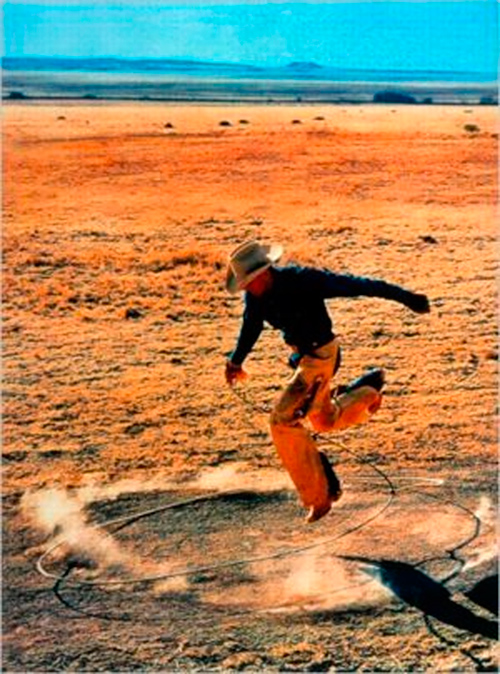
Greg Allen, Untitled (300 x 404), 2010
Don’t say you think Greg Allen’s Untitled (300 x 404) is smart over twitter if you don’t want to get involved in a long debate about it. Currently available on 20×200, the print above was conceived by Allen after an online magazine was refused reproduction rights for the original. This was a thumbnail-size jpeg of Untitled (Cowboy), 2003, artist Richard Prince’s rephotograph of a Marlboro ad. Repeating a bit of history, Allen declared the copy his own and offered it to the publication.
I like this piece, but I’m in the minority over on facebook. A few excerpts from that ongoing conversation after the jump.
Elaine P Sharpe: It’s a pretty shallow concept. Not smart, merely clever.
Man Bartlett: I’m probably out of my league here, but there’s more to the picture (pun unintended), given Greg’s history. In this case the story of the artist makes the work more compelling and gives it more depth than it first appears.
Sean Capone: I know exactly what you’re saying, Man–but my crack about “hurling yourself down the rabbit hole” was my way of saying, I think this work doesn’t dig deep enough. This territory (the materiality of the digital image artifact, appropriating web imagery) has been explored in depth already. And quoting other artists, especially Richard Prince (who work makes me shrug my shoulders anyway), is super tricky territory, and in this case, appears kind of lazy.
Or not. What do I know. Nothing personal against Greg. I’m simply responding to this specific work, and the gee-whiz artist statement attached to it, which is trying to tell me why I should be interested in looking at basically nothing.
Paddy Johnson @everyone I like this piece because it’s a response to a refusal to reproduce an image with that same history. You can criticize the work for not digging deep enough, but I’d argue that this was never Allen’s intention. He’s bringing to light the actions that made Prince’s work important through his own re-iteration. It’s the understated element of performance I like about this work — it’s a reaction. It would not exist if there wasn’t a reason to make it.
Sean Capone But why do Prince’s actions in particular need to be brought to light? I understand the shift in context regarding image availability and reproducibility between Prince’s time and now (print vs. internet).
But whereas Prince’s strategy (and others working in the field of image appropriation at that time) might have been confrontational and a valid critique, isn’t this issue somewhat banal at this point? Based on the artist statement, it seems like he is expressing wonder in a certain formal technicality (big pixel lust) but attaches Prince as a conceptual hook, or shorthand. “Get it?”
“It’s a response to a refusal to reproduce” a image that is already a reproduction of a media image from 30 years ago..
It’s like, arrgh, how many layers of displacement does the viewer have to sift through to get the point (which was already made by Prince)? Art about art about art.
“It would not exist if there wasn’t a reason to make it.” Come on Paddy–you have slammed people for making MUCH less lazy assertions than that!!
BTW, when I argue these things, it is because I care enough about it to have my mind changed. In arguing through something, often I gain insight and begin to view the work in different ways. So I’m not saying anything here that I wouldn’t discuss with the artist F2F.
P. Elaine Sharpe Appropriation and appropriation of the appropriators is having a tiny moment of resurgence. It’s been happening for a while already. This work brings nothing new to the discourse of post-digital conceptualism. Like Sean, I’m willing to have my ideas shift, but for me there isn’t any rigour in this work except that which I am projecting onto it.
Paddy Johnson: Listen, if you want to call this a lazy response go right ahead, but I’m not the one refusing to engage the specifics of this piece.
I’m saying that the event that prompted the creation of this piece can’t be dismissed as incidental. Allen didn’t make this on a lark, it was a specific response to Prince’s refusal to grant an online magazine the rights to reproduce his own reproduction. Is it deep? No. And I DON’T CARE. The event itself makes clear that the issues are still very relevant. Allen’s remake was the most straight forward and logical way to address the problem, and that’s why I like it. I’m not asking it to be something else, because I don’t want it to be anything else.
This whole debate reminds me of the flack Martha Rosler took for remaking her war collages. She took the same approach because she was still looking at the same problems. To quote myself:
We don't view activist art as successful unless it actually affects change, but are completely oblivious to the double standard maintained when we complain that the form itself is not abstract enough.
There’s no winning that argument.
P. Elaine Sharpe: So is it a significant work, or is it the product of a momentary snit over copyright? Either way, your argument for it is kind of pushing me toward disagreeing with the ‘smart’ assessment vis a vis it being a work of art (cf 20X200’s involvement in selling it). It doesn’t mean to say that you are not smart in liking it. That’s your choice and only you can determine what is smart for you. This is another discussion entirely, based on Sean’s response.
I admit openly to having ongoing bias against didactic work that is trying to teach me something, and I also admit to having more than a passing argument with Rosler over her politics of the image. We had the opportunity to discuss it at length during a PhD residency. She’s certainly the wrong example to convince me of anything. Ha!
Man Bartlett Again, out of my league here, but is back story necessary, or should it be. I’m not saying art should exist in a vacuum by any means, but should there be at least some sort purely aesthetic response limiter?
In my own case, I happened to know Greg Allen enough (online) to pique my interest, and I also recognized the Prince appropriation immediately. Knowing these things, and knowing his history as an blogger and collector added to my interest. Lastly, I enjoyed reading about the process of how it came to be created.
I also think there’s more than a little irony that 20×200 is the platform, which legitimizes it very much as a work born OF the Internet FOR the people.
P. Elaine Sharpe: The irony of it being born of the internet and being disseminated by 20X200 diminishes the concept even further and in no way validates the work as being ‘art’. If anything, it brings to mind the same mechanisms that people complained about re Skin Fruit at NuMu.
Rick Herron I wouldn’t buy this piece from 20×200 because in this case, bigger is almost certainly better. The email that went out about it says as much. If formally, it’s about how now is made up of this riot of pixels we’re to notice, you can’t see them nearly as well 8×10 as you would in a much larger size. Some of the small 20×200’s work extremely well small, the Jorge Colombo’s should be one of the first two sizes I think. But in this case, I don’t think the small print works and I can’t afford the big one. Simple as that.
And while the story is interesting, I don’t find this piece to be terribly smart. Similar ground seems to be covered by plenty of artists. I like this piece well enough, but you’re a pretty damn tough critic Paddy. I’m surprised this is something that gave you a tickle. But I’m not anti. I’m sure a 30×40 of it would look amazing. An 8×10? Not nearly as interesting to look at. If I really got jazzed about the piece, I’d hang two different sizes next to each other.
Paddy Johnson, Another take on “no winning” the debate, is that both critiques are valid. Personally I see the value in both, though I fall on the side of “interesting” as opposed to not. I realize I’m in the minority here, and I’m fine with that. There’s nothing anyone’s said that’s diminished why I like the piece, only arguments that have propped up their own dislike.
Paddy Johnson @P. Elaine Sharpe I don’t think the platform diminishes the concept, nor do I think Man was saying it validated the work. If we believe art isn’t for a general public then even when 20×200 carries art from the fine art world proper it will be unintelligible as such.
This is a different subject, but since everything gets flattened out on the internet, nothing and everything looks like art at the same time. It’s one of the reasons it’s been so hard to migrate Fine Art from the net into the gallery.


{ 42 comments }
no mention of Mandiberg’s AfterSherrieLevine.com in this debate?
no mention of Mandiberg’s AfterSherrieLevine.com in this debate?
OMG! This is the last time I Fightbook with a writer on a deadline! 😀
OMG! This is the last time I Fightbook with a writer on a deadline! 😀
Why not just put a high resolution jpeg up on 20×200 and let people print it out at whatever size they like at their local print shop?
The problem here isn’t the concept (which is old and tired but apparently still somewhat of a hot-button with some people) – but how/why/that it’s being sold as ‘fine art’.
If I were to have read about this guy handing the piece over to the magazine etc, I might have liked the story. Im a huge fan and collector of Prince and usually hate anything ‘after’ him.. but I would have appreciated that sentiment. However, having an online boutique print out copies at various sizes etc and sell them for silly prices (considering WHAT it is and how it was made) is kind of an insult on many levels.
In this case, more than ever – anyone who bought one of these editions is a total sucker and a chump for an artist’s statement. You’re buying a story to tell your friends when they ask why you have a piece of shitty, pixelated art hanging on your wall. When can we stop perpetuating this ‘all-concept-as-fine-art’ bullshit?
If 20×200 really thought this idea was so clever and cute, they could have used their channels to promote this artist and his statement without devoting an edition to it. This piece was merely tweet-worthy.
Why not just put a high resolution jpeg up on 20×200 and let people print it out at whatever size they like at their local print shop?
The problem here isn’t the concept (which is old and tired but apparently still somewhat of a hot-button with some people) – but how/why/that it’s being sold as ‘fine art’.
If I were to have read about this guy handing the piece over to the magazine etc, I might have liked the story. Im a huge fan and collector of Prince and usually hate anything ‘after’ him.. but I would have appreciated that sentiment. However, having an online boutique print out copies at various sizes etc and sell them for silly prices (considering WHAT it is and how it was made) is kind of an insult on many levels.
In this case, more than ever – anyone who bought one of these editions is a total sucker and a chump for an artist’s statement. You’re buying a story to tell your friends when they ask why you have a piece of shitty, pixelated art hanging on your wall. When can we stop perpetuating this ‘all-concept-as-fine-art’ bullshit?
If 20×200 really thought this idea was so clever and cute, they could have used their channels to promote this artist and his statement without devoting an edition to it. This piece was merely tweet-worthy.
Seems like he did it out of necessity. Prince refused the rights, Allen reproduces as a statement. Big whoop.
The Fairey and AP case is more interesting and deeper than someone monetizing from someone elses work (the Levine’s, Allen’s, etc. of the world.)
Seems like he did it out of necessity. Prince refused the rights, Allen reproduces as a statement. Big whoop.
The Fairey and AP case is more interesting and deeper than someone monetizing from someone elses work (the Levine’s, Allen’s, etc. of the world.)
I like this piece a lot.
I think the fact that it’s on 20×200 makes it even better. Part of what’s so fascinating about Prince’s appropriations are how well they do in the market. People pay ungodly amounts of money for something he stole from a magazine that costs $3.99. It’s perfect example of art’s alchemical ability to get people to not only look at, but also pay for, something that’s essentially nothing. Allen’s use of 20×200 to produce A Prince for Everybody! (Conceptual twist included!) is wonderful.
To the people saying this ground has been covered by other artists, I would say no, it hasn’t. Because no one else has a re-appropriated image like this on 20×200.
I like this piece a lot.
I think the fact that it’s on 20×200 makes it even better. Part of what’s so fascinating about Prince’s appropriations are how well they do in the market. People pay ungodly amounts of money for something he stole from a magazine that costs $3.99. It’s perfect example of art’s alchemical ability to get people to not only look at, but also pay for, something that’s essentially nothing. Allen’s use of 20×200 to produce A Prince for Everybody! (Conceptual twist included!) is wonderful.
To the people saying this ground has been covered by other artists, I would say no, it hasn’t. Because no one else has a re-appropriated image like this on 20×200.
Wow, an interesting discussion that almost makes me want to break down and join Facebook. Thanks Paddy for bringing it up here.
While i can see all the points being made here–and agree with most of them, even the seemingly contradictory or critical ones–My own thoughts on the piece are probably closest to Rick’s.
The issues of re/appropriation and infinite digital reproduction are pretty instant and shallow, or at least quickly understood, and may be worth contemplating for as long as it takes to read a blog post.
The political critique of fair use and its implicit constraints may be slightly more interesting or not, but as Rick points out, the information loss/cost only really becomes acute or worth noting at larger sizes. The real aha moment for me about the assumptions baked into the image reproduction system may be utterly banal to people who make/print things all day.
As for how the 20×200 prints work as artworks, the only reason I decided to do an edition at at all was because I thought the material objects themselves, the prints, looked good enough to exist, and they were absolutely worth (sic) their respective prices.
Partly, that’s the prints, but it’s also the prices. Which are *extremely* low, and directly correlated to the production of each print. And so the value added by my signature is right where it should be–approaching zero.
Wow, an interesting discussion that almost makes me want to break down and join Facebook. Thanks Paddy for bringing it up here.
While i can see all the points being made here–and agree with most of them, even the seemingly contradictory or critical ones–My own thoughts on the piece are probably closest to Rick’s.
The issues of re/appropriation and infinite digital reproduction are pretty instant and shallow, or at least quickly understood, and may be worth contemplating for as long as it takes to read a blog post.
The political critique of fair use and its implicit constraints may be slightly more interesting or not, but as Rick points out, the information loss/cost only really becomes acute or worth noting at larger sizes. The real aha moment for me about the assumptions baked into the image reproduction system may be utterly banal to people who make/print things all day.
As for how the 20×200 prints work as artworks, the only reason I decided to do an edition at at all was because I thought the material objects themselves, the prints, looked good enough to exist, and they were absolutely worth (sic) their respective prices.
Partly, that’s the prints, but it’s also the prices. Which are *extremely* low, and directly correlated to the production of each print. And so the value added by my signature is right where it should be–approaching zero.
Wow, an interesting discussion that almost makes me want to break down and join Facebook. Thanks Paddy for bringing it up here.
While i can see all the points being made here–and agree with most of them, even the seemingly contradictory or critical ones–My own thoughts on the piece are probably closest to Rick’s.
The issues of re/appropriation and infinite digital reproduction are pretty instant and shallow, or at least quickly understood, and may be worth contemplating for as long as it takes to read a blog post.
The political critique of fair use and its implicit constraints may be slightly more interesting or not, but as Rick points out, the information loss/cost only really becomes acute or worth noting at larger sizes. The real aha moment for me about the assumptions baked into the image reproduction system may be utterly banal to people who make/print things all day.
As for how the 20×200 prints work as artworks, the only reason I decided to do an edition at at all was because I thought the material objects themselves, the prints, looked good enough to exist, and they were absolutely worth (sic) their respective prices.
Partly, that’s the prints, but it’s also the prices. Which are *extremely* low, and directly correlated to the production of each print. And so the value added by my signature is right where it should be–approaching zero.
Greg Allen should stick to light bulbs, his speciality. The rest of you are so dumb you should kill yourselves.
Greg Allen should stick to light bulbs, his speciality. The rest of you are so dumb you should kill yourselves.
Greg Allen should stick to light bulbs, his speciality. The rest of you are so dumb you should kill yourselves.
forgive me for the length of this post, but i feel it's pertinent to the issues raised here.
darren bader is an artist whose work is currently in the 'greater new york' survey at MoMA/PS1. there's a description of his working method here:
http://artforum.com/picks/section=la&mode=pas…
i've worked with darren in the past. although i'm not officially in the show in queens, for this specific project i gave darren a piece to submit with three other things of his choosing. this group of objects, which includes the painting, an MP3 of the MIA song 'paper planes', a single still of a child displayed on a laptop, and two empty poland spring water cooler jugs, comprise the larger 'work' of his as it appears at the museum. the painting i gave to darren is a rendering of a peter halley painting titled 'particles of truth', which i painted from a JPEG of the work downloaded from peter's website.
the original work from which this painting is derived is 6 x 12 feet. this one i've just painted is called 'particles of truth (version)' and is 7 x 14 feet. peter typically uses a blocky four-inch stretcher for his work, but this version of mine is only one inch deep. the shallow support in this case corresponds to the thinness of the digital image from which it's derived. these scale relationships that address surface (or area) and support (or volume) are the only negligible material differences present between the two, and this painting is 'true' in terms of fidelity or resolution as per the original, or its representation on the web, or i guess i should say the JPEG in question, in terms or color, facture, etc as i've interpreted it.
darren submitted his work to 'greater new york' without identifying wall labels or any other information, and i honored his request to do so, even thought the painting is attributed to me and is inscribed as such on the reverse.
i assume this may be of interest here, given the discussion of greg's work, and paddy's acquisition of it.
forgive me for the length of this post, but i feel it's pertinent to the issues raised here.
darren bader is an artist whose work is currently in the 'greater new york' survey at MoMA/PS1. there's a description of his working method here:
http://artforum.com/picks/section=la&mode=pas…
i've worked with darren in the past. although i'm not officially in the show in queens, for this specific project i gave darren a piece to submit with three other things of his choosing. this group of objects, which includes the painting, an MP3 of the MIA song 'paper planes', a single still of a child displayed on a laptop, and two empty poland spring water cooler jugs, comprise the larger 'work' of his as it appears at the museum. the painting i gave to darren is a rendering of a peter halley painting titled 'particles of truth', which i painted from a JPEG of the work downloaded from peter's website.
the original work from which this painting is derived is 6 x 12 feet. this one i've just painted is called 'particles of truth (version)' and is 7 x 14 feet. peter typically uses a blocky four-inch stretcher for his work, but this version of mine is only one inch deep. the shallow support in this case corresponds to the thinness of the digital image from which it's derived. these scale relationships that address surface (or area) and support (or volume) are the only negligible material differences present between the two, and this painting is 'true' in terms of fidelity or resolution as per the original, or its representation on the web, or i guess i should say the JPEG in question, in terms or color, facture, etc as i've interpreted it.
darren submitted his work to 'greater new york' without identifying wall labels or any other information, and i honored his request to do so, even thought the painting is attributed to me and is inscribed as such on the reverse.
i assume this may be of interest here, given the discussion of greg's work, and paddy's acquisition of it.
forgive me for the length of this post, but i feel it's pertinent to the issues raised here.
darren bader is an artist whose work is currently in the 'greater new york' survey at MoMA/PS1. there's a description of his working method here:
http://artforum.com/picks/section=la&mode=pas…
i've worked with darren in the past. although i'm not officially in the show in queens, for this specific project i gave darren a piece to submit with three other things of his choosing. this group of objects, which includes the painting, an MP3 of the MIA song 'paper planes', a single still of a child displayed on a laptop, and two empty poland spring water cooler jugs, comprise the larger 'work' of his as it appears at the museum. the painting i gave to darren is a rendering of a peter halley painting titled 'particles of truth', which i painted from a JPEG of the work downloaded from peter's website.
the original work from which this painting is derived is 6 x 12 feet. this one i've just painted is called 'particles of truth (version)' and is 7 x 14 feet. peter typically uses a blocky four-inch stretcher for his work, but this version of mine is only one inch deep. the shallow support in this case corresponds to the thinness of the digital image from which it's derived. these scale relationships that address surface (or area) and support (or volume) are the only negligible material differences present between the two, and this painting is 'true' in terms of fidelity or resolution as per the original, or its representation on the web, or i guess i should say the JPEG in question, in terms or color, facture, etc as i've interpreted it.
darren submitted his work to 'greater new york' without identifying wall labels or any other information, and i honored his request to do so, even thought the painting is attributed to me and is inscribed as such on the reverse.
i assume this may be of interest here, given the discussion of greg's work, and paddy's acquisition of it.
“it’s a response to a refusal to reproduce an image with that same history”
Exactly, which is why I bought a print. $20 is a pretty small price for a daily reminder to give the man the finger.
“it’s a response to a refusal to reproduce an image with that same history”
Exactly, which is why I bought a print. $20 is a pretty small price for a daily reminder to give the man the finger.
“it’s a response to a refusal to reproduce an image with that same history”
Exactly, which is why I bought a print. $20 is a pretty small price for a daily reminder to give the man the finger.
Funny, this discussion is even more boring and dated than Richard Prince himself.
Funny, this discussion is even more boring and dated than Richard Prince himself.
Funny, this discussion is even more boring and dated than Richard Prince himself.
Boring is not always what it seems. I would not call Richard Prince boring or “dated” in the negative sense implied by Armory Blaine. However, I think Allen’s work here is very superficial and one dimensional, especially in the context of 20 x 200. Those traits CAN be good, superficiality isn’t instantly bad. From his statement, one can tell that his heart’s in the right place yet the idea isn’t quite there yet. I get it, I just don’t like it.
Boring is not always what it seems. I would not call Richard Prince boring or “dated” in the negative sense implied by Armory Blaine. However, I think Allen’s work here is very superficial and one dimensional, especially in the context of 20 x 200. Those traits CAN be good, superficiality isn’t instantly bad. From his statement, one can tell that his heart’s in the right place yet the idea isn’t quite there yet. I get it, I just don’t like it.
Boring is not always what it seems. I would not call Richard Prince boring or “dated” in the negative sense implied by Armory Blaine. However, I think Allen’s work here is very superficial and one dimensional, especially in the context of 20 x 200. Those traits CAN be good, superficiality isn’t instantly bad. From his statement, one can tell that his heart’s in the right place yet the idea isn’t quite there yet. I get it, I just don’t like it.
This was my final reply in that FB discussion that fell by the wayside, most likely because Paddy had already appropriated the thread for publication.
‘… My judgement of the work is based in my interest in the same things that interest you. Having said that, I would have to say that this, for me, is the purpose of the work in question; to centre a debate about the value of re-appropriation and the work created as an apparent result of someone realizing that copyright is malleable and ‘no’ is up for debate.
As for the rest of it, the idea that an image retains the same number of pixels as it is enlarged is so old school, so deeply and firmly entrenched in media, that it hardly bears mentioning. It doesn’t shake my little world the way somebody like Ryan Trecartin shakes my view of things and actually gives me a sense of what matters – what is matter, what is material – in media. The artists who have really taken on the issue of time and space in digital art and the concept of time are far more intriguing. It’s not about scale anymore, it’s about speed and relativity. That’s why, as Rick Herron already said so eloquently, one would need to have more than one to make the point, or only buy the biggest one, or do what I would do if I wanted to cut to the chase: grab it at 72ppi off the net and print it at whatever scale I wish beyond 8,5X11, the pixel will already be apparent.
For me the work at the centre of this discussion speaks of someone who simply is quoting the past and having a ‘holy shit’ moment that has no sense of urgency FOR ME.
Personal taste? Maybe. Informed disinterest on my part, more likely. That doesn’t mean you’re right or I’m right, it simply means that our knowledge leads us to view the work through different filters and although I’ve bought work from 20X200 before, this one won’t be jumping off the shelf at me.’
This was my final reply in that FB discussion that fell by the wayside, most likely because Paddy had already appropriated the thread for publication.
‘… My judgement of the work is based in my interest in the same things that interest you. Having said that, I would have to say that this, for me, is the purpose of the work in question; to centre a debate about the value of re-appropriation and the work created as an apparent result of someone realizing that copyright is malleable and ‘no’ is up for debate.
As for the rest of it, the idea that an image retains the same number of pixels as it is enlarged is so old school, so deeply and firmly entrenched in media, that it hardly bears mentioning. It doesn’t shake my little world the way somebody like Ryan Trecartin shakes my view of things and actually gives me a sense of what matters – what is matter, what is material – in media. The artists who have really taken on the issue of time and space in digital art and the concept of time are far more intriguing. It’s not about scale anymore, it’s about speed and relativity. That’s why, as Rick Herron already said so eloquently, one would need to have more than one to make the point, or only buy the biggest one, or do what I would do if I wanted to cut to the chase: grab it at 72ppi off the net and print it at whatever scale I wish beyond 8,5X11, the pixel will already be apparent.
For me the work at the centre of this discussion speaks of someone who simply is quoting the past and having a ‘holy shit’ moment that has no sense of urgency FOR ME.
Personal taste? Maybe. Informed disinterest on my part, more likely. That doesn’t mean you’re right or I’m right, it simply means that our knowledge leads us to view the work through different filters and although I’ve bought work from 20X200 before, this one won’t be jumping off the shelf at me.’
This was my final reply in that FB discussion that fell by the wayside, most likely because Paddy had already appropriated the thread for publication.
‘… My judgement of the work is based in my interest in the same things that interest you. Having said that, I would have to say that this, for me, is the purpose of the work in question; to centre a debate about the value of re-appropriation and the work created as an apparent result of someone realizing that copyright is malleable and ‘no’ is up for debate.
As for the rest of it, the idea that an image retains the same number of pixels as it is enlarged is so old school, so deeply and firmly entrenched in media, that it hardly bears mentioning. It doesn’t shake my little world the way somebody like Ryan Trecartin shakes my view of things and actually gives me a sense of what matters – what is matter, what is material – in media. The artists who have really taken on the issue of time and space in digital art and the concept of time are far more intriguing. It’s not about scale anymore, it’s about speed and relativity. That’s why, as Rick Herron already said so eloquently, one would need to have more than one to make the point, or only buy the biggest one, or do what I would do if I wanted to cut to the chase: grab it at 72ppi off the net and print it at whatever scale I wish beyond 8,5X11, the pixel will already be apparent.
For me the work at the centre of this discussion speaks of someone who simply is quoting the past and having a ‘holy shit’ moment that has no sense of urgency FOR ME.
Personal taste? Maybe. Informed disinterest on my part, more likely. That doesn’t mean you’re right or I’m right, it simply means that our knowledge leads us to view the work through different filters and although I’ve bought work from 20X200 before, this one won’t be jumping off the shelf at me.’
Greg, I appreciate your sentiment “The real aha moment for me about the assumptions baked into the image reproduction system may be utterly banal to people who make/print things all day.”
That’s it, exactly. My personal saturation in the photo world has led to searching out experiences in art of a different sort, an approach to sensibility that is not purely or simply visual, and if the theory is an old one FOR ME, I want it to raise new questions. I am absolutely sure your piece will be provocative for others, and I hope it sells like the proverbial hotcakes. Each one sold is an idea taking root.
Greg, I appreciate your sentiment “The real aha moment for me about the assumptions baked into the image reproduction system may be utterly banal to people who make/print things all day.”
That’s it, exactly. My personal saturation in the photo world has led to searching out experiences in art of a different sort, an approach to sensibility that is not purely or simply visual, and if the theory is an old one FOR ME, I want it to raise new questions. I am absolutely sure your piece will be provocative for others, and I hope it sells like the proverbial hotcakes. Each one sold is an idea taking root.
Greg, I appreciate your sentiment “The real aha moment for me about the assumptions baked into the image reproduction system may be utterly banal to people who make/print things all day.”
That’s it, exactly. My personal saturation in the photo world has led to searching out experiences in art of a different sort, an approach to sensibility that is not purely or simply visual, and if the theory is an old one FOR ME, I want it to raise new questions. I am absolutely sure your piece will be provocative for others, and I hope it sells like the proverbial hotcakes. Each one sold is an idea taking root.
Prince isn’t the only “Pictures Generation” artist who is a hypocritical curmudgeon about other artists reappropriating his reappropriated imagery. I’ve recently discovered that any link to an image on Robert Longo’s website will be removed very quickly. In my case, it was his “Study for Johnny Mnemonic” drawing. Although it’s an “original” Longo drawing, it’s still funny to me that a drawing of a “interweb-hacker” by a reappropriation artist can’t appear on my dinky website… so I just linked to a smaller image from a different website.
Prince isn’t the only “Pictures Generation” artist who is a hypocritical curmudgeon about other artists reappropriating his reappropriated imagery. I’ve recently discovered that any link to an image on Robert Longo’s website will be removed very quickly. In my case, it was his “Study for Johnny Mnemonic” drawing. Although it’s an “original” Longo drawing, it’s still funny to me that a drawing of a “interweb-hacker” by a reappropriation artist can’t appear on my dinky website… so I just linked to a smaller image from a different website.
See, PES, I guess i just went to a different school than you, because every place I looked at printing a 72ppi image,they touted their 1200ppi simulated resolution and required it be upscaled to at least a 600ppi TIFF. That initially included 20×200.
Pixels have certainly been done, even though the tasty grid of 8bit graphics and Photoshop is an abstraction of information that has no connection to either the screens or the ink jet nozzles where they appear.
As for those digital artists who have taken on the deep issues of time and space, I plead guilty to not being one of them. But then, I wouldn’t think Trecartin is, either; for me, he just showed that the web allows us all to get in touch with our inner Jack Smith.
See, PES, I guess i just went to a different school than you, because every place I looked at printing a 72ppi image,they touted their 1200ppi simulated resolution and required it be upscaled to at least a 600ppi TIFF. That initially included 20×200.
Pixels have certainly been done, even though the tasty grid of 8bit graphics and Photoshop is an abstraction of information that has no connection to either the screens or the ink jet nozzles where they appear.
As for those digital artists who have taken on the deep issues of time and space, I plead guilty to not being one of them. But then, I wouldn’t think Trecartin is, either; for me, he just showed that the web allows us all to get in touch with our inner Jack Smith.
I can has video response? 😉 http://tumblr.com/xembne2ub
I can has video response? 😉 http://tumblr.com/xembne2ub
I’ve heard Trecartin speak quite eloquently about his work and its relationship to speed, amongst other things. I like the way he explores the sense of acceleration and how humans have adapted and will likely continue to adapt.
Speaking of adapting, Kodak and Ansel Adams averaged out printing systems in analog photo – it’s not surprising that digital labs want to do the same, is it? Interpolation (faking data) is a given because the average prosumer wants it that way. I’ve yet to meet an artist who didn’t find their way to make what they needed to make in the way it needed to be made. You apparently did find a lab to do as you wished, and that’s what matters.
Speaking of which, I’ve got work to do. TTYL.
I’ve heard Trecartin speak quite eloquently about his work and its relationship to speed, amongst other things. I like the way he explores the sense of acceleration and how humans have adapted and will likely continue to adapt.
Speaking of adapting, Kodak and Ansel Adams averaged out printing systems in analog photo – it’s not surprising that digital labs want to do the same, is it? Interpolation (faking data) is a given because the average prosumer wants it that way. I’ve yet to meet an artist who didn’t find their way to make what they needed to make in the way it needed to be made. You apparently did find a lab to do as you wished, and that’s what matters.
Speaking of which, I’ve got work to do. TTYL.
Comments on this entry are closed.