
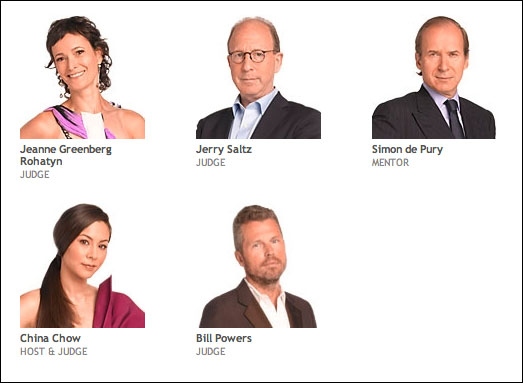
Screenshot via: Bravotv.com
Although I didn’t mention this in my review of Bravo’s Work of Art last month, based on the first episode alone in my estimation, the reality show’s greatest weakness is it’s permanent cast: the judges and mentor. Even art critic Jerry Saltz sounds a little canned, and he and Phillips auctioneer and Work of Art mentor Simon dePury are clearly the strongest cast.
Last week at a press junket I and a number of others had the opportunity to speak with Simon De Pury, China Chow, the show’s host, and judge Bill Powers. All I can say is I hope they edit the shit out of Chow and Powers because the program’s going to be really annoying otherwise. A few highlights:
Q: Do you think the art world will respect artists who win the reality show and take them seriously?
China Chow: Well I think that, first of all, whoever wins is going to get their own solo show at the Brooklyn museum, which I think is a huge endorsement, um, other than the fact that we sort of elect them as the winner of this…Um, and I think the person that won is extremely talented.
Bill Powers: I just wanna say China was moved to tears by the winner. We'll at least, leave it at that.
Q: Is there a difference between traditional forms of validation from that of museums and galleries, and those that come through different avenues like the youtube, tumblr, and reality television?
Bill Powers: I mean..look at someone like Shepard Fairey, who although has been around a long time with his, you know, Obey imagery, really jumped into the national consciousness with his Obama posters and so, you know, he's since had museum shows. I think he was arrested at a museum show in Boston and had the last show at a space in New York before he left for Los Angeles, so I mean, I think that's the guy for a long time that would have been thought of as a street artist but, you know, through a couple of his projects kind of managed to parlay that into institutional support, so…the one element that is specifically with YouTube, I think, when has video art had that level of opportunity to get their work out there that, you know, with the technology present there's just a lot more, you know, avenues to take to make a name for themselves.
Q: How has your background informed your approach to judging?
China Chow: My experience as an art lover and growing up around art and looking at it I can't separate it anyway, that's always going to be my filter in which I, I see the work and judge the work, and for me I have to say, at the end of the day I think it's important that we're discussing art, looking at art, whether or not the piece was successful or not. I think we can learn as much from the pieces that didn't work that week as we can from the ones that did, and I didn't like the elimination process, for me it was always the most best time I had was when we got to the crux of the artists and looking at their work and having that dialogue with them. Does that answer your question, sort of?
>Bill Powers: Um, I guess the first thing that came to mind is, uh”¦ there is that old saying about dealing 'if I can't smoke it I can't sell it,' and so personally I would want to be distracted or feel like there was something that resonated about a piece. And with the gallery that I have a lot of times shows that I've had have been with people who have never had a gallery show before so in some cases I would treat it as I would a studio visit.
Simon de Pury did much better when answering similar questions, even if I don’t believe he loves each contestant equally.
Q: As a mentor did you find yourself connecting with certain contestants more than others, and did you always agree with the judges decisions?
Simon de Pury: So, what I found very interesting is that obviously the role of a mentor is very different from the goal of the judge, so there are 14 contestants and obviously some of the contestants are more talented than others or some have more this more that and different personalities but it is exactly, at the end of the day, like being a father. I am a father of four grown up children and they are all very, very different, one from another. The magic thing is as a father you love them always exactly the same love and I would say that automatically being the mentor I really took an equal interest in the 14 contestants that participated in the program and basically with the elimination of every single artist that was eliminated I was each time very upset and sad that one of them was eliminated. Now in terms of my agreeing with the views of the judges. No in some cases, I would not agree with what their conclusions had been, and that is precisely what is interesting, because judging art is a subjective thing. You can see in the program what the sum of the criteria you can use to judge art and to justify why one work of art is better than another, but at the same time it remains something highly subjective and it is absolutely legitimate that not everybody feels the same way and that occasionally you have different views, even from people who are just as much inside that field as you are.


{ 30 comments }
Um, uh, I, uh, I think that, uh, um…
This show is poison-flavored bubblegum:
Chew.
Hate.
Blow.
Pop.
Chew.
Hate.
Blow.
Pop.
Die.
Um, uh, I, uh, I think that, uh, um…
This show is poison-flavored bubblegum:
Chew.
Hate.
Blow.
Pop.
Chew.
Hate.
Blow.
Pop.
Die.
I now know my job for tonight…I’m going to count the number of times China Chow says “um” and the number of times the contestants say “like” as in: “I was like trying to achieve like an overall theme to the work and it was like really difficult.”
I now know my job for tonight…I’m going to count the number of times China Chow says “um” and the number of times the contestants say “like” as in: “I was like trying to achieve like an overall theme to the work and it was like really difficult.”
I now know my job for tonight…I’m going to count the number of times China Chow says “um” and the number of times the contestants say “like” as in: “I was like trying to achieve like an overall theme to the work and it was like really difficult.”
Hmmmm, after episode 1, im really impressed at how they turned a high school art fair in to a tv show.
some really atrocious shit there.
Outside of the fashion reality shows, the art/design shows seem veered more towards a commercial aesthetic and the contestants work less individually unique.
Bravo shoulda asked China Chows daddies friends for advise wit this pig.
Hmmmm, after episode 1, im really impressed at how they turned a high school art fair in to a tv show.
some really atrocious shit there.
Outside of the fashion reality shows, the art/design shows seem veered more towards a commercial aesthetic and the contestants work less individually unique.
Bravo shoulda asked China Chows daddies friends for advise wit this pig.
“…China was moved to tears by the winner.”
We seem to be living in an era when making people cry is the primo sign of quality in artwork. eugh. BUT, if that’s what it takes to convince people that contemporary art isn’t just for uber art nerds and rich people then maybe it’s a fair trade? I just dunno if the ends justify the means.
“…China was moved to tears by the winner.”
We seem to be living in an era when making people cry is the primo sign of quality in artwork. eugh. BUT, if that’s what it takes to convince people that contemporary art isn’t just for uber art nerds and rich people then maybe it’s a fair trade? I just dunno if the ends justify the means.
“…China was moved to tears by the winner.”
We seem to be living in an era when making people cry is the primo sign of quality in artwork. eugh. BUT, if that’s what it takes to convince people that contemporary art isn’t just for uber art nerds and rich people then maybe it’s a fair trade? I just dunno if the ends justify the means.
Wow… I am right now “moved to tears”.
Wow… I am right now “moved to tears”.
Wow… I am right now “moved to tears”.
Wow… I am right now “moved to tears”.
Wow… I am right now “moved to tears”.
this is disappointing.
they sound like morons.
this is disappointing.
they sound like morons.
Work of Art does not differ from any other reality show. The show does not concentrate on how well an artist performs; instead the focus is how to best create drama and keep the audience interested. The judges do not appear to be qualified. Have any of them studied art? They appear to be opinionated. To all future serious artists, my advice is this: Appearing on Bravo’s next Work of Art may possibly do your career more harm than good. I would love to see a true art contest, one in which a series would have perhaps 6 challenges giving each artist time to think through his/her approach before finalizing it. I was very disappointed in Bravo’s Work of Art. It totally lacked integrity. I will not be a Bravo fan any longer. I’m too mature to spend time on a soap opera.
Work of Art does not differ from any other reality show. The show does not concentrate on how well an artist performs; instead the focus is how to best create drama and keep the audience interested. The judges do not appear to be qualified. Have any of them studied art? They appear to be opinionated. To all future serious artists, my advice is this: Appearing on Bravo’s next Work of Art may possibly do your career more harm than good. I would love to see a true art contest, one in which a series would have perhaps 6 challenges giving each artist time to think through his/her approach before finalizing it. I was very disappointed in Bravo’s Work of Art. It totally lacked integrity. I will not be a Bravo fan any longer. I’m too mature to spend time on a soap opera.
Regardless of whether or not the artists are good, to me it is fun watching the creative process – which I think is the same reason Project Runway is fun. So I actually like this show. I don’t take it seriously – I mean, how can you really judge who is the “best” artist anyway? In the end it’s subjective, and kind of insulting. All that aside – they need to change the judges. They are the most incredibly pretentious group of people I have ever been exposed to. Pretentious and superficial. (E.g. the fact that they were continually gushing over that one contestant’s self-absorbed shiite – the one who doesn’t like men staring at her but loves flaunting her body all the time. They thought her work was so profound – it wasn’t at all.) My God – is the art world really like that?! If so, it must be a thousand times more pretentious and awful than the fashion world, which is a shocker! What a bunch of poseurs.There have got to be qualified judges who are more down to earth (and supportive. They themselves probably don’t have a creative bone in their bodies.) I also agree China Chow has to go. I mean – what qualifications does she have?! Oh, she her parents knew some famous artists. Give me a break. She’s also extremely unlikeable, and another one who couldn’t probably draw a straight line if her life depended on it. NEXT! However, I love Simon De Pury. He’s a keeper! He’s funny, and he’s genuine – he really IS the way he is, he’s not putting it on! He’s also nice, and it seems to me he’s the real deal – he does know art.
Regardless of whether or not the artists are good, to me it is fun watching the creative process – which I think is the same reason Project Runway is fun. So I actually like this show. I don’t take it seriously – I mean, how can you really judge who is the “best” artist anyway? In the end it’s subjective, and kind of insulting. All that aside – they need to change the judges. They are the most incredibly pretentious group of people I have ever been exposed to. Pretentious and superficial. (E.g. the fact that they were continually gushing over that one contestant’s self-absorbed shiite – the one who doesn’t like men staring at her but loves flaunting her body all the time. They thought her work was so profound – it wasn’t at all.) My God – is the art world really like that?! If so, it must be a thousand times more pretentious and awful than the fashion world, which is a shocker! What a bunch of poseurs.There have got to be qualified judges who are more down to earth (and supportive. They themselves probably don’t have a creative bone in their bodies.) I also agree China Chow has to go. I mean – what qualifications does she have?! Oh, she her parents knew some famous artists. Give me a break. She’s also extremely unlikeable, and another one who couldn’t probably draw a straight line if her life depended on it. NEXT! However, I love Simon De Pury. He’s a keeper! He’s funny, and he’s genuine – he really IS the way he is, he’s not putting it on! He’s also nice, and it seems to me he’s the real deal – he does know art.
Regardless of whether or not the artists are good, to me it is fun watching the creative process – which I think is the same reason Project Runway is fun. So I actually like this show. I don’t take it seriously – I mean, how can you really judge who is the “best” artist anyway? In the end it’s subjective, and kind of insulting. All that aside – they need to change the judges. They are the most incredibly pretentious group of people I have ever been exposed to. Pretentious and superficial. (E.g. the fact that they were continually gushing over that one contestant’s self-absorbed shiite – the one who doesn’t like men staring at her but loves flaunting her body all the time. They thought her work was so profound – it wasn’t at all.) My God – is the art world really like that?! If so, it must be a thousand times more pretentious and awful than the fashion world, which is a shocker! What a bunch of poseurs.There have got to be qualified judges who are more down to earth (and supportive. They themselves probably don’t have a creative bone in their bodies.) I also agree China Chow has to go. I mean – what qualifications does she have?! Oh, she her parents knew some famous artists. Give me a break. She’s also extremely unlikeable, and another one who couldn’t probably draw a straight line if her life depended on it. NEXT! However, I love Simon De Pury. He’s a keeper! He’s funny, and he’s genuine – he really IS the way he is, he’s not putting it on! He’s also nice, and it seems to me he’s the real deal – he does know art.
I like Art. I enjoyed the show until the last night. I was so sadden by the departure of Eric. He was such an inspiration to me. He tried so hard in his work and overcoming the brutal accident and his starting over from scratch in his life. I did not pity him, I admired him. The so called artists on his team were pretentious self involved. They
only suck up to Miles, and tag along behind his so called “great ” ideas because he had won a couple of times. Miles was all “my way be cause my so called ideas are great or wonderful.” His little tagalongs sucked up and went with his ideas (the girls). Eric was an out cast because he dared to express an idea or opinion. The childish “girl” who won
last. She only accomplished he work after running around getting everyone opinion then taking their ideas and using that with her unoriginal photos. You might review the tapes and make your conclusions…….Mine Eric should have stayed. What has Peragrine accomplished besides dress for attention and wear her stupid hats.
I like Art. I enjoyed the show until the last night. I was so sadden by the departure of Eric. He was such an inspiration to me. He tried so hard in his work and overcoming the brutal accident and his starting over from scratch in his life. I did not pity him, I admired him. The so called artists on his team were pretentious self involved. They
only suck up to Miles, and tag along behind his so called “great ” ideas because he had won a couple of times. Miles was all “my way be cause my so called ideas are great or wonderful.” His little tagalongs sucked up and went with his ideas (the girls). Eric was an out cast because he dared to express an idea or opinion. The childish “girl” who won
last. She only accomplished he work after running around getting everyone opinion then taking their ideas and using that with her unoriginal photos. You might review the tapes and make your conclusions…….Mine Eric should have stayed. What has Peragrine accomplished besides dress for attention and wear her stupid hats.
I like Art. I enjoyed the show until the last night. I was so sadden by the departure of Eric. He was such an inspiration to me. He tried so hard in his work and overcoming the brutal accident and his starting over from scratch in his life. I did not pity him, I admired him. The so called artists on his team were pretentious self involved. They
only suck up to Miles, and tag along behind his so called “great ” ideas because he had won a couple of times. Miles was all “my way be cause my so called ideas are great or wonderful.” His little tagalongs sucked up and went with his ideas (the girls). Eric was an out cast because he dared to express an idea or opinion. The childish “girl” who won
last. She only accomplished he work after running around getting everyone opinion then taking their ideas and using that with her unoriginal photos. You might review the tapes and make your conclusions…….Mine Eric should have stayed. What has Peragrine accomplished besides dress for attention and wear her stupid hats.
Calling the pieces on this show “art” is like calling a McDonald’s Milkshake “food”.
If these girls represent the future of art please count me out.
Calling the pieces on this show “art” is like calling a McDonald’s Milkshake “food”.
If these girls represent the future of art please count me out.
Calling the pieces on this show “art” is like calling a McDonald’s Milkshake “food”.
If these girls represent the future of art please count me out.
The teaser for next week promises that Ryan will cry while working on his piece, “I, like, cried…” he says. Bottom, meet rock.
The teaser for next week promises that Ryan will cry while working on his piece, “I, like, cried…” he says. Bottom, meet rock.
Comments on this entry are closed.
{ 1 trackback }