
POST BY PADDY JOHNSON
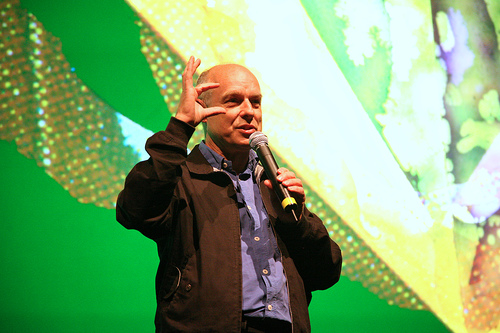
Brian Eno lectures against an Apple-esque aesthetic backdrop
Earlier this week Nicholas Carr singled out Boing Boing blogger Cory Doctorow, Google’s Tim Bray as “Luddites”, labeling their mourning for the loss of creative ends on the iPad as a dislike of progress. Carr puts it a little more eloquently, but the point as I understand it is that technological development doesn’t always bring change we like.
He puts together a compelling argument, but Carr uses the term progress interchangeably with technological development, and they’re not the same thing. I suppose we could debate the merits of whether progress exists at all, but the term implies change that will benefit society, so it’s not entirely accurate to draw luddite conclusions through the loose application of a word.
To be fair, I mostly agree with Carr’s ideological stance even if I’m quibbling over the language he used to express it. Past being an improvement over a laptop in bed, the iPad does seem like a step back, and what feels grating about all the Doctorow/Bray talk is the idea that the business of R&D was ever run with altruistic ends. To quote Carr, “…I’m not under any illusion that progress gives a damn about what I want.”
I’d add to these thoughts, that while I’m not particularly interested in purchasing the iMall iPad, (I don’t need yet another way to spend my money), I’m also not a fan of the if-I-can’t-manipulate-the-hardware-in-my-computer-so-I-can’t-be-as-creative line of logic Doctorow subscribes to. I don’t see why my creativity has to follow the same narrow path as his.
Coincidentally, the sentiments expressed above came out of a conversation I had with a friend yesterday who also reminded me of Brian Eno’s comments on why engineers tended to make products that didn’t match the way he worked. From a 1979 interview with Lester Bangs,
You can either take the attitude that [technology] has a function and you can learn how to do it, or you can take an attitude that it’s just a black box that you can manipulate any way you want. And that’s always been the attitude I’ve taken, which is why I had a lot of trouble with engineers, because their whole background is learning it from a functional point of view, and then learning how to perform that function.
Eno goes on to say that this method didn’t work for him because he knew he’d simply repeat the good sounds he’d saved after he’d figured out how to execute the program. The truth of the matter though, is that most people never even get that far. Sadly, I’m one of them which is why adding a gadget to the pool of stuff I can’t manipulate myself isn’t a huge pain to me. I’ve got social media, a blog, and flickr crap tapping my creative resources already. I don’t need or want anything else on that the list and resist the notion that my “agency” will be lost as a result (see Carr’s comments section).
As for Tim Bray’s thoughts that the iPad points to a future in which “there are “normal” computers, and then “special” computers for creative people” and price points to match — I don’t buy it. The conversation reminds me an awful lot of postulation in the 90’s that the technology industry had removed recording capabilities from portable stereos as a means of forcing people to buy the expensive professional recording equipment. Those worries turned out to be unfounded though because consumers wanted a means of creating their own music, and there were affordable ways of making that happen. Ultimately this suggests Carr’s claim that technology doesn’t care about what we want is only partially true, because the market certainly does care.
What’s really behind this conversation, to my mind, is the rightful fear that change governed by consumer groups that aren’t concerned with what’s good for them, doesn’t always yield positive results. This is a concern that can be addressed, but that’s another post.
RELATED: Zittrain


{ 40 comments }
Sure, progress doesn’t give a shit about what I want as an individual, but it sure as hell cares about what ‘we’ want as a group, ’cause it wants it’s payday.
‘We’ don’t want it then ‘we’ don’t buy it, which is not the outcome the developers of said progress are working towards.
Money talks, market dictates.
I realize you basically said this above, but apparently I wanted to say it too.
Sure, progress doesn’t give a shit about what I want as an individual, but it sure as hell cares about what ‘we’ want as a group, ’cause it wants it’s payday.
‘We’ don’t want it then ‘we’ don’t buy it, which is not the outcome the developers of said progress are working towards.
Money talks, market dictates.
I realize you basically said this above, but apparently I wanted to say it too.
It is not so important that the platform is open for the consumer to develop…. It is more important that those who DO sweat to develop applications for the platform can be assured that their application will be pass through the Steve Jobs approval process…. We are asking for the ability to truly OWN our hardware…. Therefore have the choice to forge beyond the Apple Store for apps that don’t require Steve’s Holy Blessing… This doesn’t make us Luddites, it makes us needling hair splitters who are worried that “Closed” (which is already the norm) will become ever more entrenched as an acceptable practice.
It is not so important that the platform is open for the consumer to develop…. It is more important that those who DO sweat to develop applications for the platform can be assured that their application will be pass through the Steve Jobs approval process…. We are asking for the ability to truly OWN our hardware…. Therefore have the choice to forge beyond the Apple Store for apps that don’t require Steve’s Holy Blessing… This doesn’t make us Luddites, it makes us needling hair splitters who are worried that “Closed” (which is already the norm) will become ever more entrenched as an acceptable practice.
I understand that, but I think it’s important to remember that people are developing for the end user, so Steve Jobs deciding to play God is likely to cost him money. I suppose one positive way to look at Apple’s closed systems is that they are simply strategies to build a market. You begin with a lot of restrictions, so people have a chance to get used to the software, and then you loosen them when they learn the product and inevitably want more. I’ll note however that when Apple does stuff like block Google Voice that spin on their business practice doesn’t work.
I understand that, but I think it’s important to remember that people are developing for the end user, so Steve Jobs deciding to play God is likely to cost him money. I suppose one positive way to look at Apple’s closed systems is that they are simply strategies to build a market. You begin with a lot of restrictions, so people have a chance to get used to the software, and then you loosen them when they learn the product and inevitably want more. I’ll note however that when Apple does stuff like block Google Voice that spin on their business practice doesn’t work.
The choice isn’t between not having freedom and being like Cory. The choice is between being only ever how Steve Jobs allows you to be and the freedom to be like whoever you want (including yourself). The ability to hack on the device is a guarantee of our freedom, even if we never hack it ourselves.
Luddism is a sorely misunderstood historical movement…
The choice isn’t between not having freedom and being like Cory. The choice is between being only ever how Steve Jobs allows you to be and the freedom to be like whoever you want (including yourself). The ability to hack on the device is a guarantee of our freedom, even if we never hack it ourselves.
Luddism is a sorely misunderstood historical movement…
The core of that ideology I buy, but when it means using Ubuntu instead of Mac OS X, Gimp instead of Photoshop, and Open Office instead of Word I just don’t have the patience. The problem with guarantees on our freedom is that they can take up so much of our time and resources that the word loses its meaning.
The core of that ideology I buy, but when it means using Ubuntu instead of Mac OS X, Gimp instead of Photoshop, and Open Office instead of Word I just don’t have the patience. The problem with guarantees on our freedom is that they can take up so much of our time and resources that the word loses its meaning.
A wise radio presenter pointed out to me that what’s really at stake with the fear of the iPad is the loss of the gatekeeping role nerds have always played in the computer industry, and with that loss comes a terrible amount of hacking anxietyyyyyyyyyyyyyyyy. That computer users will be less inclined to need the nerd to help them get things done is actually a good thing though. If someone doesn’t find a way to hack the iPad i’ll be very surprised. Steve Jobs has this funny unwritten mandate that everything is closed, but it’s never completely closed. There are always little tricks to get around things, I sometimes wonder if they are accounted for. With the closed approach, however, he gets the support of a very paranoid and archaic recording industry – it’s the only way to usher in the furthered online future of everything (eg. DRM). At least for now, don’t blame Apple, unless you include all the sticky IP law. Besides, Google Android can be the ‘wide open plain’ everyone is so idealistic for.
A wise radio presenter pointed out to me that what’s really at stake with the fear of the iPad is the loss of the gatekeeping role nerds have always played in the computer industry, and with that loss comes a terrible amount of hacking anxietyyyyyyyyyyyyyyyy. That computer users will be less inclined to need the nerd to help them get things done is actually a good thing though. If someone doesn’t find a way to hack the iPad i’ll be very surprised. Steve Jobs has this funny unwritten mandate that everything is closed, but it’s never completely closed. There are always little tricks to get around things, I sometimes wonder if they are accounted for. With the closed approach, however, he gets the support of a very paranoid and archaic recording industry – it’s the only way to usher in the furthered online future of everything (eg. DRM). At least for now, don’t blame Apple, unless you include all the sticky IP law. Besides, Google Android can be the ‘wide open plain’ everyone is so idealistic for.
Couple of things here Paddy: First its awesome that you reference an Eno interview with Bangs. I am currently reading Bangs’ collected criticism and it is fantastic. Love that little bit of synchronicity.
On the point that you don’t need or want any more calls on your attention. But remember a time when you had neither Twitter, a blog, a Facebook account, a flickr pool. Were you resistant then to what were then new tools?
I know I was. I hated the idea of Twitter and thought that I simply didn’t need to learn yet another network, its protocols, etc.. We all know how THAT turned out. 😉
Secondly, the iPad is a step back, for early adopters and active social networkers. But in my opinion, it is a major step forward for mainstream America. The tools for accessing social networks are getting easier to use. Tweetdeck and “Look”, a new client from the makers of Seesmic will look fantastic on an iPad. Furthermore, they enable an entire segment of the population to see these networks in a new way. I urge you to take a quick look at Seesmic Look. It’s divided into channels and trends, almost like a TV.
And the new netflix application for the iPad could surely be mastered by thousands of grandparents the nation over. Same goes for the photo apps both native and downloadable.
As for the creative argument here, I think we’ll soon see iterations of tablets, perhaps from google, that will be open source and “tinkerable” in a way that would make even Brian Eno happy. If he’s capable of that, which I have never quite been sure of. Great discussion here and thanks for posting!
Couple of things here Paddy: First its awesome that you reference an Eno interview with Bangs. I am currently reading Bangs’ collected criticism and it is fantastic. Love that little bit of synchronicity.
On the point that you don’t need or want any more calls on your attention. But remember a time when you had neither Twitter, a blog, a Facebook account, a flickr pool. Were you resistant then to what were then new tools?
I know I was. I hated the idea of Twitter and thought that I simply didn’t need to learn yet another network, its protocols, etc.. We all know how THAT turned out. 😉
Secondly, the iPad is a step back, for early adopters and active social networkers. But in my opinion, it is a major step forward for mainstream America. The tools for accessing social networks are getting easier to use. Tweetdeck and “Look”, a new client from the makers of Seesmic will look fantastic on an iPad. Furthermore, they enable an entire segment of the population to see these networks in a new way. I urge you to take a quick look at Seesmic Look. It’s divided into channels and trends, almost like a TV.
And the new netflix application for the iPad could surely be mastered by thousands of grandparents the nation over. Same goes for the photo apps both native and downloadable.
As for the creative argument here, I think we’ll soon see iterations of tablets, perhaps from google, that will be open source and “tinkerable” in a way that would make even Brian Eno happy. If he’s capable of that, which I have never quite been sure of. Great discussion here and thanks for posting!
The choice between using Ubuntu or OS X, Gimp or Photoshop, is precisely what you don’t get with the iPad.
The choice between using Ubuntu or OS X, Gimp or Photoshop, is precisely what you don’t get with the iPad.
@Zachary Just to be clear, are these your points:
1. Being resistent to software is the same as being resistent to hardware. Resistance to twitter proved to be stupid and so shall this. [I’m extrapolating that last bit.]
2. The iPad is a major step forward for mainstream america. No reason cited, but as an aside AFC should be interested in Seesmic Look.
3. People can use the iPad for apps. [Yes, I know]
4. Google will come out with a comparable open source product that won’t limit creativity.
@Zachary Just to be clear, are these your points:
1. Being resistent to software is the same as being resistent to hardware. Resistance to twitter proved to be stupid and so shall this. [I’m extrapolating that last bit.]
2. The iPad is a major step forward for mainstream america. No reason cited, but as an aside AFC should be interested in Seesmic Look.
3. People can use the iPad for apps. [Yes, I know]
4. Google will come out with a comparable open source product that won’t limit creativity.
Macs appealed in the 80s when they were still simple and you could move programs back and forth on floppies. Since then the aesthetics have changed–it’s all about elegance and lifestyle. Not elegance in the sense of “the fewest number of steps to get the job done” but self-conscious elegance, like the slick interface with drop shadows and thumbnails for every file that twist and morph when you browse them. This is adding data to create fascination, treating consumers like babies who need dangling, shiny crib toys to keep from fussing. Resisting Apple aesthetics and the consumer anxiety of constant new product roll-outs isn’t Luddism but old-fashioned pragmatism (with a hint of the stoic). As for Carr’s “technological development doesn’t necessarily give us the change we want,” a 19th Century railroad monopolist couldn’t have put it better.
Macs appealed in the 80s when they were still simple and you could move programs back and forth on floppies. Since then the aesthetics have changed–it’s all about elegance and lifestyle. Not elegance in the sense of “the fewest number of steps to get the job done” but self-conscious elegance, like the slick interface with drop shadows and thumbnails for every file that twist and morph when you browse them. This is adding data to create fascination, treating consumers like babies who need dangling, shiny crib toys to keep from fussing. Resisting Apple aesthetics and the consumer anxiety of constant new product roll-outs isn’t Luddism but old-fashioned pragmatism (with a hint of the stoic). As for Carr’s “technological development doesn’t necessarily give us the change we want,” a 19th Century railroad monopolist couldn’t have put it better.
If this were just another piece of hardware, another kind of laptop or a new desktop computer then I would say no biggie. But this is a new piece of hardware, one that could change how we behave with both hardware and software. It may be as impactful as the invention of the Mouse and GUI by Xerox.
This is also related to the 2nd point. It is because of the revolutionary interface that the iPad contains within the ability to gain mainstream acceptance.
If this were just another piece of hardware, another kind of laptop or a new desktop computer then I would say no biggie. But this is a new piece of hardware, one that could change how we behave with both hardware and software. It may be as impactful as the invention of the Mouse and GUI by Xerox.
This is also related to the 2nd point. It is because of the revolutionary interface that the iPad contains within the ability to gain mainstream acceptance.
Common Zach, step it up a notch or your comments will not be approved. You can’t say this is a new piece of hardware that could change how we behave without offering any meaningful reasons why. So far all you’ve said is that it hosts apps and it looks good. So what?
Common Zach, step it up a notch or your comments will not be approved. You can’t say this is a new piece of hardware that could change how we behave without offering any meaningful reasons why. So far all you’ve said is that it hosts apps and it looks good. So what?
Re: the Eno discussion in your post. That’s good to bring up. I’ve been talking the past few years with artists and musicians who are interested in older programs and hardware. Some want to “hack” the gear; others are just interested in the way it sounds and looks. Some of these people have Mac laptops but use them to surf the web, send emails, ordinary stuff. There is very little talk about “the future of computing” or participating in some grand Apple experiment that revolutionizes thought, mostly because we know how past claims for gear and software played out.
The 8-Bit Construction set record has a loop of a advertising voice-over saying “master your finances”–taken from an 80s Atari ad. Did anyone really master their finances with an Atari? I’m looking forward to the day when iPads can be bought cheaply and taken apart to make into sculptures.
Re: the Eno discussion in your post. That’s good to bring up. I’ve been talking the past few years with artists and musicians who are interested in older programs and hardware. Some want to “hack” the gear; others are just interested in the way it sounds and looks. Some of these people have Mac laptops but use them to surf the web, send emails, ordinary stuff. There is very little talk about “the future of computing” or participating in some grand Apple experiment that revolutionizes thought, mostly because we know how past claims for gear and software played out.
The 8-Bit Construction set record has a loop of a advertising voice-over saying “master your finances”–taken from an 80s Atari ad. Did anyone really master their finances with an Atari? I’m looking forward to the day when iPads can be bought cheaply and taken apart to make into sculptures.
I’m worried for that day. I’ve already seen enough ipod art to last me a lifetime! I’m guessing the artists remixing Steve Job’s iPad pitch on youtube have done a good job but things as good as the 8 Bit Construction Set come along very rarely.
I’m worried for that day. I’ve already seen enough ipod art to last me a lifetime! I’m guessing the artists remixing Steve Job’s iPad pitch on youtube have done a good job but things as good as the 8 Bit Construction Set come along very rarely.
@Tommoody Carr’s post is pretty confused, but has the advantage of sounding like he’s said something more profound than he has. He agrees the iPad is a step back, he’s just of the “there’s nothing I can do about it so too bad for me” variety. I’m not sure what the 19th century equivalent to this would be, but blissfully ignorant peasant sounds about right.
@Tommoody Carr’s post is pretty confused, but has the advantage of sounding like he’s said something more profound than he has. He agrees the iPad is a step back, he’s just of the “there’s nothing I can do about it so too bad for me” variety. I’m not sure what the 19th century equivalent to this would be, but blissfully ignorant peasant sounds about right.
Ha ha, I didn’t mean to imply sculptures of repurposed iPad would be good! The name Orwell gave to Carr’s type of argument is doublethink. Many Mac heads are doing this in support of the iPad. The classic is “we true heads know it’s a piece of crap, but it’s not for us–it’s important that the little people use it en masse.”
Ha ha, I didn’t mean to imply sculptures of repurposed iPad would be good! The name Orwell gave to Carr’s type of argument is doublethink. Many Mac heads are doing this in support of the iPad. The classic is “we true heads know it’s a piece of crap, but it’s not for us–it’s important that the little people use it en masse.”
Sometimes when i can’t sleep, I read online articles in bed, on my iphone. It’s a bit too little to see the text, but if I squint, I can make out a word or two. I do this in between playing the ping-pong app. I’ve read hundreds of articles this way. Even the old laptop sideways trick is very not ergonomic. The iPad could make the job of online reading a bit better for me. I think that’s the crux, it’s basically just like a magazine for online content – glossy, easy, expensive and assumed to be current – at least until next month. As one of the minions, i’d sure find a use for it (gasp… even in public!)… but it’s not a new paradigm. @zach The mouse was killed by the trackpad on laptops a fair while ago dude. ie. Apple iPad.
Sometimes when i can’t sleep, I read online articles in bed, on my iphone. It’s a bit too little to see the text, but if I squint, I can make out a word or two. I do this in between playing the ping-pong app. I’ve read hundreds of articles this way. Even the old laptop sideways trick is very not ergonomic. The iPad could make the job of online reading a bit better for me. I think that’s the crux, it’s basically just like a magazine for online content – glossy, easy, expensive and assumed to be current – at least until next month. As one of the minions, i’d sure find a use for it (gasp… even in public!)… but it’s not a new paradigm. @zach The mouse was killed by the trackpad on laptops a fair while ago dude. ie. Apple iPad.
I don’t know what your policy is on linking to other sites in comments but I found this wired article to be quite relevant:nnhttp://www.wired.com/epicenter/2010/04/apple-bans-satirennApple recently banned an artist’s app displaying his cartoons because it “contains content that ridicules public figures and is in violation of Section 3.3.14…” They also recently retroactively banned content that contained nudity. This sort of attitude is completely unacceptable to me and makes me not want to buy an iPad, which I didn’t want anyway, or an iPhone, which I had previously been considering.
I don’t know what your policy is on linking to other sites in comments but I found this wired article to be quite relevant:\n\nhttp://www.wired.com/epicenter/2010/04/apple-bans-satire\n\nApple recently banned an artist’s app displaying his cartoons because it “contains content that ridicules public figures and is in violation of Section 3.3.14…” They also recently retroactively banned content that contained nudity. This sort of attitude is completely unacceptable to me and makes me not want to buy an iPad, which I didn’t want anyway, or an iPhone, which I had previously been considering.
I really enjoyed this article by Bey Fry http://benfry.com/writing/archives/608 (creator of Processing) who was the first I saw to condemn the ipad publicly in a comprehensive way. Fry shoots down the knee jerk “it’s just a big phone” argument, insinuating that this line of reasoning is lazy. I like that Fry sees the machine as having all sorts of potential, if apple would just open it up.
“I’m comfortable with the idea that we don’t need access to the file system, and it doesn’t need to feel like a “computer.†I’m not comfortable with people being prevented by a licensing agreement, or worse, sued, for hacking the device to work that way.”
While Doctorow talks about the openness of the apple ][ Fry rightly points out that Jobs has a long history of closing down apple as much as possible.
“The irony is that the original Mac was almost a failure because of Jobs’ insistence at the time about how closed the machine must be. I recall reading about how the original Macintosh was almost nearly a failure, were it not for engineers who developed AppleTalk networking in spite of Steve Jobs’ insistence of keeping the original Macintosh as an island unto itself.”
What scares me most is that Apple’s answer to how to be creative is to use apple’s “creativity tools”. In Apple’s world the finest art possible would be an itunes visualization of the garage band song you created. The finger paint program on the ipad gives me the willies.
To me the ipad would be an incredible device if the computer were accessible though voice – Captain Picard style. “iPad, arm the torpedos and get me my email!” As it is Dragon dictation for the iphone is still a horrible experience – and I think probably will be for the foreseeable future. As it is,
@ tom – while I agree that Apple’s success rested largely on it’s design aesthetic, I do think that “the fewest number of steps to get the job done” was / is a big part of that aesthetic, for better or worse. While you see mac’s Drop shadows and wince, I see Window’s big swollen ugly pointer and do the same.
I really enjoyed this article by Bey Fry http://benfry.com/writing/archives/608 (creator of Processing) who was the first I saw to condemn the ipad publicly in a comprehensive way. Fry shoots down the knee jerk “it’s just a big phone” argument, insinuating that this line of reasoning is lazy. I like that Fry sees the machine as having all sorts of potential, if apple would just open it up.
“I’m comfortable with the idea that we don’t need access to the file system, and it doesn’t need to feel like a “computer.†I’m not comfortable with people being prevented by a licensing agreement, or worse, sued, for hacking the device to work that way.”
While Doctorow talks about the openness of the apple ][ Fry rightly points out that Jobs has a long history of closing down apple as much as possible.
“The irony is that the original Mac was almost a failure because of Jobs’ insistence at the time about how closed the machine must be. I recall reading about how the original Macintosh was almost nearly a failure, were it not for engineers who developed AppleTalk networking in spite of Steve Jobs’ insistence of keeping the original Macintosh as an island unto itself.”
What scares me most is that Apple’s answer to how to be creative is to use apple’s “creativity tools”. In Apple’s world the finest art possible would be an itunes visualization of the garage band song you created. The finger paint program on the ipad gives me the willies.
To me the ipad would be an incredible device if the computer were accessible though voice – Captain Picard style. “iPad, arm the torpedos and get me my email!” As it is Dragon dictation for the iphone is still a horrible experience – and I think probably will be for the foreseeable future. As it is,
@ tom – while I agree that Apple’s success rested largely on it’s design aesthetic, I do think that “the fewest number of steps to get the job done” was / is a big part of that aesthetic, for better or worse. While you see mac’s Drop shadows and wince, I see Window’s big swollen ugly pointer and do the same.
@Joe McKay: Windows’ and OSX’ pointer have exactly the same size and have been designed by the same artist: Susan Kare.
@Joe McKay: Windows’ and OSX’ pointer have exactly the same size and have been designed by the same artist: Susan Kare.
Comments on this entry are closed.