
POST BY PADDY JOHNSON
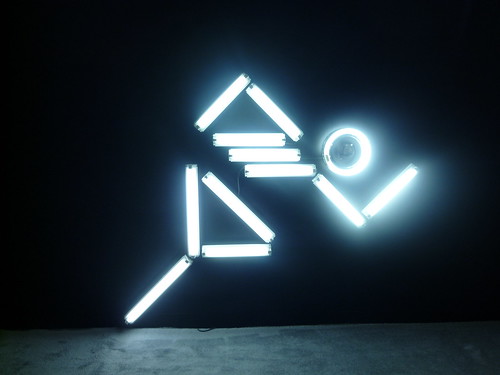
Ivan Navarro, Nowhere Man 1, 2009, florescent lights, metal fixtures, and electric energy. 66 x 77 inches Galerie Daniel Templon. Photo AFC
Phillip Niemeyer of Double Triple asked me yesterday why Ivan Navarro’s Nowhere Man 1 [pictured above] isn’t a work of plagiarism. I don’t have a sufficient defense. Spotted at the Armory’s Modern fair last week, the title does not acknowledge its origins which are obviously derived from Otl Aicher’s 1972 Munich Olympics designs. Neither one of us was convinced that rendering the piece in neon sufficiently changed the work. Perhaps there’s a commentor out there though who can better defend the work.
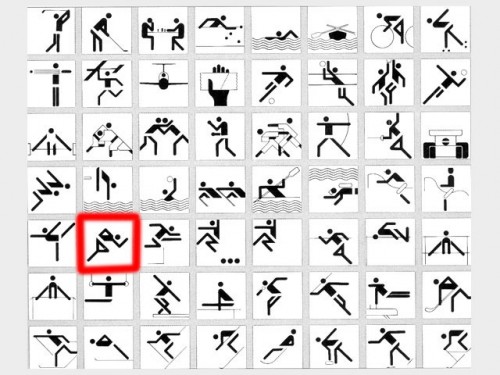
Otl Aicher’s 1972 Munich Olympics designs


{ 79 comments }
I think the question is whether or not this falls under “fair use” provisions, at least ethically (if not legally). Aicher’s design is the genesis of the visual pictogram Esperanto that now covers our visual landscape, so quoting it would be the modern day equivalent of painting a scene from the bible for someone who’s work focuses on the banal signs of modern life.
I think the question is whether or not this falls under “fair use” provisions, at least ethically (if not legally). Aicher’s design is the genesis of the visual pictogram Esperanto that now covers our visual landscape, so quoting it would be the modern day equivalent of painting a scene from the bible for someone who’s work focuses on the banal signs of modern life.
just as propaganda is the other guy’s marketing, plagiarism is the other guy’s appropriation.
Navarro’s source for the form is so obvious is must be intentional, so the question then becomes, why, and what, and how well does it succeed?
Personally, I think his bigger problem is what you call Eureka! Art: I don’t get much from Navarro beyond the gimmickry of, “Ooh, it’s a _____ made from light bulbs!”
just as propaganda is the other guy’s marketing, plagiarism is the other guy’s appropriation.
Navarro’s source for the form is so obvious is must be intentional, so the question then becomes, why, and what, and how well does it succeed?
Personally, I think his bigger problem is what you call Eureka! Art: I don’t get much from Navarro beyond the gimmickry of, “Ooh, it’s a _____ made from light bulbs!”
just as propaganda is the other guy’s marketing, plagiarism is the other guy’s appropriation.
Navarro’s source for the form is so obvious is must be intentional, so the question then becomes, why, and what, and how well does it succeed?
Personally, I think his bigger problem is what you call Eureka! Art: I don’t get much from Navarro beyond the gimmickry of, “Ooh, it’s a _____ made from light bulbs!”
just as propaganda is the other guy’s marketing, plagiarism is the other guy’s appropriation.
Navarro’s source for the form is so obvious is must be intentional, so the question then becomes, why, and what, and how well does it succeed?
Personally, I think his bigger problem is what you call Eureka! Art: I don’t get much from Navarro beyond the gimmickry of, “Ooh, it’s a _____ made from light bulbs!”
just as propaganda is the other guy’s marketing, plagiarism is the other guy’s appropriation.
Navarro’s source for the form is so obvious is must be intentional, so the question then becomes, why, and what, and how well does it succeed?
Personally, I think his bigger problem is what you call Eureka! Art: I don’t get much from Navarro beyond the gimmickry of, “Ooh, it’s a _____ made from light bulbs!”
just as propaganda is the other guy’s marketing, plagiarism is the other guy’s appropriation.
Navarro’s source for the form is so obvious is must be intentional, so the question then becomes, why, and what, and how well does it succeed?
Personally, I think his bigger problem is what you call Eureka! Art: I don’t get much from Navarro beyond the gimmickry of, “Ooh, it’s a _____ made from light bulbs!”
Plagiarism is usually reserved for literary (and literally) stealing an author’s words. So I don’t even think one can technically plagiarize an image (but perhaps that’s neither here nor there).
It would be copyright infringement. The difference being that if I took an entire blog post from AFC and said it was mine. That would be plagiarism as well as copyright infringement, but if I just took a small portion and passed it off as my own it could just be plagiarism.
But whatever. Basically Niemeyer is saying that Navarro ‘ripped off’ Aicher and doesn’t care about actual legalities (perhaps I’m wrong). My question is: so?
Plagiarism is usually reserved for literary (and literally) stealing an author’s words. So I don’t even think one can technically plagiarize an image (but perhaps that’s neither here nor there).
It would be copyright infringement. The difference being that if I took an entire blog post from AFC and said it was mine. That would be plagiarism as well as copyright infringement, but if I just took a small portion and passed it off as my own it could just be plagiarism.
But whatever. Basically Niemeyer is saying that Navarro ‘ripped off’ Aicher and doesn’t care about actual legalities (perhaps I’m wrong). My question is: so?
Plagiarism is usually reserved for literary (and literally) stealing an author’s words. So I don’t even think one can technically plagiarize an image (but perhaps that’s neither here nor there).
It would be copyright infringement. The difference being that if I took an entire blog post from AFC and said it was mine. That would be plagiarism as well as copyright infringement, but if I just took a small portion and passed it off as my own it could just be plagiarism.
But whatever. Basically Niemeyer is saying that Navarro ‘ripped off’ Aicher and doesn’t care about actual legalities (perhaps I’m wrong). My question is: so?
Plagiarism is usually reserved for literary (and literally) stealing an author’s words. So I don’t even think one can technically plagiarize an image (but perhaps that’s neither here nor there).
It would be copyright infringement. The difference being that if I took an entire blog post from AFC and said it was mine. That would be plagiarism as well as copyright infringement, but if I just took a small portion and passed it off as my own it could just be plagiarism.
But whatever. Basically Niemeyer is saying that Navarro ‘ripped off’ Aicher and doesn’t care about actual legalities (perhaps I’m wrong). My question is: so?
Plagiarism is usually reserved for literary (and literally) stealing an author’s words. So I don’t even think one can technically plagiarize an image (but perhaps that’s neither here nor there).
It would be copyright infringement. The difference being that if I took an entire blog post from AFC and said it was mine. That would be plagiarism as well as copyright infringement, but if I just took a small portion and passed it off as my own it could just be plagiarism.
But whatever. Basically Niemeyer is saying that Navarro ‘ripped off’ Aicher and doesn’t care about actual legalities (perhaps I’m wrong). My question is: so?
Ivan has acknowledged it as an appropriation.. all be it a simple one. He re-created most of the entire Otl Aicher’s 1972 Munich Olympics designs in Neon.
In his monograph for the Venice Biennale they were shown, and it was noted the importance within his body of work of “A Power Source” being required. Hence the image doesn’t exist or work without electric… This has further emphasis on society’s need (and Art’s need) for energy, power, and resources.
One of his most successful artworks required a human to pedal a bike to provide energy to light the bulbs up.
Plus.. It’s Dav Flavin meets 1970’s political graphic design. Not that terrible.. no?
Ivan has acknowledged it as an appropriation.. all be it a simple one. He re-created most of the entire Otl Aicher’s 1972 Munich Olympics designs in Neon.
In his monograph for the Venice Biennale they were shown, and it was noted the importance within his body of work of “A Power Source” being required. Hence the image doesn’t exist or work without electric… This has further emphasis on society’s need (and Art’s need) for energy, power, and resources.
One of his most successful artworks required a human to pedal a bike to provide energy to light the bulbs up.
Plus.. It’s Dav Flavin meets 1970’s political graphic design. Not that terrible.. no?
This is a really complex issue-one I’m dealing with in my own work. In the eyes of the law, there are provisions for fair use, parody, for instance. However, when it comes down to actual cases deciding the terms of fair use (Public Enemy, Jeff Koons and Monty Python are some of them), it seems like the legal understanding of fair use has more to do with the opinions of individual judges who have very little understanding of the history of appropriation and influence in art. I find most legal definitions of plagiarism insufficient.
If I were to come up with a general definition of plagiarism in art, it would be an artist whose work takes both the concept and physical realization of the concept from another fine or commercial artist. Within this definition, Richard Prince and Sherrie Levine are exempt because the concepts in their work differ from and critique elements of the images and objects they appropriate. One example that seems to look a lot like plagiarism comes from something I saw in Coagula years ago: An L.A. artist making stained glass-type windows out of butterfly wings was pretty shocked when she saw Damien Hirst making a lot of money years later off of the same concept and very similar material realization of that concept.
This work by Navarro seems to raise another, related part of appropriation that I think is important. (Note that I have only done a quick Google search on this artist and his work, so this is not an authoritative interpretation.) One reason to appropriate the image of another artist or designer is to refer to the ideas and associations related to that image. In the case of Navarro, it gave me pause that he referred to the designs developed for the 1972 Olympics, an event also remembered for the “Munich Massacre” of Israeli athletes by Palestinians. Hmm. A quick Wikipedia search reveals that the games were branded as the “Happy Games” and the logo for the event was a bright sun. This left me to wonder whether this had something to do with his use of neon as a possible critique of this bright branding of a nation trying to distance itself from its own dark past. Of course, the Flavin reference was also implicit.
Looking briefly into a couple of websites covering Navarro’s work, it seems that the artist, coming from Chile and growing up under Pinochet deals with the violence that occurs under dictatorships and other repressive governments in a lot of his work. One image of his work in particular caught my eye, a piece called, “Die Again, After Tony Smith.” Here, Navarro appropriates Tony Smith’s 6x6x6 foot black cube and extends its morbid meaning to include a reference to the ‘disappeared’ of his native Chile under Pinochet. Within the cube, there are light boxes and the Beatles’ “Nowhere Man” plays. The title of the work by Navarro illustrated on this website is also “Nowhere Man,” which leads me to wonder whether this work is a reference to the Munich Massacre at the 1972 Olympics. Certainly, the running pose of the neon figure, placed against a black wall, is going nowhere. The glow of the neon could be read as a kind of ethereal light. Could this be a kind of icon for the disappeared/slain? Or perhaps it is a consistent reference to the unnamed victims under oppressive regimes, despite the ‘happy’
face these nations try to keep on the surface.
In defense of Navarro, his work seems to appropriate the designs of others in order to call up the associations the original brings up. Even the optimistic, clean, graphic look of the original design counts here, for it looks like Navarro is trying to turn that inside out. He is not appropriating the original concept and he has transformed the original form to serve his own meaning.
That said, this isn’t a defense of the quality of this appropriation. Many appropriations of other artists (as Navarro does in his reference to Tony Smith) as well as commercial images can be very thin. The thing is, we won’t get people who use appropriation in a deep way if we don’t allow everyone to do it. This is an appeal not so much to the law, which will take years to catch up with contemporary practice, but to the gut feeling of fairness among fine and commercial artists. No one wants to be ripped off, but when appropriation as opposed to plagiarism takes place, the image/concept/material work referenced is often so well known on its own that its original maker is in no danger of having their reputation damaged or distorted. (Although I have to admit this is less true for commercial artists. I’ve always found it amusing that students learning about Sherrie Levine’s appropriations of Walker Evans are enraged, but they don’t care so much about Richard Prince’s use of the Marlboro man images.)
For other Navarro images check out: http://ase.tufts.edu/gallery/shows/navarro.html
This is a really complex issue-one I’m dealing with in my own work. In the eyes of the law, there are provisions for fair use, parody, for instance. However, when it comes down to actual cases deciding the terms of fair use (Public Enemy, Jeff Koons and Monty Python are some of them), it seems like the legal understanding of fair use has more to do with the opinions of individual judges who have very little understanding of the history of appropriation and influence in art. I find most legal definitions of plagiarism insufficient.
If I were to come up with a general definition of plagiarism in art, it would be an artist whose work takes both the concept and physical realization of the concept from another fine or commercial artist. Within this definition, Richard Prince and Sherrie Levine are exempt because the concepts in their work differ from and critique elements of the images and objects they appropriate. One example that seems to look a lot like plagiarism comes from something I saw in Coagula years ago: An L.A. artist making stained glass-type windows out of butterfly wings was pretty shocked when she saw Damien Hirst making a lot of money years later off of the same concept and very similar material realization of that concept.
This work by Navarro seems to raise another, related part of appropriation that I think is important. (Note that I have only done a quick Google search on this artist and his work, so this is not an authoritative interpretation.) One reason to appropriate the image of another artist or designer is to refer to the ideas and associations related to that image. In the case of Navarro, it gave me pause that he referred to the designs developed for the 1972 Olympics, an event also remembered for the “Munich Massacre” of Israeli athletes by Palestinians. Hmm. A quick Wikipedia search reveals that the games were branded as the “Happy Games” and the logo for the event was a bright sun. This left me to wonder whether this had something to do with his use of neon as a possible critique of this bright branding of a nation trying to distance itself from its own dark past. Of course, the Flavin reference was also implicit.
Looking briefly into a couple of websites covering Navarro’s work, it seems that the artist, coming from Chile and growing up under Pinochet deals with the violence that occurs under dictatorships and other repressive governments in a lot of his work. One image of his work in particular caught my eye, a piece called, “Die Again, After Tony Smith.” Here, Navarro appropriates Tony Smith’s 6x6x6 foot black cube and extends its morbid meaning to include a reference to the ‘disappeared’ of his native Chile under Pinochet. Within the cube, there are light boxes and the Beatles’ “Nowhere Man” plays. The title of the work by Navarro illustrated on this website is also “Nowhere Man,” which leads me to wonder whether this work is a reference to the Munich Massacre at the 1972 Olympics. Certainly, the running pose of the neon figure, placed against a black wall, is going nowhere. The glow of the neon could be read as a kind of ethereal light. Could this be a kind of icon for the disappeared/slain? Or perhaps it is a consistent reference to the unnamed victims under oppressive regimes, despite the ‘happy’
face these nations try to keep on the surface.
In defense of Navarro, his work seems to appropriate the designs of others in order to call up the associations the original brings up. Even the optimistic, clean, graphic look of the original design counts here, for it looks like Navarro is trying to turn that inside out. He is not appropriating the original concept and he has transformed the original form to serve his own meaning.
That said, this isn’t a defense of the quality of this appropriation. Many appropriations of other artists (as Navarro does in his reference to Tony Smith) as well as commercial images can be very thin. The thing is, we won’t get people who use appropriation in a deep way if we don’t allow everyone to do it. This is an appeal not so much to the law, which will take years to catch up with contemporary practice, but to the gut feeling of fairness among fine and commercial artists. No one wants to be ripped off, but when appropriation as opposed to plagiarism takes place, the image/concept/material work referenced is often so well known on its own that its original maker is in no danger of having their reputation damaged or distorted. (Although I have to admit this is less true for commercial artists. I’ve always found it amusing that students learning about Sherrie Levine’s appropriations of Walker Evans are enraged, but they don’t care so much about Richard Prince’s use of the Marlboro man images.)
For other Navarro images check out: http://ase.tufts.edu/gallery/shows/navarro.html
Appropriation isn’t plagiarism. Plagiarism is passing off someone else’s work as your own, while appropriation is explicitly taking someone else’s work and doing something interesting with it. So long as Navarro isn’t claiming to have created the original designs — and he isn’t — then this cannot be plagiarism.
Appropriation isn’t plagiarism. Plagiarism is passing off someone else’s work as your own, while appropriation is explicitly taking someone else’s work and doing something interesting with it. So long as Navarro isn’t claiming to have created the original designs — and he isn’t — then this cannot be plagiarism.
Appropriation isn’t plagiarism. Plagiarism is passing off someone else’s work as your own, while appropriation is explicitly taking someone else’s work and doing something interesting with it. So long as Navarro isn’t claiming to have created the original designs — and he isn’t — then this cannot be plagiarism.
Appropriation isn’t plagiarism. Plagiarism is passing off someone else’s work as your own, while appropriation is explicitly taking someone else’s work and doing something interesting with it. So long as Navarro isn’t claiming to have created the original designs — and he isn’t — then this cannot be plagiarism.
Appropriation isn’t plagiarism. Plagiarism is passing off someone else’s work as your own, while appropriation is explicitly taking someone else’s work and doing something interesting with it. So long as Navarro isn’t claiming to have created the original designs — and he isn’t — then this cannot be plagiarism.
Appropriation isn’t plagiarism. Plagiarism is passing off someone else’s work as your own, while appropriation is explicitly taking someone else’s work and doing something interesting with it. So long as Navarro isn’t claiming to have created the original designs — and he isn’t — then this cannot be plagiarism.
Relevant to this discussion is the precedent that emerged in a judgement issued in 1990 which is the notion of “transformative use” you may appropriate content but using it in a different way, to mean something else, in different media, in a different context, in a way that would allow you to discern the difference between the source and your work, at least that is how I understand it, but it’s complicated & I am not a lawyer!
http://williampatry.blogspot.com/2005/10/productive-use-transformative-use.html
Relevant to this discussion is the precedent that emerged in a judgement issued in 1990 which is the notion of “transformative use” you may appropriate content but using it in a different way, to mean something else, in different media, in a different context, in a way that would allow you to discern the difference between the source and your work, at least that is how I understand it, but it’s complicated & I am not a lawyer!
http://williampatry.blogspot.com/2005/10/productive-use-transformative-use.html
Relevant to this discussion is the precedent that emerged in a judgement issued in 1990 which is the notion of “transformative use” you may appropriate content but using it in a different way, to mean something else, in different media, in a different context, in a way that would allow you to discern the difference between the source and your work, at least that is how I understand it, but it’s complicated & I am not a lawyer!
http://williampatry.blogspot.com/2005/10/productive-use-transformative-use.html
Relevant to this discussion is the precedent that emerged in a judgement issued in 1990 which is the notion of “transformative use” you may appropriate content but using it in a different way, to mean something else, in different media, in a different context, in a way that would allow you to discern the difference between the source and your work, at least that is how I understand it, but it’s complicated & I am not a lawyer!
http://williampatry.blogspot.com/2005/10/productive-use-transformative-use.html
Relevant to this discussion is the precedent that emerged in a judgement issued in 1990 which is the notion of “transformative use” you may appropriate content but using it in a different way, to mean something else, in different media, in a different context, in a way that would allow you to discern the difference between the source and your work, at least that is how I understand it, but it’s complicated & I am not a lawyer!
http://williampatry.blogspot.com/2005/10/productive-use-transformative-use.html
why does everyone keep saying neon when this is obviously made from fluorescent light.
why does everyone keep saying neon when this is obviously made from fluorescent light.
why does everyone keep saying neon when this is obviously made from fluorescent light.
why does everyone keep saying neon when this is obviously made from fluorescent light.
why does everyone keep saying neon when this is obviously made from fluorescent light.
why does everyone keep saying neon when this is obviously made from fluorescent light.
My understanding of plagiarism is similar to Felix’s: plagiarism implies an intentional deception
Defining plagiarism in visual art is a bit trickier than in literature, for instance, where it’s pretty straightforward: if you use someone else’s text unattributed, you’re plagiarizing. In art, where appropriation is not only currently fashionable, but also an integral part of Western art history (Medieval/Renaissance painters routinely copied others: the Merode Altarpiece in the Cloisters, for instance, is predated by a somewhat less impressive painting whose composition is virtually identical. And, of course, for centuries, art education effectively involved copying the work of masters as a means of perfecting one’s own technique and style.) Though recent lawsuits might indicate otherwise, copying has been an accepted part of art more or less always.
I think the key thing in determining plagiarism in art is intent: if you intentionally pass an idea or image off as original when it’s derived from another artist, you’re plagiarizing. With appropriation, the viewer’s recognition of the original image and the associations it carries is typically an essential aspect of the work. Sherrie Levine counts on the fact that her audience recognizes her photos as exact replicas of Walker Evans; without that, the work loses all its impact. In this case, the symbol is so ubiquitous that it seems to go without saying that the artist didn’t create it (and I’m sure if you asked him/the gallery about the work, the first thing they’d say is “it’s from the Munich Olympics.”) The fact that this artist doesn’t do anything particularly transformative to the symbol simply speaks to the fact that this work is neither especially good nor interesting.
My understanding of plagiarism is similar to Felix’s: plagiarism implies an intentional deception
Defining plagiarism in visual art is a bit trickier than in literature, for instance, where it’s pretty straightforward: if you use someone else’s text unattributed, you’re plagiarizing. In art, where appropriation is not only currently fashionable, but also an integral part of Western art history (Medieval/Renaissance painters routinely copied others: the Merode Altarpiece in the Cloisters, for instance, is predated by a somewhat less impressive painting whose composition is virtually identical. And, of course, for centuries, art education effectively involved copying the work of masters as a means of perfecting one’s own technique and style.) Though recent lawsuits might indicate otherwise, copying has been an accepted part of art more or less always.
I think the key thing in determining plagiarism in art is intent: if you intentionally pass an idea or image off as original when it’s derived from another artist, you’re plagiarizing. With appropriation, the viewer’s recognition of the original image and the associations it carries is typically an essential aspect of the work. Sherrie Levine counts on the fact that her audience recognizes her photos as exact replicas of Walker Evans; without that, the work loses all its impact. In this case, the symbol is so ubiquitous that it seems to go without saying that the artist didn’t create it (and I’m sure if you asked him/the gallery about the work, the first thing they’d say is “it’s from the Munich Olympics.”) The fact that this artist doesn’t do anything particularly transformative to the symbol simply speaks to the fact that this work is neither especially good nor interesting.
My understanding of plagiarism is similar to Felix’s: plagiarism implies an intentional deception
Defining plagiarism in visual art is a bit trickier than in literature, for instance, where it’s pretty straightforward: if you use someone else’s text unattributed, you’re plagiarizing. In art, where appropriation is not only currently fashionable, but also an integral part of Western art history (Medieval/Renaissance painters routinely copied others: the Merode Altarpiece in the Cloisters, for instance, is predated by a somewhat less impressive painting whose composition is virtually identical. And, of course, for centuries, art education effectively involved copying the work of masters as a means of perfecting one’s own technique and style.) Though recent lawsuits might indicate otherwise, copying has been an accepted part of art more or less always.
I think the key thing in determining plagiarism in art is intent: if you intentionally pass an idea or image off as original when it’s derived from another artist, you’re plagiarizing. With appropriation, the viewer’s recognition of the original image and the associations it carries is typically an essential aspect of the work. Sherrie Levine counts on the fact that her audience recognizes her photos as exact replicas of Walker Evans; without that, the work loses all its impact. In this case, the symbol is so ubiquitous that it seems to go without saying that the artist didn’t create it (and I’m sure if you asked him/the gallery about the work, the first thing they’d say is “it’s from the Munich Olympics.”) The fact that this artist doesn’t do anything particularly transformative to the symbol simply speaks to the fact that this work is neither especially good nor interesting.
My understanding of plagiarism is similar to Felix’s: plagiarism implies an intentional deception
Defining plagiarism in visual art is a bit trickier than in literature, for instance, where it’s pretty straightforward: if you use someone else’s text unattributed, you’re plagiarizing. In art, where appropriation is not only currently fashionable, but also an integral part of Western art history (Medieval/Renaissance painters routinely copied others: the Merode Altarpiece in the Cloisters, for instance, is predated by a somewhat less impressive painting whose composition is virtually identical. And, of course, for centuries, art education effectively involved copying the work of masters as a means of perfecting one’s own technique and style.) Though recent lawsuits might indicate otherwise, copying has been an accepted part of art more or less always.
I think the key thing in determining plagiarism in art is intent: if you intentionally pass an idea or image off as original when it’s derived from another artist, you’re plagiarizing. With appropriation, the viewer’s recognition of the original image and the associations it carries is typically an essential aspect of the work. Sherrie Levine counts on the fact that her audience recognizes her photos as exact replicas of Walker Evans; without that, the work loses all its impact. In this case, the symbol is so ubiquitous that it seems to go without saying that the artist didn’t create it (and I’m sure if you asked him/the gallery about the work, the first thing they’d say is “it’s from the Munich Olympics.”) The fact that this artist doesn’t do anything particularly transformative to the symbol simply speaks to the fact that this work is neither especially good nor interesting.
My understanding of plagiarism is similar to Felix’s: plagiarism implies an intentional deception
Defining plagiarism in visual art is a bit trickier than in literature, for instance, where it’s pretty straightforward: if you use someone else’s text unattributed, you’re plagiarizing. In art, where appropriation is not only currently fashionable, but also an integral part of Western art history (Medieval/Renaissance painters routinely copied others: the Merode Altarpiece in the Cloisters, for instance, is predated by a somewhat less impressive painting whose composition is virtually identical. And, of course, for centuries, art education effectively involved copying the work of masters as a means of perfecting one’s own technique and style.) Though recent lawsuits might indicate otherwise, copying has been an accepted part of art more or less always.
I think the key thing in determining plagiarism in art is intent: if you intentionally pass an idea or image off as original when it’s derived from another artist, you’re plagiarizing. With appropriation, the viewer’s recognition of the original image and the associations it carries is typically an essential aspect of the work. Sherrie Levine counts on the fact that her audience recognizes her photos as exact replicas of Walker Evans; without that, the work loses all its impact. In this case, the symbol is so ubiquitous that it seems to go without saying that the artist didn’t create it (and I’m sure if you asked him/the gallery about the work, the first thing they’d say is “it’s from the Munich Olympics.”) The fact that this artist doesn’t do anything particularly transformative to the symbol simply speaks to the fact that this work is neither especially good nor interesting.
My understanding of plagiarism is similar to Felix’s: plagiarism implies an intentional deception
Defining plagiarism in visual art is a bit trickier than in literature, for instance, where it’s pretty straightforward: if you use someone else’s text unattributed, you’re plagiarizing. In art, where appropriation is not only currently fashionable, but also an integral part of Western art history (Medieval/Renaissance painters routinely copied others: the Merode Altarpiece in the Cloisters, for instance, is predated by a somewhat less impressive painting whose composition is virtually identical. And, of course, for centuries, art education effectively involved copying the work of masters as a means of perfecting one’s own technique and style.) Though recent lawsuits might indicate otherwise, copying has been an accepted part of art more or less always.
I think the key thing in determining plagiarism in art is intent: if you intentionally pass an idea or image off as original when it’s derived from another artist, you’re plagiarizing. With appropriation, the viewer’s recognition of the original image and the associations it carries is typically an essential aspect of the work. Sherrie Levine counts on the fact that her audience recognizes her photos as exact replicas of Walker Evans; without that, the work loses all its impact. In this case, the symbol is so ubiquitous that it seems to go without saying that the artist didn’t create it (and I’m sure if you asked him/the gallery about the work, the first thing they’d say is “it’s from the Munich Olympics.”) The fact that this artist doesn’t do anything particularly transformative to the symbol simply speaks to the fact that this work is neither especially good nor interesting.
Hmm, maybe the tricky thing about appropriation, copyright and art is that it’s only fascinating when *I’m* talking about it?
I can’t get a tweet by Joy Garnett–an artist who has more firsthand knowledge of the art/copyright quagmire than all of us here–out of my mind:
“Lawyers: stop encouraging artists to sue (esp one another) for copyright infringement; not a good thing. You are part of the problem.”
Reducing a discussion of reference and appropriation to the level of legalism and criminalization basically cedes the entire cultural debate. If that’s what you want, go to law school, not art school.
I don’t think it’s very well done, and from the hints in the comments here, I doubt I’d be interested, but I’m absolutely certain Navarro’s work is “about” more than intellectual property rights.
And a quick factcheck, Rachel: Prince’s work is not automatically exempt, it’s just famous–he gets sued all the time. And the Walker Evans Estate successfully stopped Levine’s use, sale or resale of the work. The Walker Evans Estate controlled by the Metropolitan Museum.
Hmm, maybe the tricky thing about appropriation, copyright and art is that it’s only fascinating when *I’m* talking about it?
I can’t get a tweet by Joy Garnett–an artist who has more firsthand knowledge of the art/copyright quagmire than all of us here–out of my mind:
“Lawyers: stop encouraging artists to sue (esp one another) for copyright infringement; not a good thing. You are part of the problem.”
Reducing a discussion of reference and appropriation to the level of legalism and criminalization basically cedes the entire cultural debate. If that’s what you want, go to law school, not art school.
I don’t think it’s very well done, and from the hints in the comments here, I doubt I’d be interested, but I’m absolutely certain Navarro’s work is “about” more than intellectual property rights.
And a quick factcheck, Rachel: Prince’s work is not automatically exempt, it’s just famous–he gets sued all the time. And the Walker Evans Estate successfully stopped Levine’s use, sale or resale of the work. The Walker Evans Estate controlled by the Metropolitan Museum.
Hmm, maybe the tricky thing about appropriation, copyright and art is that it’s only fascinating when *I’m* talking about it?
I can’t get a tweet by Joy Garnett–an artist who has more firsthand knowledge of the art/copyright quagmire than all of us here–out of my mind:
“Lawyers: stop encouraging artists to sue (esp one another) for copyright infringement; not a good thing. You are part of the problem.”
Reducing a discussion of reference and appropriation to the level of legalism and criminalization basically cedes the entire cultural debate. If that’s what you want, go to law school, not art school.
I don’t think it’s very well done, and from the hints in the comments here, I doubt I’d be interested, but I’m absolutely certain Navarro’s work is “about” more than intellectual property rights.
And a quick factcheck, Rachel: Prince’s work is not automatically exempt, it’s just famous–he gets sued all the time. And the Walker Evans Estate successfully stopped Levine’s use, sale or resale of the work. The Walker Evans Estate controlled by the Metropolitan Museum.
Hmm, maybe the tricky thing about appropriation, copyright and art is that it’s only fascinating when *I’m* talking about it?
I can’t get a tweet by Joy Garnett–an artist who has more firsthand knowledge of the art/copyright quagmire than all of us here–out of my mind:
“Lawyers: stop encouraging artists to sue (esp one another) for copyright infringement; not a good thing. You are part of the problem.”
Reducing a discussion of reference and appropriation to the level of legalism and criminalization basically cedes the entire cultural debate. If that’s what you want, go to law school, not art school.
I don’t think it’s very well done, and from the hints in the comments here, I doubt I’d be interested, but I’m absolutely certain Navarro’s work is “about” more than intellectual property rights.
And a quick factcheck, Rachel: Prince’s work is not automatically exempt, it’s just famous–he gets sued all the time. And the Walker Evans Estate successfully stopped Levine’s use, sale or resale of the work. The Walker Evans Estate controlled by the Metropolitan Museum.
Hmm, maybe the tricky thing about appropriation, copyright and art is that it’s only fascinating when *I’m* talking about it?
I can’t get a tweet by Joy Garnett–an artist who has more firsthand knowledge of the art/copyright quagmire than all of us here–out of my mind:
“Lawyers: stop encouraging artists to sue (esp one another) for copyright infringement; not a good thing. You are part of the problem.”
Reducing a discussion of reference and appropriation to the level of legalism and criminalization basically cedes the entire cultural debate. If that’s what you want, go to law school, not art school.
I don’t think it’s very well done, and from the hints in the comments here, I doubt I’d be interested, but I’m absolutely certain Navarro’s work is “about” more than intellectual property rights.
And a quick factcheck, Rachel: Prince’s work is not automatically exempt, it’s just famous–he gets sued all the time. And the Walker Evans Estate successfully stopped Levine’s use, sale or resale of the work. The Walker Evans Estate controlled by the Metropolitan Museum.
Kudos for spotting the neon/fluorescent mistake. I do that way too often.
Regarding the law, it is interesting that cases dealing with fair use and moral rights don’t necessarily distinguish between media. LIterature, music and the visual arts all fall under the same category. Even the issue of transformation can get very blurry when it comes down to specific examples. Never assume that your right to appropriate is protected. If someone wants to sue you and has the means to do it, they can.
Would anybody like the list of cases that came from my discussions with Volunteer Lawyers for the Arts? I can also add some of the more recent suits involving Shepard Fairey, Google’s Droid, South Butt, etc. I find this stuff fascinating.
Kudos for spotting the neon/fluorescent mistake. I do that way too often.
Regarding the law, it is interesting that cases dealing with fair use and moral rights don’t necessarily distinguish between media. LIterature, music and the visual arts all fall under the same category. Even the issue of transformation can get very blurry when it comes down to specific examples. Never assume that your right to appropriate is protected. If someone wants to sue you and has the means to do it, they can.
Would anybody like the list of cases that came from my discussions with Volunteer Lawyers for the Arts? I can also add some of the more recent suits involving Shepard Fairey, Google’s Droid, South Butt, etc. I find this stuff fascinating.
Kudos for spotting the neon/fluorescent mistake. I do that way too often.
Regarding the law, it is interesting that cases dealing with fair use and moral rights don’t necessarily distinguish between media. LIterature, music and the visual arts all fall under the same category. Even the issue of transformation can get very blurry when it comes down to specific examples. Never assume that your right to appropriate is protected. If someone wants to sue you and has the means to do it, they can.
Would anybody like the list of cases that came from my discussions with Volunteer Lawyers for the Arts? I can also add some of the more recent suits involving Shepard Fairey, Google’s Droid, South Butt, etc. I find this stuff fascinating.
Kudos for spotting the neon/fluorescent mistake. I do that way too often.
Regarding the law, it is interesting that cases dealing with fair use and moral rights don’t necessarily distinguish between media. LIterature, music and the visual arts all fall under the same category. Even the issue of transformation can get very blurry when it comes down to specific examples. Never assume that your right to appropriate is protected. If someone wants to sue you and has the means to do it, they can.
Would anybody like the list of cases that came from my discussions with Volunteer Lawyers for the Arts? I can also add some of the more recent suits involving Shepard Fairey, Google’s Droid, South Butt, etc. I find this stuff fascinating.
Kudos for spotting the neon/fluorescent mistake. I do that way too often.
Regarding the law, it is interesting that cases dealing with fair use and moral rights don’t necessarily distinguish between media. LIterature, music and the visual arts all fall under the same category. Even the issue of transformation can get very blurry when it comes down to specific examples. Never assume that your right to appropriate is protected. If someone wants to sue you and has the means to do it, they can.
Would anybody like the list of cases that came from my discussions with Volunteer Lawyers for the Arts? I can also add some of the more recent suits involving Shepard Fairey, Google’s Droid, South Butt, etc. I find this stuff fascinating.
@greg
I think you’re confusing my comment with Nicole’s: I didn’t mention Prince, nor did I bring up issues of copyright. With regard to Levine, who I did reference, again, my definition of plagiarism was theoretical, not legal. I don’t know enough about the intricacies of intellectual property and copyright law to comment about where these issues stand legally. However, I think there’s a difference between plagiarism and copyright infringement. For instance, Hank Willis Thomas’ appropriation of corporate logos and advertisements may well be considered copyright infringement (I don’t know whether he specifically has run into issues) but it’s certainly not plagiarism in my view: he’s obviously not trying to claim that he invented the Nike symbol or AmEx card designs (in fact, quite the opposite.) Likewise, the copyright holder on the Munich designs might be able to sue Navarro (whether or not they’d be successful is another question) but that doesn’t make it plagiarism (it also doesn’t make it good art: I think appropriation for appropriation’s sake is at this point pretty boring.)
@greg
I think you’re confusing my comment with Nicole’s: I didn’t mention Prince, nor did I bring up issues of copyright. With regard to Levine, who I did reference, again, my definition of plagiarism was theoretical, not legal. I don’t know enough about the intricacies of intellectual property and copyright law to comment about where these issues stand legally. However, I think there’s a difference between plagiarism and copyright infringement. For instance, Hank Willis Thomas’ appropriation of corporate logos and advertisements may well be considered copyright infringement (I don’t know whether he specifically has run into issues) but it’s certainly not plagiarism in my view: he’s obviously not trying to claim that he invented the Nike symbol or AmEx card designs (in fact, quite the opposite.) Likewise, the copyright holder on the Munich designs might be able to sue Navarro (whether or not they’d be successful is another question) but that doesn’t make it plagiarism (it also doesn’t make it good art: I think appropriation for appropriation’s sake is at this point pretty boring.)
@greg
I think you’re confusing my comment with Nicole’s: I didn’t mention Prince, nor did I bring up issues of copyright. With regard to Levine, who I did reference, again, my definition of plagiarism was theoretical, not legal. I don’t know enough about the intricacies of intellectual property and copyright law to comment about where these issues stand legally. However, I think there’s a difference between plagiarism and copyright infringement. For instance, Hank Willis Thomas’ appropriation of corporate logos and advertisements may well be considered copyright infringement (I don’t know whether he specifically has run into issues) but it’s certainly not plagiarism in my view: he’s obviously not trying to claim that he invented the Nike symbol or AmEx card designs (in fact, quite the opposite.) Likewise, the copyright holder on the Munich designs might be able to sue Navarro (whether or not they’d be successful is another question) but that doesn’t make it plagiarism (it also doesn’t make it good art: I think appropriation for appropriation’s sake is at this point pretty boring.)
@greg
I think you’re confusing my comment with Nicole’s: I didn’t mention Prince, nor did I bring up issues of copyright. With regard to Levine, who I did reference, again, my definition of plagiarism was theoretical, not legal. I don’t know enough about the intricacies of intellectual property and copyright law to comment about where these issues stand legally. However, I think there’s a difference between plagiarism and copyright infringement. For instance, Hank Willis Thomas’ appropriation of corporate logos and advertisements may well be considered copyright infringement (I don’t know whether he specifically has run into issues) but it’s certainly not plagiarism in my view: he’s obviously not trying to claim that he invented the Nike symbol or AmEx card designs (in fact, quite the opposite.) Likewise, the copyright holder on the Munich designs might be able to sue Navarro (whether or not they’d be successful is another question) but that doesn’t make it plagiarism (it also doesn’t make it good art: I think appropriation for appropriation’s sake is at this point pretty boring.)
The debate about plagiarism is misguided in this case. Otl Aicher’s 1972 Olympic pictograms are actually purchasable as a font if you need to use them. This is something the museum where I first showed this work did in order to publish the images in the catalogue of the exhibition. My investigation into this is related to how the proportions of standard sizes of fluorescent lights match the proportions in the pictograms which already follow the Renaissance ideals of human proportion.
The debate about plagiarism is misguided in this case. Otl Aicher’s 1972 Olympic pictograms are actually purchasable as a font if you need to use them. This is something the museum where I first showed this work did in order to publish the images in the catalogue of the exhibition. My investigation into this is related to how the proportions of standard sizes of fluorescent lights match the proportions in the pictograms which already follow the Renaissance ideals of human proportion.
The debate about plagiarism is misguided in this case. Otl Aicher’s 1972 Olympic pictograms are actually purchasable as a font if you need to use them. This is something the museum where I first showed this work did in order to publish the images in the catalogue of the exhibition. My investigation into this is related to how the proportions of standard sizes of fluorescent lights match the proportions in the pictograms which already follow the Renaissance ideals of human proportion.
The debate about plagiarism is misguided in this case. Otl Aicher’s 1972 Olympic pictograms are actually purchasable as a font if you need to use them. This is something the museum where I first showed this work did in order to publish the images in the catalogue of the exhibition. My investigation into this is related to how the proportions of standard sizes of fluorescent lights match the proportions in the pictograms which already follow the Renaissance ideals of human proportion.
The debate about plagiarism is misguided in this case. Otl Aicher’s 1972 Olympic pictograms are actually purchasable as a font if you need to use them. This is something the museum where I first showed this work did in order to publish the images in the catalogue of the exhibition. My investigation into this is related to how the proportions of standard sizes of fluorescent lights match the proportions in the pictograms which already follow the Renaissance ideals of human proportion.
It kind of looks like lincoln logs. It’s a double plagiarism!
It kind of looks like lincoln logs. It’s a double plagiarism!
It kind of looks like lincoln logs. It’s a double plagiarism!
It kind of looks like lincoln logs. It’s a double plagiarism!
I’m with Nicole, 100% right!
I’m with Nicole, 100% right!
I’m with Nicole, 100% right!
I’m with Nicole, 100% right!
I’m with Nicole, 100% right!
read the comment above by Mike @ MAO
read the comment above by Mike @ MAO
Postproduction
Postproduction
Postproduction
Postproduction
Postproduction
Postproduction
Plagiarism Checker – http://plagiarisma.net – free online duplicate content finder.
Plagiarism Checker – http://plagiarisma.net – free online duplicate content finder.
Plagiarism Checker – http://plagiarisma.net – free online duplicate content finder.
Comments on this entry are closed.